
Hello everyone:
As always, please remember to scroll past the end of the essay to read some curated Anthropocene news.
Now on to this week’s writing:
As a writer and word geek, I’ve led a life often fixated on odd little questions about, say, alphabetic order and the etymology of “harm”. I used to keep the large American Heritage Dictionary at my bedside for light reading. Words are an endless playground. Some people want to die on a mountaintop or surrounded by family; I’d be delighted if my final words were a slightly raunchy pun that made Heather laugh.
I forget sometimes how far down the language rabbit hole I live. I’m not an expert on languages, linguistics, or grammar, nor is my interest particularly academic, but I have a relationship with sentences and image-making that starts at my toes and works up through nerve and heart before emerging out of my fingertips onto the (now digital) page. Amid all my reading and writing for the Field Guide I can forget that not everyone plays in the same playground.
Still, though, as a species we live deep inside the abstraction of written language. From novels and Times articles to crosswords and the Constitution to billboards and pop-up ads on our phones, groupings of these weird little squiggly symbols we call letters conjure up stories that work their way through nerve and heart to tell us who we are and what our lives mean.
Over the last few centuries, those stories have increasingly separated us from the living world. We imagine we’re alone on Earth, and thus live in harmful ways that make that falsehood real. We’re not alone, of course, nor are we more important than other life. But what isolates humans from other species is our ability and willingness to reimagine the world for our purposes. To other life, our sentences can be death sentences.
Those untethered stories begin, I think, with a language untethered from the soil. Instead of speaking of (and to) the land and waters, we imagine vanishing points (abstract art, mathematical empty sets, the blank page, life on Mars, etc.) and then head in those directions.
Like matryoshka dolls, we’re now nested so deep within multiple images of ourselves - mirrors, photos, screens, ad nauseam - that even when exploring what remains of the wild we’re imagining those images and don’t know what the outside really is. These boxed-in lives we lead - car, house, office, store - are layers of shell we hide within from wind and rain and cold and heat, but those may only be the outer layers. Our abstraction begins, perhaps, with the weird little symbols.
I’ve been reading James Bridle’s book Ways of Being: Beyond Human Intelligence again. I set it aside a few years ago as a flood of other books came in, but am now working on it, a few pages at a time, absorbing what I can of its remarkable richness. And it is Bridle who has explained to me that it was not written language per se which alienated us from the real world. It was the transition from pictographic writing (like hieroglyphs, in which the symbols represented the real things they described) to phonetic writing, in which the letters we call consonants and vowels merely represent sounds. “The more-than-human world disappears from the system,” Bridle says, and we’re left with “the shape of the utterance” and “the sound of ourselves speaking it.”
Written language was a window that became a mirror.
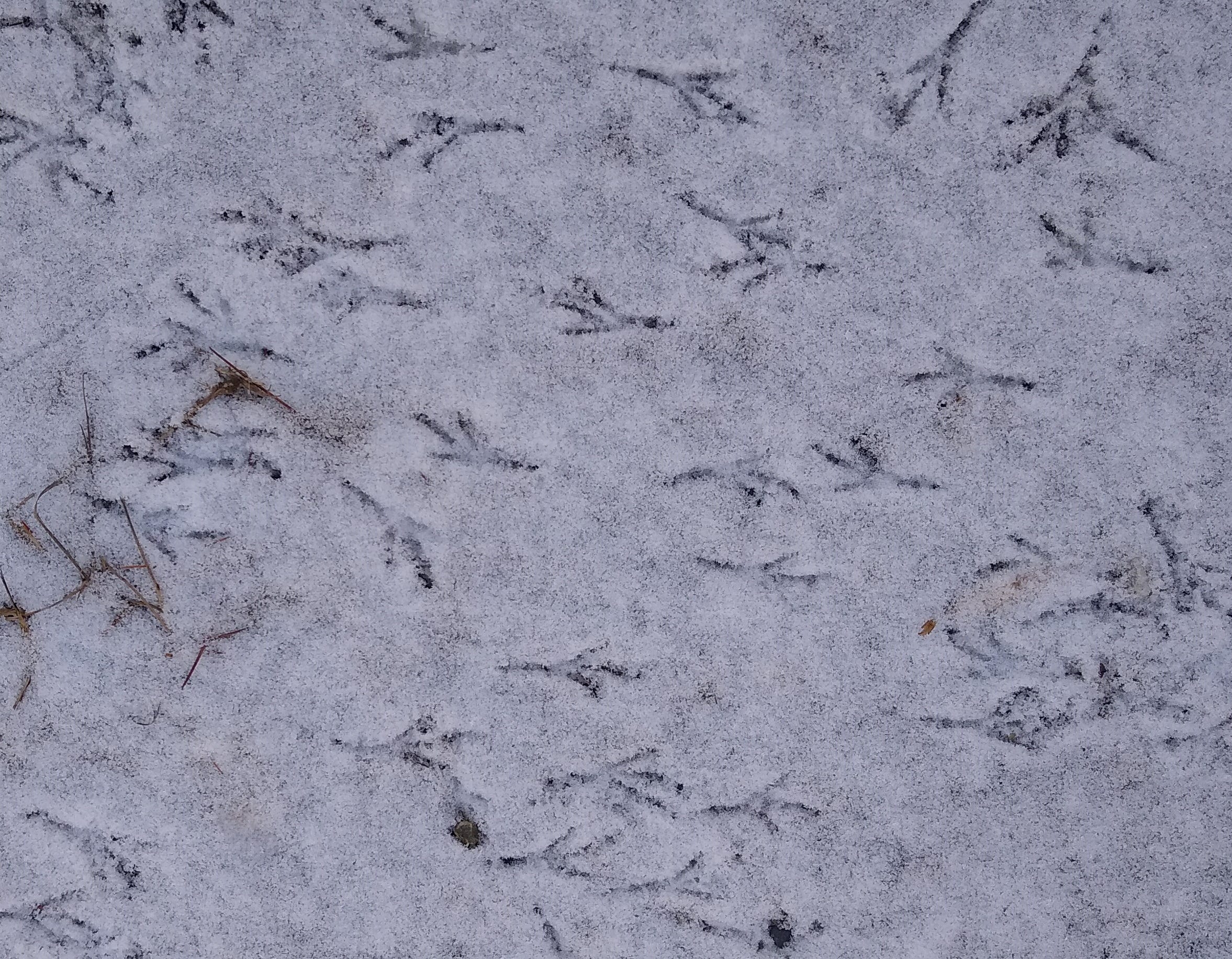
Still, though, I have to remind myself, often, that these manufactured realities, including language, are only a subset of the greater one. Everything on Earth is of the Earth. A language is a cultural artifact built with natural sounds and shapes. Our speech is wind given form by plant-fed flesh. Bridle puts it this way:
Language is an emulation and an epiphenomenon of the environment: it brings us closer to the world and arises out of it.
Even the selfish oil-to-plastic and metallic alchemy behind these screens and keyboards and circuit boards relies entirely on the greater alchemy that deep time practices on old leaves and the Earth’s stony crust. Computers “exist in the world with us,” Bridle says, and “the computational environment is continuous with the natural one.” Our bodies ache while hunched over typing on them, lightning or flood will disable them, and their creation and disposal has an ongoing industrial impact on the planet. Bridle identifies it as an ecology, a “continuity between technology, the body and the biosphere.”
Remarkably, the written roots of phonetic English still carry traces of their pictographic origins. Digitized, they carry it still. Bridle lays this out nicely in his Ways of Being chapter, “Talking to Strangers,” after explaining the “bow-wow” theory of the origin of human language. Bow-wow posits that we began to develop meaningful speech by imitating “the sounds of the world itself”: wind and wolf, stream and cicada. The origin of the little squiggly symbols that make up these sentences still shows on my screen and yours:
Aleph, the first letter of the Semitic alphabet, was written 𐤀 . Aleph is also the ancient Hebrew word for ‘ox’, which the letter depicts as a head with horns. It is also related to the Egyptian hieroglyph of that animal. Rotated, it becomes this letter: A. Likewise, our letter M is derived from Semitic letter mem. The Hebrew word for water, mem was drawn as a little wave: 𐤌. The letter O, made into a vowel by the Greek scribes, comes from the letter ayin, meaning ‘eye’, while Q derives from the letter qoth, which also means ‘monkey’. The tail of this ‘q’ is a vestigial monkey tail. Traces of animals, of waves, of bodily parts, exist within text, within the kernel of this machine. My computer speaks bow-wow.
Whether sitting at these computers, talking to the mirror-world of chatbots, or writing poems about wolves and streams, our languages and actions are of this world. Whatever we create or destroy, and whatever tortured logic we use to justify our worst actions, that ox- and monkey-laden history of our speech and writing remains. So, too, does the greater alchemy of deep time turning everything we’ve ever known or will ever do back into leaves and the trace metals of Earth’s crust. We’re in the flow.
The question of the age is whether we will adjust our alchemy to harmonize with the greater flow, for the benefit of all life, or whether we follow our abstractions to the vanishing point.
The computational environment now speaks through us too. The astonishingly rapid and socially organic adoption of new rules for communication through texting - the lol, brb, imho, and so much more - was a linguistic revolution, an “efflorescence of language,” as Bridle says. The ox horns and monkey tails may linger in our letters, but the constraints of texting have driven changes in the everyday speech of a generation, who now say “lol” aloud.
And maybe the durability of laughter through all these transformations is a good omen. We’ll need laughter on the path ahead, certainly, but I think it’s more vital than merely a respite amid crises. For one thing, language can guide our return to a better relationship with the more-than-human world by expressing joy in that relationship. We are in desperate need of more awe and wonder while connecting to plants, animals, and places. But we also need a lot more joy in general. I mean a shared joy, a laughter that crosses (and maybe erases?) political lines by being rooted in a shared attention to the real world.
There’s nothing abstract about laughter, or our desire to laugh. It’s as physical as dirt and as glorious as a sunrise. As the great 13th century poet Rumi believed, “the divine is the impulse to laugh and we are all the different ways of laughing.” Our faces crease into smiles and our breath bursts forward from these bodies made of plant-fed flesh in ways that would be instantly familiar to humans of any culture or era.
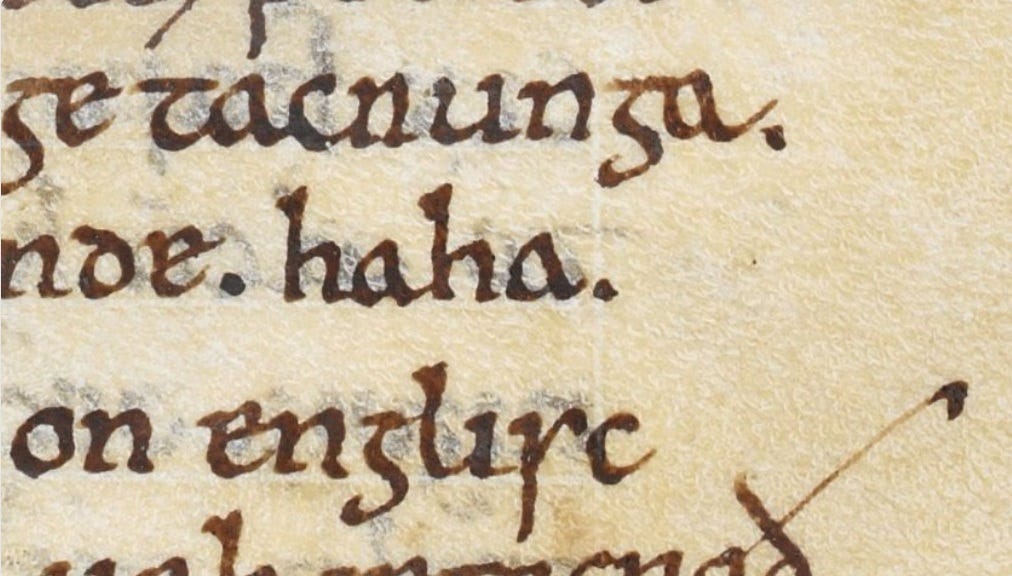
I was struck by Bridle’s history of the interjection haha, which to me is merely an annoying textspeak mannerism that replaces nuanced responses to something funny. But a thousand years ago, he says, Ælfric of Eynsham noted its use in his Old English grammar book - “haha and hehe denote laughter in Latin and in English” - and Chaucer used it 400 years later in The Canterbury Tales. Twenty years ago, a study of a large trove of texts by Canadian teens found that haha and lol were the most common interjections.
The history and ecology of communication, from monks hunched over their quills and vellum to teens hunched over their thumbs and phones, is rife with the urge for joy and laughter as a means to social cohesion. Monks in medieval times inscribed jokes in the margins of their sacred texts, and today’s emoticons and emojis seem to exist primarily for expressing humor. Even here in my writing about the burning world, it’s almost impossible for me to keep from trying to be witty or droll. I am, after all, the guy who’d like his final words to be a punchline for his wife.
Maybe it all comes down to love, then, as the thread that might hold the world together: Love of life expressed through love of language, and love for others kept alive through a shared love of the world’s beauty. It’s a lot to pin on haha and lol, I know, but we’re such a desperately social species that any shared joy might become a shared purpose.
Finally, I’ll just note that behind language, behind society, behind laughter, and behind our own sense of self is the silence that already binds everything together. If you have a good relationship with silence, you’ll already know that it sees these squiggles as just squiggles and hears our words as just wind and wolf. If stone and leaf are liquefied by the impossible silence of deep time as the Earth churns its mountains into lava and back again to mountains, then what is durable about these words?
So much of what passes for civilization is just noise. What is worst about us is often what (and who) is noisiest. “It’s no accident,” Bridle says in an interview about Ways of Being, “that all the great religious spiritual traditions teach silence and awareness and clearing one’s mind and trying to get away from this constant process of language, which is a constant process of estrangement…” When asked why his poems talk so much about silence, Rumi wrote that “The radiant one inside me has never said a word.”
And here’s the poet Charles Simic taking joy in the true wonder of silence:
Silence, solitude, what is more essential to the human condition? “Maternal silence” is what I like to call it. Life before the coming of language. That place where we begin to hear the voice of the inanimate. Poetry is an orphan of silence. The words never quite equal the experience behind them. We are always at the beginning, eternal apprentices, thrown back again and again into that condition. There is a complexity which demands its equivalent in words. Of course, it is impossible to do it justice. I say Yes to the impossible – therefore poetry.
If our language is anchored to silence, then so too will be our actions, our corrections to the mistakes of civilization, and our joy in doing the work. Humans will always be abstract thinkers, whether in the building of pyramids, poems, or policies, but that capacity for abstraction, like our capacity for violence, must be constrained by a maturity rooted in love, awe, wonder, joy, laughter, and silence.
Anything less isn’t worth talking about.

Thanks for sticking with me.
From Ali Bin Shahid and Regenesis, “The Repair Crew,” a truly remarkable long-form essay explaining, in deceptively simple language, how we owe everything to plants, how climate change is a function of capitalist debt, and how we’re wrong to pathologize the Earth - Too much carbon! The weather is all wrong! - when what needs managing is us. There’s so much more in this essay, and I recommend you take the time to enjoy its elegant dissertation:
The Earth is not the patient here. The Earth is the doctor, and it is already working, and it has been the whole time.
From Mike Shanahan and Planet Ficus, “The Fig Tree Above the Whirlpool,” a timely and fascinating insight into a critical moment in The Odyssey, with the hero saved by a fig tree, which as I’ve written recently might be an important tree for saving all of us.
From the Times, “He’s the Last Great Land Artist You’ve Never Heard of,” a profile of Charles Ross and his nearly-complete project in New Mexico, Star Axis, which has taken him half a century to create. A stunning and elegant monolithic work in stone built with mathematical precision, Star Axis centers viewers on Polaris (the North Star). Ross imagines it as “a sculpture that would help people sense the deep past and distant future.” The site may last for centuries.
Two good-news stories from Reasons to be Cheerful: Evidence is mounting in cities around the globe that the rapid adoption of EVs is significantly reducing air pollution and improving public health, and “What if We Never Built Another Building?,” a profile of a remarkable Swiss architect who is revolutionizing urban construction by preserving rather than replacing buildings, and by using reclaimed materials rather than buying new ones. Her work is reducing emissions and winning global awards.
A new book, The Earth Said Remember Me: How to Revive Our Memories and Restore the Planet, by Jason Dove Mark, looks like something worth reading. I’ve only seen promotional material, but wanted to put it on your radar. Offered as an antidote to shifting baseline syndrome - how each generation normalizes the ongoing disappearance of the natural world - the book is built on four rules of re-engaging with life: Go outside. Bear Witness. Make a record. Pass it on.
From Nautilus, a selection of the ten “Best Books on the Science of Art.” It’s not clear if any of these books are new, and some are a quarter-century old. The purpose, then, is not to sell new books but to provide a small library of volumes that have best articulated why art matters to our strange human selves:
Every one of these 10 books makes its case for why art makes you feel the way you do. They explain how art lights up your nervous system, memory, culture, and why in human evolution it seemed like a good idea for art to rouse your emotions. Not all these authors agree with one another, and you may find some of their arguments more persuasive than others. But if art is a big part of your life, and you want to investigate why, these are the books to check out.
From Grist, you may know that much of the heat we’re generating is absorbed by the oceans and is causing great harm there, but you may not know that some of that heat is sent back to the land to cause some of our worst heatwaves.
From Heatmap, a surprising and daunting revelation that wildfires are much more common now in the Eastern U.S. than any of us imagine. Nearly half of the 77,850 wildfires in the country last year were east of the Mississippi. The fires are, for now, much smaller and less intense than the megafires of the West and in boreal Canada, but the forests are denser and more fragmented with much, much more human infrastructure at risk if those forests burn.
From Inside Climate News, tribes and environmental groups are filing multiple suits against the federal government to stop the proposed redefinition of “harm” as defined by the Endangered Species Act. As I wrote last week, the administration is trying to eliminate habitat loss from the definition. The article provides a good explanation of why the redefinition will likely gut the effectiveness of the ESA, since most species protected by it have become endangered because of habitat loss.
In similarly tragic news from the Guardian, the administration has tossed out all scientific advice regarding the regulation of PFAS chemicals in waste sludge (i.e. biosolids) used as fertilizer on farms, which “has sickened farmers, destroyed their livelihoods, killed livestock, polluted water supplies, and poisoned meat and food products sold to the public.” The EPA has long failed to take the contamination of sludge/fertilizer seriously - testing is limited to nine heavy metals, despite 90,000 artificial chemicals being detected - though the Biden administration had begun to do so:
The government has also not carried out meaningful testing of food products grown in [PFAS]-contaminated sludge. In Maine, where more than 100 farms so far have been found to be affected by tainted sludge, chemicals that were spread decades ago were discovered to be still contaminating the land, including on organic farms, where farmers unwittingly grew crops in chemical-laden soil.
“It’s shocking that the EPA is willing to throw all of these people under the bus and the EPA’s solution here is ‘do your own research – we’re not going to regulate anything, so if you think it’s dangerous then figure it out for yourself,’” Dumais said.
From David Roberts and the Volts podcast, “The US is terrible at building public transit. Here’s how to get better,” another great Volts conversation that gets right to the heart (and nuts and bolts) of a pressing clean energy problem.
Comments
Nothing yet. Say the first thing.
Sign in to join the conversation.