
There is one critical lesson that every intelligence analyst learns — put the Bottom Line Up Front (BLUF). With that in mind, the BLUF of this piece is that the 2026 US murder rate will likely be incredibly low (at least compared to US recorded history). Or maybe the BLUF should be that there will be around 10,000 fewer murder victims in the United States this year than there were in each of 2020, 2021 and 2022. Either way, I wanted to tell you the BLUFs early because we’re not going to actually get to those BLUFs for a few paragraphs.
The FBI should come out with their 2025 data in the not too distant future (no, I don’t know when it’s coming out), but it is 2026 right now and our interests should be turning to where crime may end up in 2026. To that end, I’m working on something new: a tool for forecasting where the FBI’s upcoming crime estimates will land.
I want to test it on the 2025 FBI estimates when they’re released, but the hope is to add this feature to the Crime Index in the not too distant future. I won’t go too far into the weeds of how it works, but the forecast combines monthly data from the Crime Index national sample and the Crime Data Explorer’s monthly data to give a rough estimate of what the FBI will report in its Crime in the US report.
To do this, we take CDE data that is more or less complete for 2025 and combine it with the Crime Index current sample of nearly 600 agencies to come up with a forecasted offense count and rate for the still officially-unreported (by the FBI) 2025. Then we use both sources to add on a 2026 forecast with a healthy confidence interval that reflects the uncertainty inherent in the data. Each sample is weighted by which has performed better in backtesting for each crime type in the historical data.
To simplify — we have monthly crime data in the CDE, we have monthly crime data in the Crime Index, and we can combine them both to tell which does better in predicting the FBI’s estimates and use that to generate a forecasted crime count.
The data is imperfect, so all forecasted figures come with a 90 percent confidence interval, counts are rounded to the nearest hundred, and rates are rounded to the nearest tenth. It’s impossible to say with exact certainty where the FBI’s crime estimates will land, but I’m betting (not literally) that the data and modeling has come far enough that accurate forecasts can be built.
There’s one other thing worth mentioning before I get to the actual murder forecast I've been teasing. The FBI tends to revise previous year estimates up — sometimes quite a bit — when they release the next year’s data. This is especially true with its murder estimates.
The FBI’s estimate — released last August — estimated that there were 16,935 murders in the US in 2024, but we already know that’s an undercount. The CDE’s monthly data shows 17,240 murders were reported in 2024 with 96.2 percent participation meaning that the initial estimate is at least off by 300.
History suggests the revision will be larger. We know, for example, that New Orleans didn’t report it’s 124 murders in 2024 and that the FBI will estimate that count (and other missing agencies) on top of its known number.
The forecast considers the scope of revisions over the last few years and thinks that the 2024 murder count will be revised upwards to around 17,474 murders when the 2025 data release happens in a few weeks. The 2025 and 2026 estimates can be built off the current initial estimate that we know is an undercount, but it is smarter to also build based on what we think the revised 2024 starting point will be.
Understandably, there’s a lot of uncertainty involved here. The data isn’t perfect, the data we do have for 2026 is lagged a few months, and there is plenty of time left in 2026 for things to change even if they rarely do this late in the year. All of this uncertainty creates a reasonably tight 2025 forecast but a sizable margin of error in the 2026 estimate.
Still, even with all of that uncertainty, what’s clear is that the title of this piece is correct. While it’s not fully clear that 2025 will 100 percent be the lowest murder rate ever recorded in the US, it is decently clear that the 2026 murder rate will be by far the lowest ever recorded.
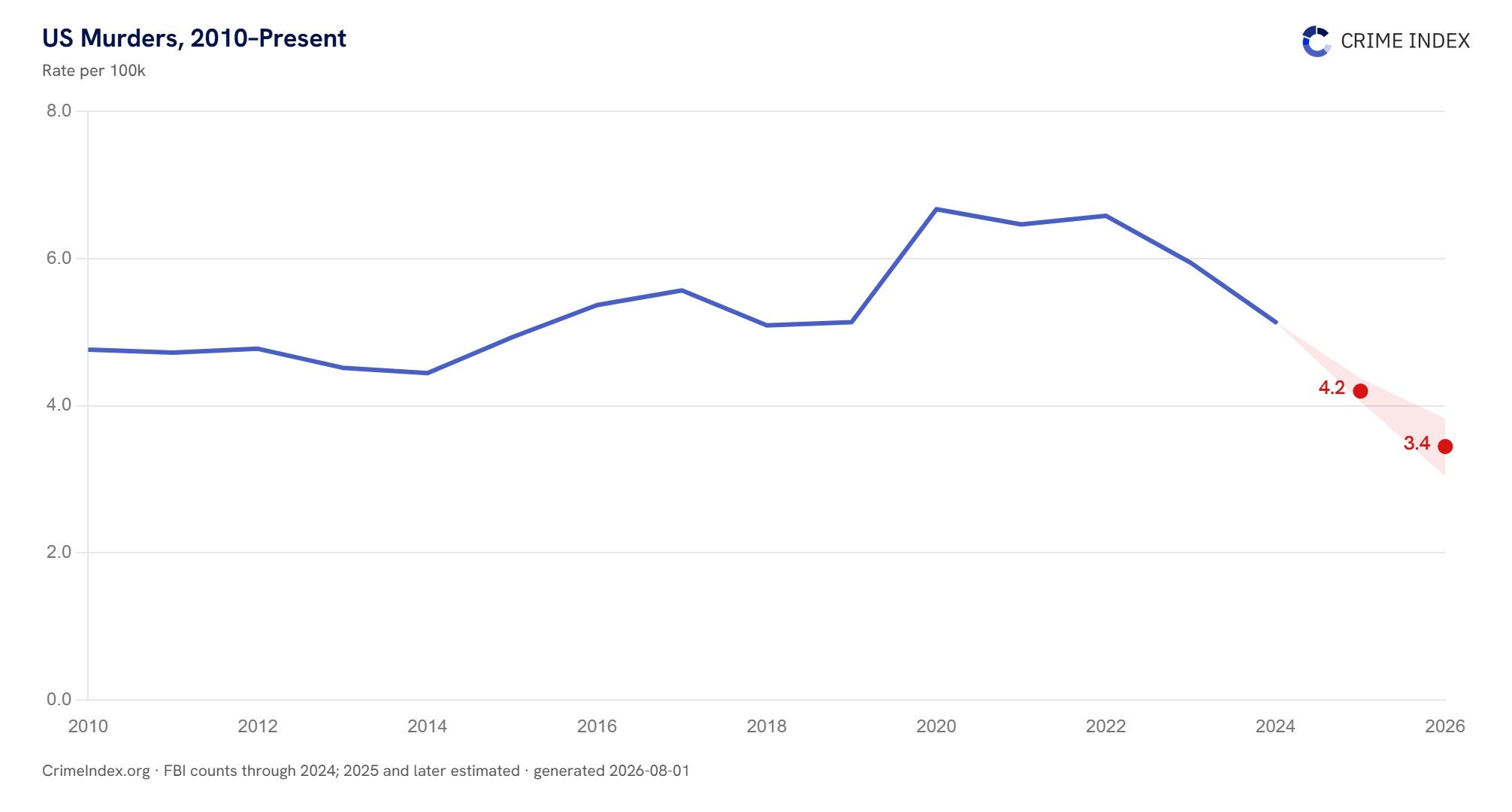
Here is the US murder rate since 2010 with 2024 revised upwards (from around 4.9 per 100k to 5.1 per 100k) and where the country’s murder rate is forecast to end up in 2025 and 2026. The 2025 murder rate should come in at between 4.1 and 4.4 per 100k while the 2026 murder rate should come in at an astonishing 3 to 3.8 per 100k based on the currently available data. Could that change? Yes. Is it a sensible forecast given all we currently know? Also yes. Will the 2026 rate be substantially lower than anything we've ever recorded (FBI murder estimates back to 1960)? Almost certainly yes.
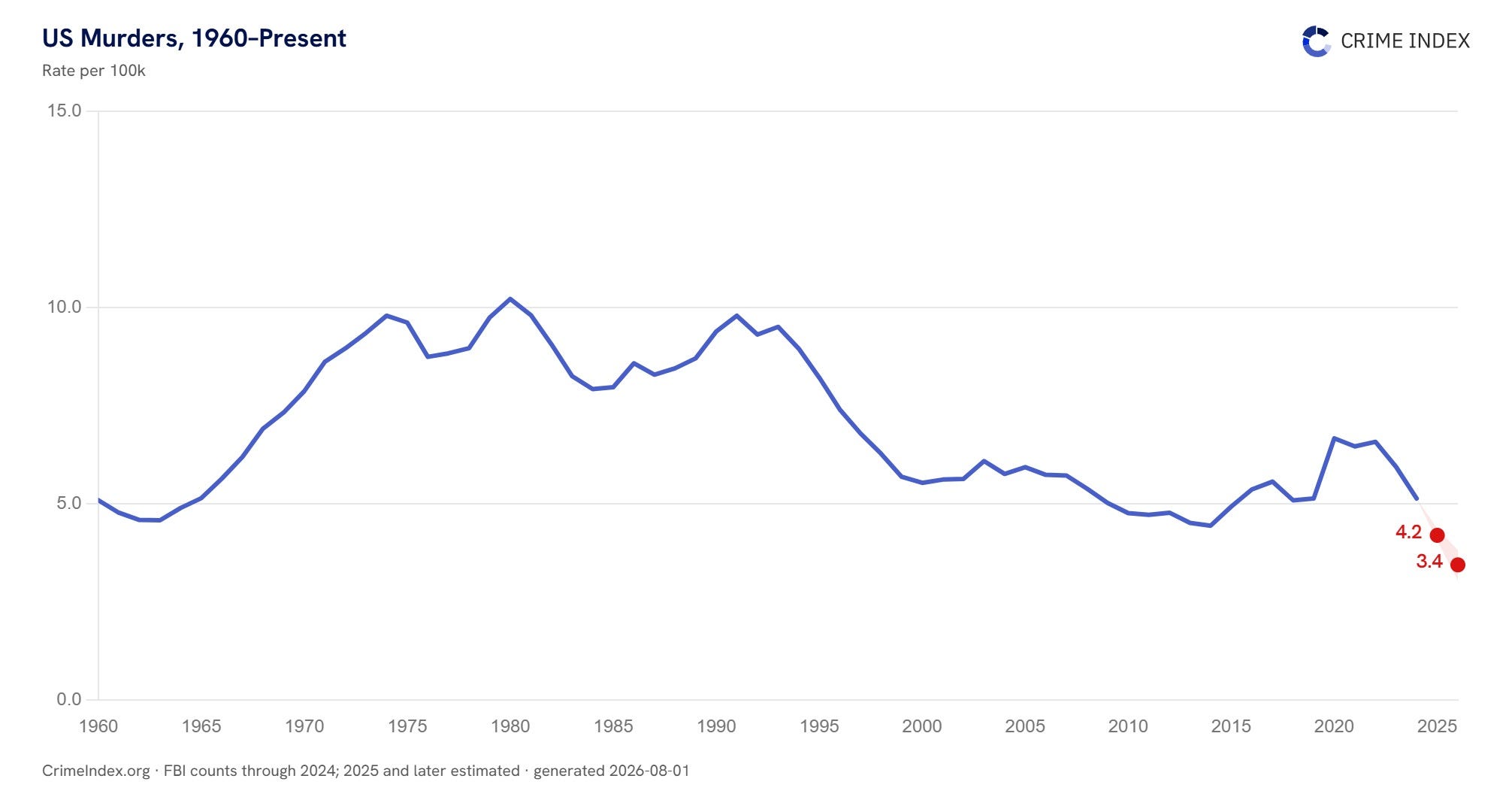
The 2026 murder rate forecast is even more astonishing when you look at the below graph of the US murder rate since 1960. The 2026 murder rate will not just be the lowest ever, it could be more than 20 percent lower than the previous lowest rate ever recorded by the FBI (4.4 per 100k in 2014).
This is Drew Brees breaking Dan Marino’s single-season passing record with one game left to play or Mark McGwire eviscerating Roger Maris’ 61 home runs in 1998 (minus the steroids). Consider that the United States could have the fewest murders since the mid-1960s in 2026 despite having about 150 million more people. That’s about ten thousand fewer people murdered in 2026 than in 2020, 2021 and 2022. That's an even larger drop in murder than occurred in the 1990s in an even shorter timeframe.
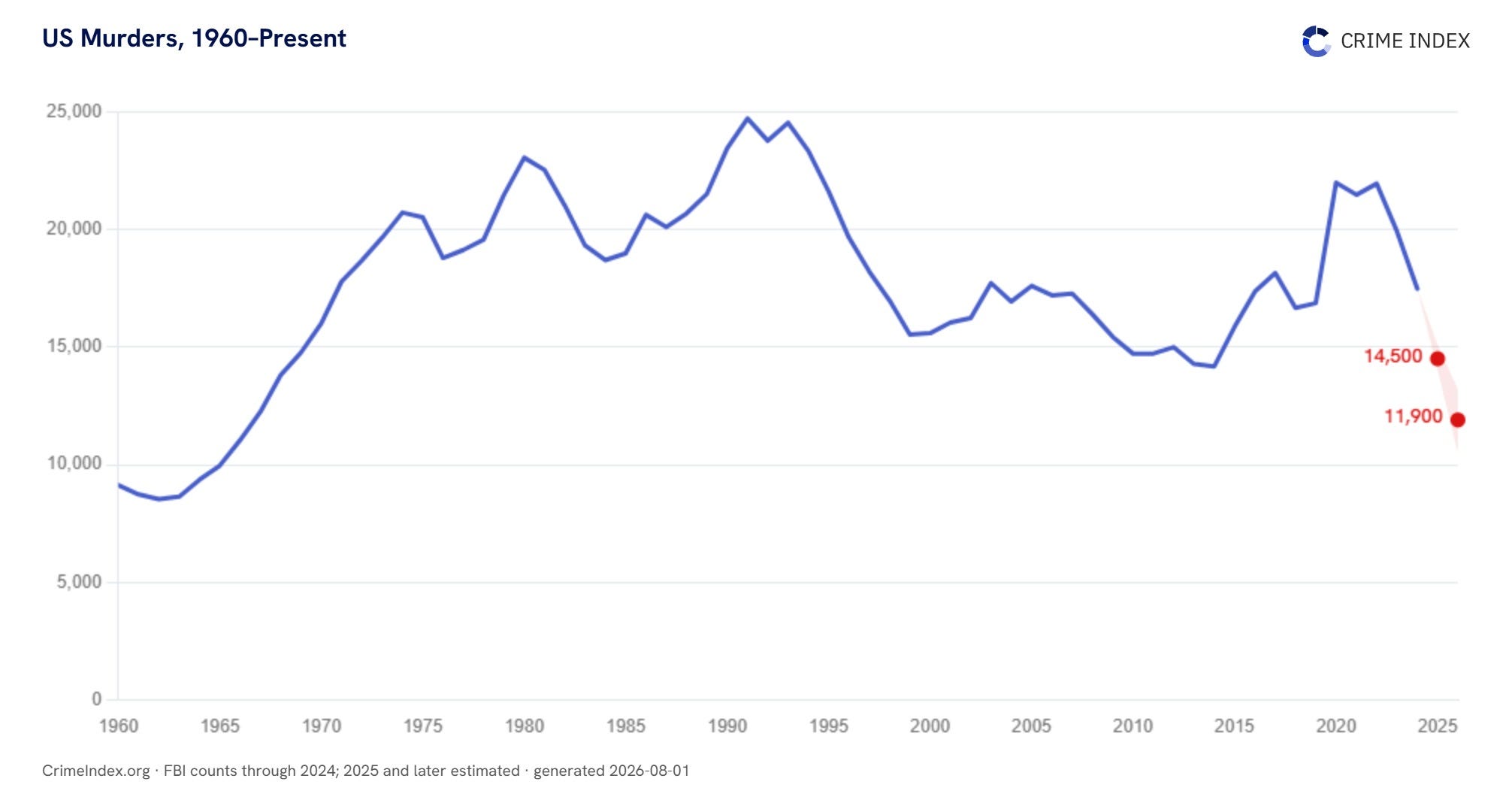
Will the drop in murder continue through the rest of 2026 and beyond? There’s no way of knowing. But there are no signs that the drop in murder that started in 2023 is slowing down and it's impossible to say just how low the nation's murder rate could eventually get.
My newest guest is Andrew Papachristos, one of the smartest people (though he is a Bears fan) thinking through how to use data to reduce gun violence. Andy has spent his career trying to read networks more systematically. He’s a professor at Northwestern University who studies how social ties and relationships shape who becomes a victim and who doesn’t and how that knowledge can be put to use before the next shooting, not just after.
In this episode, we get into what network science actually is, how cities are using it to reach people at the highest risk, and why the same principles hold whether you’re looking at Boston, New Haven, Newark, or Chicago. We also talk about what it actually looks like when violence intervention workers use this research well and what the current historic crime decline might be obscuring.
You can also catch it on the Jeff-alytics YouTube page where I’ll be posting episodes and video clips, so be sure to like and subscribe there if you’re so inclined!
And while you’re here, be sure to check out these other recent great episodes:
Vera President Insha Rahman
Director, NORC Center on Public Safety & Justice John Roman
Criminologist Andy Wheeler
Filmmaker Lynn Novick
Thanks for reading Jeff-alytics! This post is public so feel free to share it.
No posts
Comments
Nothing yet. Say the first thing.
Sign in to join the conversation.