
This is Part IV, and the penultimate installment, of a series I’m calling A Crisis of Meaning and Purpose that explores our fascistic and democratic crises have been driven by historic levels of loneliness, depression, and fear. In Part I we discussed how the Neoliberal Consensus intentionally divided us in order to undermine democratic opposition to capital and in Part II the focus shifted to MAGA as a fascistic cult that promises terrified Americans a sense of community and power. Part III explored the role of the corporate internet and social media in exacerbating atomization and worsening its symptoms.
These articles are free for educational and organizing purposes, but Dispatches From A Collapsing State depends on your support. If my work has helped or resonated with you, please consider becoming a paid subscriber.
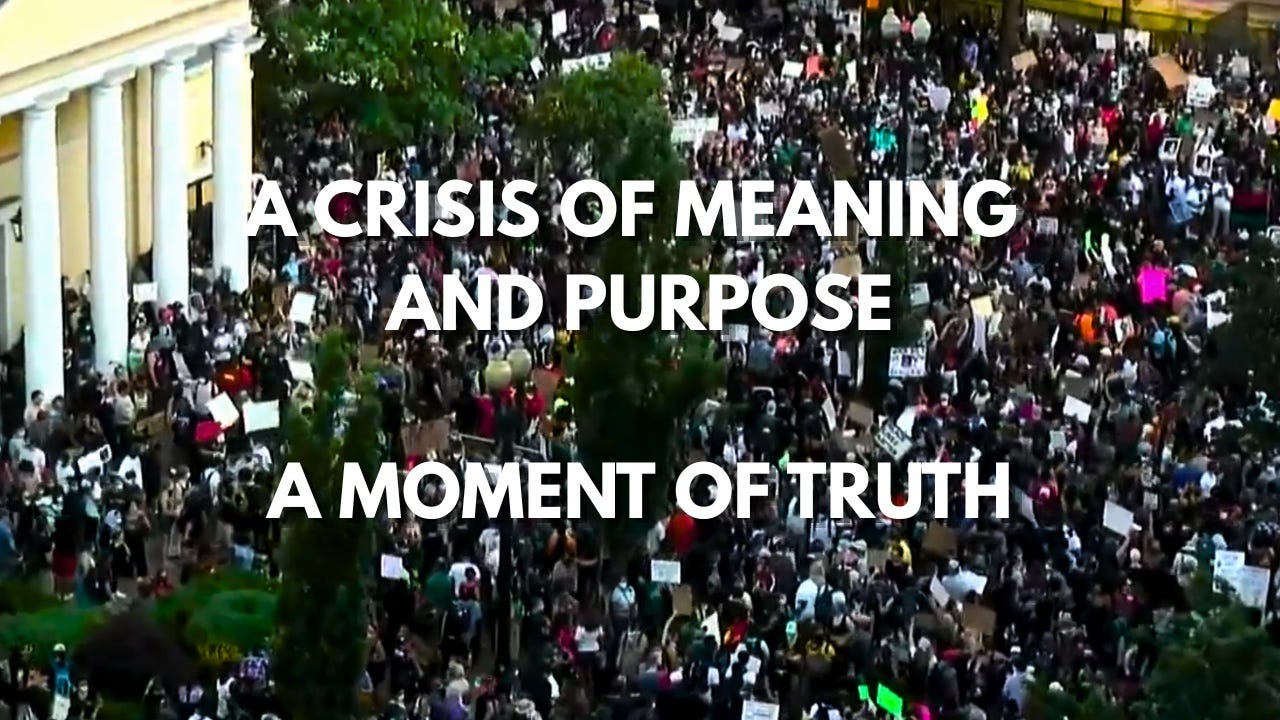
On May 25th, 2020, George Floyd was murdered in broad daylight. He had been arrested for using a fake $20 bill at the Cup Foods grocery store to buy a pack of cigarettes and, for his crime, Officer Derek Chauvin drove his knee into the back of Floyd’s neck for nearly ten minutes. As Chauvin murdered him, Floyd begged for his life and called for his mother. Bystanders pleading for mercy were ignored and restrained from helping Floyd. Luckily, 17 year old Darnella Frazier had just arrived at the store and filmed the killing on her cellphone. What erupted next was the largest protest movement in the history of the United States of America.
The first protest of what would come to be known as the Black Lives Matter (BLM) movement took place the very next day. Over the following weeks, they grew in size and were met with tear gas and rubber bullets and teeth-gnashing anger. Before it was over, upwards of 26 million Americans would find themselves on the streets and squaring off against police. Protests spread around the nation and to over 90 countries.
Though Floyd’s murder was the spark, the 2020 protests might not have reached their size and magnitude had the world not been engulfed by the COVID-19 pandemic that officially began just two months before the killing. In those two months, society as a whole had been rocked and effectively shut down. Businesses closed, the economy dealt a staggering blow, and politics and culture effectively altered forever. For some, their jobs shifted to videoconferencing and telework, while others, designated as “essential workers,” were expected to show up in person and risk their lives. While this might make sense when considering medical personnel fighting a generational plague, the label applied to service industry workers, who accounted for the broad majority of pandemic deaths in the first year.
The pandemic served as a wake-up call. The flaws and failures of America’s infrastructure made the tragedy worse, leaving hospitals bereft of necessary equipment and protection and the populace without materials needed to weather the storm. An aching and depleted medical system buckled under the pressure and cost god knows how many lives. Faced with a historical crisis, leadership in the political class and managerial class revealed its priorities by attending to the ailing economy and feeding the population into the maw of the virus.
In addition to the obvious failures and inhumanity, there was an opportunity for clarity. Absent the noise and activity of regular, accelerated life, and kept from the overstimulating and dissociating rush of existing within modern America, what with its precarity and emphasis on optimization and distraction, there was a dull, throbbing quiet that revealed something deeper and more startling. At long last, the American was forced to sit in the stillness and feel the loneliness that had always been there.
The spectrum of responses by Americans feeling this deep despair, and how they ultimately chose to ease their pain, would create the chaotic world in which we now reside.
On Wednesday, March 11th, 2020, the World Health Organization officially designated COVID-19 as a pandemic. That evening, minutes before the scheduled game between the Utah Jazz and the Oklahoma City Thunder, Jazz center Rudy Gobert tested positive for the virus. The game was cancelled and the NBA suspended its season indefinitely. The next day the NCAA Basketball Tournaments were cancelled, Spring Training for the MLB was called off, and professional sports shut down.
The interruption of sports might seem like a minute footnote in the face of a generational plague, but it is hard to overstate the anesthetizing effect of pastimes and fandom. Suddenly, over night, schools were closed, businesses shuttered, and hundreds of millions of Americans were left to wander their houses and reckon with the silence. It shouldn’t be a surprise that drinking skyrocketed by upwards of 20% or that less than a month into lockdown a series of angry protests emerged. As President Donald Trump continually downplayed the crisis and Right Wing media amplified the lies, supporters flooded the streets and disrupted capitals demanding the country reopen. When they weren’t screaming at or threatening lawmakers and public health officials, they were logging online and consuming round-the-clock conspiracy theories from ascendant influencers telling them, depending on the hour, that they were either being subjected to a plot by the Deep State to crush their will or targets of a sophisticated bio-weapon intended to wipe out the white race. Largely isolated from the rest of society, they surrounded themselves with fellow conspiracy theorists, all of them banded together in search of “the truth.”
And, the truth was, that the silence was too much. The Right Wing / authoritarian personality is so racked with internalized self-loathing that projection of self-hatred must be projected outward and/or numbed with dissociation is necessary to stave off intrusive thoughts and reflection. It is the same with their performance of self, or, rather, the performance of the person they are attempting to will themselves into being. As for dissociation, the lack of places to go, things to do, and work to obsess over, left them devoid of distraction. Even when facing a virus that would go on to kill 1.2 million Americans, including many of their own family members, it was easier to curb cognitive dissonance and pretend it wasn’t real and, in many cases, kill themselves and their loved ones with exposure, than it was to sit in stillness.
It might sound flippant, but many Americans traded their lives and the lives of others so they could go back to Applebee’s.
In the end, what became clear, was that life in modern America, what with its plethora of dissociative properties and commodified delusions was predicated on continuing a state of restless, self-serving distractions that sought to deflect introspection and reflection. This is the essence, after all, of the Make America Great Again Movement and Trumpism as a whole. The purpose is to accumulation of wealth and power, but what drives the project forward is a complex and increasingly contradictory series of rationalizations that stave off cognitive dissonance in favor of temporary soothing. In the moment, it might ward off the collapse of brittle self, but, over time, the stress and pain of delayed reckoning grows and grows and grows, necessitating anger and violence and projection outward.
MAGA, like other Right Wing authoritarian movements, is politically a project obsessed with consolidating power and control while enriching its leaders and their benefactors, but culturally, at the base, it is a tireless cult of enablers promising its members that as long as they continue lying to themselves they will never be alone and they will never have to face the terror in the mirror or the threat of a quiet night alone with their own thoughts.
In other words, MAGA is and has always been a cult selling the illusion of belonging and offering the false comfort of delusional certainty.
The build up of pressure from the pandemic and the political class’s inability to answer the threat beyond injecting $2.2 trillion dollars into the economy as an attempt to stabilize the damage found its release initially in the form of Right Wing rage, but the counter force was soon to come with the BLM protests. You see these pendulum actions often in times of crisis. A thorough examination of something like the 2008 financial collapse must link seemingly disparate events like Occupy Wall Street and then the rise of the Tea Party, one being the mobilization of democratic energies into demanding reform and the reaction being a wealth class-controlled reaction. By the same token, the BLM protest movement is inextricably linked to its reactionary successor January 6th.
Though framed as a leftist insurrection piloted by shadowy cabals - the Right has a tendency to immediately frame any actual populist action as being directed by “outsiders,” namely Jews in carrying on the poisonous libel of The Protocols of the Elders of Zion - and despite claims that the protests were the work of communist agitators, what took place across America was a synthesis of the viewpoints of the Left and broad swathes of the Democrats’ liberal base. With the full scale of the status quo’s failures on display, it was a not-so-subtle shift of the Overton Window. It helped to have an obvious injustice as a rallying point, but what emerged was a long-overdue recognition that things would not change on their own. Collective action was a necessity to force the sclerotic status quo to do what needed done.
The BLM Movement pushed beyond simulated, consumer politics and provided both an outlet for simmering frustrations and a medium for real, on-the-ground, collective action and organizing. There were demands (defunding the police and addressing obvious inequality in law enforcement) and there were actions (sustained protest and civil disobedience). Millions of Americans who had either never protested before or had some limited experience in actions against the illegal war in Iraq or during Occupy were accepted into the fold and given real-time organizing experience.
Eventually, the Democratic Party had no choice but to accede. At least, symbolically. Establishment Democrats like Nancy Pelosi donned Kente cloths and kneeled in faux-solidarity. In the months that would follow, however, the party sprinted as quickly as possible from the issue of defunding the police or, more accurately, redistributing excessive funding in favor of investments in community projects and social programs.
Eventually, establishment stalwart Joe Biden would win the nomination after the party facilitated a standing-down of candidates in order to counter the insurgent campaign of Bernie Sanders. Biden, as president, wouldn’t just reject the issue of defunding police, but flooded law enforcement around the country with hundreds of millions of dollars in new investment.
The election of Biden in the midst of the pandemic was greeted as something akin to liberation. Four long years of Donald Trump’s incompetence, grift, and abuse naturally took a toll. Though the pandemic was far from over, it felt like a promise the end might be in sight. The MAGA years were treated as aberrations as we were treated to videos of former presidents Bill Clinton, Barack Obama, and Republican George W. Bush seemed tilted toward a worldview that the worst was behind us and “normal” was here to stay. In the days following the attempted coup of January 6th, voices from across the political spectrum seemed in agreement on the magnitude of the event. Biden’s inauguration was scripted with a reassurance that the long national nightmare was at an end. It was as if the party was telling us quietly, “Now that we’re past all that…”
In addition to the failure to address necessary reform of law enforcement, the Biden Administration’s progressive agenda was undermined by members of the Democratic Party.
Trump wasn’t held responsible for his crimes and was allowed to return to power.
Before long, perception of January 6th began to twist and transform. It was ugly, certainly, but a coup? More like a riot that got out of hand.
And, as things started to unravel, Democratic voters, many of whom had marched during the BLM protests, were chastised for their questioning.
Flagging material conditions were irrelevant, strategists told them, because the numbers were “good.” Surely they simply didn’t understand economics.
With the war crimes and genocidal violence in Gaza, they were told to be quiet because it could hurt Biden’s reelection chances and then Kamala Harris’s bid. When some protested at college campuses, those same voices cheered on the police and college administrators who attacked them and ruined their futures. They were cast as being antisemitic. Unserious. Destructive. Suddenly, the same aspersions cast by the Right against the BLM protesters was adopted by Democrats, including the verbiage. Surely “outside agitators” were preying upon easily duped young people.
When it was time for the 2024 Democratic National Convention the divide couldn’t have been more apparent. The party denied any Palestinian voices from being heard while protesters gathered in the streets of Chicago and squared off once again with police. Inside the convention center, the party featured former Republicans and promises that Democrats enjoyed the support of Wall Street, thus attempting to put a final touch on partisan divides, Occupy, and resistance to the genocide in Gaza.
It was supposed to feel as if the uprising of 2020 had never happened, save for those kept behind fences and forced to fend for themselves against a phalanx of police.
Something strange happens when a political party exorcises groups. Some tend to give up completely and others form their own coalitions and become what I have termed “radicalized orphans.” Faced with a lack of representation, they fight back against the party that has rejected them and their connections grow stronger as they engage in shared struggle. Absent national representation, they tend to concentrate on local concerns and organizing, creating power bases far away from Washington, D.C. But, because parties derive power from their base and voters, these conflagrations tend to challenge the national party over time.
These groups begin to recognize something that might not have been apparent before. Previously, they were subjects of a Neoliberal worldview in which everyone was out for themselves and partnerships were merely transactional, but by focusing on local organizing and projects like mutual aid, it becomes increasingly clear that this was an illusion. The parasocial nature of modern politics evaporates as they realize the “heroes” and “champions” they were fed through slickly-produced videos, publicity stunts, and finely planned rallies are not only strangers but strangers with incentives and motivations that directly counter their own. With time, these tensions erupt in electoral politics and have a tendency to shift paradigms in ways that seemed previously impossible.
Mutual aid and solidarity also rely on communication and with that communication comes realization. As more Americans who have been abandoned by not just the parties but by politics altogether and in totality by capitalist monopolization share discussions about their beliefs and conditions, they have started to realize the political paradigm itself was always fabricated and illusory. While corporate media told them almost every issue enjoyed a near 50/50 split, their discussions came to reveal what actual polling has always communicated: there exists a broad supermajority consensus that is altogether ignored by the rank and file of both parties and their organs within corporate media.
As that happens, issues that are largely ignored or not given voice by politicians and media, including the rise of AI and data center construction, become unavoidable at the local level. Grassroots protests sprout up and, in the midst of collective action, protesters are looking across the distance and recognizing faces they never imagined joining them. While neither party will take their position, Democrats and liberals have found themselves in partnership with Republicans and MAGA faithful. The language of cooperation and belonging isn’t quite there yet, but the rumblings continue to grow louder. There is, they suspect and are starting to hear from alternative candidates who receive endless attacks from the same politicians who have betrayed them time and time again, a deeper level to what is happening that cuts much, much deeper than the Red vs. Blue framing they’ve been subjected to.
And they begin to believe they aren’t alone as they always believed.
Comments
Nothing yet. Say the first thing.
Sign in to join the conversation.