
Welcome back to the fourth installment (of 12) exploring the actions, approaches, and stories from Learning Environment. In my previous post, we examined how asking students to “Shift the Gaze” helps them notice what had previously gone overlooked.
However, once we have shifted our students’ gaze, the work lies in encouraging them to move from noticing to actively engaging and investigating the world (and community) around them.
Oftentimes, a “field trip” is seen as a reward or a day off. An escape for students and teachers alike from “real” work.
But when crafting an authentic, meaningful, engaging, and rigorous learning environment, we must think of and curate excursions outside the classroom not as trips but as fieldwork opportunities.
For the unintiatied, fieldwork isn’t a break from the curriculum, but a hallmark of a Deeper Learning classroom.
The first… trip I arranged for my class… was to the American Museum of Natural History… the trip did not live up to my hopes for recreating… worlds of wonder…, [my students’] general lack of enthusiasm signaled that better trip planning was necessary to maximize their learning (and engagement).
— Learning Environment, pages 3-4
As I write in Learning Environment, I discovered early on in my teaching career that without pre-trip preparation, any out-of-the-classroom experience, no matter how honorable the intent, would remain a “noun”—a place you go to look at things— that is, unless there was proper student preparation. Indeed, when proper planning was in place, any excursion could live up to its idealized vision and become a “verb”—something I (and students) actively did.
When all three pillars are in place we have create the conditions to support learning in the field and open the possibility for students to step into roles as practitioners, explorers, scientists, and even community activists.
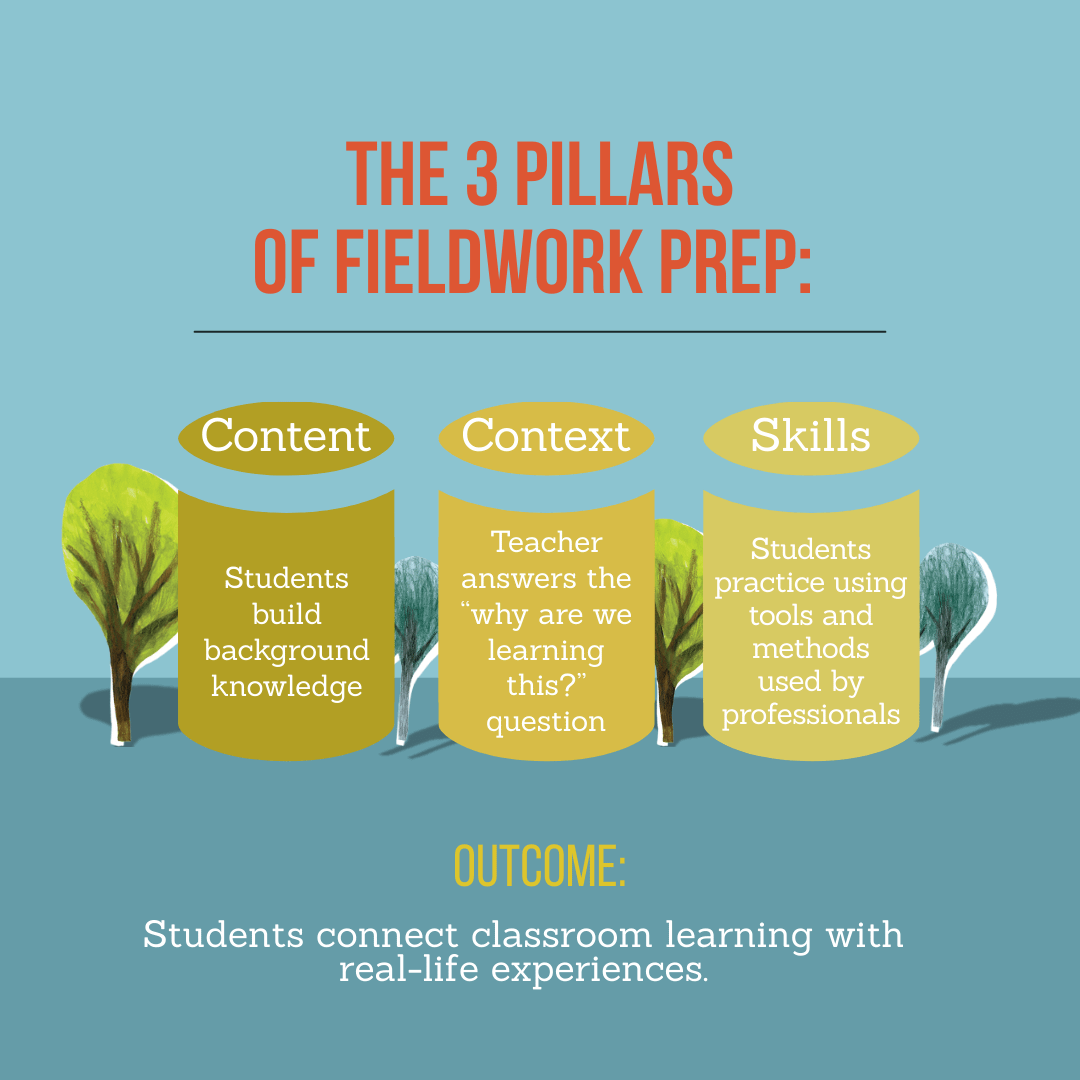
To transform a fieldwork (or field trip) outing into an engaging and memorable learning experience, I relied on my 3 Pillars of Pre-trip Preparation.
Content (The What): Students need background knowledge to make sense of what they see (and learn) when they leave the classroom behind. If we were testing water quality, we first had to understand the nitrogen cycle and pH scales, so that the data we collected would actually tell us a story. If we were visiting a historical archive with primary sources, learning where they came from, who wrote them, and what they signify was paramount.
Context (The Why): We must answer the “why” questions to help students understand how a journey outside the classroom’s walls fits into the larger scope of their learning. By students knowing why they are going on a trip and what we, as a class, hope to learn from it, we can answer relevant questions and build student buy-in.
Skills (The How): Before leaving the classroom, we practice with the tools we’ll be using in the field—titration kits, tape measures, field journals—always starting in the classroom, where things are (relatively) calm and familiar. This helps ensure that when we arrive at the field site, our students’ attention is on the inquiry rather than on struggling with the piece of equipment, tool, or skill they are expected to use or perform.
In other words…
Without content, students are at risk of becoming overwhelmed;
Without context, they question a trip’s purpose;
And without the skills needed to actively engage, they risk becoming spectators rather than active participants in their learning.
When all three pillars are in place we have create the conditions to support learning in the field and open the possibility for students to step into roles as practitioners, explorers, scientists, and even community activists.
Helping give credence to my belief that the world around our schools is the ultimate learning laboratory.
Here are some examples of how you can begin to build the 3 pillars in your classroom.
In-Classroom Field Practice: Before an outing, have students practice data collection on classroom “samples.” This could look like testing tap water with the same kits they will use at a river, measuring a tree’s “DBH” (diameter at breast height) of a chair leg, conducting a “practice” interview with a peer before an oral history project, or sketching a common classroom or school yard object before a site visit to a museum or nature center.
Here’s a free resource of a pre-trip practice I used to introduce water testing to my students.
Reducing Novelty: Spend (at least) one class period familiarizing students with where they will be going and what they will be expected to do there. Doing so will reduce the novelty effect—a phenomenon in which students are so overwhelmed or distracted by the “newness” of a location that they cannot focus on the academic lift. Diminishing novelty can be done by giving students a virtual tour or letting them browse an organization’s website. Providing this context helps the field site feel familiar to students when they arrive and encourages them to focus on the task at hand rather than using their cognitive bandwidth to get familiar with new surroundings.
Data Collection Focus: In the field, students should be focused on collecting data that will be analyzed (and utilized) back in the classroom. Maybe they are collecting a sample, a measurement, an observation, a sketch, or an interview. Whatever it is, let students know that the better and more robust their data collection is outside the classroom, the easier and more meaningful the analysis will be upon their return. Providing scaffolds, structures, routines, and templates for doing so also doesn’t hurt.
The Impact: Intentional preparation leads to student confidence and agency in the field. When students know the what, the why, and the how (The 3 Pillars), they can navigate a fieldwork experience with a sense of purpose and agency. In turn, I have seen in my own classroom how fieldwork, coupled with local data collection, can encourage students to want to solve local problems in the world around them.
Are you looking to move beyond a traditional “field trip” model and toward authentic, rigorous fieldwork? Need support building The 3 Pillars across the programming at your school or organization?
At Fox EduConsulting, I Dream, Collaborate, and Create with educators to design learning environments and out-of-school experiences that align with state (and national) standards, including portraits of a graduate and competencies to spark student curiosity.
Interested? Contact Jared and together, let’s build the 3 pillars that will support your students’ next adventure.
Coming Up Next: In post 5 of the Learning Environment series, “Creating a Third Space in the Classroom,” we’ll unpack what happens when the culture of the professional meets the lived experience of the student—and the magic that happens in the middle.
Buy Learning Environment Today
Dr. Jared Fox, is an education expert and the founder of Fox EduConsulting. Through his consulting practice, Jared helps schools and organizations craft authentic, engaging, and comprehensive learning environments - with a specialty working at the intersection of science, the environment, and social justice.
Comments
Nothing yet. Say the first thing.
Sign in to join the conversation.