
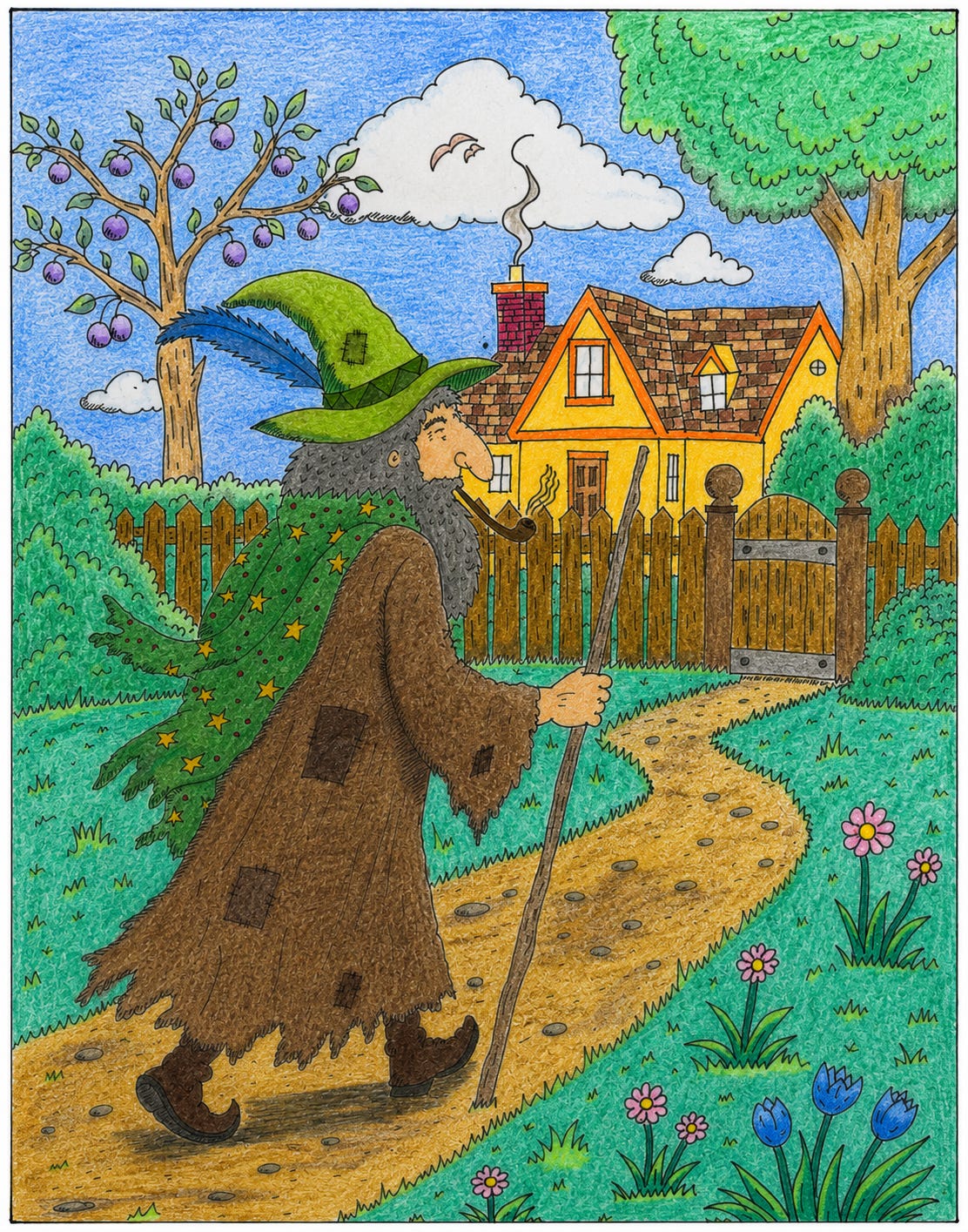
Today we meet the old wizard himself: Old Artaxerxes, ragged coat, green hat, blue feather, old pipe, and all.
This is the second illustration in my attempt to give Tolkien’s Roverandom a few more pictures. I am teaching myself to draw, and this is a way to develop my skills while providing pictures for my kids as I read the book to them. You can read the original post, as well as see the first illustration of Rover at these links:
One thing I’ve been inspired to do with these illustrations is to approach each one by studying and even researching the subject at hand, meaning I want the picture to include objects and details that help tell the story as it was originally given to us by Tolkien. This is a skill I’ve picked up over the past twenty years in academia. Thankfully, it’s pretty easy to do this with Roverandom, though sometimes you need to read between the lines and beyond the immediate paragraph to get the deeper details.
Tolkien introduces Artaxerxes as so:
“Not every old man with ragged trousers is a bad old man: some are bone-and-bottle men, and have little dogs of their own; and some are gardeners; and a few, a very few, are wizards prowling round on a holiday looking for something to do.”
I think this introduction is both mischievous and delightful. We see a different kind of wizard from the one Tolkien typically gives us, as with Gandalf. Artaxerxes isn’t on a grand quest, or standing before kings, or battling a Balrog beneath a mountain. He’s simply prowling around on a holiday looking for something to do.
Tolkien then tells us that this old man,
“… came wandering up the garden-path in a ragged old coat, with an old pipe in his mouth, and an old green hat on his head [with] a blue feather stuck in the back of [it].”
Ah! Now we get helpful details about Artaxerxes. He is on a “garden-path.” We get specificity of the raggedness of his clothes (specifically, that he is in a “coat”). And we learn that he has an old pipe in his mouth and an old green hat on his head with a blue feather stuck in the back of it. I love that Tolkien gives us the colors of the hat and feather!
These details are easy enough to discern, but Tolkien drops other hints throughout the first chapter that are a little harder to glean. We also learn he is a “nimble plum-gatherer,” that he came from Persia before he got lost and ended up living in “Pershore,” which I take to be a coastal community. He is also two thousand years old.
So, given all these details, in this illustration I wanted Artaxerxes to feel like a figure who has wandered into the story, almost as if the garden path (which leads to the “old lady’s” house, which Tolkien says is far away “inland” of the shore, which is why I added seagulls) accidentally summoned him because of the plum tree in the distance. As a wizard, he’s old, but not frail. He’s ragged, but not pathetic. He’s comic, but not, as we soon discover, harmless. I tried to show his age through the long beard, the heavy eyebrows, the lines around his eyes, and his posture, which is slightly hunched. He needed to look like a man who had seen history, but who still had enough sprightliness left in him to climb after plums and quarrel with a puppy. And because Artaxerxes comes to us as a Persian wizard, I tried to give his complexion a warmer eastern coloring, something that would suggest his origin. I also gave him a proper wizard scarf and colored it in the colors of the modern-day Persian flag.
Overall, I opted to be fairly detailed in this illustration in an attempt to help capture the scene and the story, not dissimilar to what I did with Rover in the Garden.
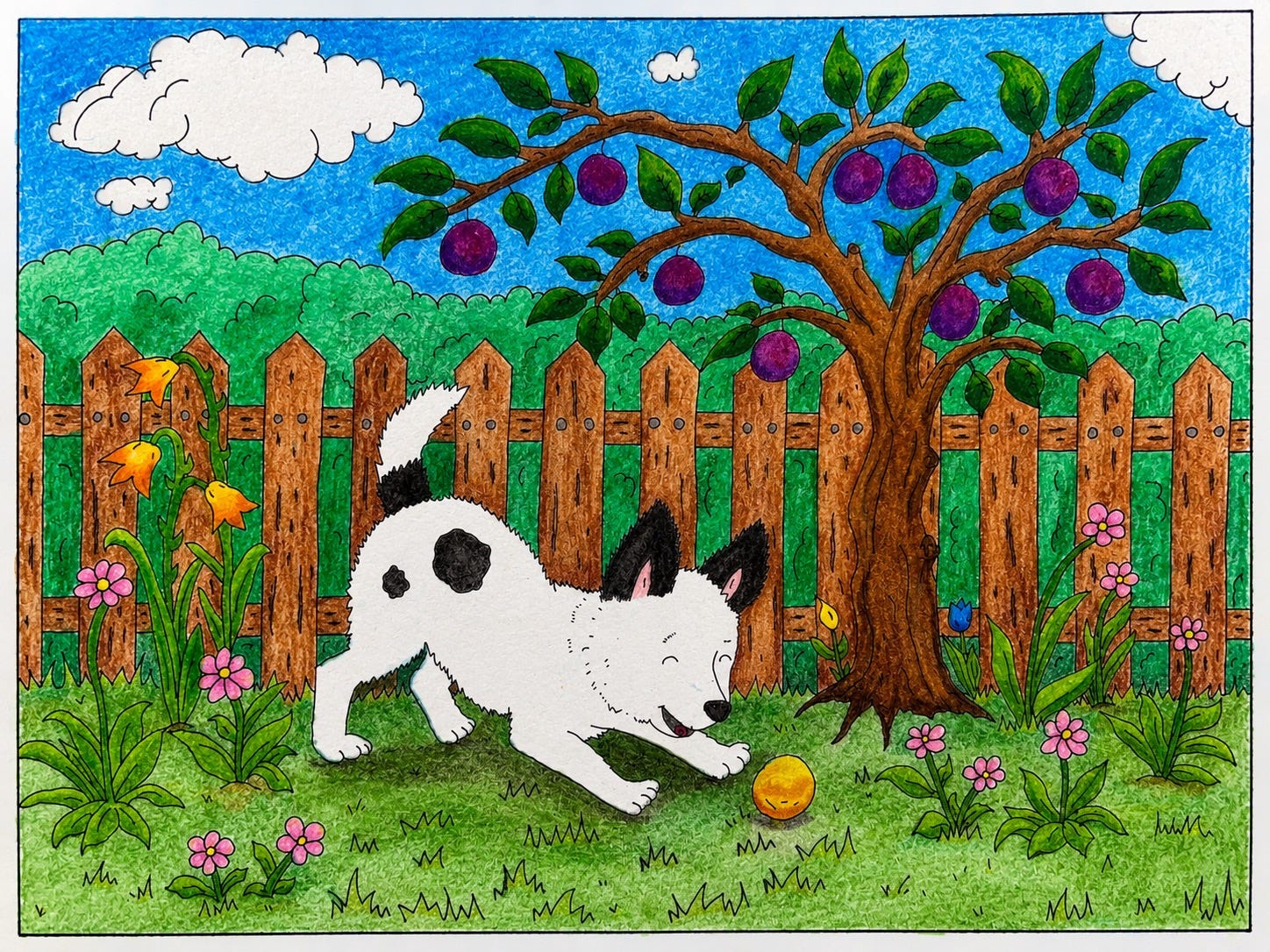
It’s after this that the trouble starts.
Rover bites Artaxerxes’ trousers, and the wizard responds by turning him into a toy. This is the hinge of the whole story. Without Artaxerxes, Rover stays a little dog in a garden. With Artaxerxes, Rover becomes Roverandom, sent through a world of moon-dogs, dragons, sea creatures, and enchanted adventures. So, Artaxerxes is the catalyst that drives the story forward.
In my mind, I tried to connect these two illustrations so that you could imagine Rover in the garden at the end of the garden-path.
If you’re reading Roverandom with your children, I hope this helps them see the moment a little more vividly. And if you’re reading it for yourself, I hope it reminds you that Tolkien’s lesser-known tales are still full of the deep delight of a man who knew that even a lost toy dog could become the beginning of a fun odyssey.
My next illustration will likely be a simple one of Rover biting Artaxerxes’s trousers. I am going to attempt what I call a medieval manuscript-storybook style for it, which means white space in the back with a focus on the characters with vibrant colors. I am thinking I will attempt detailed pictures, like what I’ve done with Rover in the Garden and Old Artaxerxes, of key scenes, and do simpler illustrations for the in-between events.
If you like what I’m doing, I hope you’ll subscribe so you can see the story unfold and maybe discover more about Tolkien’s theory of subcreation along the way.
No posts
Comments
Nothing yet. Say the first thing.
Sign in to join the conversation.