
Prime Minister Takaichi is determined to fortify the foundations of Japanese national power. Science & research & transformative deep-tech innovation are at the very center of this new strategy. Her plans are ambitious, all-encompassing, and backed by an unprecedented commitment - both in terms of size, Y370 trillion, or just about two-thirds of current GDP, and duration, initiatives will be backed for 14-years. The goal is to force the next evolution of Japan’s economic structure by mobilizing and directing both public & private funds towards a common goal. What could possibly go wrong? Is more money funneled through established institutions and structures really going to make a difference? I am honored to present to you a real-world perspective on what actually needs to happen to power-up the true engine of national power - the better a nation’s “frontier science and deep-tech innovation” the greater her national resilience, economic security, and global competitiveness.
I am honored to present you with this guest contribution by Dr Peter Gruss. He has been my mentor and friend for more than a decade now. Peter is arguably the most experienced global leader in the science-academia-deep-tech-innovation-national-policy-making ecosystem. He is uniquely relevant to Japan because he has actually been leading from within the trenches here in Japan, first as President of Japan’s leading science university. OIST, the Okinawa Institute of Science & Technology (consistently ranked in the top-ten global science research universities by Nature Magazine); and now as a member of Tokyo University’s Policy Council. His unique “skin-in-the-game insights” make it very clear that money is, yes, a necessary condition, but not a sufficient one to realize Takakich’s dream. True institutional reform is needed to overcome Japan’s R&D conversion problem…..Enjoy and, as always, comments welcome. Many cheers from rainy Kauaii ;-j
by Dr Peter Gruss - President Emeritus of OIST & the Max Planck Society, and current University of Tokyo Policy Council Member
Japan is a high-R&D country with a public-research conversion problem. Its total R&D effort is large, but its system is heavily business-led, while its position in globally top-cited research and science-linked patenting is weaker than one would expect from the size and sophistication of the economy. The reform question is therefore not only whether Japan should spend more. It is whether Japan’s public research system - JSPS/KAKENHI, JST, RIKEN, AMED, NEDO, AIST, MEXT, METI, and national universities - is organized to convert public funding into frontier science, high-value patents, startups, standards, and industrial capabilities. This paper argues for a Japanese metascience agenda: a systematic effort to study and improve how science is funded, reviewed, managed, opened, replicated, and translated.
Public research funding is not merely a subsidy for universities or laboratories. It is one of the core engines of national innovation. Publicly funded research produces the scientific foundations on which later technologies, patents, firms, and industries are built. This is especially true for early-stage and high-risk research, where private firms often underinvest because the benefits are uncertain, long term, and difficult to capture exclusively. The economic case for public R&D is therefore not only that it produces papers. It generates spillovers: trained people, new methods, datasets, instruments, standards, patents, startups, and industrial capabilities.
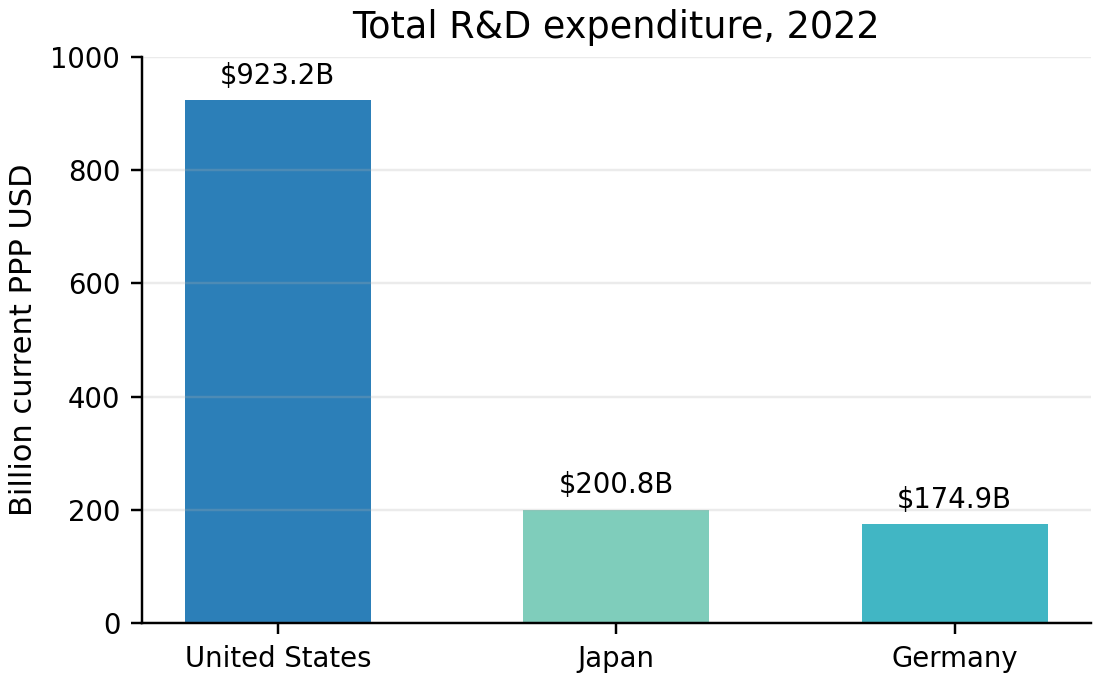
International data show the scale of the issue. In 2022, the United States spent roughly $923.2 billion on R&D, Japan about $200.8 billion, and Germany about $174.9 billion in current PPP-adjusted dollars. Japan is therefore not a marginal science economy. It remains one of the largest R&D systems in the world. But the structure of that system differs from Germany and the United States. Japan’s official FY2022 survey reported total R&D expenditure of about ¥20.70 trillion, with businesses accounting for 73.1% of total R&D. The U.S. system is also strongly business-led, with business performing roughly 78% of R&D. Germany’s business share is commonly reported in the mid-to-high 60s, around 67%.
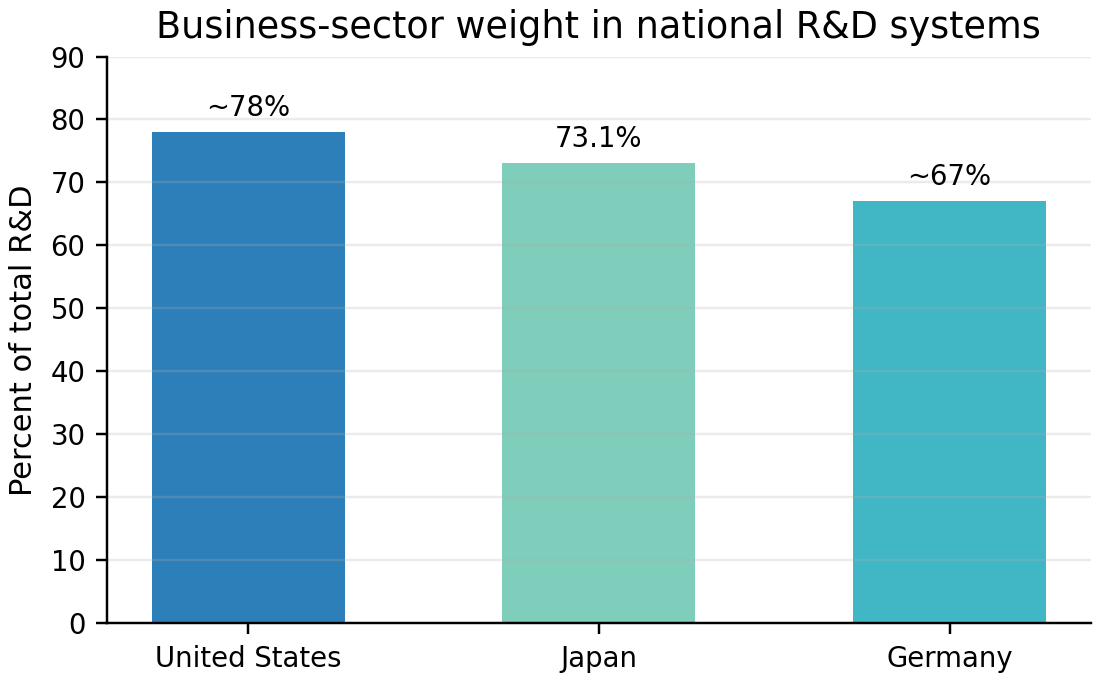
Japan has a large industrial R&D machine, but its public and academic research base appears less effective at converting national R&D strength into globally leading science. Germany’s public research landscape is institutionally deep, including Max Planck, Fraunhofer, Helmholtz, Leibniz, DFG, universities, and federal-Länder co-financing. The United States combines enormous business R&D with very large federal mission and health research budgets. Japan’s public research system must become stronger, more open, and more experimental if it is to feed the next generation of science-based innovation.
The comparison based on government and business R&D still understates the resources available to the U.S. research system. The United States also has a substantial philanthropic layer that finances long-horizon basic research, high-risk investigators, new institutes, shared datasets, and research tools. This funding is not a substitute for federal support: it is much smaller, more concentrated, and often targeted to particular fields. Its importance lies in flexibility. Philanthropic funders can make long commitments, support people rather than narrowly specified projects, and create new organizational models more quickly than government.
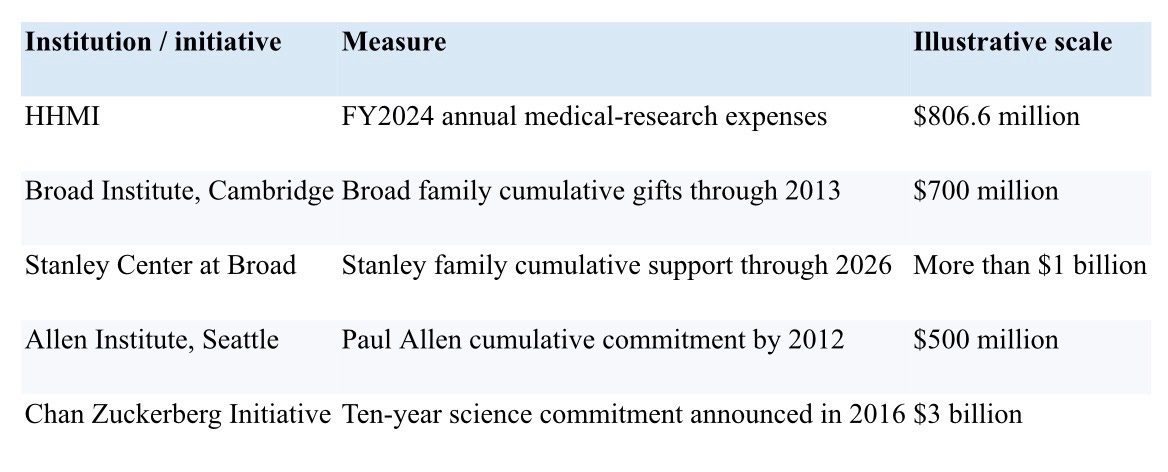
The scale is significant. HHMI reported $806.6 million in medical-research program expenses in fiscal year 2024. In Cambridge, the Broad family provided $700 million cumulatively to establish and endow the Broad Institute, while the Stanley family’s support for psychiatric research at Broad has exceeded $1 billion. In Seattle, Paul Allen’s cumulative commitment to the Allen Institute had reached $500 million by 2012. The Chan Zuckerberg Initiative committed $3 billion over ten years to biomedical science and technology. Other major contributors include the Simons Foundation, the Gordon and Betty Moore Foundation, Schmidt Sciences, and disease-focused foundations.
These figures should not be added mechanically to annual federal R&D totals: some are yearly expenditures, others are multi-year or cumulative gifts, and many institutes also receive government grants. Nevertheless, they demonstrate a structural U.S. advantage. Public funding supplies scale and continuity; philanthropy adds patient, flexible capital and institutional experimentation. Japan should therefore strengthen public basic-research funding while also creating tax, governance, and matching-fund incentives for larger private foundations, endowed research institutes, and long-term gifts to universities and national research organizations.
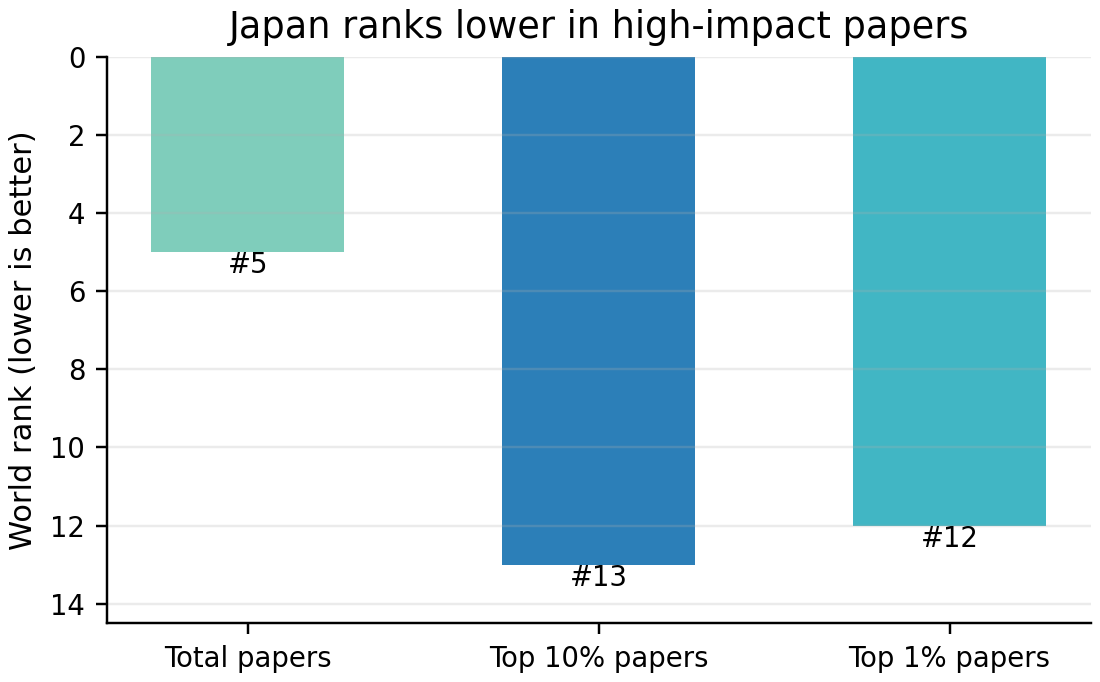
Japan’s challenge is not only input volume; it is output quality and conversion efficiency. NISTEP’s 2024 indicators show that Japan ranked fifth in total papers by fractional count, but only thirteenth in adjusted top 10% papers and twelfth in adjusted top 1% papers. Top-cited papers are not perfect measures of scientific excellence, but they are a useful warning signal. A country producing many papers but fewer globally leading papers may be spreading effort across too many incremental projects, underfunding high-risk work, disadvantaging younger researchers, or relying on review systems that reward feasibility more than originality.
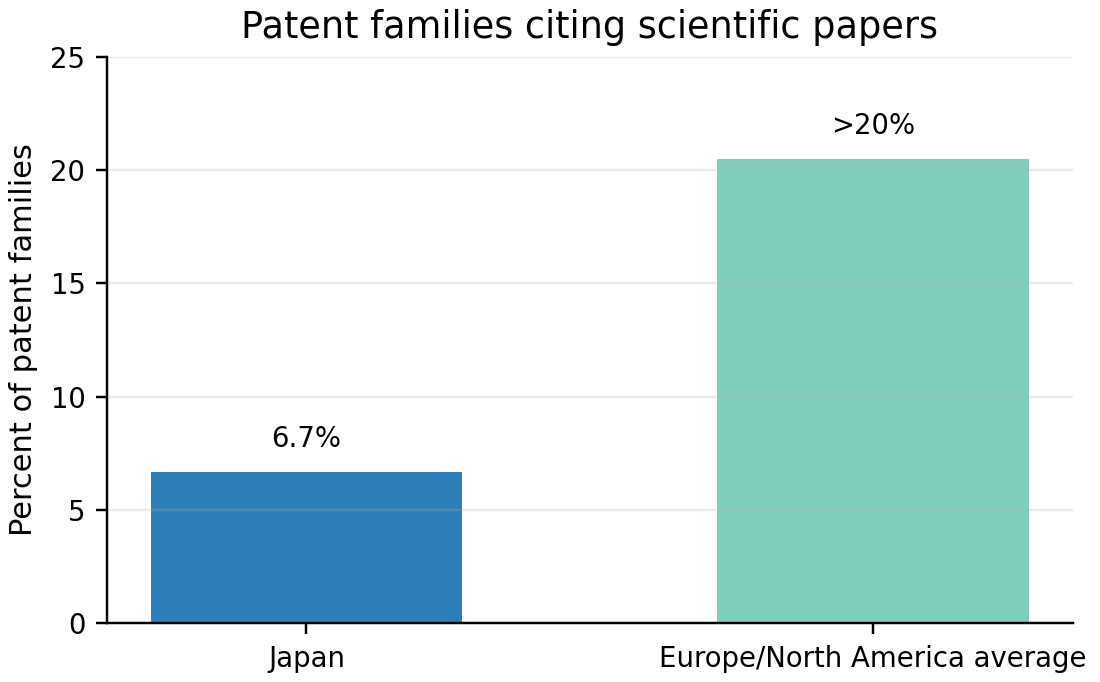
The innovation side raises a similar concern. NISTEP reports that Japan ranks highly in patent families that cite scientific papers, but only 6.7% of Japanese patent families cite academic papers. NISTEP also notes that this is below the average for Europe and North America, which is above 20%. The defensible statement is that Japan has a weak science-to-technology linkage compared with the broader Europe/North America benchmark.
The link between excellent science and valuable invention is not speculative. A large-scale study matching 4.8 million patent families to 43 million scientific publication records found that patents linked to high-quality science are about twice as valuable as those linked to low-quality science. For Japan, the goal should be to raise the conversion rate from public R&D funding to top 10% and top 1% papers, and from excellent science to high-value patents, standards, startups, and industrial platforms. Here are some thoughts how to improve the Japanese R&D funding system:
The Japan Society for the Promotion of Science should establish an internal KAKENHI Metascience Lab. KAKENHI is Japan’s broadest investigator-led academic funding mechanism, so it is the best place to study whether the grant system selects originality or rewards safe incremental work. The lab should have secure access to proposal texts, reviewer scores, panel decisions, award histories, applicant career data, publications, citations, datasets, patents, and later funding outcomes.
The lab should answer concrete questions. Are early-career researchers disadvantaged in review? Which review criteria predict long-term scientific impact? Are interdisciplinary proposals penalized because they do not fit existing panels? Do repeat awardees dominate flows of funding? Does KAKENHI underfund high-novelty proposals because preliminary data and feasibility are overweighted? How much time do researchers lose preparing unsuccessful applications?
Five pilots should begin immediately: young investigator independence grants of five to seven years; partial lotteries among proposals that pass a high-quality threshold; a high-risk KAKENHI track where novelty is scored separately from feasibility; two-stage applications to reduce burden; and reviewer calibration using historical outcomes to identify bias against early-career, interdisciplinary, or high-risk proposals.
Japan should also make greater use of non-Japanese reviewers, particularly for large, interdisciplinary, high-risk, and internationally oriented proposals. Carefully selected overseas experts would broaden the range of scientific judgment, reduce dependence on domestic networks and established schools, and help benchmark Japanese proposals against the global frontier. International reviewers should complement, not replace, Japanese expertise, and conflicts of interest, confidentiality, language, and review timelines should be managed through clear rules and professional support.
The Japan Science and Technology Agency should become the main testing ground for strategic and mission-oriented funding reform. JST already manages CREST, PRESTO-style programs, Moonshot programs, strategic basic research, technology transfer, and team-based funding. It is therefore the right institution to test how program design affects risk, speed, and translation.
JST should pilot ARPA-style program-manager authority in selected programs. Program managers should have discretion to start, stop, expand, redirect, or combine projects as technical evidence changes. This model is suitable for engineering-heavy, platform-building, and mission-oriented work, but curiosity-driven basic research should not be forced into inappropriate short-term milestones. JST should also test open-topic strategic calls, where researchers propose unexpected routes to national challenges rather than responding only to narrow themes.
JST should fund Focused Research Organization pilots: time-limited, full-time teams building public-good tools, datasets, and platforms too large for one lab and too pre-commercial for a startup. International challenge programs with Germany, the UK, South Korea, Singapore, and the EU would allow Japan to compare funding designs across systems and learn faster than it can alone.
RIKEN should be Japan’s central laboratory for testing long-horizon, high-autonomy science. Its key metascience question is simple: does long-term institutional funding produce more frontier research than short-cycle competitive project funding? RIKEN has the scale, prestige, facilities, and national legitimacy to answer that question.
RIKEN should pilot eight- to ten-year flexible funding for selected research leaders and emerging younger leaders. It should expand independent young PI groups with their own budgets, space, hiring authority, and technical staff. It should build cross-center platforms in AI for science, structural biology, quantum technology, computational science, bioengineering, and advanced measurement. It should recognize research products beyond papers - datasets, models, software, protocols, materials, cell lines, and instruments - as formal outputs. It should also host embedded international labs with partners such as Max Planck, Helmholtz, CNRS, ETH-domain institutions, and leading Asian institutes.
Biomedical research is an area where reliability failures are especially expensive. AMED should lead Japan’s metascience agenda for biomedical reproducibility, clinical translation, and patient-level data governance. It should fund independent replication of influential preclinical studies before large translational investments are made. It should require registered reports in selected high-cost biomedical areas, especially where flexible analysis choices or publication bias can distort decisions.
AMED should also run translational failure analyses. Japan needs to know why promising discoveries fail to become clinical products: weak target validation, inadequate trial design, poor data standards, fragmented patient cohorts, IP problems, insufficient venture funding, or weak links between discovery laboratories and hospitals. A formal AMED-RIKEN bridge could connect RIKEN discovery research with AMED translational programs, with shared data standards and stage-gated evaluation.
NEDO and AIST should lead reform in industrial technology, energy, manufacturing, robotics, semiconductors, batteries, and climate technology. NEDO should test open-topic industrial technology calls that allow firms, startups, universities, and institutes to propose unconventional solutions to national challenges. It should use milestone-based public-private funding where technical progress can be measured, and it should track whether grants increase venture financing, patents, standards participation, procurement, and industrial adoption.
AIST should benchmark itself against Germany’s Fraunhofer Society and test which contract-research models create the greatest spillovers. Japan should experiment with IP models - exclusive licensing, non-exclusive licensing, patent pools, open standards, and public-good licensing - and evaluate downstream effects. AIST should also create mobility fellowships allowing researchers to spend one or two years in startups or industrial labs and return without penalty.
National universities should become active participants in metascience reform. Japan should make a clear institutional shift: an assistant professor should not be the assistant to a professor. Early-career researchers should have their own budgets, space, hiring authority, and the right to pursue independent research agendas. MEXT should require independent young PI tracks with startup packages, protected research time, and transparent promotion criteria.
University governance also needs reform. Japan should create full supervisory boards for national universities with real strategic authority, external expertise, and international participation. These boards should include distinguished scientists, technology leaders, entrepreneurs, international academics, and public-interest representatives. They should evaluate whether universities are producing frontier research, supporting young investigators, attracting global talent, reducing bureaucracy, and contributing to national innovation.
Internationalization must become central to research reform. After the bachelor’s level, Japan should expand English-language graduate teaching and research training in selected programs, especially in science, engineering, medicine, AI, materials, robotics, energy, and life sciences. This does not mean abandoning Japanese. It means making Japan’s research system easier for international graduate students, postdocs, and faculty to enter.
Japan should set a national target to reduce avoidable research administration by 20% within five years. MEXT should coordinate this across JSPS, JST, AMED, NEDO, RIKEN, AIST, and universities. Reforms should include shorter proposals, fewer duplicative reports, harmonized data-management plans, common CV formats, shared grant portals, simplified procurement, better research-manager career tracks, and more professional support staff for laboratories.
Finally, Japan needs a secure national R&D data infrastructure. It should link grant applications, reviewer scores, funding decisions, publications, patents, datasets, clinical trials, startups, licensing, standards, procurement, career outcomes, and international collaboration. The infrastructure must be privacy-preserving and allow approved researchers to study the system without exposing confidential proposal-level data. Without this backbone, Japan will not know which reforms work. With it, Japan can manage science policy as a learning system.
Japan does not face a simple spending problem. It faces a public-research efficiency and translation problem. The country spends heavily on R&D overall, but its system is strongly business-led, its share of globally top-cited science is weaker than its publication volume suggests, and the connection between scientific papers and patents is weaker than it should be. The answer is not to copy another country. Japan should build its own metascience system: evidence-driven, institutionally specific, and focused on higher conversion from public funding to excellent science and from excellent science to high-value innovation.
The agenda is practical. JSPS should study and reform KAKENHI. JST should test new funding models. RIKEN should test long-horizon autonomy. AMED should improve biomedical reliability. NEDO and AIST should test industrial translation. FRO-Japan should build tools and platforms that traditional labs cannot. Universities should give young researchers real independence, reform governance, and internationalize graduate training. MEXT should reduce burden and create an R&D data infrastructure. If Japan implements these reforms, it can turn metascience from an abstract field into a national strategy for scientific renewal and economic resilience.
NSF/NCSES, Science & Engineering Indicators 2025, Global R&D and International Comparisons, including 2022 current PPP R&D estimates.
Statistics Bureau of Japan, Survey of Research and Development, FY2022; summarized in UK Science and Innovation Network, Japan.
NISTEP, Japanese Science and Technology Indicators 2024, including Japan’s rankings for total papers, adjusted top 10% papers, adjusted top 1% papers, and patent families citing scientific papers.
OECD Main Science and Technology Indicators and OECD Research and Development Statistics, including business-sector R&D performance and cross-country definitions.
Poege, F., Harhoff, D., Gaessler, F., and Baruffaldi, S. (2019). Science quality and the value of inventions. Science Advances.
· Howard Hughes Medical Institute, FY2024 Audited Financial Statements: $806.6 million in medical-research program expenses.
· Broad Institute: Broad family gifts totaling $700 million; Stanley family philanthropic support exceeding $1 billion by 2026.
· Allen Institute: Paul G. Allen cumulative commitment of $500 million by 2012.
· Chan Zuckerberg Initiative: $3 billion ten-year commitment to science announced in 2016.hhhh
Dr. Peter Gruss is a German developmental biologist renowned for his pioneering work in gene regulation and embryonic development. He earned his PhD from Ruprecht-Karls-Universität Heidelberg in 1977, followed by postdoctoral training at the NIH in Bethesda, where he co-discovered enhancers — gene-activating elements that operate in a tissue-specific manner. In 1986, he was named Director of the Max Planck Institute for Biophysical Chemistry, and has held the status of honorary professor at the University of Göttingen since 1990.
He served as President of the Max Planck Society from 2002 to 2014, during which time his influence extended well beyond the laboratory into corporate boardrooms and government. On the corporate side, Gruss served on the Supervisory Board of Siemens AG from 2008 to 2014, and following his resignation from that board, was appointed Chairman of the Siemens Technology & Innovation Council (STIC) in early 2015. He also served on the Supervisory Boards of Munich RE and Actelion Pharmaceuticals, as well as on the Advisory Boards of Deloitte and Allianz. He was appointed as a member of the “Innovation Dialogue” of the Federal Chancellery by Chancellor Angela Merkel — a direct advisory role at the highest level of German government on science and technology policy.
In terms of scientific leadership bodies, Gruss served as President of the International Society of Developmental Biology from 1993 to 1997, and as President of the EMBL Council from 2000 to 2002. He has been a member of the Senates of the Alliance of Scientific Organizations in Germany, the German Research Foundation (DFG), the German National Academy of Sciences Leopoldina, and acatech, the German Academy of Science and Engineering. He also served on the Scientific and Academic Advisory Committee and the International Board of the Weizmann Institute of Science, and on the Academic Advisory Council of the Stiftung Charité.
His international academy memberships include the American Academy of Arts and Sciences, the Göttingen Academy of Sciences, the European Molecular Biology Organization, and the German National Academy of Sciences Leopoldina. He is an honorary member of the Japan Academy and the National Academy of Sciences of the Republic of Korea, and a foreign member of the Polish Academy of Sciences. In January 2017, Gruss became President of the Okinawa Institute of Science and Technology (OIST), and was later honored with Japan’s Order of the Rising Sun, Gold and Silver Star, for his exceptional contributions to Japanese science and education.

No posts
Comments
Nothing yet. Say the first thing.
Sign in to join the conversation.