
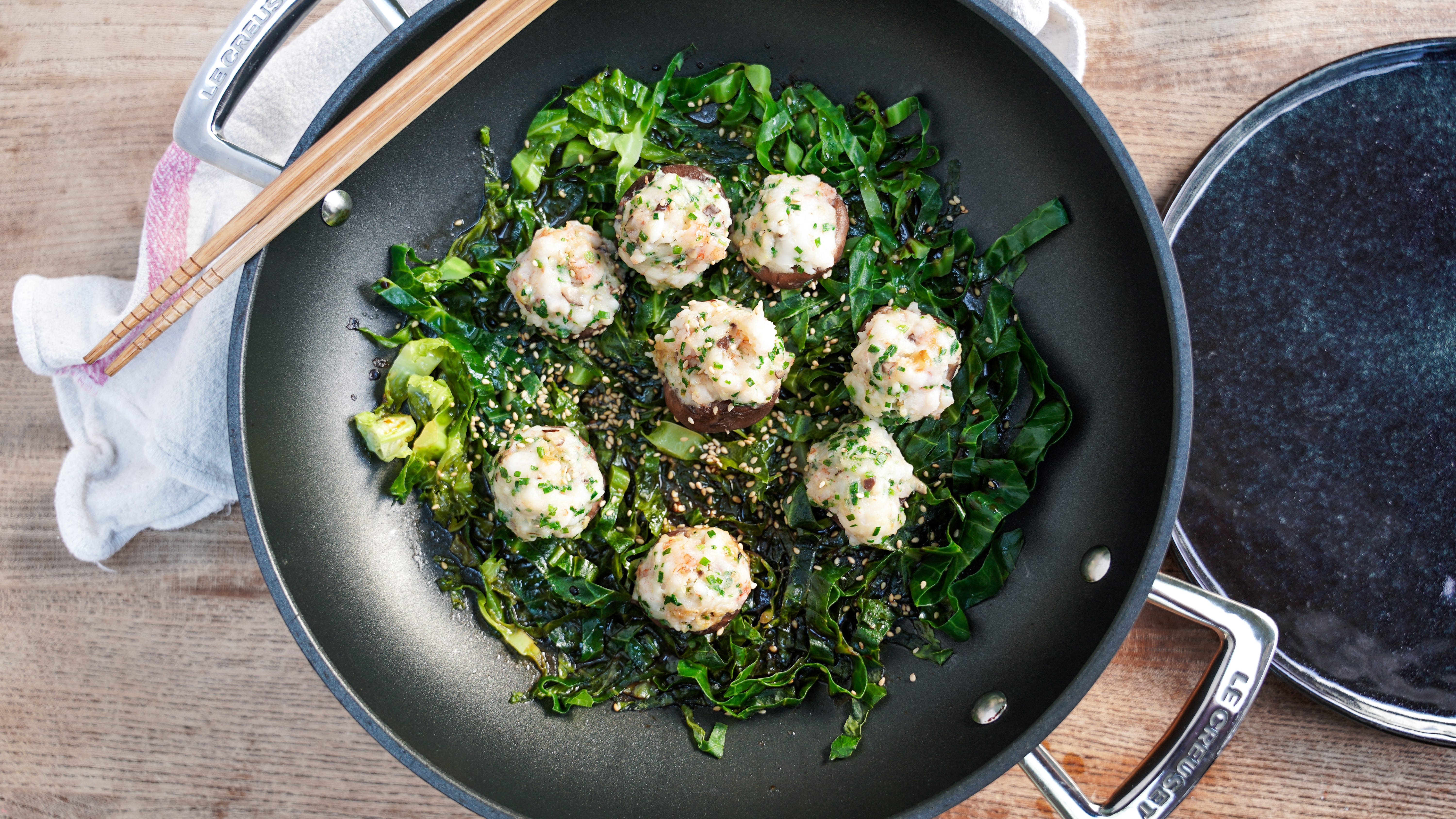
The idea started with ebi shumai. Those small, neat steamed prawn dumplings, soft wrapper, juicy filling, a little dab of karashi mustard on the side, are one of my favourite things to eat in Japan. There’s a lightness to them that I find hard to resist. But I’m gluten-free, and shumai wrappers are made with wheat flour, so for a long time I just went without.
Then it occurred to me: the mushroom cap is doing exactly the same structural job as the pastry. It holds the filling, it steams beautifully, and it adds something a wrapper never could, because shiitake has its own deep, savoury character that works with the prawn rather than simply containing it. Once I’d made that connection, this recipe came together quickly. It’s now one of the dishes I make most often.
A little background on shumai. The dish arrived in Japan via China, where it’s called shaomai and has been eaten for centuries, most famously as part of dim sum. Japanese cooks adapted it, as they tend to do with most things they borrow, by making it cleaner, lighter and more precisely seasoned. The classic Japanese version uses prawn or pork, a thin wheat wrapper pleated into a small open cup, and is steamed briefly so the filling stays just-cooked and tender. In Yokohama, which has one of Japan’s oldest and most celebrated Chinatowns, shumai is practically an institution. The city’s Kiyoken brand has been selling its cold shumai, designed to be eaten at room temperature and packed into bento boxes, since 1928. People bring them home from trips to Yokohama the way others bring back regional sweets or sake. It’s that kind of dish: much loved, particular, tied to a place.
I grew up eating shumai as a treat, they appeared at weekends or family gatherings alongside other small steamed dishes. The pleasure is partly in the ratio: just enough wrapper to hold the filling together, no more. When you remove the wrapper and use a mushroom cap instead, you lose the slight chew of the pastry but you gain a more direct version of the same idea, with the mushroom taking oin the role of the wrapper.

I teach Japanese cooking every month, online and in person in London. Here are the next dates if you’d like to come:
Healthy Japanese Cooking Class Eat healthily the Japanese way, with unique, easy-to-make recipes. £35 · 1.5 hours · Online · Monday 8th June, 19:00 (UK) Book your place
Japanese Home Cooking: Ichiju Sansai Simple Japanese techniques, with recipes for delicious home cooking. £105 · 3 hours · Yuki’s Kitchen, Crystal Palace, SE London · Wednesday 10th June, 18:30 (UK) Book your place
Sushi: Let’s Roll! Yuki’s signature class, a fantastic introduction to sushi rolling. £105 · 3 hours · Yuki’s Kitchen, Crystal Palace, SE London · Saturday 27th June, 10:30 (UK) Book your place
Now. Fresh shiitake are non-negotiable here, and I want to be clear about that. Dried shiitake are wonderful for dashi and for dishes where they rehydrate slowly during long cooking, but for this recipe they will not hold the filling and the texture will be wrong.
Don’t try it.
Look for fresh caps that are firm, domed and as meaty as possible. They need to be substantial enough to carry a generous spoonful of paste without collapsing during steaming. In Japan, fresh shiitake are graded by the thickness and curvature of the cap. The best ones, called donko, are thick, tightly curled at the edges and almost spherical. Those are the ones to look for if your lucky enough to have a choice. In London I find the best fresh shiitake at Japanese grocers and larger Asian supermarkets. Standard supermarket shiitake tend to be thinner and flatter. They’ll work, but the meatier varieties give noticeably better results and are worth seeking out.
What makes shiitake genuinely remarkable as an ingredient, beyond its texture, is its flavour chemistry. It contains some of the highest concentrations of free glutamates of any mushroom, and glutamates are the naturally occurring compounds responsible for umami, that savoury depth that makes you want to keep eating without being able to explain exactly why. This is why shiitake has been used in Japanese cooking for centuries not just as a vegetable but as a flavour amplifier, the thing that makes everything around it taste more of itself.
When you steam shiitake with sake, as in this receipe, the alcohol in the sake acts as a solvent, drawing out and lifting those glutamate compounds further into the cooking liquid and back into the mushroom flesh. The result is a mushroom that tastes significantly more of itself than one simply fried or roasted. This is not a subtle difference. The first time I made this dish I was surprised by how much depth came out of six minutes of steaming. It is one of those moments where understanding the science makes you a better cook, because once you know why it works, you know not to skip the sake or rush the lid off too early.
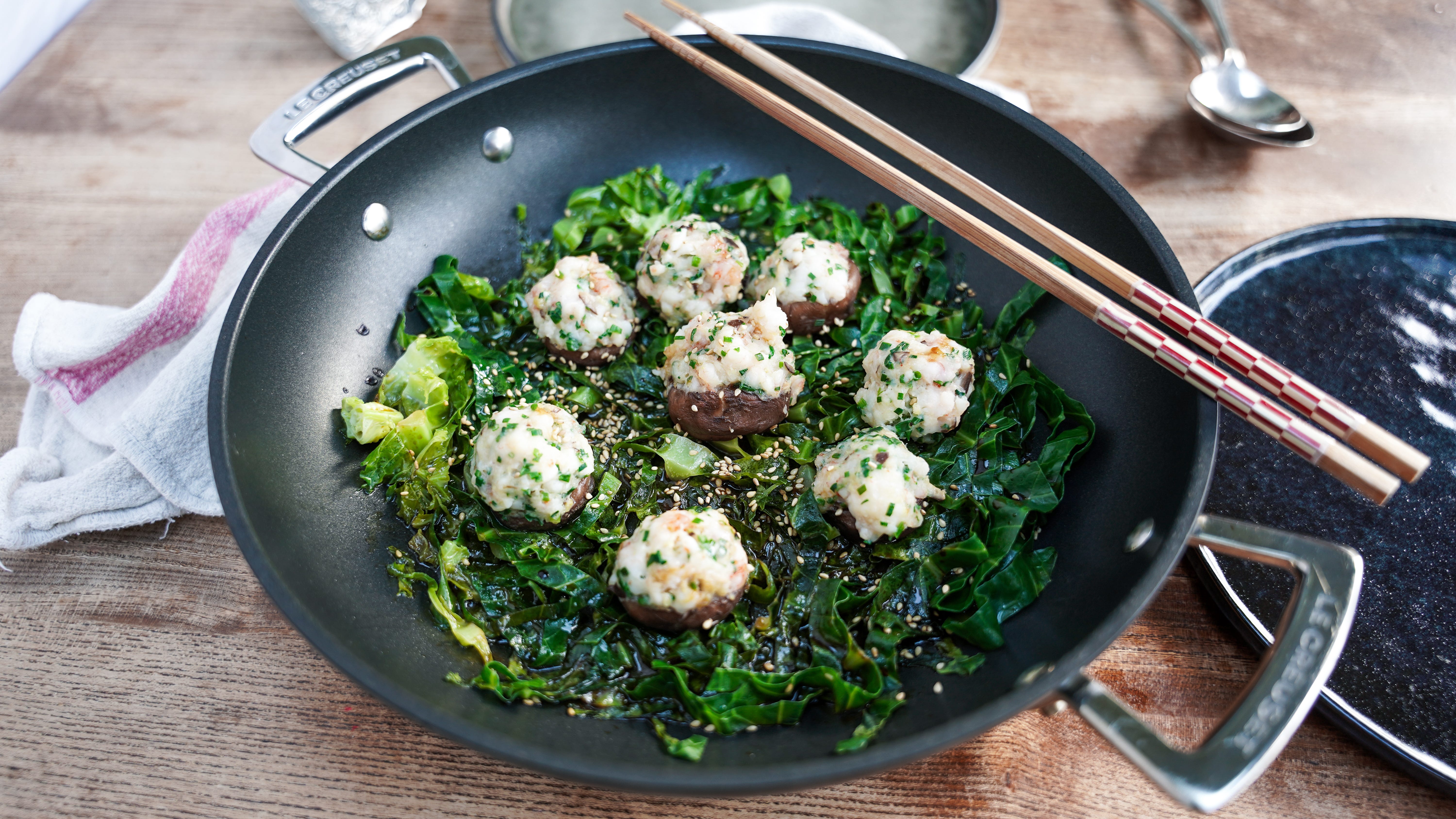
The cross cut into each cap matters too, for the same reason. It is not just decorative. Cut carefully, just deep enough to score the flesh without going all the way through, and the cuts will open as the mushroom steams and relaxes, letting the cooking liquid soak into the flesh rather than simply running off the surface. Use a sharp knife and take a moment to do it properly. Trust me. The difference in flavour between a scored and unscored cap in this recipe is real and worth the extra thirty seconds.
The filling is simple but the details matter. Fresh prawns, chopped finely into a paste, mixed with grated ginger, chives, cornstarch, sake, sesame oil and a small measure of soy sauce. The cornstarch is doing quiet but important work. It binds the paste so it holds its shape on top of the mushroom during steaming, and it gives the finished filling a slightly silky, bouncy texture that is very close to what you find inside a proper shumai. Without it, the paste can turn grainy and loose during cooking. Do not leave it out.
Chop the prawns finely, more finely than you think necessary. The paste should be cohesive enough to mound on the mushroom without falling apart when you press it gently into place. If you chop too roughly, the filling will be crumbly and won’t hold. Spend an extra minute with the knife and you’ll notice the difference immediately.
I often use prawns straight from the freezer, defrosted quickly under cold running water, and they work very well. There is something genuinely useful about keeping a bag in the freezer and knowing this dish is always twenty minutes away. That said, if you have very fresh prawns, bought that day from a good fishmonger, the flavour will be sweeter and the texture more delicate. Both versions are good. The frozen prawn version is the one I make without thinking twice on a weeknight.
One thing I do instinctively: the offcuts from scoring the shiitake caps go straight into the prawn paste. It would feel wrong to discard them. They carry flavour, they add texture, and it takes five seconds to chop them in. In Japanese cooking there is a word, mottainai, that roughly translates as “what a waste” and expresses regret at discarding something that still has value. I grew up with this instinct before I knew the word for it, but the word describes the instinct exactly. A good kitchen wastes almost nothing, not because of rules, but because the scraps usually have something left to give.
The greens underneath the mushrooms are not padding. They sit in the steaming liquid and absorb everything that drips down from the mushrooms during cooking, the sake, the sesame, the prawn juices, the glutamates leaching out of the shiitake. By the time the mushrooms are done, the greens have become genuinely worth eating. I use spring greens, but cabbage works well, kale too, even broccoli stems sliced lengthways. Use what you have. The point is that nothing in the pan is wasted, and the greens that emerge from six minutes of steaming with sake and sesame are better than they have any right to be.
"Once you understand why sake makes everything taste better, you'll find yourself reaching for it constantly. It isn't just alcohol. Sake contains amino acids, including glutamates, that deepen savouriness, and its natural sweetness rounds out sharper flavours without you ever noticing it's there. Japanese cooks have known this for centuries. It is in almost every savoury dish for a reason."
A word on steaming, because I think it is consistently underestimated as a method. The absence of sizzle makes it feel less dramatic than frying, but the results are often more flavourful than you migh expect. The prawn stays tender rather than tight, the mushroom retains its juices, and the aromatics, ginger, sake, sesame, stay bright and clean rather than cooking off into the pan. It is also one of the healthiest ways to cook. No excess oil, no aggressive direct heat, very little loss of nutrients to the cooking process.
The one thing you must get right: the lid. It needs to fit properly. A gap lets the steam escape and the mushrooms will cook unevenly and take longer. Check before you start. If your lid is loose, a sheet of foil pressed firmly over the pan will do the job.
I made these for a girls’ night recently and they disappeared fast. We had them as a starter with cold sake and they were exactly right for the occasion, light enough not to sit heavily before the rest of the meal, interesting enough that more than one person asked what was in the filling.
They are just as good on a school night with a bowl of rice and nothing else.
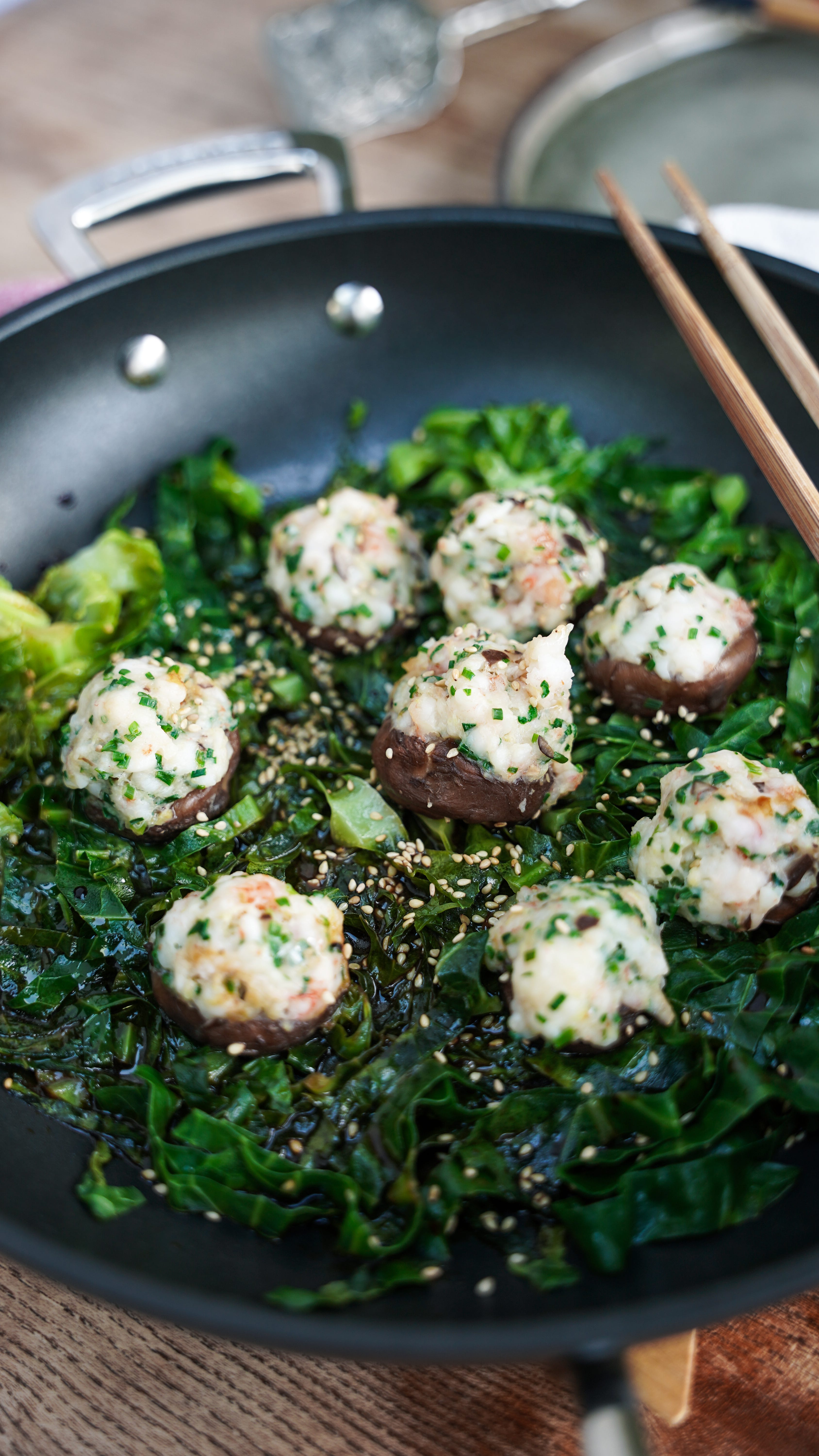
Serves 2
Comments
Nothing yet. Say the first thing.
Sign in to join the conversation.