
*Editor’s note: This article was originally published on 7/22/2026 on LinkedIn.
Welcome to issue 211 of Japan Climate Curation! 📬 I’m Hiroyasu Ichikawa (ichi), curating Japan’s climate news weekly since 2022 for 550+ subscribers on this Substack & [3,210+ on LinkedIn].
🎧 Audio versions available: English 🇺🇸 | Japanese 🇯🇵
Found this valuable? A quick like or share helps others stay informed. 🙂
Haven't checked the Climate Curation newsletter yet? It's in Japanese, but the headlines covering the global climate and energy news you shouldn't miss are easy to skim — and there's an English audio summary if you'd rather listen.🎧

Hiroyasu Ichikawa/市川裕康@SocialCompany
#ClimateCuration vol.217 / 今週のテーマは「地球が熱を逃がせなくなった夏」。The Economistが指摘するグローバルディミング、欧州ETSの緩和、企業の脱炭素予算のAI流出——逆風が続く一方、オーストラリアの蓄電池ブームと日本の変電所整備など、盛り沢山でした🙂 climatecuration.theletter.jp/posts/ed58dd63…

4:27 AM · Jul 18, 2026 · 177 Views
1 Repost · 1 Like
Disclaimer: Generative AI tools (Claude, ChatGPT, Gemini Notebook) have been used for summary and translation assistance. 🙂
[🇯🇵📰👀Japan Climate News Headlines]
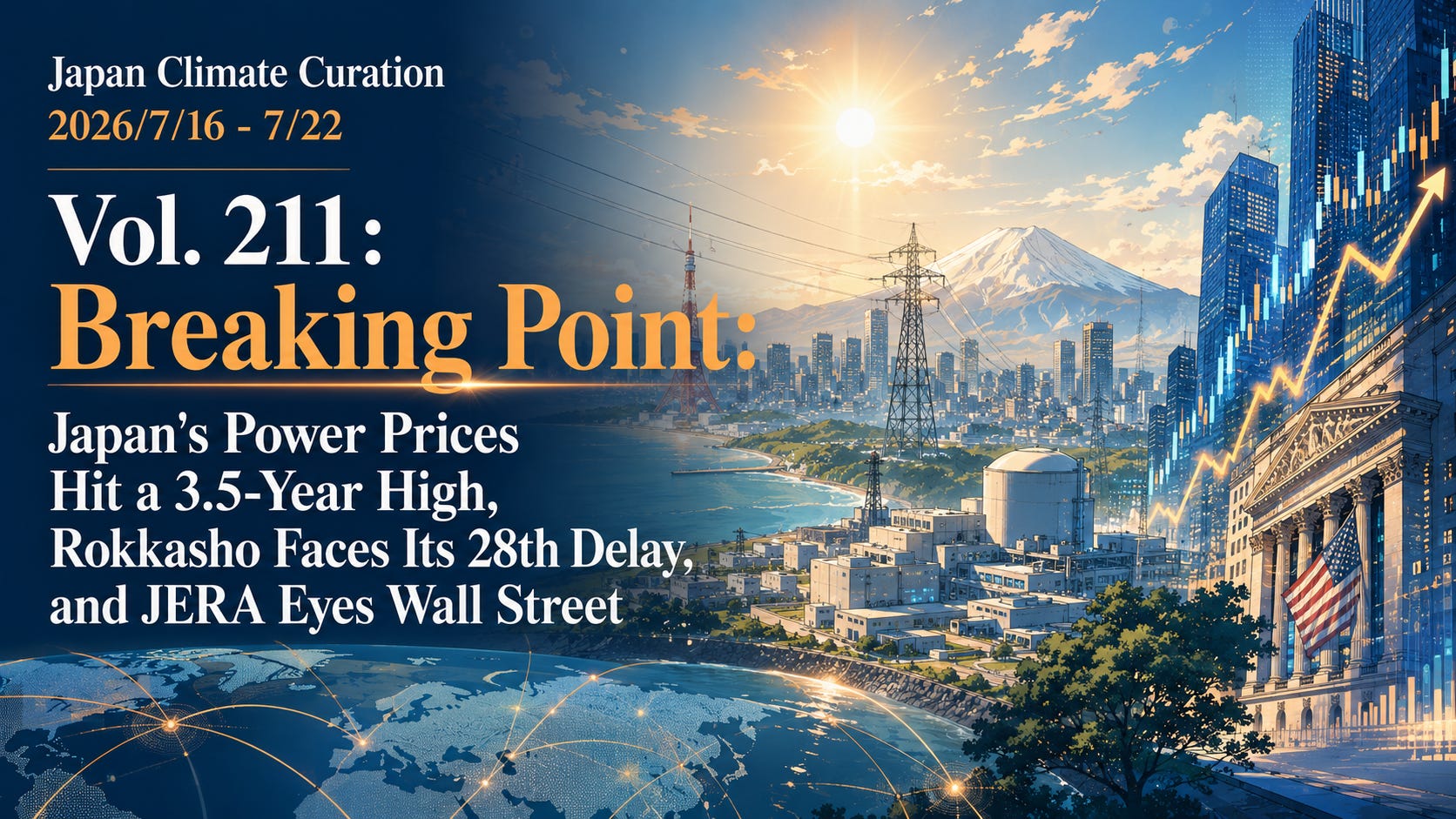
⚡ Japan’s Spot Power Price Hits 3.5-Year High as Heat, Yen Weakness and LNG Costs Deliver Triple Blow [7/22 Bloomberg]
☢️ Japan’s Rokkasho Reprocessing Plant Faces 28th Delay as Regulators Demand Pre-Completion Waste Treatment [7/17 Nikkei Asia]
⛽ Inpex Breaks Ground on $21 Billion Abadi LNG Project in Indonesia, Targeting 9.5 Million Tonnes by 2030 [7/16 Nikkei Asia]
⛽ Japan’s JOGMEC Weighs Stake Sales in Asia-Pacific LNG Projects as Demand Growth Reshapes Portfolio Strategy [7/16 Bloomberg]
🏦 JERA Explores US Stock Listing to Fund Global Expansion and Attract International Investors [7/17 Reuters]
📊 GX-ETS Enters Mandatory Phase but Benchmark Transparency Gap Undermines Credibility [7/22 Climate Integrate]
🏭 EU’s Green Steel Framework Sets New Market Access Rules — And Japan’s Steel Industry Must Adapt [7/17 Renewable Energy Institute]
🔋 Sumitomo Chemical to Mass-Produce Halide-Based Solid-State Battery Electrolyte by FY2028, Targeting EV Cost Parity [7/21 Nikkei Asia]
✈️ Mitsubishi Corp Teams Up With ADM to Develop Soy and Corn-Based Sustainable Aviation Fuel [7/20 Nikkei Asia]
😴 Japan’s Summers Are Stealing Sleep: Climate Change Costs Urban Residents Up to 50 Hours a Year [7/19 The Japan Times]
【1】⚡ Japan’s Spot Power Price Hits 3.5-Year High as Heat, Yen Weakness and LNG Costs Deliver Triple Blow [7/22 Bloomberg]
Japan’s day-ahead spot electricity price hit ¥24.78/kWh on July 22 — the highest since January 2023, up 24% week-on-week — as a triple shock converged: record heat pushing 40°C across Kanto, Chubu, and Kansai; Japan-Korea Marker LNG spot prices at $21.61/MMBtu (highest since late March); and the yen sliding past 163 per dollar to a four-decade low, amplifying imported fuel costs. Abnormal heat is forecast to return across both Kanto and Kansai from late next week into early August.
💡 Insight:
The yen at a four-decade low is now an active amplifier of Japan’s energy crisis — converting LNG price shocks into even larger yen-denominated import bills and creating a feedback loop between currency weakness and electricity costs that monetary policy cannot easily break.
The ¥24.78/kWh price — 24% above last week and the highest since January 2023 — is approaching the level that triggered emergency government intervention during the 2022–23 energy crisis, making a policy response increasingly likely.
【2】☢️ Japan’s Rokkasho Reprocessing Plant Faces 28th Delay as Regulators Demand Pre-Completion Waste Treatment [7/17 Nikkei Asia]
Japan Nuclear Fuel Ltd.’s Rokkasho reprocessing plant — already delayed 27 times — faces a potential 28th postponement after regulators demanded pre-completion treatment of high-level liquid radioactive waste accumulated since 2006 active testing. NRA Chairman Yamanaka called the liquid waste “high risk.” JNFL will submit a revised construction plan in 3–4 months. The delay has stalled Aomori’s emergency evacuation planning and prompted the governor to demand a new completion schedule.
💡 Insight:
The NRA’s demand for pre-completion liquid waste treatment is a new technical requirement that was not part of the original regulatory framework — and it signals that Japan’s nuclear regulator is willing to add scope to already-delayed projects rather than accept residual risk.
Rokkasho’s indefinite delay directly threatens the operational continuity of every nuclear reactor in Japan, not just the fuel cycle strategy.
【3】⛽ Inpex Breaks Ground on $21 Billion Abadi LNG Project in Indonesia, Targeting 9.5 Million Tonnes by 2030 [7/16 Nikkei Asia]
Inpex broke ground on the $20.9 billion Abadi LNG project in Indonesia’s Maluku province on July 16, targeting 9.5 million tonnes/year of LNG production by 2030. Inpex holds 65%, with Pertamina (20%) and Petronas (15%). The project — discovered in 2000 but repeatedly delayed — will become Indonesia’s second-largest LNG facility. Indonesia is pressing for a 2029 start; Inpex CEO Ueda acknowledged “a lot of pressure from the government” to accelerate.
💡 Insight:
Abadi’s 9.5 million tonne/year capacity makes it a material non-Hormuz LNG supply source for Japan at precisely the moment when the Hormuz crisis has made supply route diversification a national security imperative.
Indonesia’s political pressure on the 2029 timeline — including a permit revocation threat — introduces a new category of project risk that Inpex has not faced at comparable scale since the Ichthys LNG project in Australia.
【4】⛽ Japan’s JOGMEC Weighs Stake Sales in Asia-Pacific LNG Projects as Demand Growth Reshapes Portfolio Strategy [7/16 Bloomberg]
Japan’s state energy agency JOGMEC has invited bids for asset valuation services related to potential stake sales in LNG projects across Asia and Oceania, Bloomberg reports. Specific projects were not identified, but JOGMEC holds stakes in Australia’s Wheatstone LNG and Indonesia’s Tangguh LNG. The move aligns with JOGMEC’s mandate to provide early-stage financing for high-risk projects before transferring stakes to Japanese companies or selling to local investors once commercially viable.
💡 Insight:
JOGMEC’s potential divestment from mature LNG projects signals a strategic portfolio rebalancing — freeing capital for higher-risk early-stage projects that commercial Japanese companies cannot yet justify, at a moment when the Hormuz crisis has elevated LNG supply security to a national priority.
The explicit mention of “local investors” as potential buyers for Asia-Pacific LNG stakes is a geopolitically significant detail that reflects Japan’s broader energy diplomacy strategy.
【5】🏦 JERA Explores US Stock Listing to Fund Global Expansion and Attract International Investors [7/17 Reuters]
JERA — Japan’s largest power generator with ¥3 trillion in annual revenue and 59GW of domestic capacity — has begun a feasibility study for a US listing, Reuters reports exclusively. The unlisted company, owned by TEPCO and Chubu Electric, is examining US market conditions, investor demand, and regulatory requirements. No decisions on timing, structure, or valuation have been made. The move reflects growing overseas institutional investor demand and JERA’s accelerating international expansion.
💡 Insight:
A JERA US listing would be the most significant Japanese energy company capital markets event in decades — and it would reframe JERA from a domestic utility into a globally investable energy infrastructure platform.
JERA’s US listing consideration is part of a broader structural shift in how Japanese companies access global capital — and it signals that Tokyo’s capital markets are no longer sufficient for companies with genuinely global operations.
【6】📊 GX-ETS Enters Mandatory Phase but Benchmark Transparency Gap Undermines Credibility [7/22 Climate Integrate]
Japan’s GX-ETS entered its mandatory phase in April 2026, covering 300–400 companies with Transition Plan submissions due September 30. Climate Integrate finds that benchmark-based allowance allocation in the power and steel sectors cannot be meaningfully verified from public data: JERA, J-POWER, Nippon Steel, and JFE Steel all lack publicly available benchmark-relevant data. Allocation amounts are notified to companies but not publicly disclosed — limiting external assessment of whether the system incentivizes real emissions reductions.
💡 Insight:
GX-ETS entering its mandatory phase is a milestone — but the transparency gap identified here means it cannot yet function as a credible price signal for corporate decarbonization investment.
The disclosure gap in GX-ETS is structurally similar to the early years of the EU ETS — and the EU’s experience shows that transparency failures in the allocation phase create windfall profits for incumbents and undermine the system’s emissions reduction credibility for years.
【7】🏭 EU’s Green Steel Framework Sets New Market Access Rules — And Japan’s Steel Industry Must Adapt [7/17 Renewable Energy Institute]
The EU’s Ecodesign for Sustainable Products Regulation (ESPR) will classify steel products A–E by carbon footprint, with the Industrial Accelerator Act (March 2026) giving preferential public procurement access to lower-emission materials. Japan’s steel industry faces both challenge and opportunity: measuring actual product emissions is essential for CBAM compliance and market access, while large-scale electric arc furnace steel could qualify as “low-CFP steel” if properly certified.
💡 Insight:
The EU’s A–E carbon footprint classification for steel is not just a compliance exercise — it is a market access gate that will determine which Japanese steel products can compete for European public contracts and subsidy-backed projects.
Japan’s large-scale electric arc furnace transition — a key pillar of its GX steel strategy — could become a significant competitive advantage in Europe if properly certified, but the window to shape the classification rules is closing.
【8】🔋 Sumitomo Chemical to Mass-Produce Halide-Based Solid-State Battery Electrolyte by FY2028, Targeting EV Cost Parity [7/21 Nikkei Asia] ]
Sumitomo Chemical plans to mass-produce a halide-based solid-state battery electrolyte by FY2028, developed with Kyoto and Tottori universities. The material matches sulfide-based electrolyte ionic conductivity — critical for charge/discharge speed — while eliminating the need for strict humidity controls and enabling use of existing lithium-ion battery production equipment. Japan’s solid-state battery supply chain is accelerating: Idemitsu, Nissan, Suzuki, and Sumitomo Metal Mining all target 2027–2028 commercialization.
💡 Insight:
Halide-based electrolytes eliminating the need for humidity-controlled manufacturing environments is the cost breakthrough that solid-state battery commercialization has been waiting for.
Japan’s solid-state battery supply chain is converging on a 2027–2028 commercialization window across multiple companies simultaneously — creating a structural advantage that China’s current battery dominance has not yet replicated at scale.
【9】✈️ Mitsubishi Corp Teams Up With ADM to Develop Soy and Corn-Based Sustainable Aviation Fuel [7/20 Nikkei Asia]
Mitsubishi Corp will explore soybean and corn-based SAF production with ADM — the world’s second-largest grain company — covering the full value chain from grain procurement to oil extraction and fuel production. Mitsubishi’s US subsidiary Agrex may participate. IATA projects SAF demand to surge from 2.4 million tonnes in 2026 to 500 million tonnes by 2050. The EU mandated a 2% SAF blend from 2025, rising to 70% by 2050, creating structural demand growth.
💡 Insight:
Mitsubishi’s grain-to-SAF vertical integration strategy positions Japan’s largest trading house at the intersection of global food supply chains and aviation decarbonization — a combination that no pure-play energy company can replicate.
The 2050 SAF demand projection of 500 million tonnes — versus 2.4 million tonnes in 2026 — represents a 200x market expansion that will require agricultural commodity supply chains to be fundamentally repurposed at scale.
【10】😴 Japan’s Summers Are Stealing Sleep: Climate Change Costs Urban Residents Up to 50 Hours a Year [7/19 The Japan Times]
Climate Central analysis finds Japan’s urban residents lost 34–50 hours of sleep annually from 2020–2025 due to high temperatures, with 9–14% attributable to climate change. A University of Tokyo study found 40% of Nagoya residents experience sleep disorders when nighttime lows hit 30°C, with health burden comparable to heatstroke hospitalizations. With energy prices rising, 70% of surveyed Japanese say they have avoided using AC for economic reasons, compounding the health risk.
💡 Insight:
The convergence of climate-driven sleep loss and energy price-driven AC avoidance creates a compounding productivity and public health crisis that will affect Japan’s labor market well beyond the construction and outdoor sectors already tracked in heatstroke statistics.
The 9–14% of sleep loss attributable to climate change — not total heat exposure — quantifies a specific liability that decarbonization policy can address, and it is growing.
📬 That’s a wrap for this week! Thank you for reading.
Found this useful? A quick like, comment, or share on LinkedIn helps more people discover Japan’s climate developments. 🙏
📩 Stay connected:
🇯🇵 Japanese edition: [Climate Curation](LinkedIn / theLetter link) — every Saturday
🐦 X (Japanese): @SocialCompany
🦋 Bluesky (English): socialcompany.bsky.social
💼 Work with me: Looking for research, consulting, or market insights on Japan’s climate/energy sector? Let’s talk. 📧 hiroyasu.ichikawa[@]socialcompany.org | ☕ Coffee chats welcome!
Comments
Nothing yet. Say the first thing.
Sign in to join the conversation.