
*Editor’s note: This article was originally published on 7/9/2026 on LinkedIn.
Welcome to issue 209 of Japan Climate Curation! 📬 I’m Hiroyasu Ichikawa (ichi), curating Japan’s climate news weekly since 2022 for 550+ subscribers on this Substack & [3,200+ on LinkedIn].
🎧 Audio versions available: English 🇺🇸 | Japanese 🇯🇵
Found this valuable? A quick like or share helps others stay informed. 🙂
Haven't checked the Climate Curation newsletter yet? It's in Japanese, but the headlines covering the global climate and energy news you shouldn't miss are easy to skim — and there's an English audio summary if you'd rather listen.🎧 Here's the latest audio episode in English — give it a listen!

Hiroyasu Ichikawa/市川裕康@SocialCompany
#ClimateCuration vol.215 /今週のテーマは「AI時代の代償」。米国の化石燃料発電投資が数十年ぶりに中国を逆転し、2025年の世界のCO2増加の約36%を米国が占めたという分析に注目。AIデータセンターの膨大な電力需要が、脱炭素の流れを静かに巻き戻しているようです。 climatecuration.theletter.jp/posts/700c0d82…

4:47 AM · Jul 4, 2026 · 199 Views
1 Repost · 2 Likes
Disclaimer: Generative AI tools (Claude, ChatGPT, NotebookLM) have been used for summary and translation assistance. 🙂
[🇯🇵📰👀Japan Climate News Headlines]
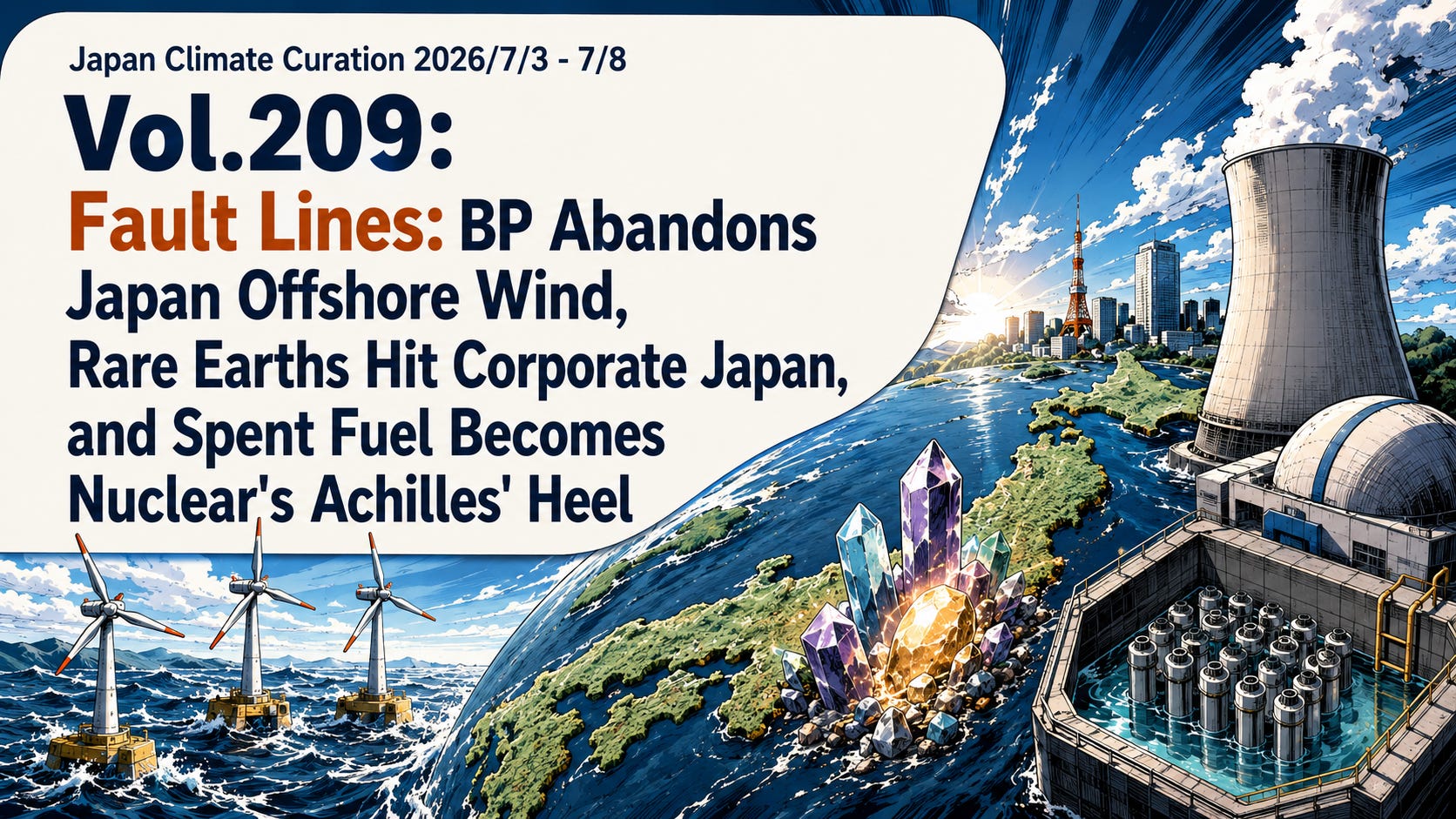
🌊 BP Weighs Exit From Marubeni-Led Offshore Wind Consortium in Yamagata, Japan [7/5 Nikkei Asia]
🧲 China’s Rare-Earth Embargo Spreads Through Japan’s Corporate Supply Chains as Warnings Mount [7/7 Reuters]
⚛️ South Korea, US and Japan Sign SMR Cooperation Agreement at NATO Summit [7/8 Reuters]
☢️ Spent Fuel Crisis Threatens Japan’s Nuclear Revival as Rokkasho Faces 28th Delay [7/7 Nikkei Asia]
🏭 Japan Shifts From Gas to Coal as Hormuz Disruption Squeezes LNG Supply [7/7 Bloomberg]
⛽ Inpex Signs 15-Year Deal With ADNOC for 1 Million Tonnes of UAE LNG From Ruwais Project [7/8 Bloomberg]
🚗 Japan’s EV Subsidies Push New Nissan to $3,450 — Cheaper Than Used, Triggering Market Distortion Risks [7/7 Nikkei Asia]
🌿 Mitsubishi Corp Leads 80-Company CDR Coalition, Targeting GX-ETS Integration by FY2026 [7/7 Nikkei GX]
⚗️ IEEFA: Japan’s Ammonia Co-Firing Strategy Faces Cost, Supply, and Timing Constraints That Renewables Don’t [7/3 IEEFA]
⚙️ Hydrogen Combustion Engines Gain Ground as Lower-Cost Alternative to Fuel Cells in Japan [7/4 Nikkei Asia]
【1】🌊 BP Weighs Exit From Marubeni-Led Offshore Wind Consortium in Yamagata, Japan [7/5 Nikkei Asia]
BP is considering withdrawing from the Marubeni-led offshore wind consortium off Yuza, Yamagata Prefecture — a Round 3 project awarded December 2024, targeting operations by June 2030. BP holds ~25% of the SPC; remaining partners will absorb its stake. The exit stems from difficulties integrating the pre-JV asset into JERA Nex bp. This would mark the first withdrawal from Japan’s six remaining awarded offshore wind zones, following Mitsubishi Corp’s three-zone exit and Equinor’s full Japan departure.
💡 Insight:
BP’s potential exit from an already-awarded zone crosses a threshold that Equinor’s departure did not: this is not a company leaving before winning a bid, but withdrawing from a project that was contracted, planned, and scheduled for 2030 operations.
The JERA Nex bp integration failure as the proximate cause of BP’s exit is a warning for the entire offshore wind M&A and partnership market in Japan — corporate integration timelines and project timelines can conflict in ways that force divestiture regardless of project fundamentals.
【2】🧲 China’s Rare-Earth Embargo Spreads Through Japan’s Corporate Supply Chains as Warnings Mount [7/7 Reuters]
A shortage of critical minerals is starting to affect the broader Japanese economy, with Tokyo Stock Exchange filings mentioning rare earths doubling in May–June versus historical norms. Over two-thirds of ~200 recent filings cite negative or potential negative impact. Chinese customs data shows zero exports of terbium and dysprosium oxide to Japan from November through May. Mizuho warns the impact could exceed the 2010 episode given AI and EV supply chain depth.
💡 Insight:
The doubling of rare-earth risk disclosures in Tokyo Stock Exchange filings is the most actionable data point for investors: it signals that supply chain stress is moving from procurement teams to board-level financial risk reporting.
Japan’s alternative supply timeline mismatch is the structural vulnerability that China is exploiting — G7 stockpile coordination, US joint development, and deep-sea mining are real initiatives, but none will deliver material supply within the 12–18 month window that corporate Japan is now facing.
【3】⚛️ South Korea, US and Japan Sign SMR Cooperation Agreement at NATO Summit to Counter Chinese Nuclear Exports [7/8 Reuters]
The foreign ministers of South Korea, Japan and the US signed an SMR cooperation memorandum on the sidelines of the NATO Ankara summit on July 7. Foreign ministers Cho, Rubio, and Motegi agreed to jointly provide competitive energy options in the Asia-Pacific and beyond. The trilateral deal positions the three allies as a coordinated counterweight to Chinese and Russian dominance in nuclear reactor exports globally.
💡 Insight:
The NATO venue is the most significant signal in this story: SMR deployment is now formally embedded in alliance security architecture, not just energy policy.
Japan’s simultaneous $62 billion+ US SMR investment and this third-country deployment agreement position Japan at the center of a two-track nuclear strategy: capital provider domestically and technology exporter internationally.
【4】☢️ Spent Fuel Crisis Threatens Japan’s Nuclear Revival as Rokkasho Faces 28th Delay and Kansai Electric Turns to France [7/7 Nikkei Asia]
Kansai Electric’s spent fuel pools have reached 89% capacity and will fill in 2–3 years, forcing the company to ship 400 tonnes to France’s La Hague plant from FY2027. Japan’s only domestic reprocessing facility at Rokkasho, originally due in 1997, has been delayed 27 times and only just completed its regulatory submission in June. TEPCO’s pools are at 80%, and Aomori’s governor has blocked further transfers to the interim storage facility, citing Rokkasho uncertainty.
💡 Insight:
The La Hague solution is a temporary pressure valve, not a structural fix — and it exposes the degree to which Japan’s nuclear expansion is contingent on a single facility that has missed its completion deadline 27 times.
The Aomori governor’s refusal to accept TEPCO fuel transfers introduces a new local governance risk into Japan’s nuclear fuel cycle that has received almost no attention in international media.
【5】🏭 Japan Shifts From Gas to Coal as Hormuz Disruption Squeezes LNG Supply and Pushes Prices 70% Higher [7/7 Bloomberg]
Japan cut gas-fired power generation by 16% year-on-year in June, increasing coal output by 4.6%, as Hormuz disruption tightened LNG supply and pushed Asian spot prices ~70% above pre-war levels. Japan’s LNG imports fell ~7% from March to June versus the same period last year. The shift highlights how the Middle East conflict — choking ~20% of global LNG exports — is pushing Asian buyers back toward coal as a near-term substitute.
💡 Insight:
Japan’s coal comeback is not a policy choice — it is a price-driven emergency response that directly contradicts its decarbonization commitments, and the longer Hormuz remains disrupted, the harder it will be to reverse.
The 70% LNG price premium over pre-war levels is the financial mechanism that makes coal economically rational for Japanese utilities — and it will persist as long as Qatar’s revival falters.
【6】⛽ Inpex Signs 15-Year Deal With ADNOC for 1 Million Tonnes of UAE LNG From Ruwais Project [7/8 Bloomberg]
Inpex has signed a 15-year deal with ADNOC to purchase ~1 million tonnes per year of LNG from the Ruwais project, starting 2028. Japan currently imports less than 700,000 tonnes/year from the UAE — about 1% of total imports — making this a significant supply diversification. The deal comes as Hormuz uncertainty has risen again following a missile strike on a Qatari LNG tanker on July 7, underscoring Japan’s urgency to secure non-Hormuz-exposed supply.
💡 Insight:
The Ruwais deal is Japan’s most concrete post-Hormuz supply diversification move to date — but it solves the wrong problem if Hormuz remains contested.
Ruwais being 90% committed before commercial operations begin in 2028 signals that global LNG buyers are in a race to lock in non-Hormuz supply — and Japan’s window to secure additional volumes is closing.
【7】🚗 Japan’s EV Subsidies Push New Nissan to $3,450 — Cheaper Than Used, Triggering Demand Surge and Market Distortion Risks [7/7 Nikkei Asia]
Japan’s combined central and Tokyo government EV subsidies have pushed the effective price of a new Nissan Sakura to ¥560,000 ($3,450) — below the average used-car price of ¥1.51 million. EV sales nearly tripled year-on-year in Q2 to 32,378 units, exceeding 3% of new car sales for the first time. However, subsidy-driven demand risks depressing the used EV market, accelerating used-car exports, and creating a demand cliff if subsidies end.
💡 Insight:
Japan’s EV demand tripling in a single quarter on the back of subsidies is a policy success story and a structural warning simultaneously.
The inversion of new versus used EV prices is creating a critical minerals recycling problem hiding inside an EV success story — pushing used EVs toward export rather than domestic reuse and undermining Japan’s battery materials recycling strategy.
【8】🌿 Mitsubishi Corp Leads 80-Company CDR Coalition, Targeting GX-ETS Integration and Government Policy by FY2026 [7/7 Nikkei GX]
Mitsubishi Corp leads an 80-company Japan CDR Council — including all seven major trading houses — targeting domestic market creation for carbon dioxide removal. Japan’s 2050 net-zero scenario requires offsetting 50–240 million tonnes/year of residual emissions via CDR. Technical CDR credits currently cost $200+/tonne versus $3–20 for reduction credits, creating a buyer deadlock. The council aims to submit policy proposals by FY2026, including CDR integration into Japan’s GX-ETS framework.
💡 Insight:
All seven of Japan’s major trading houses joining a CDR council is an unprecedented act of pre-competitive cooperation — and it signals that the industry views CDR market infrastructure as a public good that no single company can create alone.
The GX-ETS integration discussion is the policy lever that could transform CDR from a niche corporate commitment into a compliance-driven market in Japan.
【9】⚗️ IEEFA: Japan’s Ammonia Co-Firing Strategy Faces Cost, Supply, and Timing Constraints That Renewables Don’t [7/3 IEEFA]
Note: IEEFA advocates for renewable energy and is critical of fossil fuel transition pathways.
IEEFA finds blue ammonia co-firing is projected to cost 145–220% more than onshore wind and 240–464% more than solar by 2040. The Blue Point Complex — JERA’s primary US supply source — has seen capex nearly double from $2 billion to $4 billion since 2022. RE100’s exclusion of ammonia co-firing from renewable claims from 2027 threatens corporate demand, affecting 90+ Japan-headquartered firms.
💡 Insight:
RE100’s 2027 exclusion of ammonia co-firing from renewable electricity claims is the commercial demand shock that Japan’s ammonia strategy has not yet priced in.
The Blue Point Complex cost escalation from $2 billion to $4 billion is a leading indicator for the entire blue ammonia import strategy — and it has not been reflected in Japan’s official LCOE projections.
【10】⚙️ Hydrogen Combustion Engines Gain Ground as Lower-Cost Alternative to Fuel Cells in Japan [7/4 Nikkei Asia]
Hydrogen combustion engines are gaining traction as a lower-cost alternative to fuel cells — with system costs potentially one-tenth of fuel cell equivalents and compatibility with lower-purity hydrogen. Kawasaki Heavy Industries’ O’Cuvoid unit targets hundreds of billions of yen in sales within 10 years. The global hydrogen engine market is forecast to exceed $20 billion in 2036, surpassing the fuel cell market. Toyota, Mitsubishi Fuso, and India’s Tata Motors are all developing hydrogen engine vehicles.
💡 Insight:
The hydrogen engine vs. fuel cell debate is resolving as a segmentation story — and the segmentation favors engines in exactly the markets where Japan’s industrial base is strongest.
The 10x system cost advantage of hydrogen engines over fuel cells changes the economics of Japan’s hydrogen demand creation strategy, dramatically expanding the addressable market and potentially accelerating the cost reduction curve that makes the entire hydrogen economy viable.
📬 That’s a wrap for this week! Thank you for reading.
Found this useful? A quick like, comment, or share on LinkedIn helps more people discover Japan’s climate developments. 🙏
📩 Stay connected:
🇯🇵 Japanese edition: [Climate Curation](LinkedIn / theLetter link) — every Saturday
🐦 X (Japanese): @SocialCompany
🦋 Bluesky (English): socialcompany.bsky.social
💼 Work with me: Looking for research, consulting, or market insights on Japan’s climate/energy sector? Let’s talk. 📧 hiroyasu.ichikawa[@]socialcompany.org | ☕ Coffee chats welcome!
Comments
Nothing yet. Say the first thing.
Sign in to join the conversation.