
*Editor’s note: This article was originally published on 6/18/2026 on LinkedIn.
Welcome to issue 206 of Japan Climate Curation! 📬 I’m Hiroyasu Ichikawa (ichi), curating Japan’s climate news weekly since 2022 for 540+ subscribers on this Substack & [3,190+ on LinkedIn].
🎧 Audio versions available: English 🇺🇸 | Japanese 🇯🇵
Found this valuable? A quick like or share helps others stay informed. 🙂
Haven't checked the Climate Curation newsletter yet? It's in Japanese, but the headlines covering the global climate and energy news you shouldn't miss are easy to skim — and there's an English audio summary if you'd rather listen. 🎧 Here's the latest one — give it a listen!
Disclaimer: Generative AI tools (Claude, ChatGPT, NotebookLM) have been used for summary and translation assistance. 🙂
[🇯🇵📰👀Japan Climate News Headlines]
⚛️ US Taps Japan’s $550 Billion Investment Pledge to Fund Nuclear Revival and SMR Export Push [Nikkei Asia]
☢️ Kashiwazaki-Kariwa’s Restart Exposes Japan’s Nuclear Waste Storage Crisis [AP]
🌊 Japan Rewrites Offshore Wind Auction Rules After Round 1 Collapse [DeepWind / METI]
🧲 Japan Eyes Greenland Rare-Earth Mining to Break China Supply Dependency [Nikkei Asia]
🔋 Japan Eyes Mandatory EV Battery Collection Law as Waste Volume Set to Triple by 2030 [Nikkei Asia]
🔵 China’s Hydrogen Push Leaves Japan Behind as Fuel Cell Race Enters Its Next Phase [Nikkei Asia]
🔄 Mitsubishi Corp Softens 2030 Climate Targets and Scraps Renewable Energy Capacity Goal [Nikkei GX]
🏦 Tokyo Positions Itself as Asia’s Transition Finance Hub With $25 Billion in GX Bonds [Reuters Plus]
⚛️ Fusion Supply Chain Race Heats Up as Suppliers Bet on a $73 Billion Market by 2040 [Financial Times]
⚠️ E3G Briefing: Japan’s LNG Deals Won’t Solve Its Chokepoint Vulnerability — Only Clean Energy Can [E3G]
【1】⚛️ US Taps Japan’s $550 Billion Investment Pledge to Fund Nuclear Revival and SMR Export Push [06/12 Nikkei Asia]
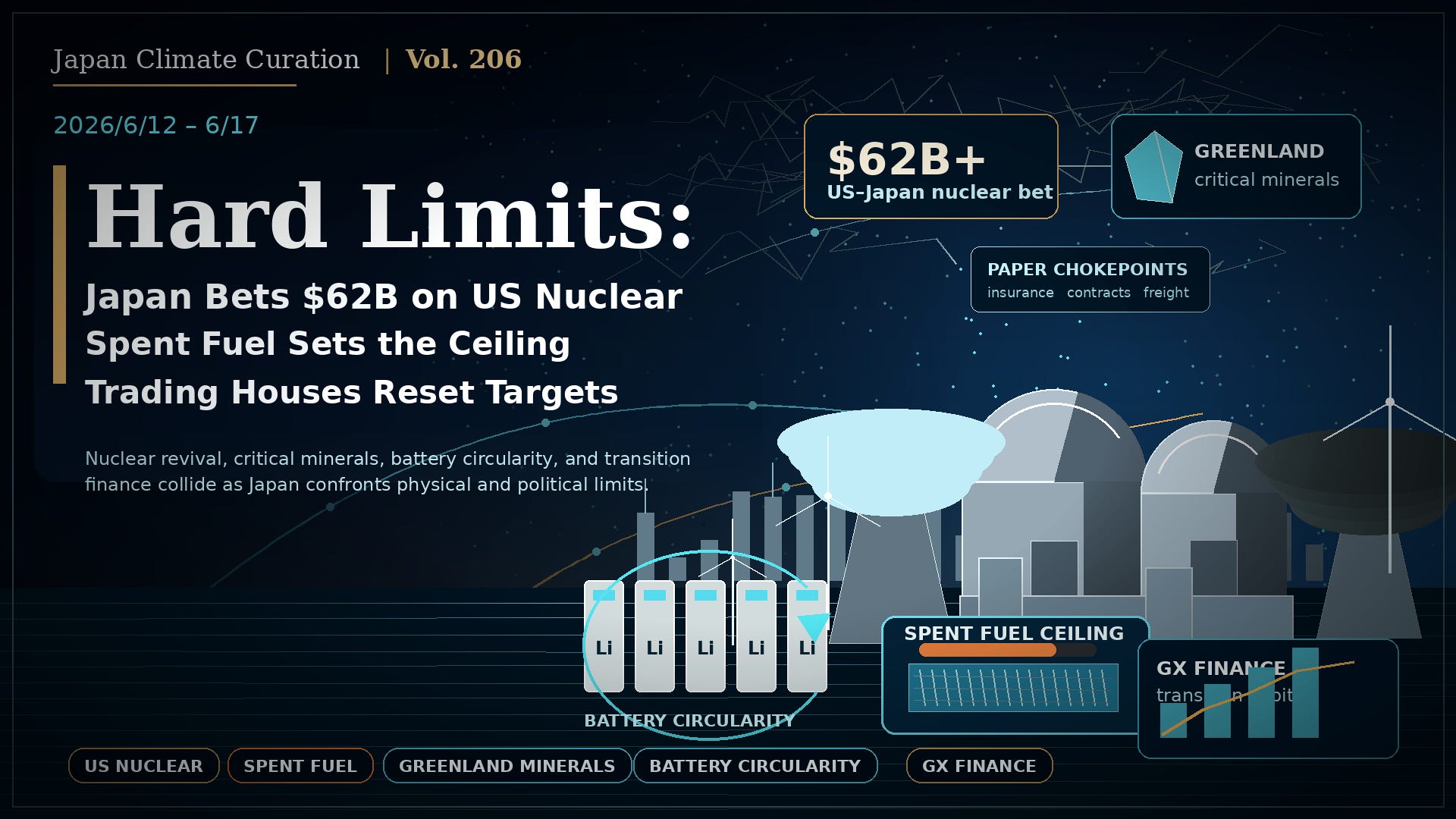
The US will deploy part of Japan’s $550 billion investment pledge to build nuclear power plants, Commerce Secretary Lutnick told Nikkei. Japan is eyeing up to $40 billion in SMRs by GE Vernova and Hitachi, plus a potential $25 billion in NuScale — totaling over ¥10 trillion ($62.3 billion). The Trump administration aims to quadruple US nuclear capacity from 100GW to 400GW by 2050, driven by AI data center power demand.
💡 Insight:
Japan’s $62 billion+ nuclear investment in the US is simultaneously a financial commitment, a technology acquisition strategy, and a geopolitical bet.
The AI power demand crisis is the forcing function behind the US-Japan nuclear deal — not climate policy.
【2】☢️ Kashiwazaki-Kariwa’s Restart Exposes Japan’s Nuclear Waste Storage Crisis [06/11 AP]
The restart of the world’s largest nuclear plant — Kashiwazaki-Kariwa No. 6 — highlights Japan’s spent fuel storage crisis. Cooling pools at 17 plants are ~80% full; three will reach capacity within five years. Japan is considering Minamitorishima, a remote Pacific island, for final disposal, but faces local opposition. The recycling plan has stalled and Japan holds enough plutonium for thousands of nuclear weapons.
💡 Insight:
Japan’s nuclear expansion ambition has a hard physical ceiling: storage capacity.
The final disposal site search is at least two decades from resolution — creating a structural overhang for Japan’s entire nuclear program.
【3】🌊 Japan Rewrites Offshore Wind Auction Rules After Round 1 Collapse [06/11 DeepWind / METI]
Japan’s METI and MLIT revised offshore wind auction rules on June 5, codifying four post-Round 1 reforms: a scoring price floor that removes incentive for unrealistically low bids; business feasibility raised to equal weight with price (120:120); granular checklist-based feasibility scoring; and construction speed reduced to 10 points with schedule flexibility. Per-bidder award caps and withdrawal penalties will be set in zone-specific tender documents.
💡 Insight:
The 120:120 price-to-feasibility parity is the most consequential change for international developers re-evaluating Japan.
Better rules do not solve Japan’s offshore wind cost problem — they just prevent the worst bids from winning.
【4】🧲 Japan Eyes Greenland Rare-Earth Mining to Break China Supply Dependency [06/14 Nikkei Asia]
Japan plans to send JOGMEC geologists to Greenland this summer to study rare-earth and critical mineral mining prospects. The move targets dysprosium for EV motors, graphite for batteries, and tantalum and niobium for semiconductors. With China controlling ~70% of global rare-earth production and imposing export restrictions, Japan is building a supply chain strategy that includes potential EU-based refining partnerships.
💡 Insight:
Greenland is emerging as a critical minerals hub where Japan, the US, and Europe are all converging — creating both partnership and competition dynamics.
The EU refinery partnership model is Japan’s most realistic path to a functional Greenland supply chain.
【5】🔋 Japan Eyes Mandatory EV Battery Collection Law as Waste Volume Set to Triple by 2030 [06/16 Nikkei Asia]
Japan’s Environment Ministry and METI are drafting a framework to potentially mandate EV battery collection under the auto recycling law, as waste volumes surge — from 13,000 recovered in FY2024 to a projected 400,000 by FY2040. A working group launches this summer. Used batteries contain lithium and cobalt critical to Japan’s resource security. The EU enacted binding battery recycling rules in 2023; China is building a full tracking system.
💡 Insight:
Japan’s EV battery recycling gap is a resource security vulnerability hiding in plain sight.
The EU Battery Regulation and China’s tracking system are setting the global standard Japan must now match.
【6】🔵 China’s Hydrogen Push Leaves Japan Behind as Fuel Cell Race Enters Its Next Phase [06/12 Nikkei Asia]
China’s hydrogen fuel cell vehicle sector has reached 40,000 units and 557 stations, backed by $1.1 billion in subsidies, while Japan has fewer than 5,000 FCVs and just 142 stations — less than half its target. Japan’s hydrogen costs ~10x fossil fuels, and its 70MPa fueling standard inflates infrastructure costs. The Iran war is reviving energy-security arguments for hydrogen, but analysts warn batteries may win even in long-haul trucking.
💡 Insight:
Japan’s hydrogen strategy is losing industrial competitiveness ground to China at a structural level — not just a speed-of-deployment level.
The Iran crisis may be hydrogen’s best near-term argument in Japan — but it is an energy security argument, not an economics argument.
【7】🔄 Mitsubishi Corp Softens 2030 Climate Targets and Scraps Renewable Energy Capacity Goal [05/27 Nikkei GX]
Mitsubishi Corp has revised its 2030 GHG reduction target from a single 50% figure to a range of 30–50%, and scrapped its goal to double renewable energy capacity — citing geopolitical upheaval, the Russia-Ukraine war, Middle East tensions, and surging AI power demand. The 2050 net-zero commitment stands. Sumitomo Corp has also softened its interim targets. Both trading houses are pivoting toward “avoided emissions” contributions across their value chains as the new primary decarbonization metric.
💡 Insight:
Japan’s trading houses are setting the template for how Asian industrials will reframe — not abandon — decarbonization commitments.
The target revision is a leading indicator of how Japan’s broader industrial sector will respond to the convergence of geopolitical risk and AI power demand.
【8】🏦 Tokyo Positions Itself as Asia’s Transition Finance Hub With $25 Billion in GX Bonds [06/17 Reuters Plus]
Japan accounts for ~62% of global transition bond issuance, having raised ~$25 billion under its GX Economy Transition Bond program since February 2024. Tokyo is positioning itself as Asia’s transition finance hub, with sector-specific decarbonization roadmaps developed jointly with government — a model Korea has explicitly replicated as “K-GX.” The ICMA’s November 2025 Climate Transition Bond Guidelines align closely with Japan’s framework, boosting its international credibility.
💡 Insight:
Japan’s transition finance framework is becoming the de facto template for Asia — a first-mover advantage with real commercial implications.
GX-ETS, which went live in April, is providing the missing data infrastructure that transition finance has long needed.
【9】⚛️ Fusion Supply Chain Race Heats Up as Suppliers Bet on a $73 Billion Market by 2040 [06/14 Financial Times]
Fusion industry suppliers are expanding capacity ahead of commercial reactor demand, betting that construction spending alone will reach $73.1 billion/year by 2040 — three times the $20 billion in electricity fusion plants are expected to generate by then. Japan’s Fujikura is investing ~$72 million to triple superconducting magnet capacity by 2027. Kyoto Fusioneering is actively persuading component suppliers to invest despite a 10-year+ demand horizon.
💡 Insight:
The real near-term fusion opportunity is in construction and supply chain, not electricity generation.
Japan’s superconducting materials dominance is a strategic chokepoint in the global fusion race.
【10】⚠️ E3G Briefing: Japan’s LNG Deals Won’t Solve Its Chokepoint Vulnerability — Only Clean Energy Can [06/11 E3G]
E3G’s June briefing assesses Japan’s chokepoint vulnerability as “medium-high” — on par with the EU and higher than South Korea, China, and Singapore — with 95% of crude oil imports transiting the Straits of Hormuz and Malacca. The report argues that LNG diversification deals offer only temporary protection and that lasting energy security requires cutting import dependence through electrification, renewables, efficiency, and grid investment — not new long-term fossil infrastructure.
💡 Insight:
E3G’s framework directly challenges Japan’s current crisis response — and the Petronas-JERA 20-year deal signed recently is precisely the kind of long-term lock-in the briefing warns against.
The “paper chokepoints” concept is the under-recognized risk dimension. Beyond physical disruption, E3G identifies insurance withdrawal, sanctions, inflexible contracts, and freight constraints as compounding risks that can cascade through global markets even without physical blockade.
📬 That’s a wrap for this week! Thank you for reading.
Found this useful? A quick like, comment, or share on LinkedIn helps more people discover Japan’s climate developments. 🙏
📩 Stay connected:
🇯🇵 Japanese edition: [Climate Curation](LinkedIn / theLetter link) — every Saturday
🐦 X (Japanese): @SocialCompany
🦋 Bluesky (English): socialcompany.bsky.social
💼 Work with me: Looking for research, consulting, or market insights on Japan’s climate/energy sector? Let’s talk. 📧 hiroyasu.ichikawa[@]socialcompany.org | ☕ Coffee chats welcome!
Comments
Nothing yet. Say the first thing.
Sign in to join the conversation.