
Joint Embedding Predictive Architecture (JEPA) is a framework proposed by Yann LeCun as an alternative to the two dominant paradigms in self-supervised learning:
contrastive methods like CLIP, which learn by comparing positive and negative pairs
generative methods like MAE or video diffusion models, which learn by reconstructing raw pixels.
The key philosophical insight is this: predicting at the pixel level forces a model to spend enormous capacity on unpredictable, irrelevant details like the exact texture of grass, the shimmer of light on water, the grain of a surface. These details are essentially random noise from the standpoint of understanding what is happening in a scene.
LeCun’s argument is that intelligent systems should instead learn to predict in an abstract representation space, focusing on the parts of the world that are actually predictable and semantically meaningful.
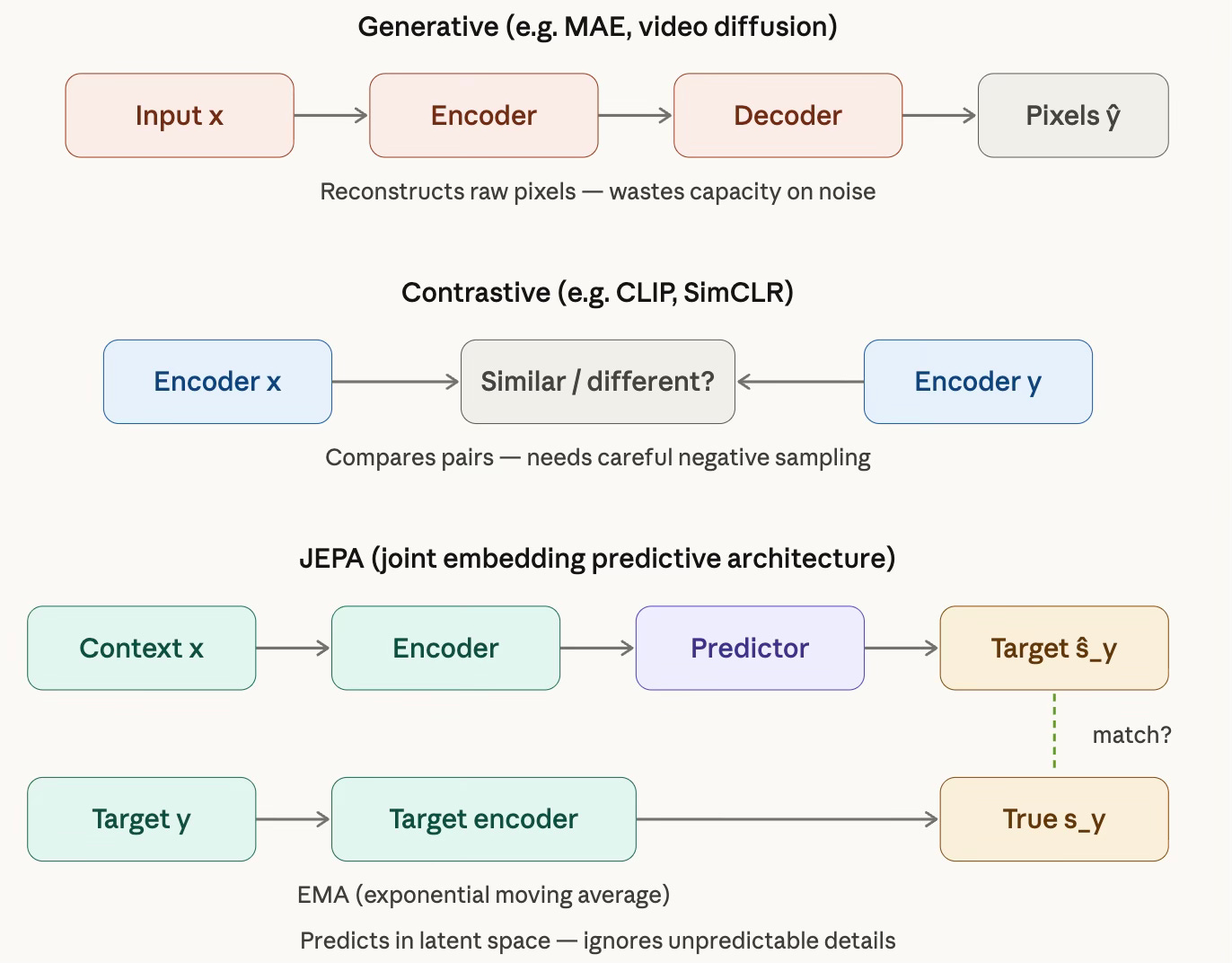
In a JEPA system, you have:
An encoder that maps a visible/context portion of the input into an embedding.
a predictor that tries to predict the embedding of the missing/target portion.
a target encoder that produces the ground-truth embedding to match against, typically an exponential moving average of the main encoder.
Crucially, the predictor never has to reconstruct raw pixels, it just needs to get close in embedding space.
This has a practical consequence: semantically equivalent but superficially different outputs (two valid answers to the same question, two plausible continuations of a scene) will be nearby in embedding space, even though they would look completely different in pixel space. The model naturally learns to abstract away irrelevant variation.
V-JEPA applies the JEPA principle to video. It predicts masked spatio-temporal regions in a learned representation space rather than reconstructing them at the pixel level. Concretely, given a video clip, the system masks out large spatio-temporal blocks (tubes of patches across multiple frames), encodes the visible patches, and then has the predictor fill in the embeddings of the masked regions.
V-JEPA’s pretraining is based solely on an unsupervised feature prediction objective, and does not use pretrained image encoders, text, negative examples, human annotations, or pixel-level reconstruction. This is a notably clean setup — the model learns purely from watching video.
The results were striking: it achieved 82.1% on Kinetics-400 and 71.2% on Something-Something-v2, surpassing previous best video models by +4 and +10 points respectively, all with frozen backbone evaluation (no fine-tuning).
V-JEPA 2 took the original recipe and scaled it dramatically. It was pretrained on a video and image dataset comprising over 1 million hours of internet video, using encoder models up to 1 billion parameters.
The key extensions from V-JEPA to V-JEPA 2 include: 3D tubelet tokenization (patches spanning 2 frames), 3D rotary positional embeddings, a progressive resolution training schedule that moves from 16 frames at 256×256 to 64 frames at 384×384, and multi-block masking at ~90% ratio.
But the really exciting part was what came after pretraining. By post-training a latent action-conditioned world model (V-JEPA 2-AC) using less than 62 hours of unlabeled robot videos from the Droid dataset, they deployed it zero-shot on Franka robot arms in two different labs — enabling picking and placing of objects using planning with image goals, without any task-specific training or reward. This demonstrated that self-supervised video pretraining can bootstrap genuine physical-world planning.
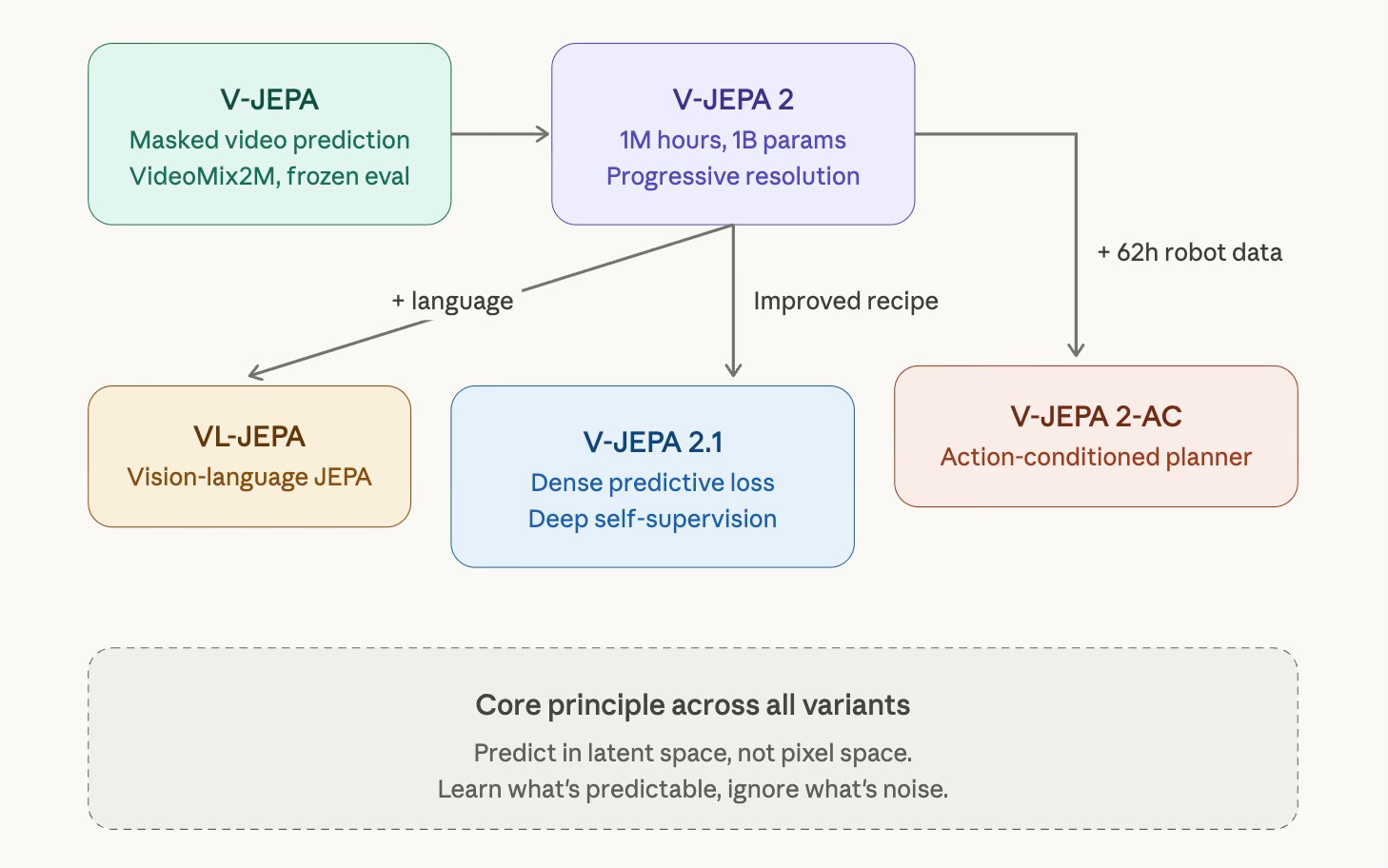
This is the latest member of the family, released on March 16, 2026. V-JEPA 2.1 improves the training recipe to focus on learning high-quality and temporally consistent dense features. While V-JEPA 2 was already excellent at global video understanding tasks (classifying an action, answering a question about a scene), V-JEPA 2.1 focuses on making the per-token features (the dense, spatially localized representations) much higher quality.
The paper introduces four key innovations:
1. Dense Predictive Loss. In the original V-JEPA / V-JEPA 2, only the masked tokens contributed to the self-supervised loss. The encoder produced representations for visible patches, the predictor predicted representations for masked patches, and the loss was computed only on the masked ones. V-JEPA 2.1 uses a masking-based self-supervision objective where all tokens (both visible/context and masked tokens) contribute to the self-supervised training loss. This is a subtle but important change. By supervising every token, the encoder is pushed to produce high-quality features everywhere, not just in regions that happen to be visible during a particular forward pass.
2. Deep Self-Supervision. Rather than applying the loss only at the final layer of the encoder, V-JEPA 2.1 applies the self-supervised loss at multiple intermediate representations of the encoder models. This ensures that useful, semantically rich features emerge throughout the depth of the network, not just at the output. It is reminiscent of auxiliary losses in deep networks, but applied to the self-supervised prediction objective specifically.
3. Multi-Modal Tokenizers. V-JEPA 2.1 introduces multi-modal tokenizers for images and videos, allowing the model to handle both modalities with appropriate tokenization schemes rather than treating images as single-frame videos.
4. Model and Data Scaling. The approach benefits from model and data scaling, and the paper demonstrates improvements across both dense prediction tasks (where you need per-pixel or per-patch output quality) and global prediction tasks.
The net effect is that V-JEPA 2.1 produces features that are not only good for telling you what action is happening (global understanding) but also good for telling you exactly where things are and how they move over time with spatial precision (dense understanding). The PCA visualizations of the learned features reportedly show much cleaner, more temporally consistent spatial maps than previous versions.
The JEPA family represents a bet that the path to robust AI, especially for physical-world understanding, robotics, and planning, runs through self-supervised prediction in latent space rather than through pixel-level generation or text-supervised contrastive learning. The progression tells a clear story:
V-JEPA showed the principle works for video.
V-JEPA 2 showed it scales and can bootstrap a world model for robotic planning.
V-JEPA 2-AC showed the world model can actually plan actions. VL-JEPA showed you can bridge to language.
V-JEPA 2.1 shows how to get the dense, spatially precise features you need for fine-grained tasks, closing a gap that earlier versions had relative to methods like DINOv2.
The underlying thesis that you should learn to predict what is predictable and abstract away what is not is what LeCun has been advocating as a foundation for machine intelligence that goes beyond pattern matching toward genuine world understanding.
No posts
Comments
Nothing yet. Say the first thing.
Sign in to join the conversation.