
Last week the Telegraph reported on some comments I made about air conditioning. The comment section is quite something as one would expect it to be. By saying what I think is a fairly nuanced thing to say about cooling, I appear to have become an unlikely hero of the anti-net-zero crowd.
I’m grateful for the enthusiasm. But allow me to point out three ironies.
Irony one: air conditioners are heat pumps in disguise
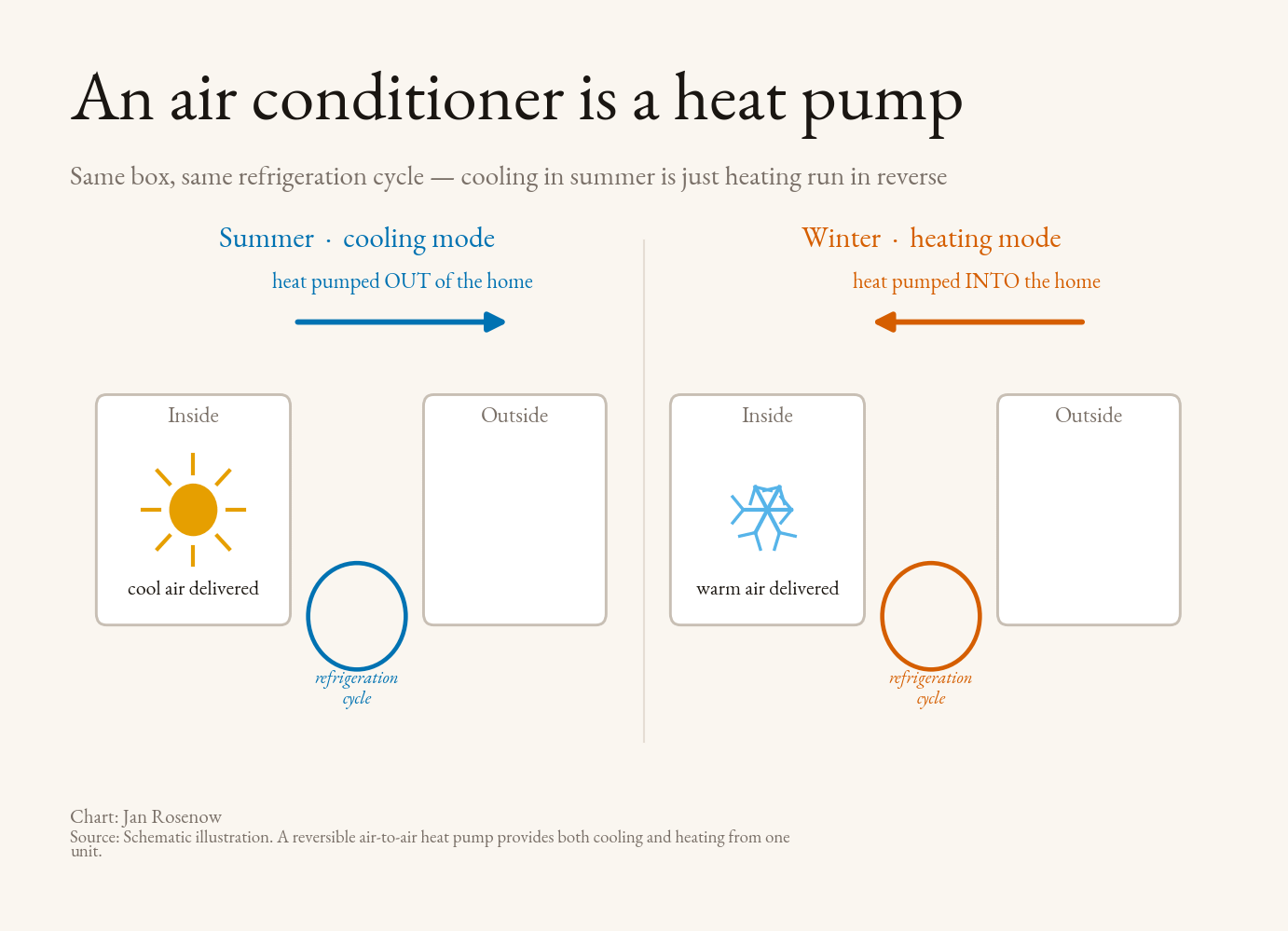
Many of the people now cheering me on have spent years telling us that heat pumps don’t work. Here is the thing: an air conditioner is a heat pump. It uses the same refrigeration cycle, the same compressor, the same refrigerant, and the same physics. The only difference is that a heating heat pump is designed to move heat into the building, while an air conditioner moves heat out. Many modern systems can do both at the flick of a switch. More on this later.
If you believe air conditioning works (and it does) then you already believe heat pumps work. Because they are the same machine and they work very well in all building types – more on this here.
Irony two: you can’t deny the heat and demand the cooling
For years I was told that climate change is a hoax and that British summers aren’t getting hotter. Now some of the same voices demand to know why on earth Britain never installed air conditioning. You cannot have it both ways.
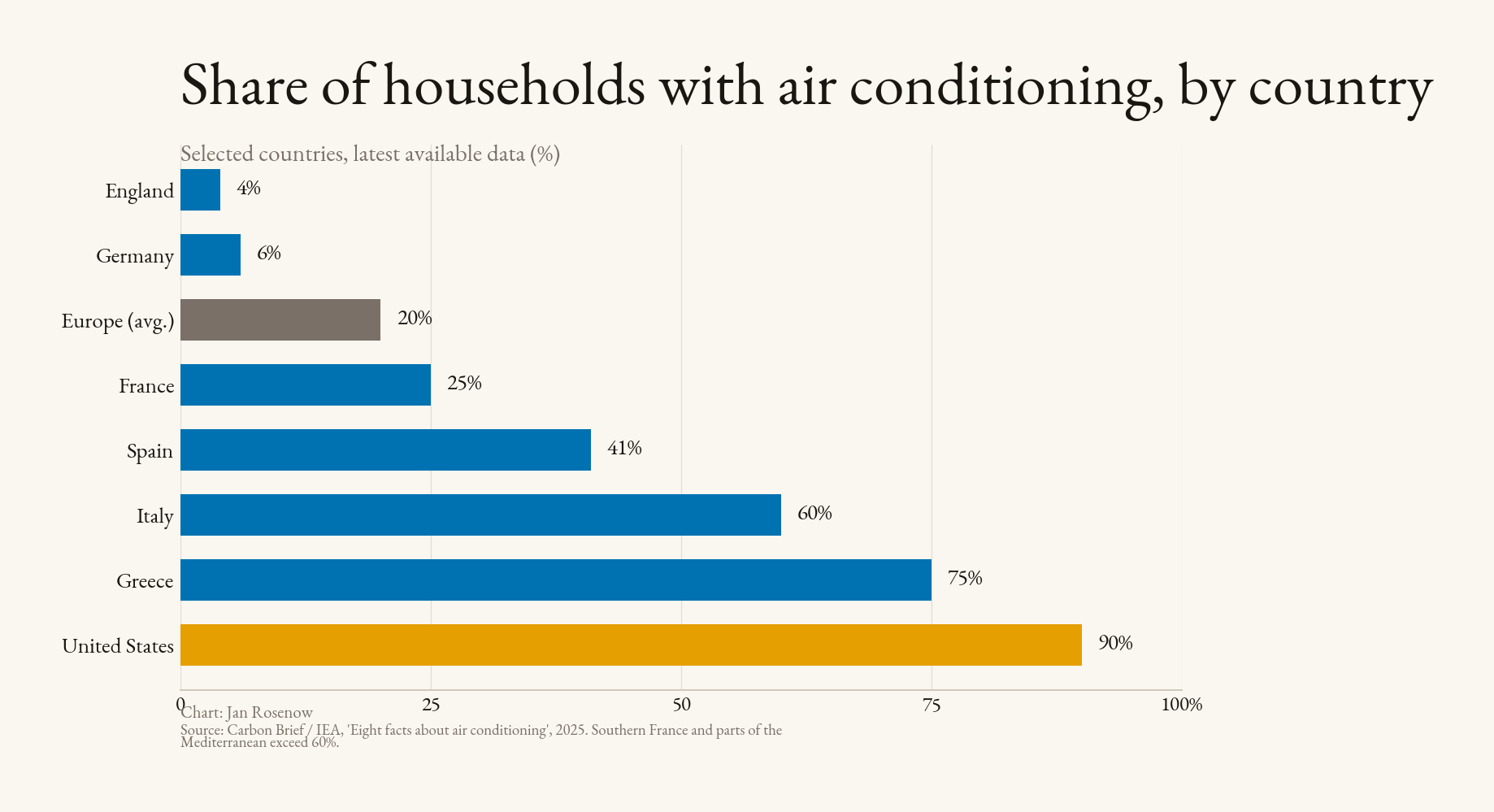
The rising demand for cooling is driven by the warming climate. Europe has warmed by around 2.5°C since pre-industrial times (the fastest-warming continent on Earth), and we simply have far more hot and also hotter days than we used to. The reason Britain never bothered with air conditioning is the same reason it is now scrambling to think about it: for most of living memory it was cool enough that only about 4% of English homes have installed mechanical cooling systems. In Greece it is 70–80%, in Italy nearly 60%, and in the United States over 90%.
Irony three: affordable cooling depends on the things this crowd loves to attack
Running air conditioning affordably depends on exactly the things the anti-net-zero crowd likes to campaign against: cheap solar power, a modernised grid, and efficient electric technology.
Air conditioning will require more electricity. The good news is that solar generation peaks at almost precisely the moment cooling demand is high: in the hot, bright middle of the day. The sunshine that makes a home unbearably hot is the same sunshine that can provide cheap electricity to cool it. Fight cheap solar and a smarter grid, and you are fighting the cheapest way to keep cool.
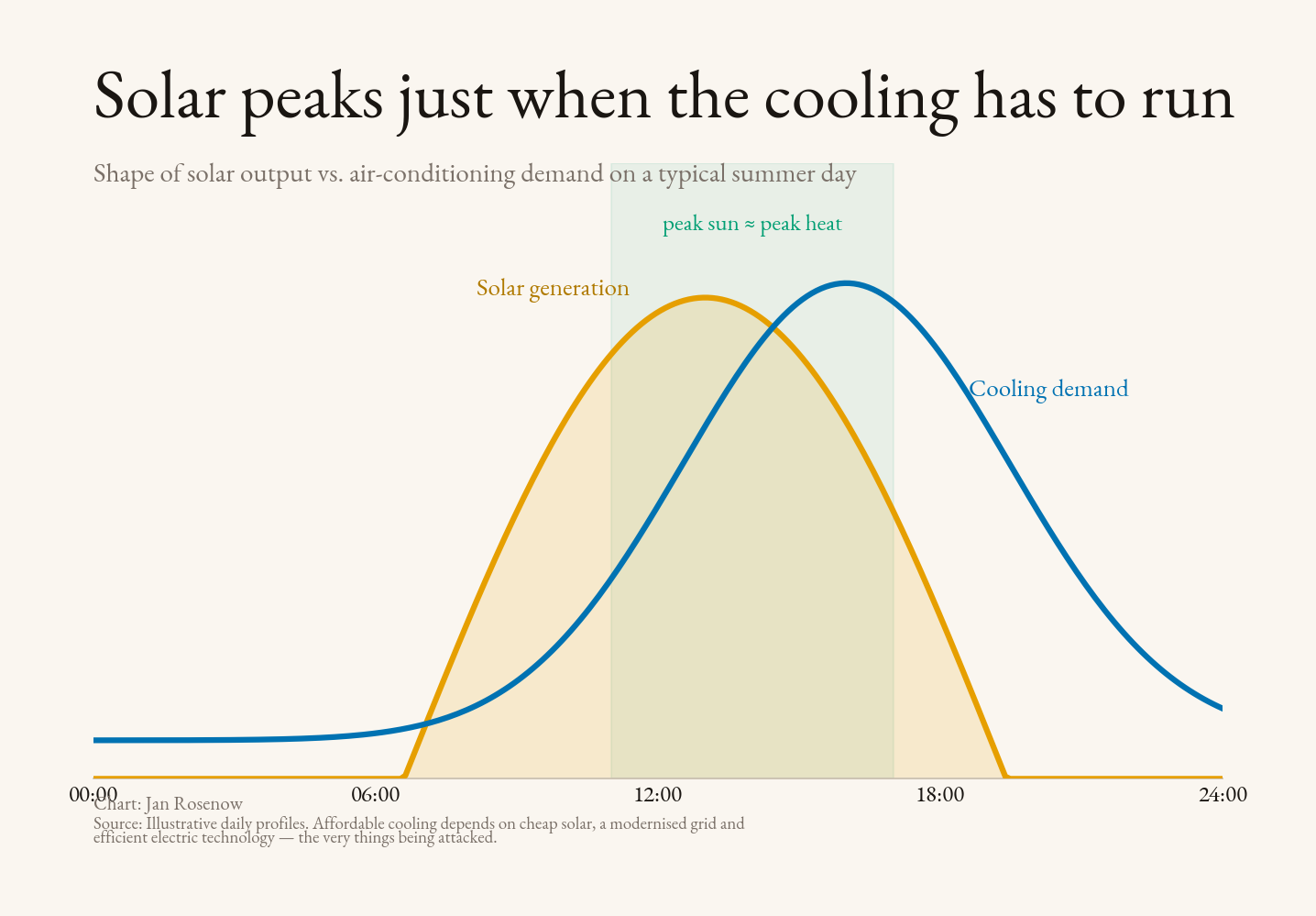
Where there is not a good match of solar and cooling is during hot nights but in Northern Europe those are still relatively rare and the cooling demand is much lower than during the daytime. And increasingly batteries can help with this too.
What I actually said about cooling
In case it got lost in the noise: my argument is that rising heat is a genuine risk to health and productivity, and that much of Europe’s building stock was simply never designed for these temperatures. Carbon Brief notes that cooling averted roughly 190,000 heat deaths a year between 2019 and 2021, and Europe’s heat-death rate is several times that of the better-cooled United States. The June 2026 heatwave alone is estimated to have killed more than 20,000 people across Europe.
Passive measures should come first wherever possible, because they avoid the need for excessive mechanical cooling in the first place: shading, shutters, insulation, better design. This is not abstract for me. We have just fitted 13 external shutters to our windows for exactly this reason: external shading is far more effective than internal blinds and we recently supported a mature tree in our garden to stop it from falling, because shade is cooling you don’t have to pay for.
But in many cases even after passive measures have been considered and implemented, active cooling will still be needed. It should be efficient, clean and affordable. The alternative to planning for this is not that there will be no air conditioning. Instead the problem is millions of cheap, inefficient units bought in a panic. We already see that mobile air conditioning units in the UK sold out.
Cooling can decarbonise heating
There is an opportunity too though: The growing demand for cooling is potentially a route we have to decarbonise heating.
A reversible air-to-air heat pump cools in summer and heats in winter from the same unit. This is not exotic. Most heat pumps in Scandinavia are air-to-air systems; the same is true across much of the United States and many other parts of the world. Once a household has installed a unit to survive August, it also owns a low-carbon heating system for January, if it is an air-to-air heat pump.
Ground-source heat pumps are naturally reversible and exceptionally efficient for cooling, using the stable temperature of the ground as a heat sink in summer and a heat source in winter, and, unlike individual air conditioners, they don’t dump waste heat into the street.
Manufacturers are also now bringing out combined units that pair air-to-water heating for radiators, underfloor heating and hot water with air-to-air cooling in a single system. That matters, because it lets homes keep the wet heating they already have while adding efficient cooling, rather than choosing between the two. For those not familiar with European radiator heating systems: many homes use a wet heating system rather than ducted forced air heating technology.
There are real constraints on the role air-to-air can play in the UK and other European countries. Many of our homes are traditionally heated with radiators, our building stock is older and more complex with many heritage buildings, our planning rules are not yet set up for it. But the direction is clear. As more and more countries move into a dual mode of needing both heating and cooling, we have to stop discussing the heating transition and the rise of cooling as if they were separate conversations. They are the same conversation.
And it doesn’t have to mean a unit in every window
There is also a smarter way to cool a city than millions of individual boxes each pumping hot air onto the pavement. If everyone in Paris installed their own air conditioner, the city’s streets could warm by more than 2°C cooling indoors by making outdoors worse.
Paris offers the alternative. The city runs one of the largest district cooling networks in the world, operated by Fraîcheur de Paris, drawing cold water from the Seine to chill the Louvre, hospitals, offices and stations through a network of underground pipes and it plans to expand it dramatically over the coming years. Cooling is generated centrally and efficiently, often using off-peak and low-carbon electricity, and the waste heat is managed rather than dumped into the streets. It is the cooling equivalent of district heating, and for dense cities it is a serious option.
None of this is anti-net-zero. It is net zero. Cheap clean power, efficient machines, passive design first, and a bit of joined-up thinking between how we heat and how we cool. If that makes me a hero of the anti-net-zero crowd, I’ll take the applause. I suspect they’re clapping for the wrong reasons.
No posts
Comments
Nothing yet. Say the first thing.
Sign in to join the conversation.