
When you fill up your car, you pay for the fuel. You don’t pay for the fumes drifting across the school playground down the road, or the damage to the climate, or the hospital admissions that follow. Those costs are just as real; they’re simply charged to somebody else, and they never show up on your receipt.
For more than two decades I’ve been circling the same question: what does economics actually have to say about this? My first energy research project, as a student at the Wuppertal Institute in 2004, was a study for the German Environment Agency asking whether lignite really deserved its reputation. Germany’s utilities liked to call brown coal the country’s only subsidy-free source of power. We went looking for the hidden support, from tax breaks to the cost of resettling entire villages that stood in the path of the diggers, and the subsidy-free story fell apart fairly quickly. We put the quantifiable social costs of lignite power at up to 21.7 eurocents per kilowatt-hour. Even on the more cautious estimates, the hidden damage came to roughly as much as generating the electricity in the first place.
The lesson stuck. The price of energy on paper and its cost to society are not the same number, and often not even close. A few years ago a large study finally put figures on that gap for electricity worldwide, and that is what this issue is about.
Markets exist to put a price on things. You want bread, the baker wants money, you settle on a number, and that number is meant to capture the cost of making the bread plus a margin.
Sometimes, though, an activity creates costs that fall on people who were never part of the deal. A factory tips its waste into a river: good for the factory and its customers, bad for everyone living downstream, none of whom were asked and none of whom were paid. Economists call this an externality, a side-effect landed on someone who had no part in the transaction.
The idea is more than a century old. I studied in more than 25 years ago when I was interested in how economics as a discipline approaches environmental degradation. Alfred Marshall set it out in the 1890s and Arthur Pigou sharpened it in the 1910s: where there’s an external cost, the market gets the price wrong, and a firm left to its own devices will make too much of the harmful stuff, because someone else is footing the bill for the harm.
Electricity is the textbook example. Burn coal and you get heat, which becomes power. You also get fine particles that lodge in people’s lungs, sulphur and nitrogen oxides that turn into smog and acid rain, and carbon dioxide that warms the planet for centuries. The plant owner sells the electricity, but it doesn’t pay for the heart attacks, the ruined crops or the flooding. Those costs are real. They’re also spread thinly across millions of people, many of them distant and poor, which makes them easy to overlook.
Putting a price on the invisible
For years these costs were treated as essentially unknowable, the kind of thing you can't read off a meter. But researchers have spent three decades chipping away at them, study by study and pollutant by pollutant (our small lignite paper was one early contribution), and in 2021 Benjamin Sovacool and colleagues pulled the whole literature together into something genuinely useful. They combined 139 studies and 704 separate estimates, 83 of those studies and 318 of the estimates dealing specifically with electricity, into a meta-study.
Their headline figure for electricity is an average external cost of roughly 7 cents per kilowatt-hour. Scale that up to global electricity production and the hidden costs reach about $11.6 trillion a year, or $3.8 trillion even on their more conservative central estimate.
The part that changes everything
This is what makes it a Bright Spots story rather than another entry in the climate-gloom file: the hidden costs are wildly uneven. They cluster around burning things. When Sovacool’s team broke the external cost down by source, the gap between fuels they uncovered was enormous.
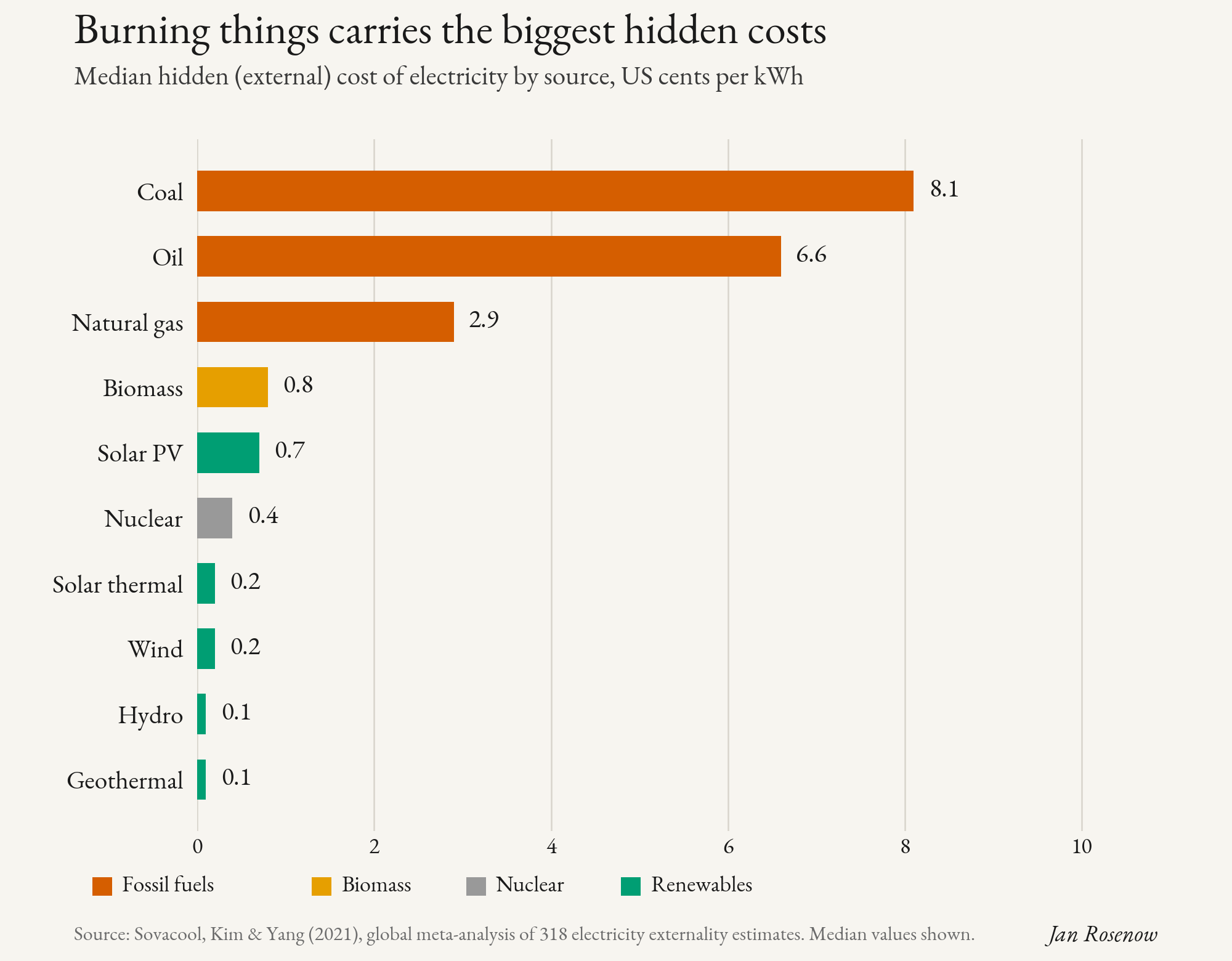
Coal tops the table at a median external cost of about 8.1 cents per kilowatt-hour. Oil comes in around 6.6, natural gas at 2.9. After that the numbers collapse. Everything else sits below a cent: biomass at 0.8, solar PV at 0.7, nuclear at 0.4, solar thermal and wind at 0.2, hydro and geothermal at 0.1, which is to say next to nothing. Coal’s external costs run to roughly 12 times those of solar PV, 41 times those of wind, and 87 times those of geothermal.
We spend a lot of energy arguing about whether clean power is cheap enough to compete on its own. That argument leaves externalities out entirely. Put them back in, price coal and gas at their true cost to society, and it stops being a close contest.
There’s a revealing asymmetry in how this gets debated. People who dislike renewables work hard to draw attention to system costs, the grids, the storage, the back-up capacity you need to integrate wind and solar. Those costs are real and should be counted, no argument from me there.
The same voices go remarkably quiet about the externalities of fossil fuels, which are several times larger. You can’t demand a full accounting of every integration cost of a wind farm and then leave 8 cents of coal damage per kilowatt-hour off the books.
The bigger picture
Coal alone accounts for most of electricity’s hidden costs worldwide, something like 60% of them. So in narrow economic terms, the single most valuable thing we can do is stop burning it. Every coal plant that shuts, and every wind farm or solar array that takes its place, cancels a bill that would otherwise land on hospitals, farms and coastlines, one that never showed up on anyone’s electricity statement but was being paid all the same.
These costs are real but diffuse, which is precisely why policy finds them so easy to ignore. Adding the health costs would roughly double the price of coal in most large economies, and yet almost nowhere does the market do it. Twenty years on from our lignite study, Germany is still mining and burning brown coal, so I hold no illusion that pointing at the numbers is enough on its own.
Still, the clean option and the cheap option turn out to be the same option, once you count properly. The only reason that isn’t obvious is an accounting failure a century old. Carbon pricing, pollution standards, an end to fossil-fuel subsidies (all of them are ways of putting the hidden bill back onto the price tag) would let the market stop pretending burning things is free.
One thing to look out for
The same study points to something that cuts the other way: energy efficiency. Every kilowatt-hour we don’t use carries a positive external benefit of around 7.8 cents, roughly $312 billion a year globally. The cheapest and cleanest kilowatt-hour is still the one we never had to generate, and it barely features in the debate we actually have.
No posts
Comments
Nothing yet. Say the first thing.
Sign in to join the conversation.