
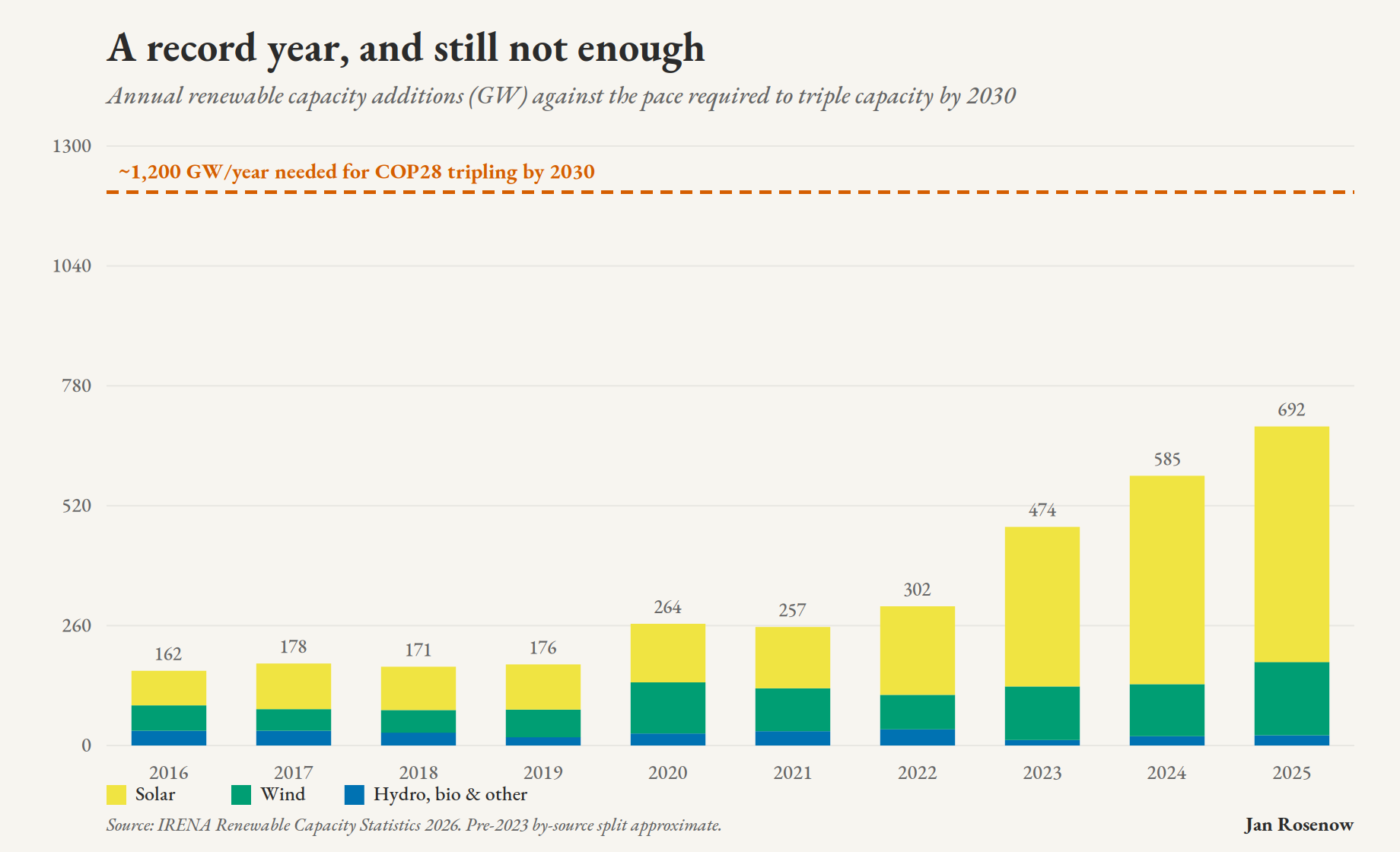
2025 was another record year for renewables. The world added 692 gigawatts (GW) of renewable power capacity last year alone, the largest annual increase ever recorded, bringing the global total to 5,149 GW. Solar did most of the heavy lifting, with 511 GW installed in a single year, around three-quarters of all new capacity. Renewables now account for just under half of all installed power capacity on the planet.
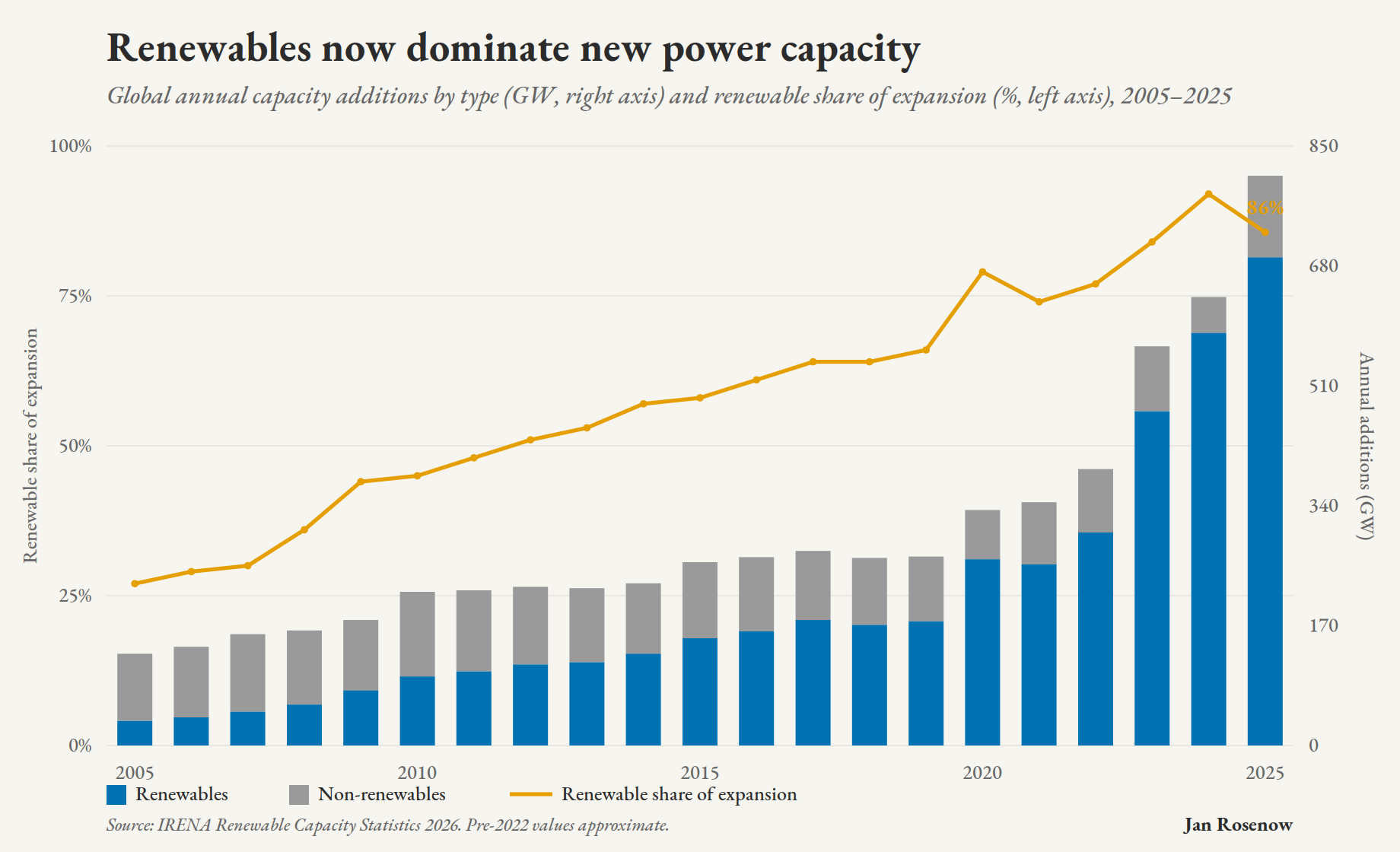
Twenty years ago renewables were a quarter or so of annual additions, easy to wave off as a niche. That line has climbed steadily ever since. Most of this is now solar and wind which together made up 96.8% of net renewable additions in 2025, largely driven by the economics and falling costs.
But you will notice that even though record renewable energy capacity additions were made in 2025 the share of renewables of new capacity dipped slightly: Renewables took 86% of all new capacity last year but it was 92% the year before. Fossil additions increased compared to the year before. For example, China, alongside its vast clean build-out, added more than 100 GW of non-renewable capacity, roughly four-fifths of it coal. However, the utlilisation rate of coal plants in China is dropping which means whilst more capacity is being added overall coal generation has started to decline.
Was 2025 fast enough?
The harder question is whether a record year is actually a fast enough year? The answer is yes if we use the tripling renewables capacity as a benchmark. At COP28 the world agreed to triple renewable capacity to more than 11 terawatts by 2030. Meeting the COP28 pledge requires sustaining growth at roughly 15-17% per year globally, every year to 2030. In 2025 capacity growth was 18%.
Who leads?
In terms of sheer scale of renewable capacity additions the answer is clear: China. It added 440 GW on its own. Europe installed 77 GW, North America around 55 GW. Africa had its best year on record at 11 GW, with most of it in Ethiopia, South Africa and Egypt. That is worth celebrating given how slow historic deployment on the continent has been.
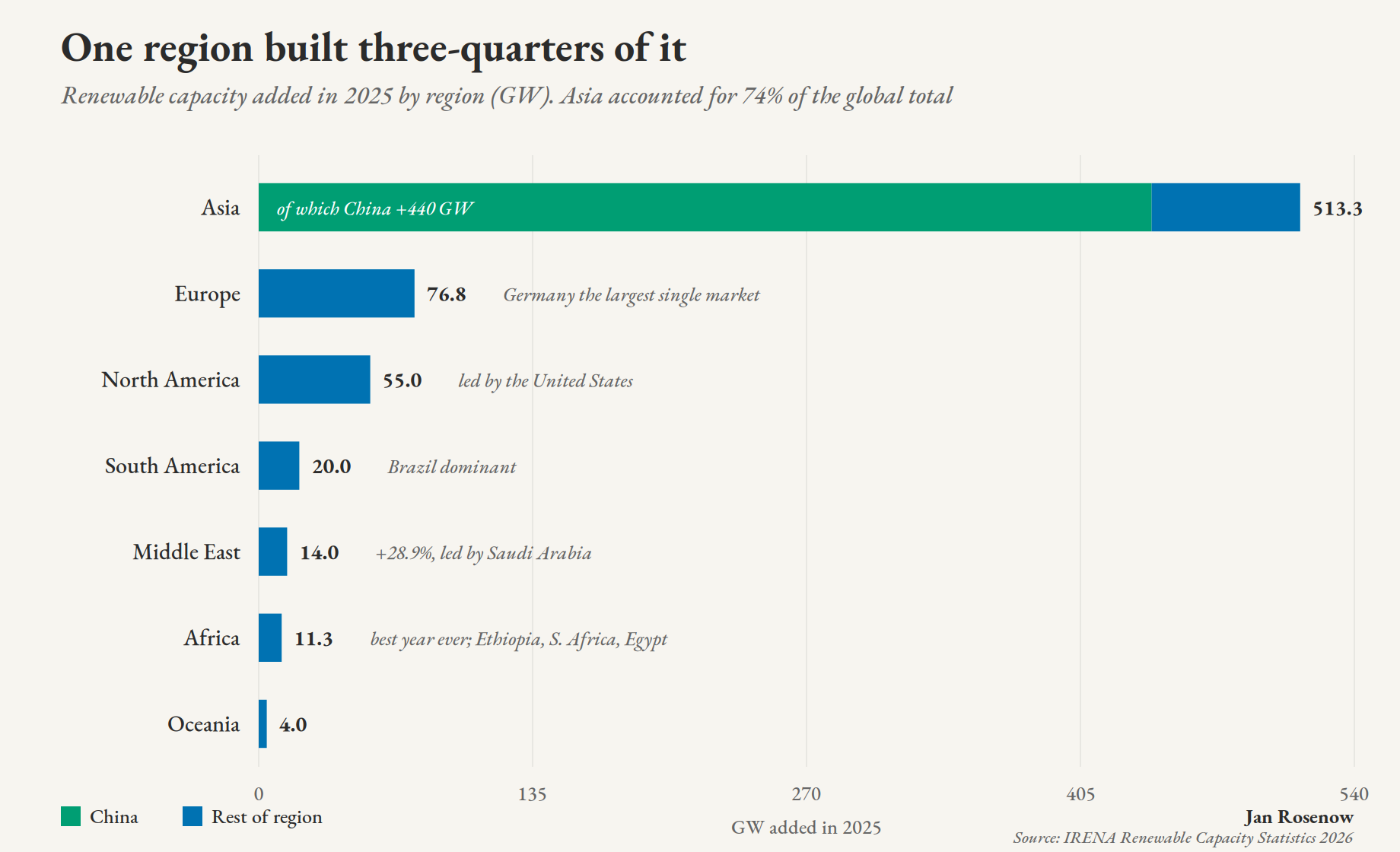
What the absolute figures miss, though, is how fast some of the late adopters are now moving. Saudi Arabia drove a 29% jump in Middle East renewable capacity last year, a figure that would have looked fanciful a decade ago. Africa grew 16%, the quickest on record so far. Being near the bottom of that chart in 2025 tells you where a country stands today, not where it is heading, and the places lagging historically are now speeding up deployment substantially.
Capacity is not generation
At this point a careful reader is already objecting: Capacity is not generation. A 49% share of capacity does not mean renewables are producing 49% of our electricity. If we want to know how the transition is really going, capacity is the wrong number to use. Generation is what really counts.
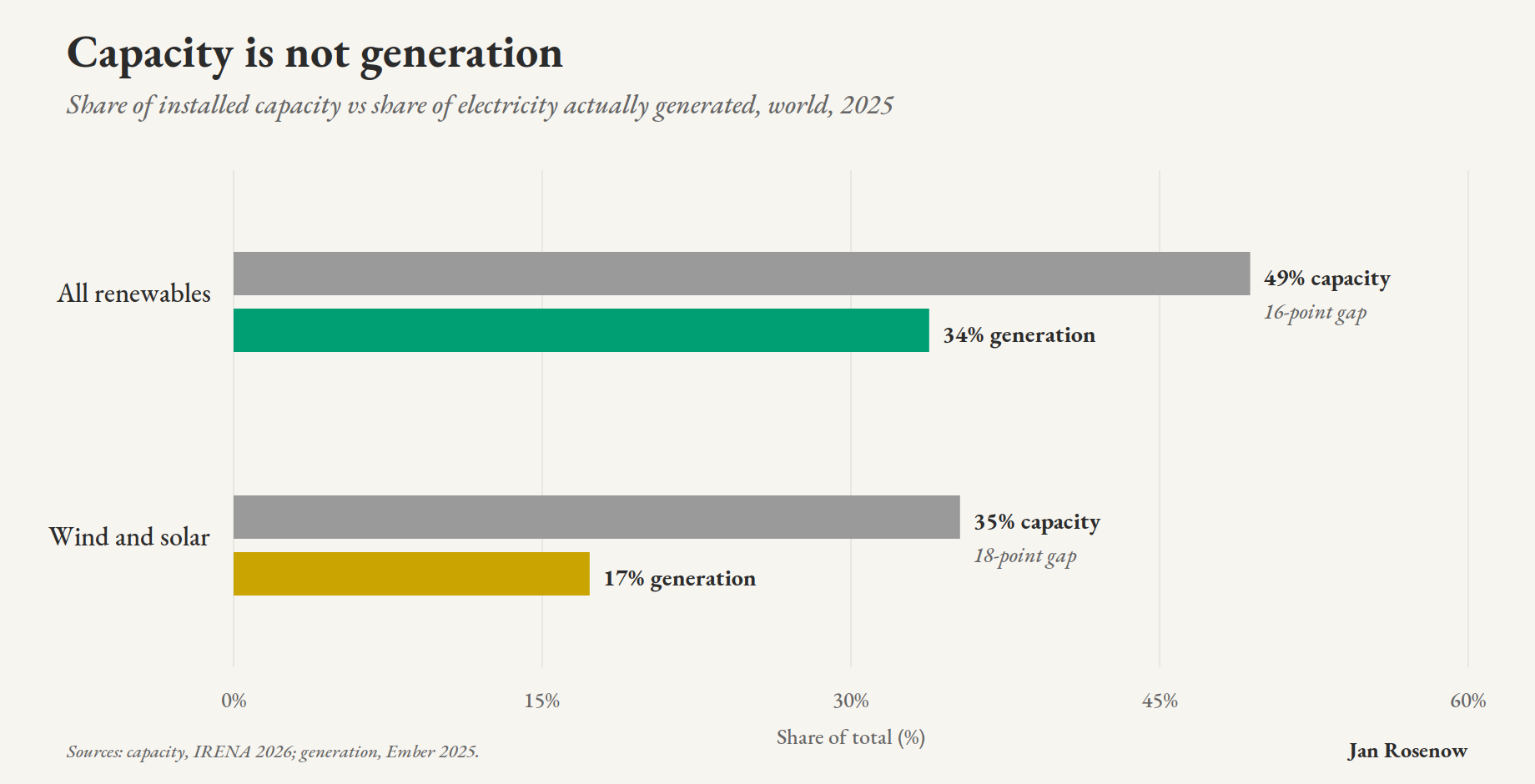
Measured by generation, non-fossil sources (renewables plus nuclear) supplied 43% of the world’s electricity in 2025, up from below 33% two decades earlier. Renewables alone reached 33%. Wind and solar together hit 17% and their increase is particularly impressive because it was close to zero at the start of the century. In absolute terms wind and solar generated 5,490 terawatt-hours in 2025, up 18% in a single year.
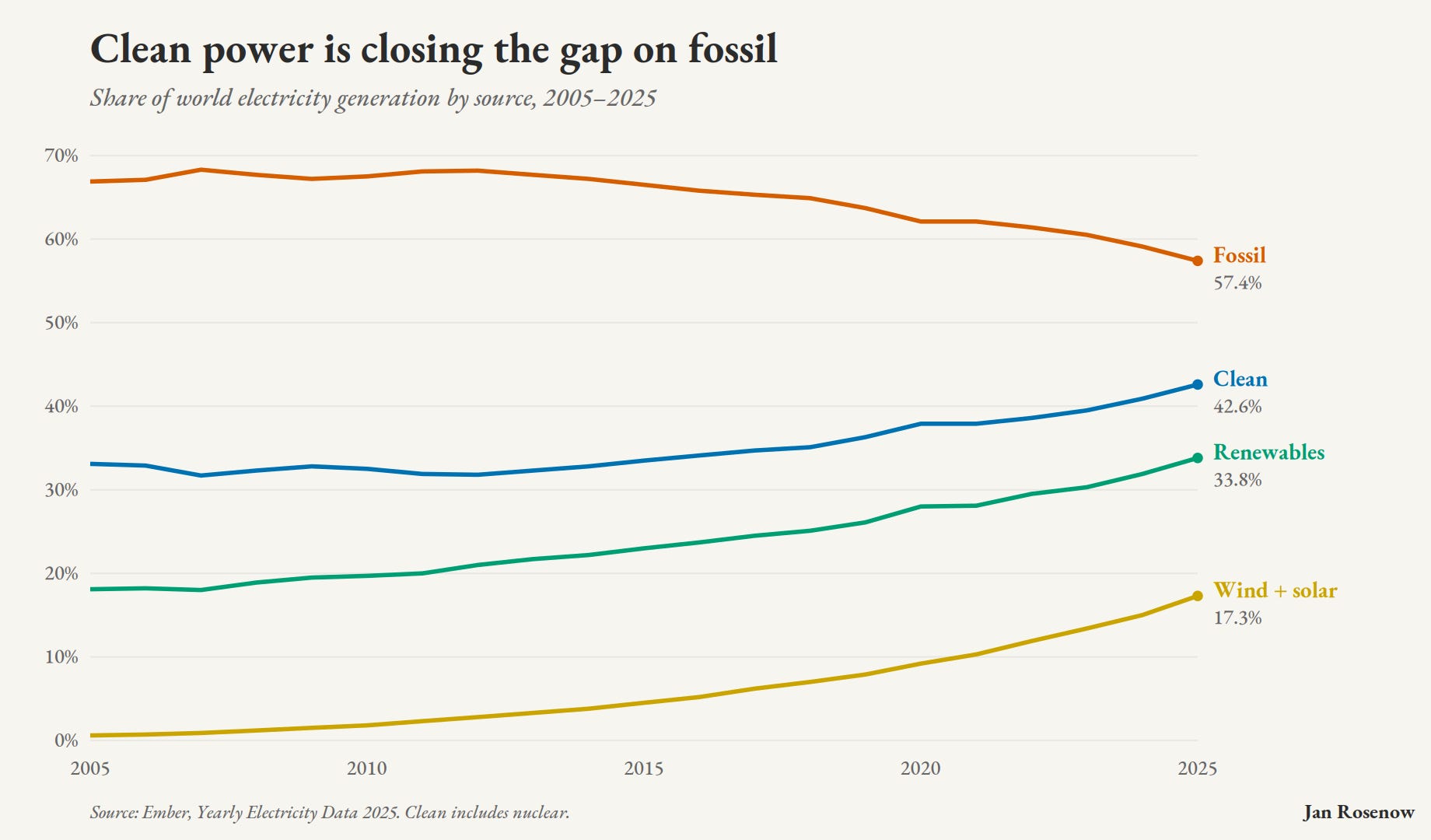
Fossil generation fell in 2025, the first decline since the pandemic slump of 2020. It is a small dip and it may not hold. But for the first year in memory, all that new clean generation did more than accommodate rising demand: It started, just barely, to push fossil output down. If that turns into a trend rather than a blip it means legacy fossil generation declines in absolute terms not just as a share of generation. Only then will we see a continuous and sustained reduction in power sector emissions.
So what is holding the pace back? Not the technology, and increasingly not the cost. Solar modules and wind turbines have kept getting cheaper. The binding constraints today are grids, permitting, and storage. Transmission lines take the better part of a decade to plan and build. Connection queues stretch for years in many markets. There is a huge pipeline of grid-scale storage capacity waiting to be connected.
Some claim that this shows the failure of the expansion of renewables. I’d argue it is a feature of the transition not a bug - we just did not build grids out fast enough as we underestimated the speed at which particularly wind and solar would expand. Speeding up requires regulatory, market design and policy reform around the world. When you look closely, many of these issues are solvable and are already being solved today.
It is important to point out that electricity is only 21% of global final energy consumption. If we want to reduce fossil fuel consumption in transport, industry and buildings we will have to use more clean electricity in those sectors. Electrification will have to increase substantially in the future as I explain in my recent Substack article. This is why the next decade will not only be about increasing the share of renewables in the power sector but also about how to use more electricity instead of fossil fuels in the end-use sectors.
No posts
Comments
Nothing yet. Say the first thing.
Sign in to join the conversation.