
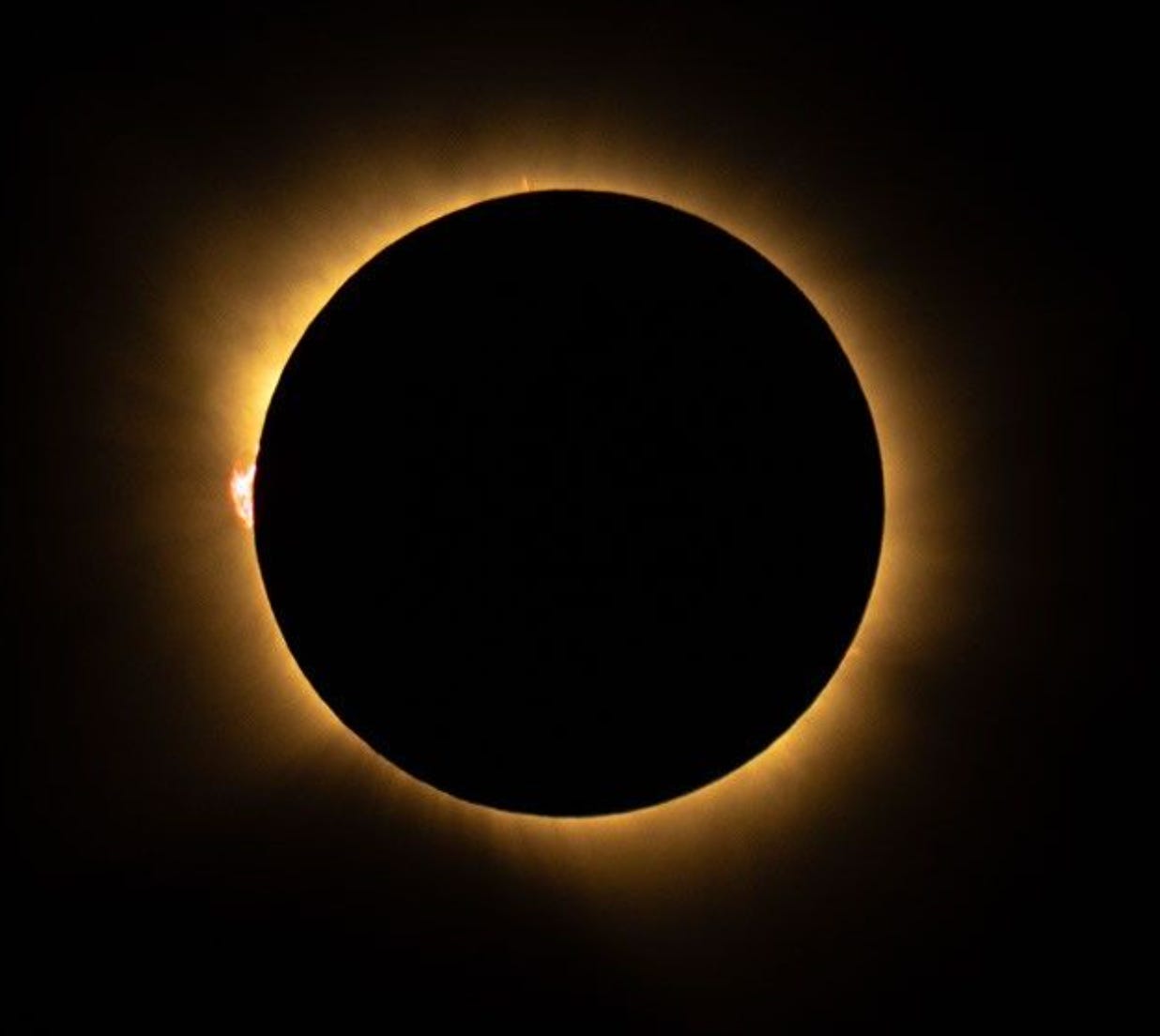
Every eclipse is a remarkable combination of the mechanistic inevitability of the Universe and messy serendipity.
The orbital cycles of the Sun-Earth-Moon system are like gears in a celestial clock, keeping track of the passage of time since an imprecise origin, when the mechanism assembled out of interstellar clouds. Some gears are small and fast, others big and slow. The Earth spins on its tilted axis. The Moon orbits in its tilted plane, approaching perigee and retreating to apogee. Together they fixate on the Sun. Occasionally the gears align and we are treated to an eclipse, the Moon casting its umbral shadow across the Earth more often than you might think. Every 6 months we enter eclipse season and are guaranteed at least one New Moon crossing the node between Earth and Sun. The alignment in turn ensures at least one solar eclipse paired within a half-month by a lunar eclipse, though many drift unobserved across oceans. Only near perigee does the Moon appear big enough to completely occlude the Sun and dazzle with a total solar eclipse—about every 18 months. Eclipses come in 18-year-11-month-8-day cycles, wandering in latitude and longitude around the globe so that hundreds of years can pass before a total solar eclipse returns to any given locale.
Therein is the mechanistic inevitability of the laws of gravitational dynamics that allow us to trace back historical eclipses to specific dates through retro-calculation. On May 28th (my birthday, I think not coincidentally but assign some astrological significance) in 585 BCE, mid-battle during a five year war in what is now modern day Türkiye, an eclipse stunned soldiers out of their murderous charge—or so the story goes as recounted by Herodotus. Interpreting the dramatic event as an omen, a portent of angry gods, both sides laid down their weapons and signed a peace treaty. Such were my hopes for the eclipse of August 12, 2026.
That the Moon can eclipse the Sun is also a gift of messy serendipity. In a catastrophic collision 4.5 billion years ago, Theia, a protoplanet about the size of Mars, struck the Earth, vaporizing a hunk of the mantle and ejecting the debris into orbit. From whence comes the Moon. That interplanetary accident, in the mayhem of unregulated traffic in the early solar system, gave our rocky planet our glorious Moon—the proverbial rib to our proverbial Adam. We are the only rocky planet around the Sun that has a moon. Our moon’s name is Moon, as prior usage in this dispatch suggests, with the fond diminutive Luna.
Luna is 400 times smaller than the Sun and coincidentally 400 times closer so that the ratio of diameter to distance for the Moon matches the ratio for the Sun. That the Moon thereby can occasionally block out the blazing Sun is entirely fortuitous, though of course nothing is truly serendipitous if you subscribe to the deterministic view of the dictates of physics. And everything is slightly serendipitous if you subscribe to the probabilistic mores of quantum mechanics.
Wherever you are, and most of you but for a handful of spacefaring souls, are here on Earth, whether or not you gathered to marvel at this unique moment and felt some shift in your terrestrial perspective, some urge to declare a detente in any conflict great or small, we were nonetheless all in this together.
I leave you at the close of this astronomically special week (having also been treated to the Perseid meteor shower) with a small offering from the final pages of Black Hole Survival Guide:
“The Solar System motion is something of a spectacle, something to provoke the imagination. The Sun and plasma winds and planets and the multifarious, ample moons and striated rings and Jupiter’s red-raw stormy eye and all the human-made satellites—flicked, shiny, lost coins forever falling in the harsh quiet—and Pluto—champion of the hundreds of dwarf planets—and those planets that shattered into neurotic asteroids and interplanetary ice, rocks, fog, magnetic lines…all traveling together at a daunting speed exceeding two hundred kilometers every second—every breath—in the pinwheel spin of our galaxy around an emptiness more massive than 4 million suns. All the elements of our solar system spinning and orbiting, the original orrery, in mechanical glory like an arcane, wildly ambitious timepiece while we stagger around on one rough gear, oblivious.”
—Janna
Comments
Nothing yet. Say the first thing.
Sign in to join the conversation.