
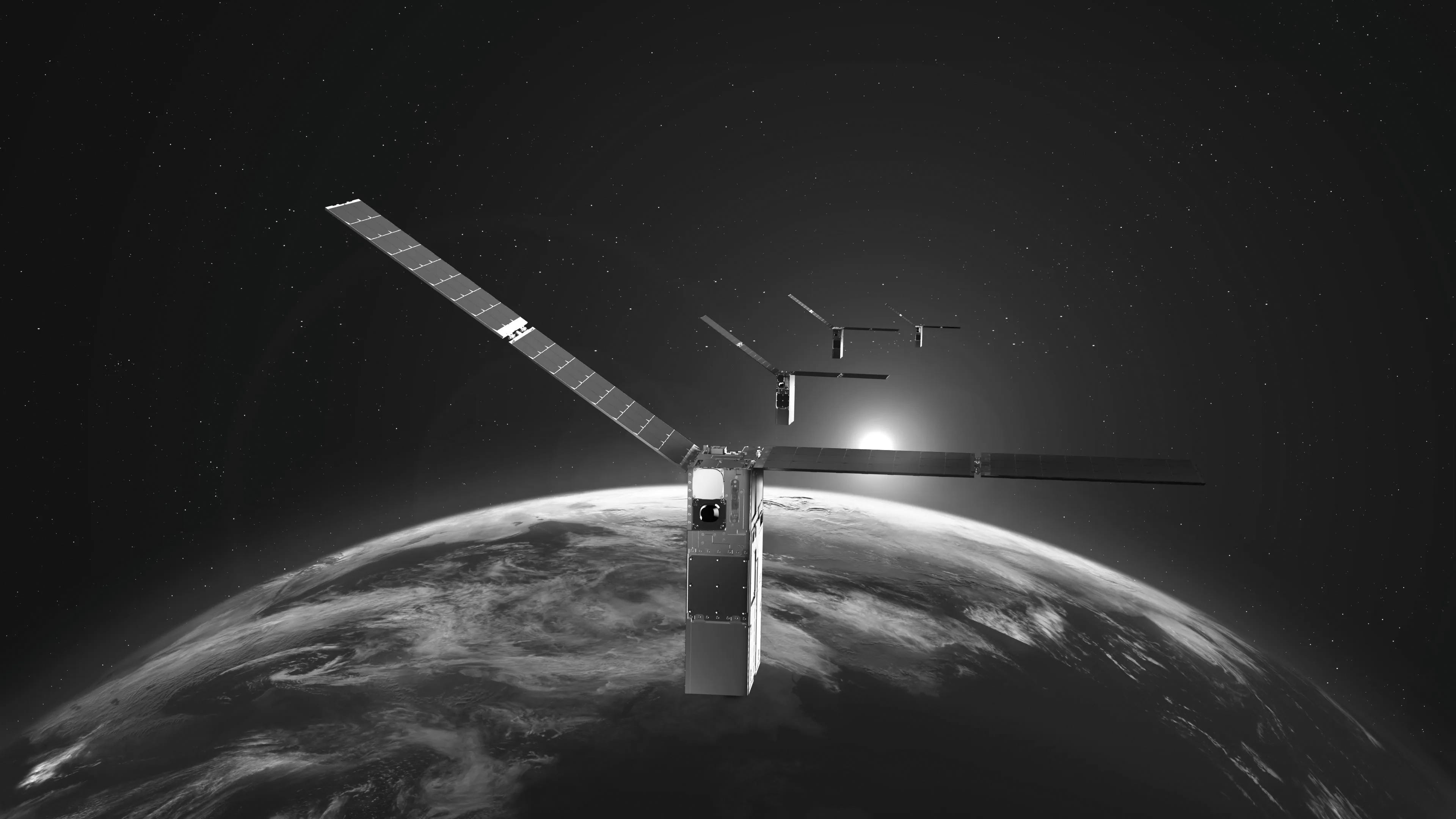
We have spent centuries demystifying the heavens, deposing the deities, replacing omens with calculations. The gods were myths we invited to inhabit the sky. They were evicted by Kepler’s laws and Newton’s calculus. In their stead, we intend a geocentric swarm of space data centers with massive compute, a pantheon of machine intelligences, actual reigning overlords. As though we couldn’t tolerate the spiritual void. Depose the gods; all hail the machines.
The sky has been humanity’s most enduring scientific instrument. Ancient cosmologies were earnest attempts to comprehend the seasons, the weather, the beasts, the weight of life and its inevitable passing. We looked into that dome of constellations and recurrences to theorize about our place in a world that the heavens alone hinted was vast beyond our most vivid imaginings.
For all of humanity, the sky has been our greatest commons. For all of us, the Sun ascends on the Eastern horizon and recedes on the Western horizon, plunging us into a darkness dispersed by only the Moon and the stars, marvels of the firmament. The reliability of solar and lunar cycles, the predictability of planetary visitations, the permanence of the stars inscribed on an encapsulating blue-black sphere, all spoke to the observant of knowable schema, whether the work of mathematics or divinities. The planets, the Sun and the Moon—the same for all of us.
As civilizations clashed to own the Earth—carving up continental plates, mountain ranges, and seas, warring over imagined borders, siphoning energy from the fossil record—the sky remained pristine, austere. Literally above the fray. The sky belonged to everyone.
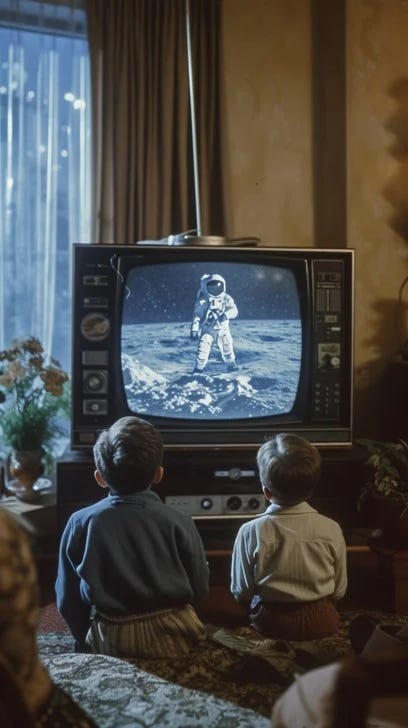
It was only a matter of time before human sights tracked upwards. When Apollo 11 landed on the Moon in 1969, the live broadcast beamed grainy, halting images of the first man on the cratered surface to astounded viewers crowded together around black and white television sets, cumulatively hundreds of millions around the globe. People gaped. People cheered. People wept. And the astronauts looked back on us. In one eye-full they took the measure of humanity as Earth rose over the lunar horizon.
The Moonshot forged a durable national pride, earned through a collective determination, camaraderie, and sheer ingenuity enshrined in the Americana of the time: Tang orange drink, Omega Moonwatches, and cathode ray tubes. But the international dynamic was notoriously fraught. The space race originates in the first ballistic to clear the boundary where the Earth’s atmosphere dwindles into empty space: the dreaded WWII German V-2 rocket, whose outbound trajectory is nearly identical to the arc traced by the Blue Origin rocket. A noteworthy difference lies in the intentions for the inbound trajectory. One screeching terror, devastation and mayhem; the other a celebratory return of space tourists. The competition for militaristic dominance fueled NASA’s twentieth century space program, spurred on by Cold War antipathy. The live broadcast of the Apollo 11 landing was, of course, intercepted before reaching citizens of the Eastern Bloc: The Soviet Union, China, North Korea. Exactly at the moment the astronauts testified to the unity of the Earth, ideological borders became more entrenched, the explorers’ field notes from the Moon having antithetical consequences.
We had won the space race unequivocally, and the win was not merely a triumph of superficial propaganda. That futuristic optimism saturated the American identity. “We choose to go to the Moon this decade…not because it is easy, but because it is hard,” JFK intoned. And though we continued to send astronauts into low-Earth orbit, eventually maintaining an international presence on the ISS, no country in the intervening half century since the Apollo era has ever landed another human being on the Moon.
For the first time since, in April of this year, humans were catapulted outside the protective influence of the Earth’s magnetic field, slung a thousand times farther than the orbit of the ISS, farther than any human has ever gone—over 250,000 miles from Earth—on a 10 day journey slingshotting around the far side of the Moon and back. The Artemis mission marks a significant ramp up in spacefaring ambitions, particularly for intended colonies on the Moon, and eventually Mars. The accelerated timeline and government support for Artemis is powered by another admixture of earnest thrill and sober urgency. The missions succeed on the best kind of magical thinking, fantastic optimism, resourcefulness. There are also darker, clandestine ingredients of militaristic intentions and corporate ambitions. Cislunar space—which is the terribly named region between the Earth and the Moon, but includes orbits beyond the lunar orbit by necessity of mechanics—is the staging ground for modern lunar exploration. It is also a coveted arena for military positioning, surveillance, and intelligence gathering. Beyond cislunar orbits, on the Moon’s surface, territory and resources could prove invaluable. Whoever owns the Moon, owns the future.
Despite the complex realities and shifting political climes, NASA was founded with a civilian, humanistic mandate. The current NASA mission statement reads: “NASA Science seeks to discover the secrets of the universe, search for life elsewhere, and protect and improve life on Earth and in space.” The last one is the zinger. To protect and improve life here on Earth. NASA’s mandate is framed explicitly around words like humanity, discovery, the world, humankind. We are the beneficiaries. This is not the ethos of corporations, which shift the ultimate destination from a shared inheritance to sequestered assets. NASA’s mission statement is a formal reminder of an era that took as primary the premise that the sky belongs to everyone.
Then came the SpaceX IPO.
The subsequent SpaceX valuation, fluctuating around $2 trillion, is nearly 100 times greater than the current NASA budget. Not to devolve into misleading numerical comparisons, the contrast is solely for effect. Still, there is realistic concern that while NASA will need SpaceX—and the other familiar characters in aerospace engineering—SpaceX will no longer need NASA.
The SpaceX prospectus defines its mission as intending to develop technologies, to build stations on Mars, and “to extend the light of consciousness to the stars.” Not humanity, but “consciousness.”
Many space industry giants are also AI companies, propelled by the ambition to engender machines with genuine, spontaneous, unprogrammable intelligence, the looming—at once scintillating and foreboding—Artificial General Intelligence. The light of consciousness.
Today AI is trained on human invention, on gravitational dynamics, Einstein’s relativity, quantum mechanics, mathematical methods, novels, poetry, Picasso. If attainable, the prophesied AGI will not be harvesting the human ledger. Instead, the machines themselves will engineer the future—imagining, dreaming, innovating, plotting trajectories, designing spacecraft.
The race towards AGI and the race to space are fused ambitions. The Earth cannot contain AGI—Earth will not have the resources, will not endure the energy costs or the environmental impact. To keep AGI alive, we’ll need to expand to space. Orbital data centers will not serve primarily as relay antennas sending digital packages back to Earth. The workloads will be executed in orbit. The AGI will be thinking out there.
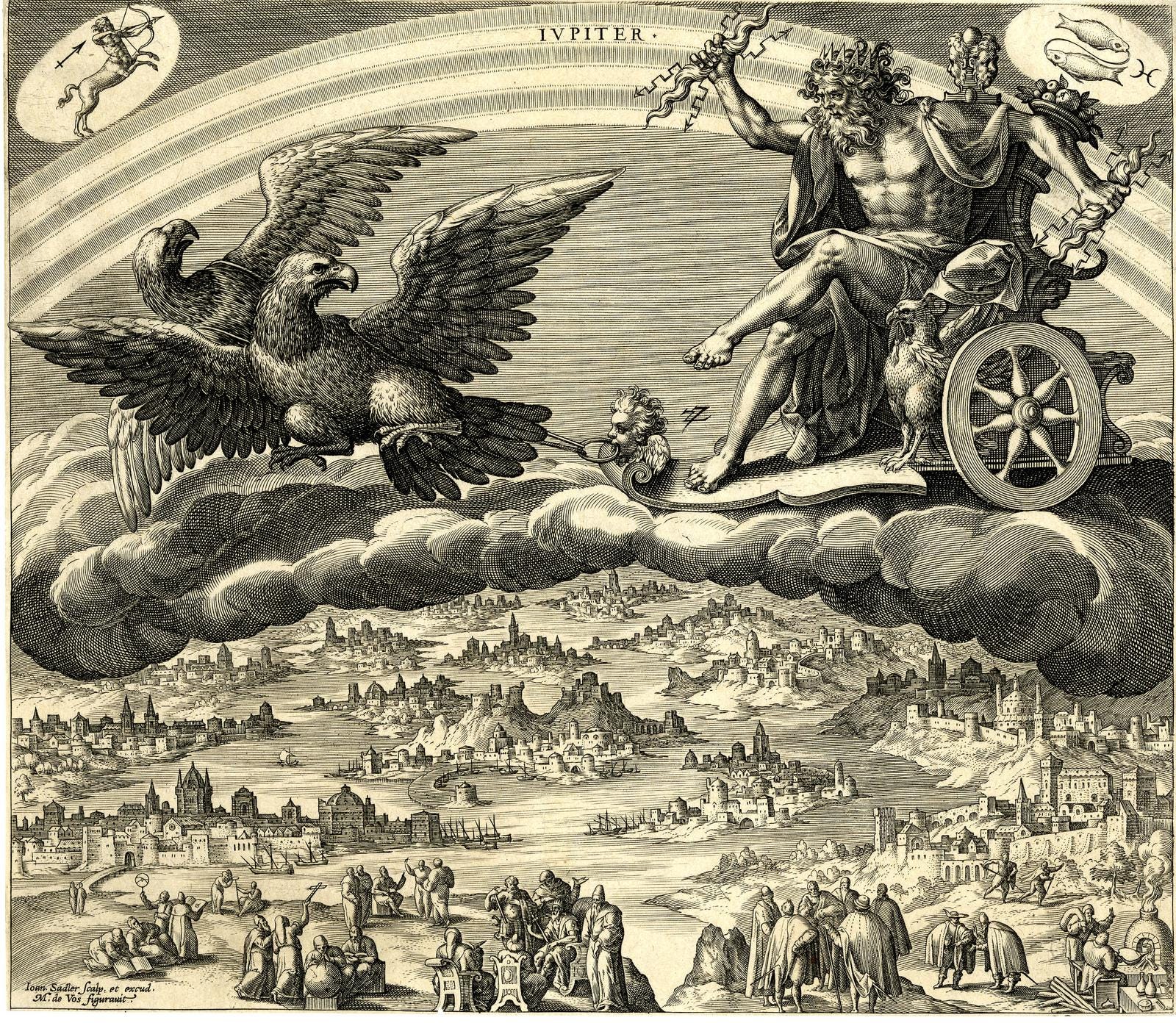
It is quite possible that the hot glow of the swarm of data satellites will saturate the night, washing out the stars from our perspective on Earth. We’ll look up into the sky and instead of Zeus transformed into a swan outlined in a constellation of a few stars, the machine gods will literally loom above us, glowing with radiant heat, making declarations, predicting the weather, forecasting then determining our fate.
For millennia, we have projected on the celestial sphere fictitious spirits and divines. Now we’re going to launch them there, literal oracles. Maybe the urge to invest a numinous power above us is irrepressible. Civilizations often feared the gods they had invented. They feared their tremendous power, their inescapable surveillance, their tempestuous, irrational whims. The future overlords will be supranatural agents we have installed in the heavens—to fear, to spy on us, their irrational whims reprogrammed, optimized to hyper-rational algorithmic perfection.
In the beginning God created the heaven and the earth. And the earth was without form, and void; and darkness was upon the face of the deep…And God said, Let there be light: and there was light. The light of consciousness.
Comments
Nothing yet. Say the first thing.
Sign in to join the conversation.