
There is little official information about how Russia manages its military recruitment internally. Most of what we know is based on anecdotal evidence, such as regional officials mentioning targets they are required to meet. Although indirect and often vague, these statements already suggested the existence of a hierarchical system: the federal government assigns each region a recruitment quota that the regional government must fulfil.
But the hierarchy does not end at the regional level. Regional governments set targets for their districts, which in turn task settlements and even companies with finding men willing to sign military contracts. Details contained in municipal-level reports published in recent years help reveal how and when the current hierarchical recruitment system was originally established.
On February 14, 2023, Putin signed Order PR-309 on the “replenishment of troops (forces) with personnel.” The exact content of the order has not been made public, but it most likely tasked Medvedev with coordinating recruitment and set an annual recruitment target. Medvedev began holding regular discussions on recruitment with regional governments on February 22, 2023, and a nationwide recruitment campaign was launched on April 1, 2023. Districts across Russia cite Order PR-309 in official reports and on their websites as the legal basis for establishing local recruitment task forces.
According to a district report from Omsk Oblast, all districts in the region received “their” quotas from the regional government on March 1, 2023. At that point, the regional quota had apparently been broken down into district-level targets. The report also shows how the district quota was further divided into quotas for individual settlements. In 2023, this particular district reported having found 37 recruits against a quota of 50. The target was apparently calculated on the basis of the number of Russian men in fitness categories A and B listed in the district’s military register.
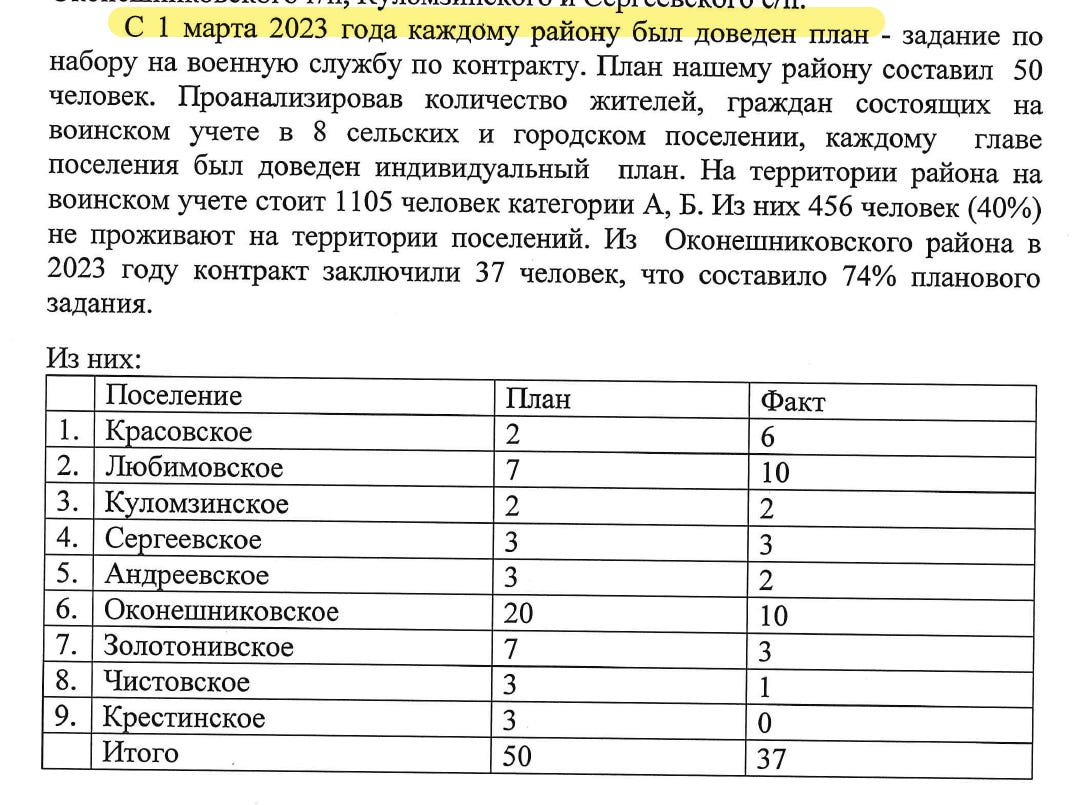
In 2024, the district’s quota was increased to 51, and 42 men had signed contracts by October 21, 2024. The same district report also mentions an annual recruitment target for the region set by the Ministry of Defense, without disclosing the actual number.
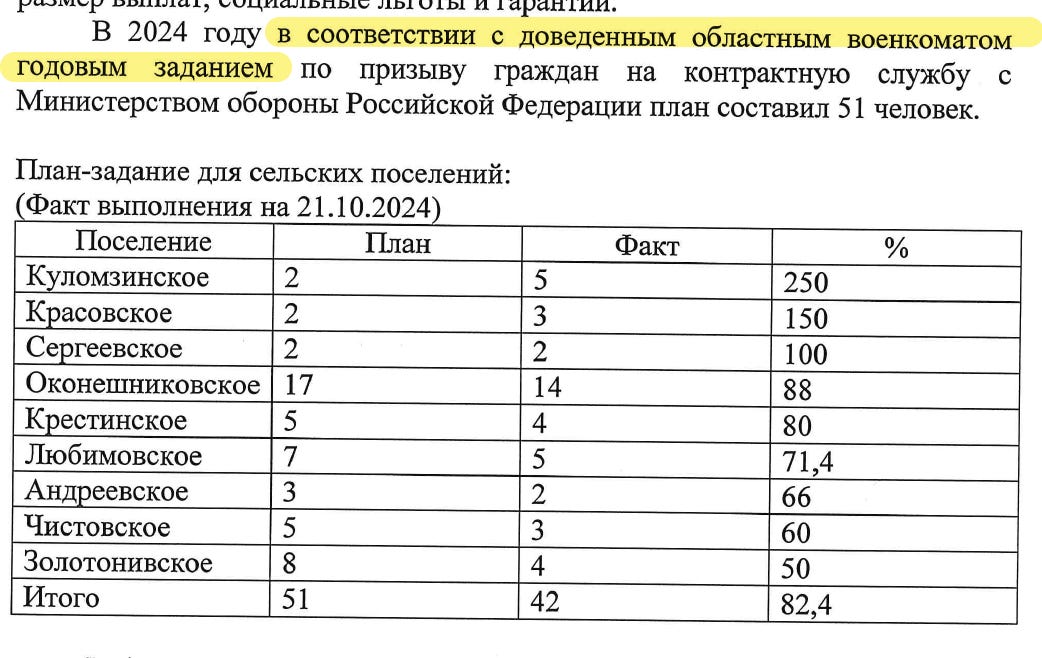
There are dozens of similar reports from district and city governments referring to quotas, although concrete recruitment figures like those cited above are rare. The City of Krasnodar reported that 2,354 new military contracts had been signed in 2024, equivalent to 91.8% of its target, and also cited Putin’s Order PR-309 as the legal basis.
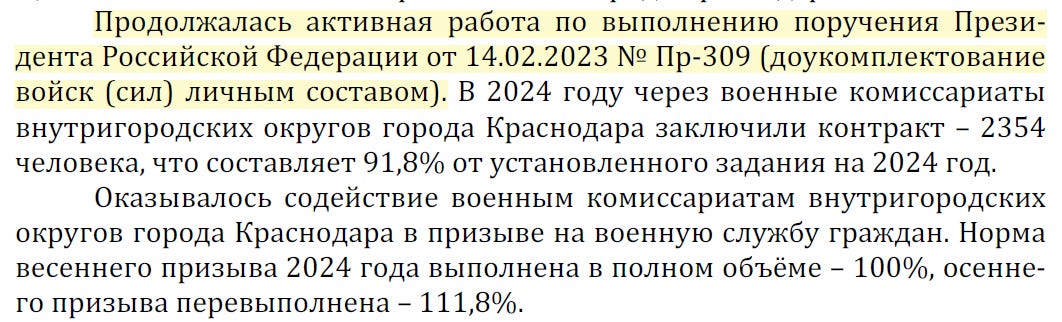
In 2024, Putin issued another order on the “replenishment of troops (forces) with personnel” on September 29. Nine days earlier, on September 20, 2024, Putin’s Decree No. 814 (note that several links in this report require a VPN to open) had established an interdepartmental recruitment commission within the Security Council. The new document (actually a list of orders) was designated PRS-1098. Afterward, districts began citing PRS-1098 instead of PR-309 in their recruitment reports, suggesting that PRS-1098 replaced or updated the previous legal basis (although some documents continued to cite PR-309 in 2025 and even 2026).
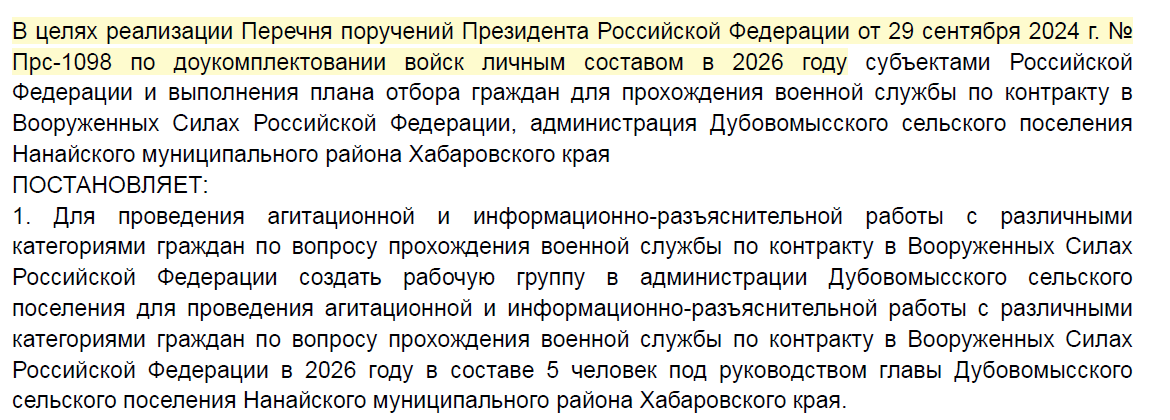
On October 25, 2024, Medvedev said that Putin had decided to continue the replenishment of the troops and that he had been tasked with coordinating the effort. According to a report published on the website of a settlement in Khabarovsk Krai, the new PRS-1098 document of September 2024 concerned recruitment in 2025.
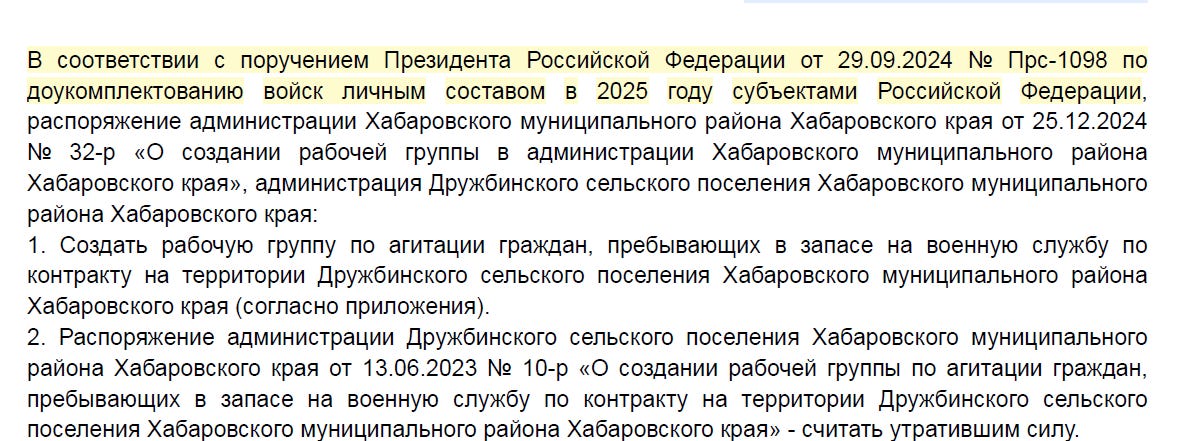
Another settlement in Khabarovsk Krai still cites PRS-1098 in its plans for a 2026 recruitment task force, indicating that the document remains the relevant legal basis for Russian military recruitment in 2026.
Reports from Belgorod’s districts proved far more comprehensive than those from any other region. For that, we have to thank Belgorod Governor Vyacheslav Gladkov: on December 4, 2024, he decided to include recruitment performance among the key performance indicators for Belgorod’s 22 districts. As a result, it was possible to reconstruct almost all regional and district recruitment targets for 2024 and 2025, reveal how the regional quotas were broken down among the districts, and determine how many contracts were actually signed across the region.
Districts across Russia are required to publish annual performance reports. These reports cover a wide range of socio-economic KPIs intended to measure the quality and effectiveness of district governance. There are two separate sets of indicators: one defined by the regional government and another by the federal government. In Belgorod Oblast, the district governments with the highest overall scores receive financial awards (usually a few million rubles) in the following year.
As a consequence of the governor’s decision to include recruitment among the regional KPIs, all districts had to publish recruitment details in their annual reports (they can all be found on the districts’ pages in Russia’s state portal Gosuslugi - there are no direct download links). Most included both the number of recruits they were expected to find (their target) and the actual number of contracts signed. Many reports also explain what exactly was done to find recruits and, in some cases, what difficulties the districts encountered or why they failed to meet their targets.
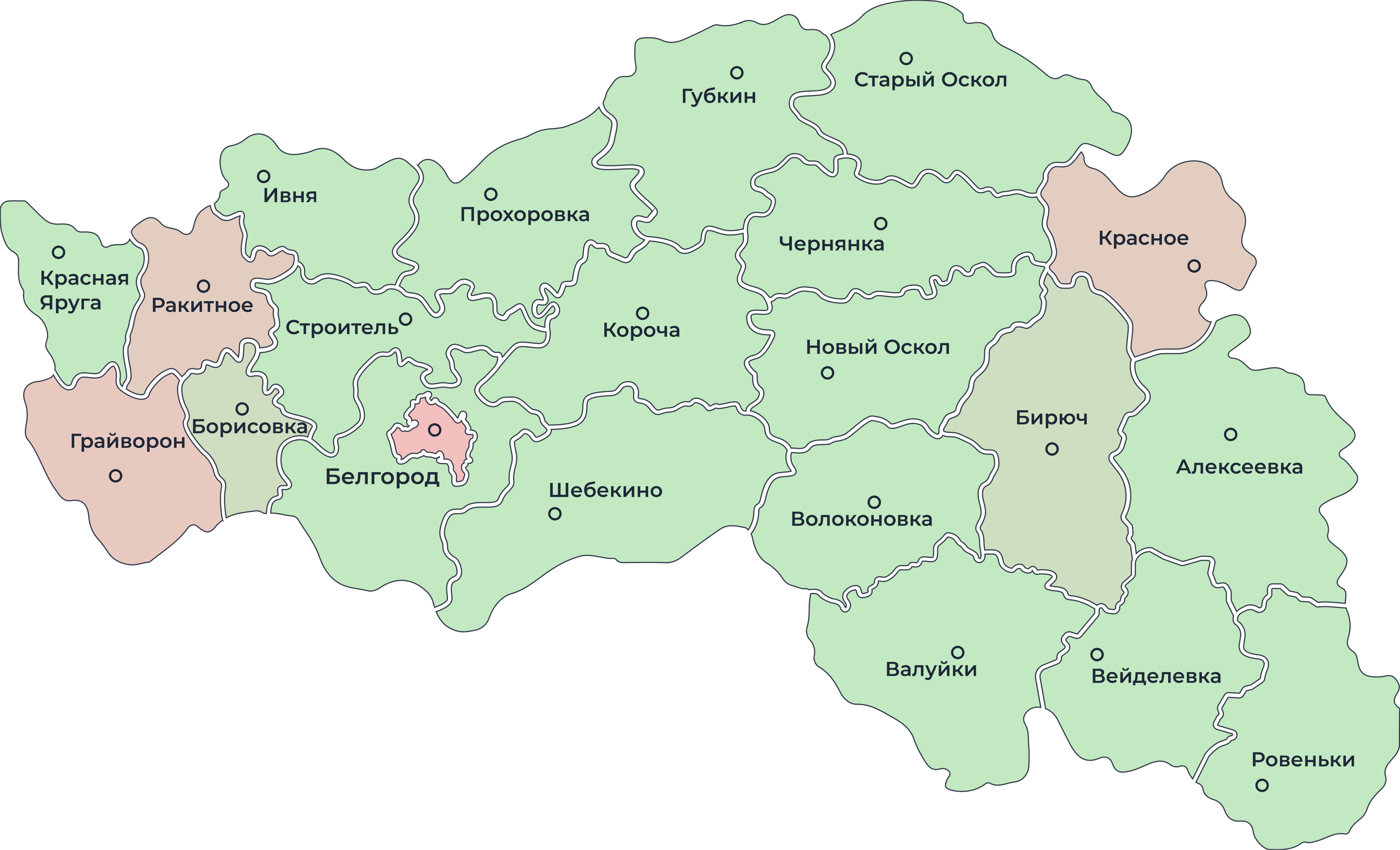
The regional government of Belgorod Oblast also published an overview of the performance of all districts. With one exception, the results in the overview correspond to those reported by the districts themselves. In 2024, all districts met their recruitment targets. In 2025, around one-third fell short, despite sharply reduced targets.
Unfortunately, Belgorod is not representative of a typical Russian region because it is situated on the front line, so it doesn’t tell us much about overall recruitment dynamics in the rest of Russia. The shrinking local population and the security situation are most likely the reasons why Belgorod’s recruitment target was reduced so sharply in 2025. Here is a map of Belgorod’s districts, colored according to their recruitment KPI performance in 2025:
Meanwhile, the districts’ explanations contain some very interesting details that shed light on recruitment dynamics and methods. Some districts are exceptionally generous with the data they share. In Veydelevsky District, for example, district head Anzhelika Samoylova writes in her report that 233 men joined the army between February 24, 2022, and December 31, 2024: 80 through mobilization in late 2022 and 153 as contract soldiers.
The report also provides a monthly breakdown of recruitment in 2024, when the district’s target was 62. It shows a major effort late in the year, particularly in November, when 13 men were recruited. The district was probably pushing hard to reach the target on time. In December, recruitment slowed to six men, ensuring that the target was met while avoiding significantly exceeding it. The district’s official population is 20,000, so a target of 62 in 2024 was equivalent to 0.31% of the population, close to Russia’s overall recruitment rate of 0.3% (427,000 out of 143 million).
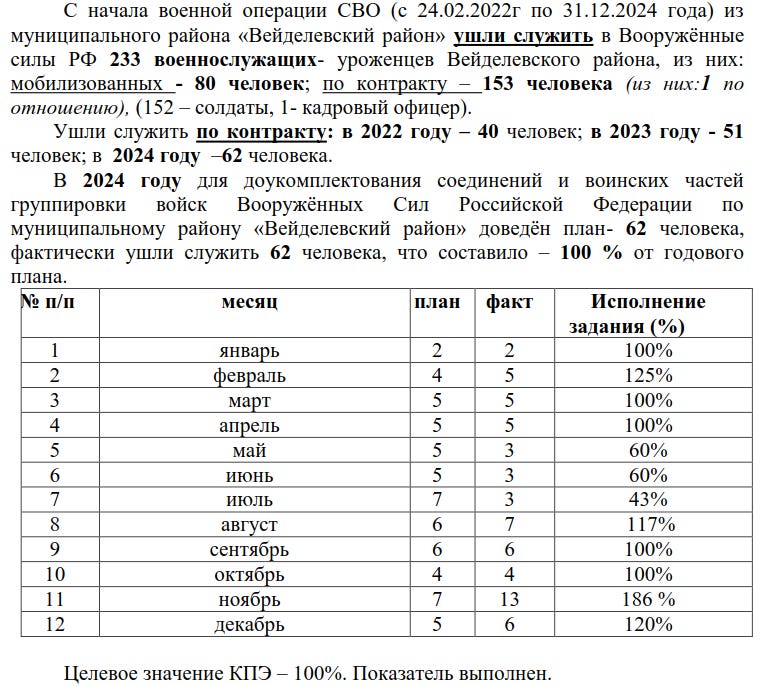
All districts apparently tried to meet their targets without recruiting more men than necessary. This makes a lot of sense in a quota system: if a district head sees that more men are willing to sign contracts than are needed to fulfil the target, she will try to shift some of them into the following year.
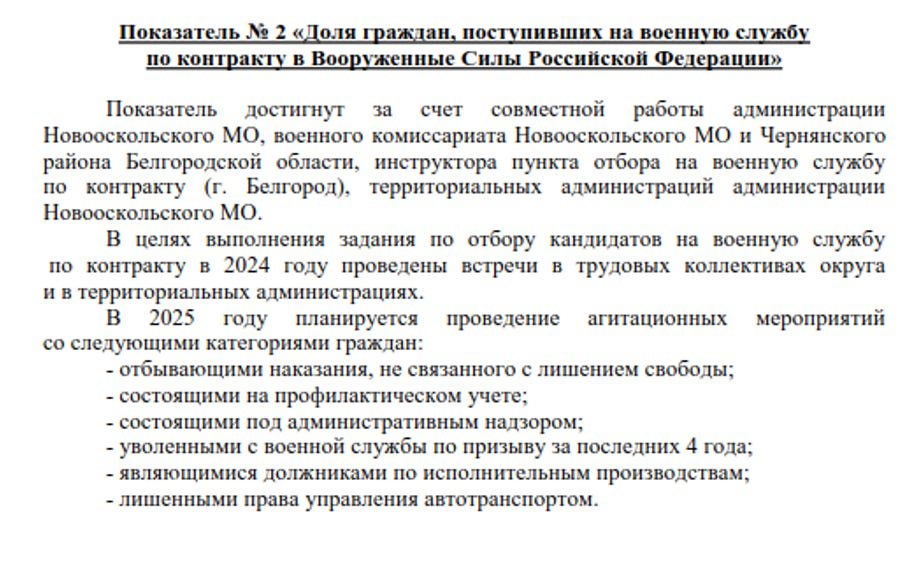
The reports also reveal quite a lot about how recruitment targets are met. It seems that cases in which a man simply walks into a recruitment center to sign a contract are relatively rare. Instead, there is considerable systematic pressure: districts draw up lists of potentially “suitable candidates” and repeatedly contact them for “conversations,” including through visits to their homes and workplaces.
For example, Novooskolsky district reports that it focuses on certain categories of citizens:
men serving non-custodial sentences;
men registered for preventive monitoring;
men under administrative supervision;
men discharged from compulsory military service within the past four years;
debtors subject to enforcement proceedings;
men disqualified from driving motor vehicles.
The role of law enforcement in recruitment is quite significant. Districts claim to cooperate closely with local police, bailiffs, and investigative bodies in finding contract soldiers. Municipal reports from other regions of Russia confirm this. For example, the local police in a district in Khabarovsk Krai reported that it had conducted 2,500 talks with potential recruits in 2025 and managed to convince 28 suspects under investigation, three other Russian citizens, and one foreign national to sign contracts. The district has a population of 55,000, so its total recruitment target was probably around 180, meaning that law enforcement contributed almost 20% of the target (assuming it was fulfilled).
Many reports from Belgorod Oblast also mention less aggressive measures, such as printing leaflets, putting up billboards, or informing people about the financial benefits of military service. Overall, however, it is easy to imagine how the head of a settlement might use all kinds of formal and informal methods to pressure individuals in the local community whom they consider promising recruitment prospects.
Some districts complained in their reports that it was difficult to meet their quotas because so many people had left Belgorod Oblast, shrinking the pool of suitable candidates. They reported difficulties recruiting effectively amid constant attacks and evacuations. Some reports also said that the high wages offered by local businesses made military service less attractive.
One particularly interesting complaint came from Krasnensky District, which failed to meet its quota in 2025. The report says that the local task force had successfully convinced several men to sign up for military service, but that they changed their minds at the last minute and went to another region to sign contracts there, presumably to receive a higher sign-on bonus. This shows that men shopping around for the highest bonus are a relevant factor in Russian recruitment.
After reading the reports from Russian districts and settlements, there should no longer be any doubt about the multilayered hierarchy of targets that underpins Russia’s recruitment system.
Using Belgorod’s dataset, it is possible to cross-check recruitment estimates based on regional budget data. In 2024, the confirmed total from district reports (around 3,900, including estimates for the missing data points) is higher than the number of payouts from the regional budget, which stood at around 2,900. In 2025, however, the number of payouts from the regional budget was much higher (around 2,700) than the estimated total from the district reports (around 1,400 - unfortunately, the data is more patchy in 2025). This indicates that some payments for recruits signed in 2024 were not made from the regional budget until early 2025, and that the pace of budget payments reflects the recruitment situation a few weeks earlier rather than the situation at that moment.
Finally, almost all district recruitment targets in Belgorod were closely correlated with district population size, at least in 2024, before the drastic reduction in the overall quota. Each district had to recruit around 0.3% of the local population in 2024. This is very close to the target for most Russian regions suggested by the data previously presented on this blog.
P.S. A new report on regional recruitment data from recent months will be published soon!
No posts
Comments
Nothing yet. Say the first thing.
Sign in to join the conversation.