
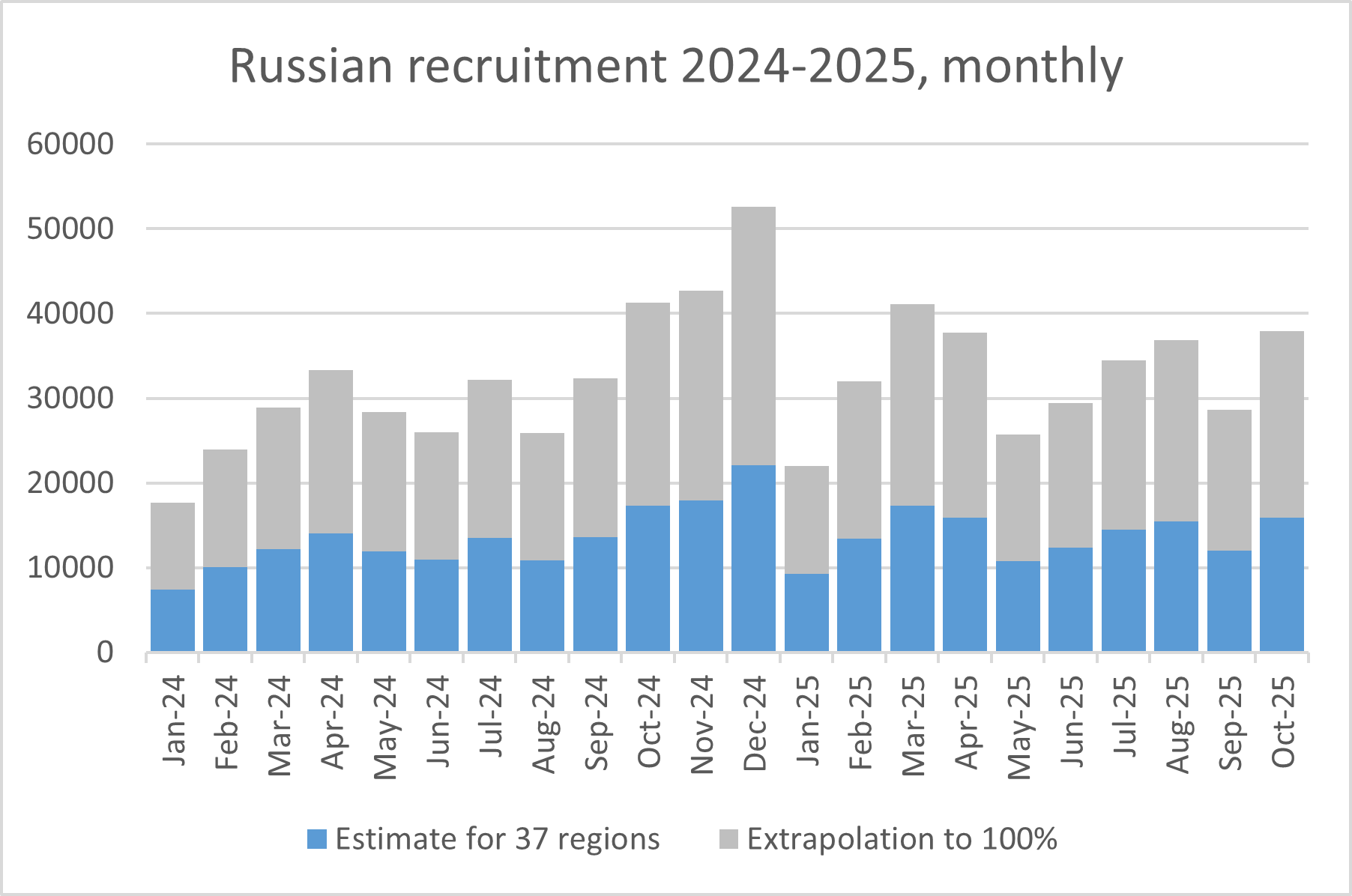
Recently, there has been a lot of noise surrounding Russian recruitment. Over the last months, payouts were significantly decreased in a number of regions. Then, a few days ago, Russia passed a new law on the mobilization of reservists, leading to speculation that the Kremlin may initiate another round of forced mobilization. However, regional data suggests that Russian recruitment remains stable - with around 30,000 contracts signed per month. The October estimate is even higher, at 37,938 new contracts. Last year, the number for October was 41,292. In the final months of 2025, the data could be somewhat inflated because the budget cycle leads to more payments late in the year.
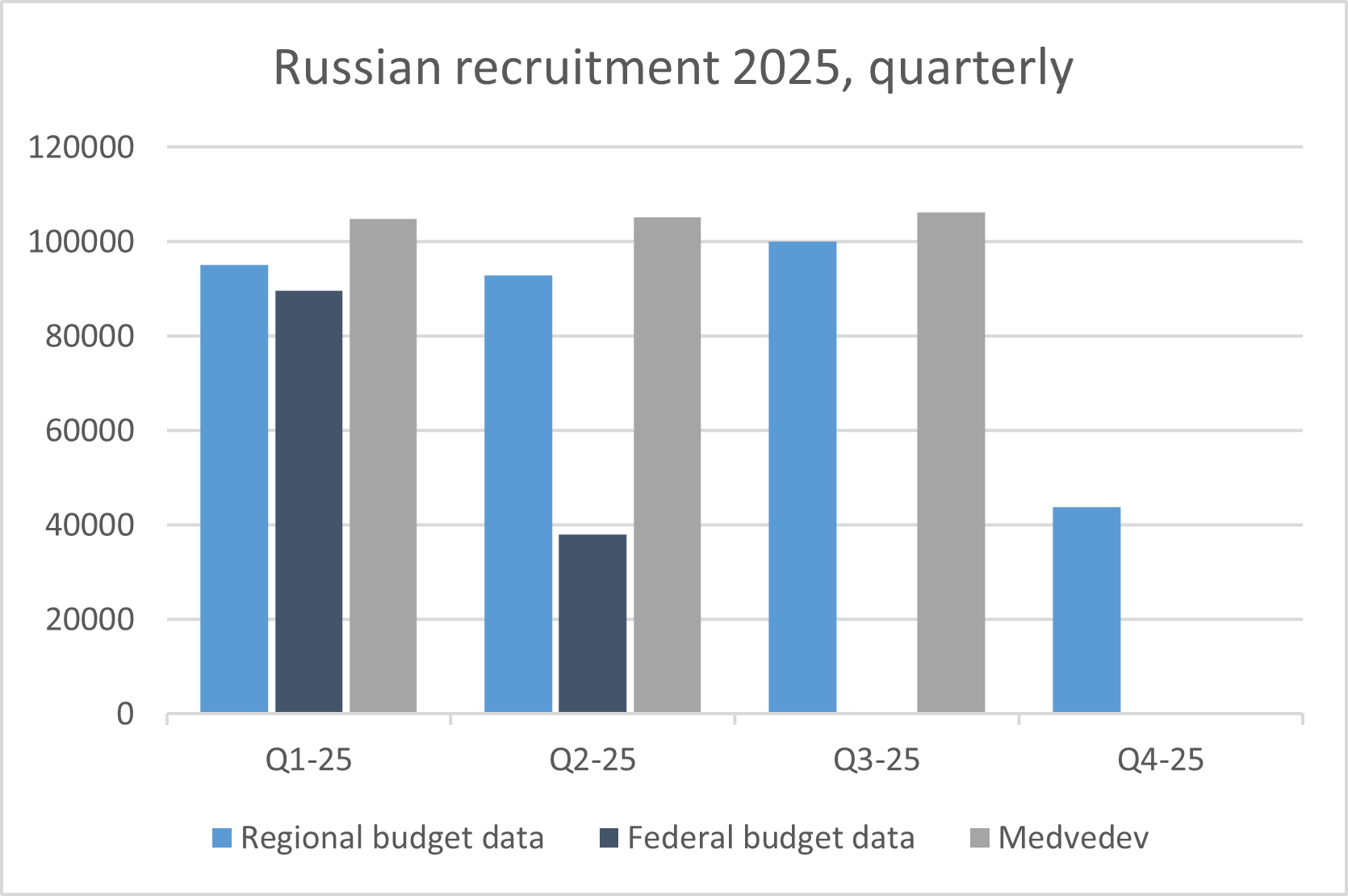
On October 17, Dmitri Medvedev claimed that Russia managed to recruit an additional 336,000 men for the military in 2025. This number implies that over 100,000 new contracts were signed in Q3 of 2025 (after Q2, the total was 210,000). It is close to the estimate for Q3 based on regional budgets (99,994). Medvedev’s quarterly numbers have been rather stable in the past. However, given the top-down approach of Russian recruitment (regions must fulfill their quotas - or else), this stability is not necessarily unrealistic: In this system, recruitment difficulties would rather manifest as desperate measures by regional governments to fulfill their quotas (e.g., higher bonuses, semi-forced recruitment) before the national total significantly falls.
Unfortunately for Russia watchers, there was another indication that federal budget data may no longer be useful for recruitment estimates. In a budget listing published with the 2025 budget amendment law in September, the recruitment line item was missing. In the Q2 listing, spending on that line was already unrealistically low, possibly indicating that it was being transferred to the classified part of the federal budget. The next budget report is due in a couple of days. Then, there will be more clarity.
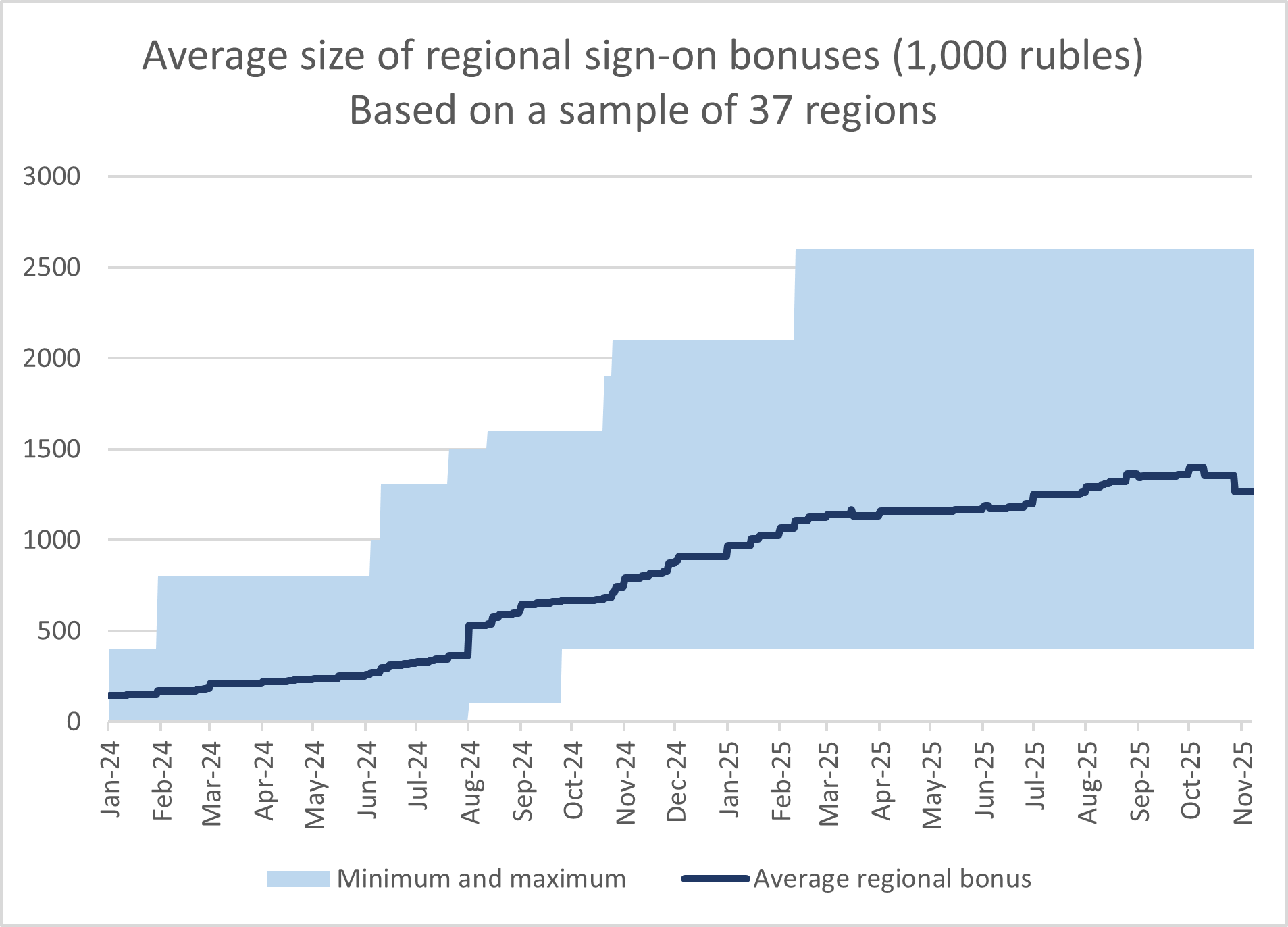
Several regions have cut their bonuses in recent weeks. Three examples from my dataset are the Republic of Mari El, Orenburg Oblast, and Saratov Oblast. These regions have several things in common. Based on regional data, they recruited more than the average Russian region this year and spent a large portion of their budgets on recruitment. As the year comes to an end, these regions have likely considered both budget and recruitment pressures - and decided to prioritize budget balance.
The country’s economic slowdown has had a particularly negative impact on regional budgets. A significant portion of regional tax revenue comes from profit taxes, which have decreased year-over-year, even before adjusting for inflation. Business profits are under pressure due to high wages (tight labor markets), high interest rates (central bank policy to combat inflation), and falling demand.
Of course, the war is generally more important than budget balance. The regions that lowered their bonuses could only afford to do so because they overachieved in the past and - most likely - already fulfilled their quotas. Meanwhile, regions with lower recruitment figures (e.g., Tambov) have recently increased their bonuses.
Regional data on war casualties is much sparser than recruitment data. The method to estimate war-related deaths is similar, but only 13 regions currently provide usable data in their budget listings. Nevertheless, this data could lend credence to some of the higher Russian casualty figures that have been circulating lately. Maybe not the the “100,000 since January” Marco Rubio mentioned in July, or the “60,000 killed in July” that he stated in August. But 5,000-10,000 killed Russians per month could easily be supported by regional budget data.
The 13 regions under observation comprise only a small subset of Russia; just 17.8% of the Russian population lives there. In recent months, these regions have paid out compensation for an average of over 50 killed soldiers per day (in October 2025, for example, there were 53 KIA payouts per day in the 13 regions). Although the payouts fluctuate considerably and there is one outlier region in the sample (Bashkortostan), the data still supports estimates of over 200 Russian war fatalities per day.
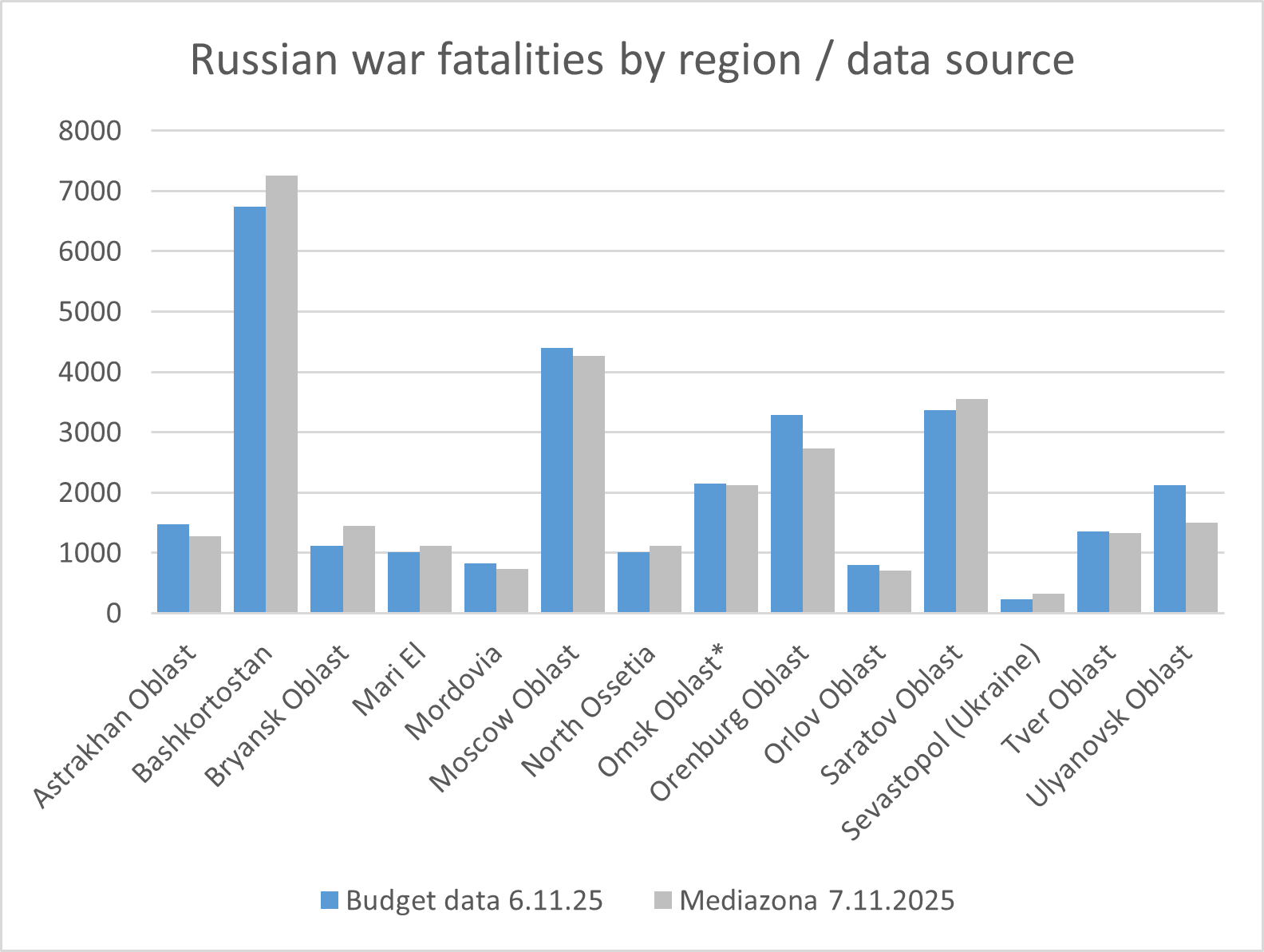
This is not a precise estimate. There could be distortion in the data in either direction. While there was a significant increase in payouts in 2025, the cause is unclear. It could be due to a higher number of eligible families (i.e., more killed contract soldiers), or it could be due to the bureaucracy not processing payments at a consistent rate, which would distort the estimate. At the same time, the number of payouts should represent the minimum number of actual casualties, not the ceiling, because not every soldier has relatives who are eligible for a payout, and not all eligible relatives receive their payment.
All charts are based on official data published by Russia’s Finance Ministry, Mediazona data is from the 200 project, sign-on bonuses are based on Russian news reporting and official statements.
No posts
Comments
Nothing yet. Say the first thing.
Sign in to join the conversation.