
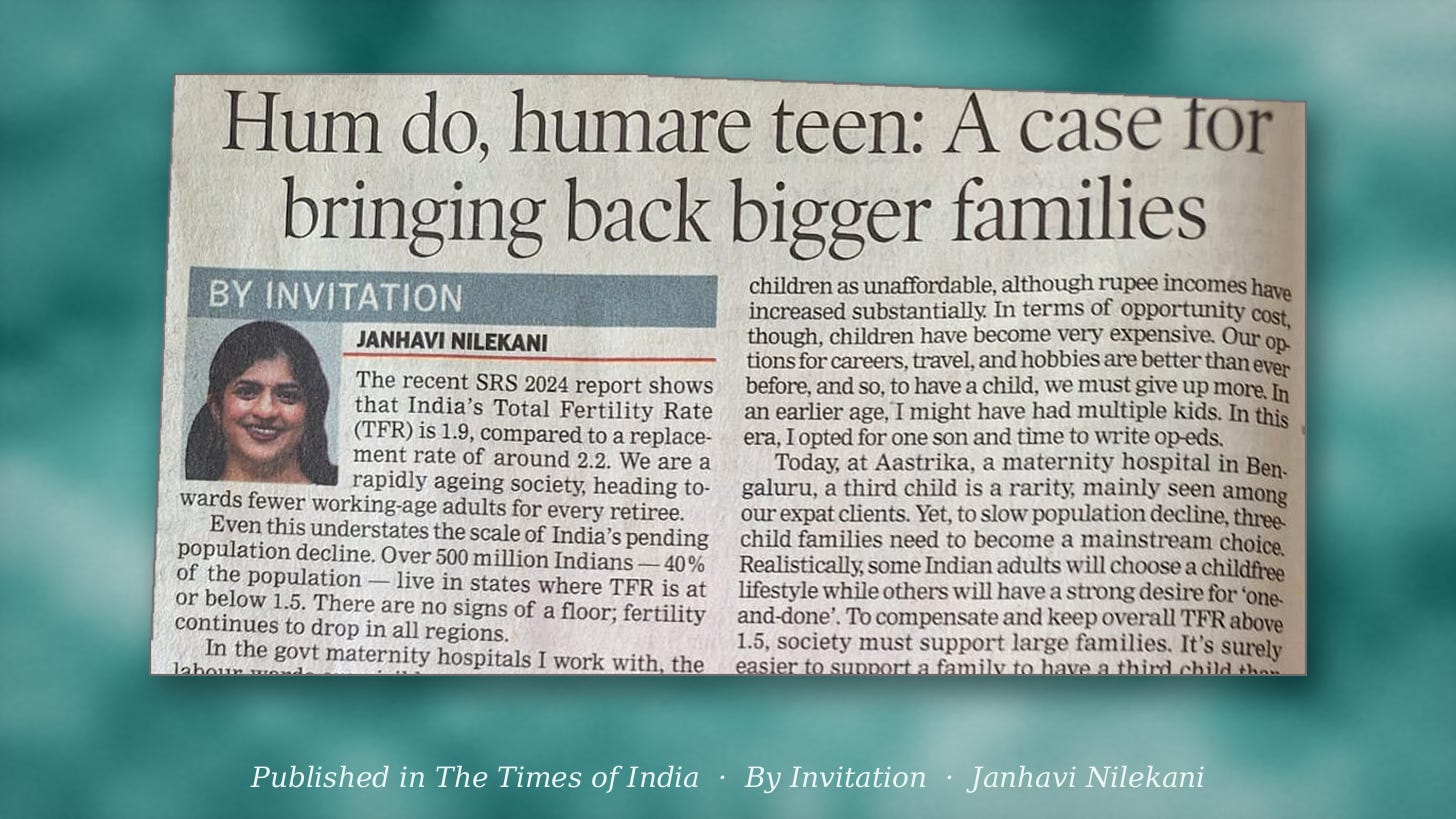
I had the opportunity to write for Times of India on India’s collapsing fertility rates - a policy issue I am very concerned about! My op-ed is titled “Hum do, humare teen: A case for bringing back bigger families” and is available here.
This blog post provides data, calculations, and citations.
All fertility, mortality, and sex-ratio figures are from the Sample Registration System (SRS 2024) and used throughout the calculations.
Primary Source: Sample Registration System Statistical Report 2024, Office of the Registrar General & Census Commissioner, Ministry of Home Affairs (released May 2026).
The recent SRS 2024 report shows that India’s Total Fertility Rate (TFR) is 1.9, compared to a replacement rate of around 2.2.
Total Fertility Rate is 1.9 [SRS 2024, TFR by Residence, India and Bigger States/UTs, Statement 24, p. 85]
The replacement rate is around 2.2, rather than 2.1, due to skewed sex ratios and higher mortality rates, compared to developed countries.
Replacement rate calculations: Replacement-level fertility is the TFR at which a generation exactly replaces itself: 1 ÷ (female share of births × female survival to adulthood). The familiar 2.1 assumes a near-natural sex ratio (about 952 girls per 1,000 boys) and very low child mortality. India’s sex ratio at birth is 918 girls per 1,000 boys [SRS 2024, Sex Ratio at Birth by Residence, Table 35, p. 67], so girls are only 918 ÷ 1,918 = 47.9% of births, and the under-five mortality rate is 28 per 1,000 [SRS 2024, Under-five Mortality Rate, Statement 53, p. 169], implying about 97.2% survival to age five. This gives a replacement rate of 1 ÷ (0.479 × 0.972) = 2.15; using stricter survival to reproductive age (~96%) it rises to about 2.17 or 2.18. This is rounded to 2.2 in the op-ed.
Over 500 million Indians – 40% of the population – live in states where TFR is at or below 1.5.
Eleven states and union territories had a TFR at or below 1.5 in SRS 2024 [TFR by Residence, Statement 24, p. 85]. Their projected 2026 populations [NCP, Population Projections 2011–2036]:
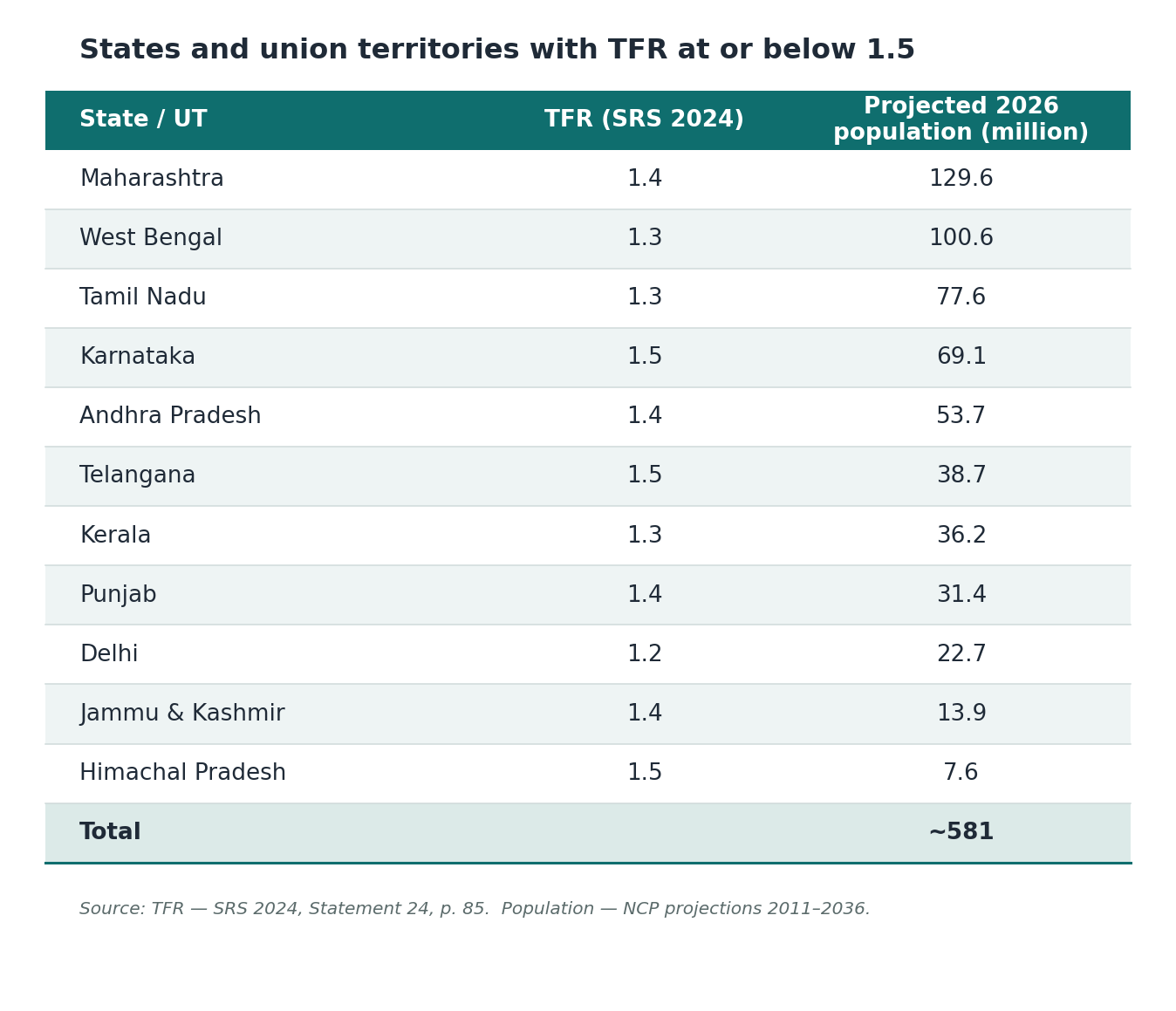
581 million ÷ 1,429 million (projected national population, 2026 [NCP]) = 40.6% — more than 40% of Indians, over half a billion people.
Source: NCP — Population Projections for India and States 2011–2036, Report of the Technical Group on Population Projections, National Commission on Population, Ministry of Health & Family Welfare (2020).
Annual births peaked at ~29 million at the turn of the millennium. Today, around 23 million babies are born each year… The absolute number of children has already peaked in 2010, and has been falling since.
Source: Rukmini S, Is India’s Demographic Dividend Over?, Data For India (November 2025).
37% of married Indian women aged 15 to 49 are permanently sterilised.
Source: 37% of currently married women aged 15–49 [NFHS-6, 2023–24, India Fact Sheet]. Source: NFHS-6 — National Family Health Survey (NFHS-6), 2023–24: India and State/UT Fact Sheets, International Institute for Population Sciences (released May 2026).
Sikkim and Andhra Pradesh have moved in that direction [toward pronatalism].
Andhra Pradesh, cash incentives for a third and fourth child — Andhra CM Naidu promises cash incentives for third, fourth child, Business Standard, 16 May 2026.
Sikkim, maternity leave, salary increments and IVF support — Leave, pay hike, more: In Sikkim, get rewarded by having more kids, EastMojo (PTI), 16 January 2023.
Maternity leave benefits are 26 weeks for the first two children, and only 12 thereafter. Income-tax relief for education applies only for the first two offspring.
Maternity leave: Maternity Benefit Act, 1961 (No. 53 of 1961), s. 5(3), as amended by the Maternity Benefit (Amendment) Act, 2017 (No. 6 of 2017) — 26 weeks for a woman with fewer than two surviving children, 12 weeks for the third and subsequent children.
Children’s education tax relief: Income Tax Act, 1961 (No. 43 of 1961), s. 80C and s. 10(14) read with rule 2BB, Income Tax Rules, 1962 — the tuition-fee deduction and the children’s education allowance exemption are both confined to two children.
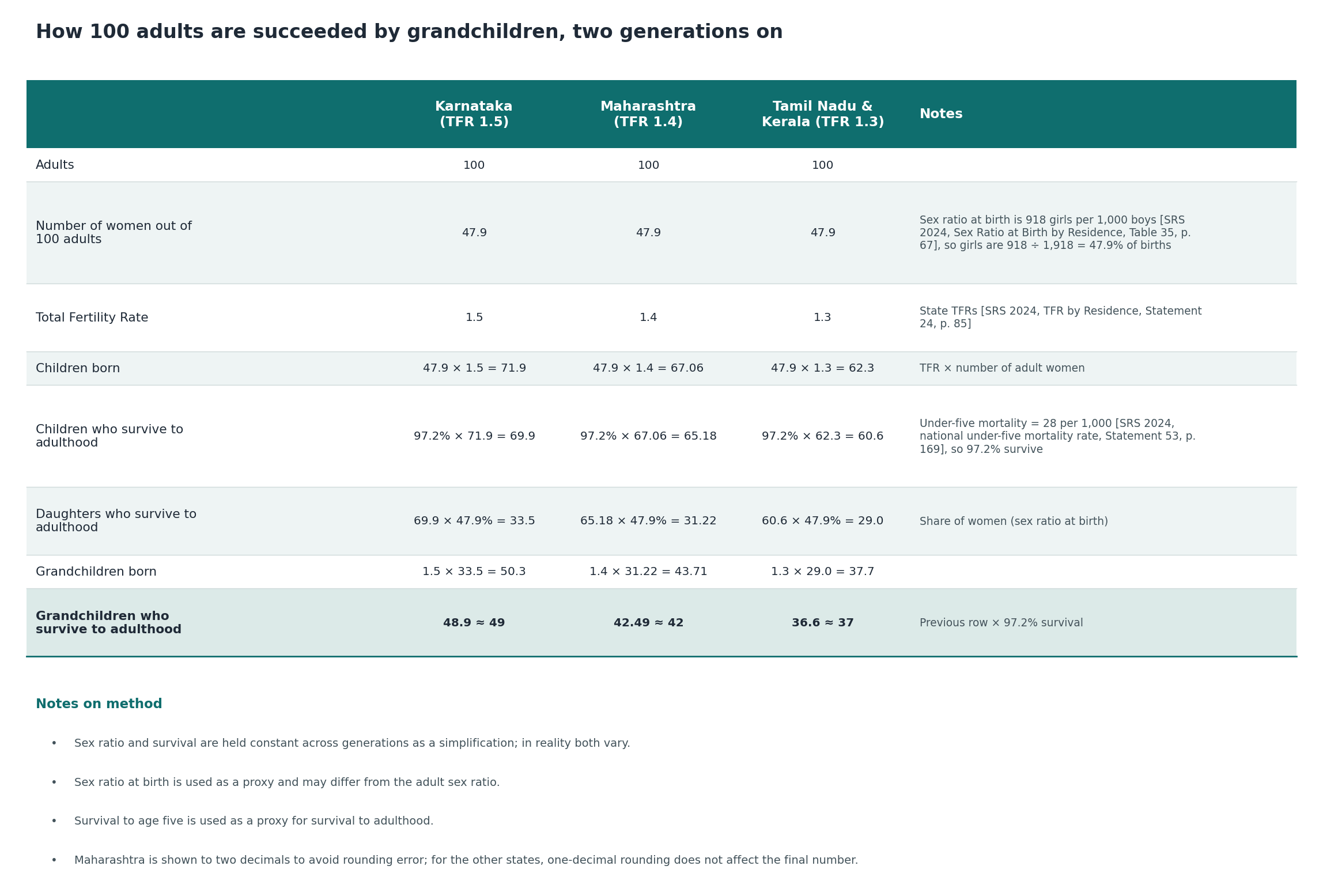
Every 100 Indian adults are succeeded by just 49 adult grandchildren in Karnataka, and only 37 in Tamil Nadu and Kerala. Maharashtra is also added to the table below.
No posts
Comments
Nothing yet. Say the first thing.
Sign in to join the conversation.