

Injustice anywhere is a threat to justice everywhere. We are caught in an inescapable network of mutuality, tied in a single garment of destiny. Whatever affects one directly affects all indirectly. Never again can we afford to live with the narrow, provincial “outside agitator” idea. Anyone who lives inside the United States can never be considered an outsider.
-Martin Luther King Jr., “Letter from Birmingham Jail”
On Martin Luther King Day, I met some of the other resident scholars and staff in St. Cloud for a talk on “Letter from Birmingham Jail.”
I was late. I’d driven into St. Cloud earlier that day for a doctor appointment. And then stayed, killing time so that I didn’t have to drive back to Collegeville in between. I left the bar where I had stopped to eat and write with plenty of time, but my phone was dying, and (as anyone who knows me will tell you) I am bad at directions, so the instructions I’d scrawled to myself on a scrap of paper were insufficient navigation in the dark and the snow. I ended up at the wrong church, then finally found the right one, smaller and tucked to the side of a frontage road. The talk was in progress when I arrived, an interview-style conversation between a former journalist and Pastor James E. Alberts II, who, along with serving as the Senior Pastor of Higher Ground Church of God in Christ, is also one of the board members of the Collegeville Institute.
I’ve taught this letter to my students before. I’ve read it as a student myself. I imagine the talk was planned weeks prior, with the same idea as always—that King’s letter remains relevant, worth reading in any time and place.
Our particular time and place was central Minnesota, in the midst of the current ICE violence.
Reading is contextual, and everything landed differently that night.
At one point in the conversation, the interviewer asked Pastor Alberts about white moderates. Someone had sent in the question: “Who would the white moderates that King addresses in his letter be during the ICE situation we have right now? And what would Dr. King say to them?” Pastor Alberts responded as follows:
Dr. King didn’t hold back on what would collectively be called the participation of the white moderate that sees [injustice], holds on to an ideological belief that would speak against it, and does nothing. You’ll say it from the comfort of your own warmth and your own security, but you won’t say that in the picket line. You won’t say that in front of the people that need to hear it. You won’t correct your friends, family, circles.
“And you wouldn’t put your body on the line,” said the interviewer, referencing a comment Pastor Alberts had made earlier in the evening.
“You need to put your body on the line,” he echoed.
Someone else asked a questions about trainings—what kind of trainings King might have envisioned to engage in social justice work.
No trainings, he said.
“Just do it.”
A few days prior, I’d driven to a training for constitutional observers in Brainerd, Minnesota.
I was driving there because it was the closest training I could find to St. Cloud—an hour or so to the north. It was cold and windy and much less direct than I thought.
But there was something hypnotizingly beautiful about the way the snow was swirling in dizzying eddies over the country roads, too. And, after sitting in my apartment and watching the news cycle through one awful thing after the next for the past several days—something good about moving through them.
I was doing a training because I didn’t know what else to do, and here was one answer: Drive somewhere. See what others are doing and how they are doing it.
The training, run by the Immigrant Defense Network, was to-the-point. It was in a packed church basement, and at times felt a bit like the town hall meetings in Parks and Rec, but the presenter knew how to reign people in when they went on about the specific property laws in the county or random questions about Portland or ideas for how to keep your phone charged. She was clear and concrete. She was honest about ambiguities. She showed a video from the Cities—and then said: It’s not going to be like that here, in rural Minnesota. We aren’t going to have huge crowds showing up. We’re more spread out.
I took furious notes—on best practices for staying calm, on rights of people being detained and the role of observers, on logistical details about where to upload videos. And then I cried, a little, when the trainer spoke about how, in the midst of all of this, people keep showing up for their neighbors. How it’s horrible, but look at everyone here—we don’t know each other, but these trainings have never been this full, people coming and asking, What can I do? Food pantries springing up to help people staying in their homes. It is horrible and hopeful, all at once.
I cried at that, sitting alongside strangers with our coats half on, sipping coffee and tea out of styrofoam cups.
That keeps happening, the crying. I think, if you were to ask my sister, who knows me well, how often I cry, she would tell you that I don’t. I think most people who say that they don’t, mean they do so in private. But these past weeks, I have not been able to stop tears coming down my face in public. At the gym (in the middle of a news briefing) and at mass (during a homily from the one of the monks, a brief and quiet reading about how scripture deals with its kings) and during silent meditation at an Episcopal retreat center up the road.
I feel guilty about this. Because I am a bystander, weeping from a distance. Because my citizenship is not in question when I walk down the street. Because people are harmed all the time, at different corners of the world—and injustice ought to be felt to the same degree, regardless of proximity. And I am crying in this way only now, when it is obvious and close.
I don’t know what to do with that. Within myself or here. Other than say this: Better to be uncomfortable than not. There is nothing good about what is happening, but given what is happening, it is good that a piece of writing from the not-so-distant past, like King’s letter, can reach into the present and feel not like a lesson in rhetoric—but like something you have to grapple with in your body. Where will I go. What will I do.
I don’t think that Pastor Alberts was actually knocking such trainings—but rather the tendency to think that they are a prerequisite to action.
Contemplation and discernment can be used in this way too. At times, people use discernment, not to precipitate action, but to forestall it. And so what I heard Pastor Alberts saying was: Don’t let the desire for training get in the way of acting. You can do something right now. You don’t need to wait.
I think this is actually why the slow process of reading and thinking that takes places in a classroom is all the more important. Because when the moment calls, it’s already there, for you to draw upon.
I’m thinking of sitting in that church listening to Pastor Alberts’s reading of King’s letter, which I had yet to reread but which was so clear in my mind as he spoke. I’m thinking of my former teachers, some of whom taught that letter to me. I’m remembering the teacher who introduced me to Catholic Social Teaching, when I was a middle school student with a slew of questions about the world and God, feeling everything deeply—primarily injustice.
And there she was, taking all of those big questions and not making them any smaller. But also saying: Here is a way to think about them. And then, to our entire class: What are you going to do? We were 11 and 12 and 13 and 14. But she made it clear, even then (like so many teachers do) that we not only could respond to injustice. We were obligated to.
I’m thinking of my own students, wondering if anything we read in my class and others’ classes is still swirling inside of them too.
On Tuesday, the day after the MLK Day talk, I went to a local laundromat to help with a program the Catholic Worker runs, providing financial assistance to people for their laundry twice a month.
It was my first time there, so the family with the shift before me showed me the system for distributing quarters and keeping track in a notebook.
It’s dead tonight, they noted. It’s normally really busy.
Flipping back through the notebook, this was clear—the other pages were filled, the current one was not.
This had come up in the volunteer email earlier that month, the fact that most of the people using the service were Somali families, and that people have been afraid to leave their homes. We haven’t had the same level of ICE presence in St. Cloud as in the Cities. But they have been here, and so the uncertainty and fear have been here as well.
The other volunteers left, and I stood stood at one of the counters, alternating between reading my book and handing out quarters and chatting with some of the women while they waited for their loads to wash or dry.
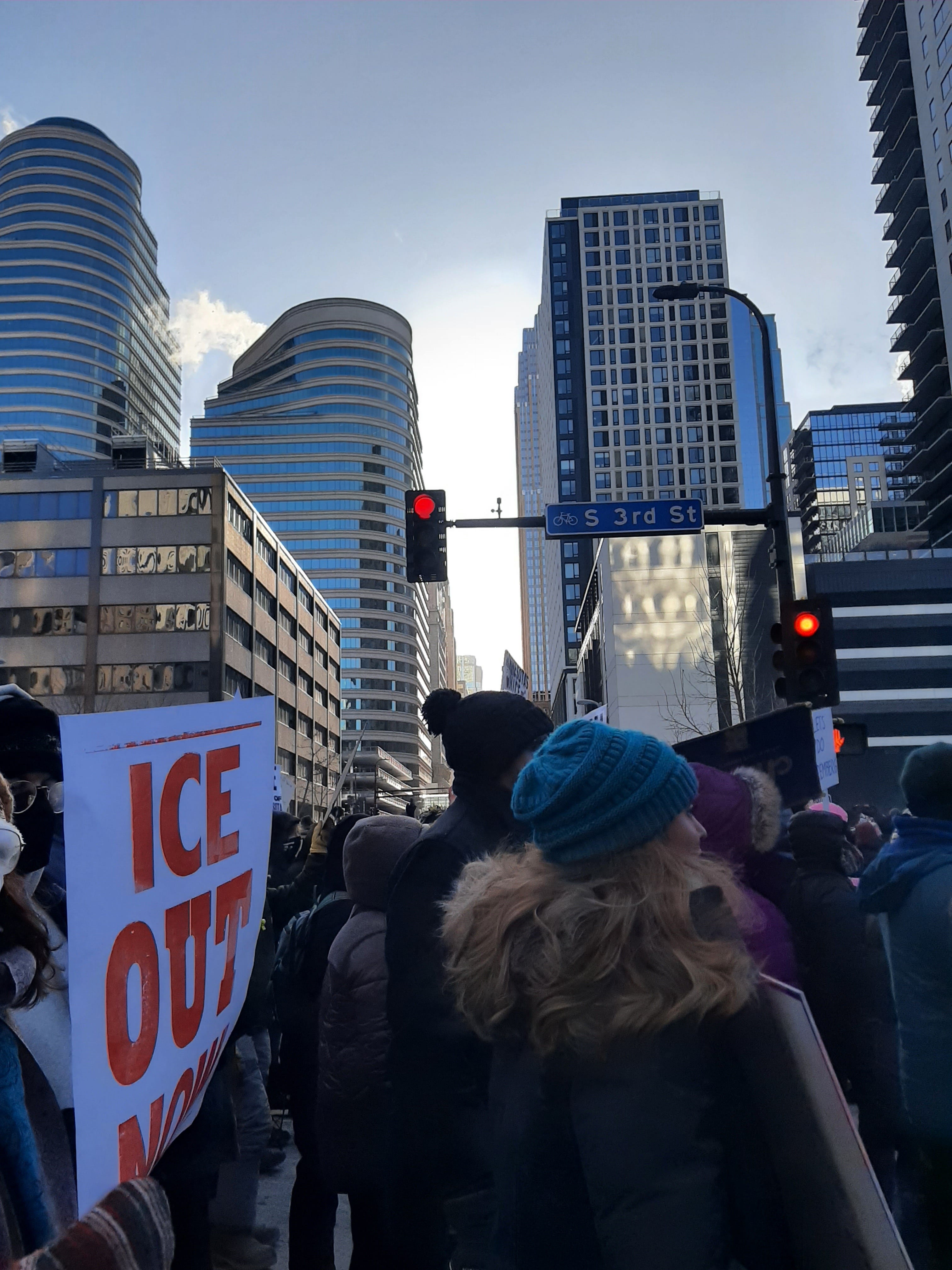
On Friday, three of us drove down to the Cities together for the protest.
We piled our warm clothing and signs and some food into my neighbor’s Jeep and got on the highway.
The roads into Minneapolis were eerily empty, quiet. We weren’t sure if it was the cold—negative 21 degrees when we started driving, about 10 degrees warmer in the metro, though colder with the windchill—or the economic freeze that had also been planned that day. But it was strange, akin to driving around during the height of the pandemic.
We parked a few blocks from my old high school, near St. Anthony Main. The entire walk to the march, actually, reminded me of high school—all of the streets were ones I’d walked down or run down or driven down during those years.
The march felt smaller than we thought, starting out. I couldn’t see as well as I would have liked—my glasses immediately fogged up and then froze, like a windshield with no wipers. I could see enough, though: a mass of signs, everyone bundled up head to toe and inching forward. There were local faith and union leaders speaking at the front of the procession, leading call and response.
When we got to the Target Center, which had been designated as a warming center, there were volunteers from local unions who were helping to run people’s bags through security so that we could enter and sit down inside. We warmed up for a bit, but then left before the program of speakers started—our meter was running out, and we still had to walk back to the car.
It wasn’t until the walk back that the size of it all became apparent—we were leaving, but we kept passing people still making their way down the streets. We walked by the Minneapolis Public Library, which hadn’t even been on the route we’d taken, and the road was full of people walking.
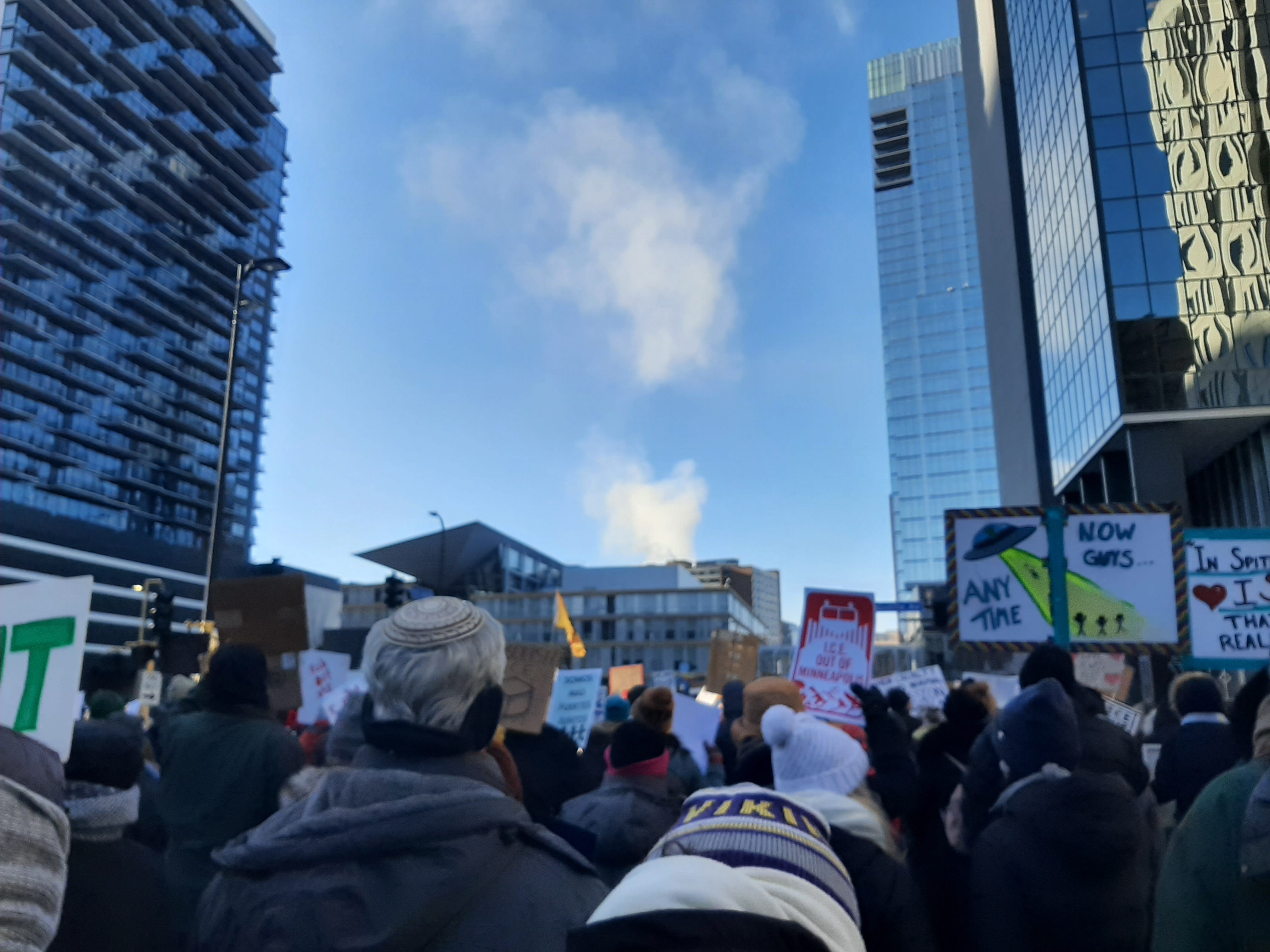
I am not typically much of a protest person. What’s the point? I usually think. Protests aren’t going to change anyone’s mind.
So what do they do? From the handful I’ve attended: They offer hope and a feeling of solidarity. Often through an expression of shared sorrow and anger and resolve.
From ones that I’ve witnessed others partake in: They bring attention to something that might otherwise be forgotten or dismissed. They don’t let people look away, even those who might want to.
On the drive back to St. John’s, the treeline across the cornfields was dark over the snow, lit from behind by the sun. Everything felt like it was plunging quickly back into quiet. And I felt, immediately, a tension: The march had been good, this sign of unity and the energy coming forth from it. But I did not, actually, want to feel good about it; such a feeling was too close to complacency. How easy it would be, I thought, to retreat back to the woods and become one of King’s white moderates, counting this as an action completed, while of course, nothing has changed.
A protest looks like action—but it is also a site of contemplation, particularly when we look at it from a distance, whether that distance is physical or temporal. What do I make of this? What do I do with this?
What next?

The morning after the protest, I wrote a little about it, adding to things I’d started to draft earlier in the week, a kind of gathering of pieces. Everything was half-thought out, fragmentary. As it remains, still.
I paused to read a story for an online workshop, and then just before, the news broke about another shooting in Minneapolis.
It was shocking but hard to register fully. The updates were still coming when I left to join the workshop.
We were all coming from different states. Wisconsin, Ohio, Oregon, Mississippi. We talked about what was happening. And then we discussed the short story.
It feels strange to transition from the disbelief of what is unfolding to ordinary practices like this. But also necessary—to pause and gather, even virtually, with other people. To talk about what others are thinking and writing and making.
After the workshop, I watched the press briefing from the police chief and the mayor and the governor. Then jumped on Instagram and saw what friends were posting. About the news and about continued efforts by local businesses and churches and organizations and individuals.
Later that evening, more details came about Alex Pretti: who he was and how his neighbors and coworkers and family described him. His work as a nurse and his commitment to social justice. Put your body on the line, I recalled. He’d done that. The people providing mutual aid, and continuing to document and observe, and showing up to mourn together were doing it too.
You deplore the demonstrations that are presently taking place in Birmingham. But I am sorry that your statement did not express a similar concern for the conditions that brought the demonstrations into being. I am sure that each of you would want to go beyond the superficial social analyst who looks merely at effects and does not grapple with underlying causes.
-Martin Luther King, Jr., “Letter from Birminham Jail”
A few things that I want to say: I’m not planning to change what I write here. By that I mean: I’m planning to keep writing the way I always have, about the things I’ve always written about. I’m writing about what’s going on with ICE in Minnesota because it feels impossible not to. That’s how fundamentally altered the texture of daily life feels right now, even at a remove from the Cities—I can’t think about teaching and writing and reading without the current climate intersecting with it.
I also mean: I’m not planning to change what I write. But I wasn’t planning to write about this at all. And I don’t really know what’s coming.
I have a backlog of posts that feel trivial to me right now. But I may post them in the coming weeks anyway. In part because I remember what it was like to teach through the pandemic, and, during that time, in order to keep teaching through it, I needed not to read about it all the time. This is not, of course, the same thing as living through the current circumstances in the Twin Cities. But I think there’s a similar truth: That in order to keep doing the work or living through the current threat to our communities, we will need all of the ordinary things too.
I do not have a lot to offer right now—in terms of words or actions. But seeing all of the grassroots responses spring up, I think it’s a mistake to see the smallness of what one has to offer and not offer it at all. One can always do something. And this is what I take in rereading King’s letter: There are always reasons to wait, always reasons why an action can be deemed the wrong response. Insufficiency can be one of them. Imperfection another.
So I’ll end by offering this lengthy list of “Ways to Support Minnesota’s Immigrant Communities.” It’s a snapshot of some of the current community efforts—and also a way to help from near or far.
Comments
Nothing yet. Say the first thing.
Sign in to join the conversation.