
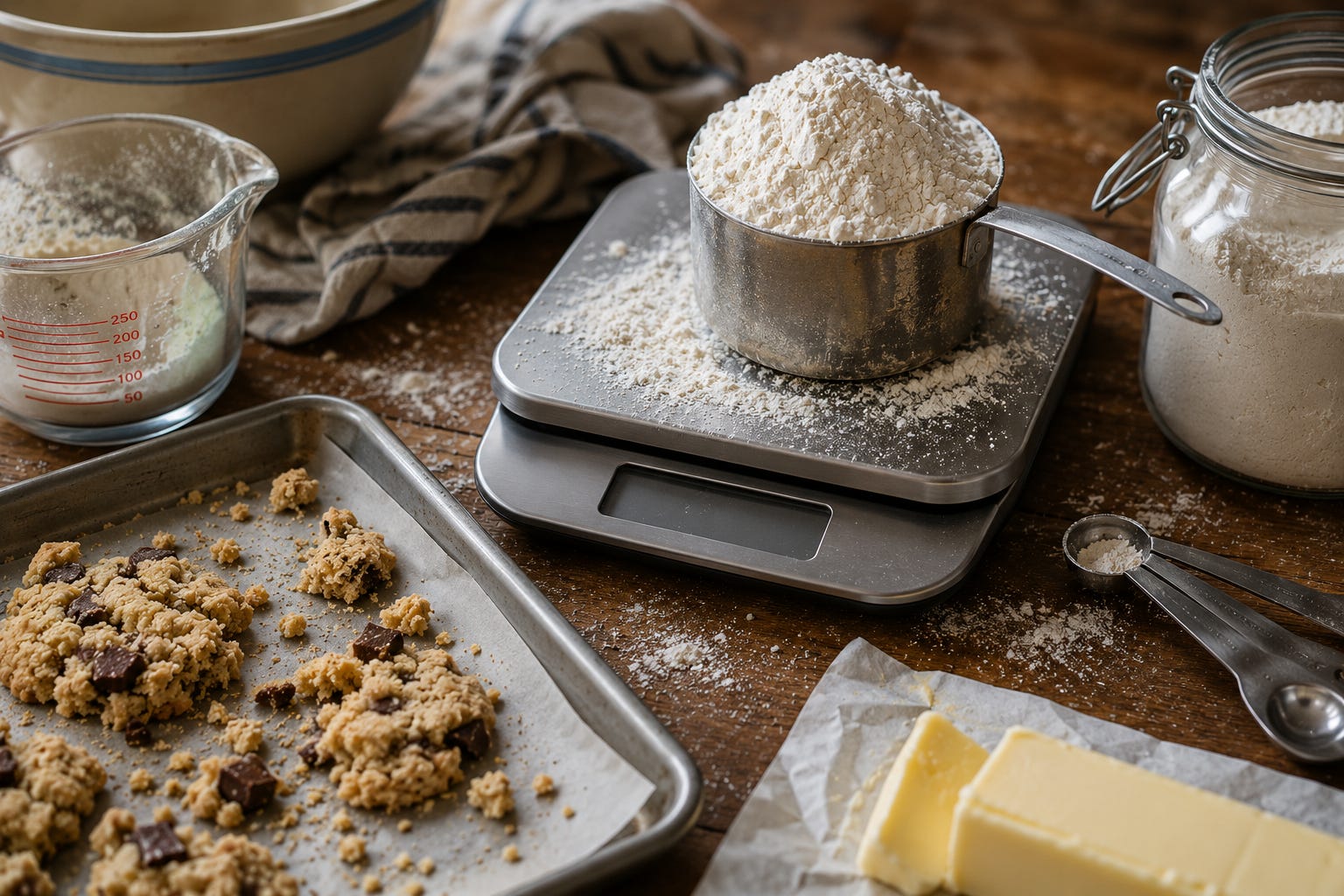
Yesterday, I made a chocolate chunk shortbread recipe from the New York Times and discovered that the amount of flour apparently weighs whatever you want it to. The recipe called for 2½ cups of flour, which it helpfully informed me was 325 grams. For reasons unknown, I decided to weigh the flour after measuring it.
The scale said 360 grams. Now, one would assume that a recipe published by a major newspaper—with a test kitchen, recipe developers, editors, and assorted food professionals—might have noticed that the two measurements don’t actually match. Apparently not. Faced with conflicting instructions, I split the difference. Shortbread is one of those recipes where there is nowhere to hide. It’s basically butter, sugar, and flour. Too much flour and you don’t get cookies. You get expensive chocolate-studded drywall. (I used good chocolate, not Hershey’s chips.)
I crumbled the entire batch and put it in the freezer. People always suggest noble second acts for baking failures—cheesecake crusts, trifles, ice cream toppings—but realistically, six months from now I’ll find the container, wonder what it is, and throw it away. I should have Googled it: 2 /12 cups of flour is 300 grams.
The experience sent me down a recipe rabbit hole. Why, for example, does every bean recipe begin with a can opener?
I don’t buy canned beans. Never have. Beans and chickpeas, you buy them dried in most grocery stores. Soak them for a few hours, ideally overnight, simmer until they’re tender, and carry on with your life. I understand why recipes use canned beans. They are predictable. Every can contains roughly the same amount, and cooks can proceed directly to the next step. Dried beans have minds of their own. Some cook in an hour, some take three. Recipe developers value certainty. Still, I find it odd that we’ve reached a point where recipes assume everyone owns canned beans but nobody owns a pot. Canned beans also cost considerably more than dried and often contain additives and a surprising amount of sodium.
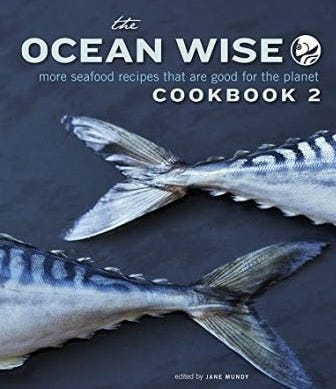
I’ve spent enough time around recipes to know they’re hardly infallible. Years ago, I edited two Ocean Wise cookbooks. The first brought together 90 recipes contributed by chefs across Canada, while the second contained another 150. Before publication, there was a surprising amount of detective work involved.
More often than not, the ingredients didn’t match the method. I had to test every recipe and nearly pulled my hair out. For instance, halfway through a recipe, the instructions would suddenly say “add parsley,” even though parsley was nowhere in the ingredient list. Another recipe called for 1 cup of olive oil in the ingredients, but used only half a cup in the directions. Ingredients appeared from nowhere. Quantities mysteriously changed. These weren’t amateur recipes. They came from talented professional chefs.
That’s because professional cooks don’t really cook from recipes. Most chefs use recipes as rough road maps. In restaurant kitchens, people cook by experience, instinct, and repetition. Measurements become suggestions. Directions become shorthand. Then some poor editor has to translate that shorthand into something the rest of us can follow.
After working through hundreds of recipes, I developed a healthy skepticism. So, when my scale reads 360 grams and a recipe calls for 325, I’m reaching for another scale and checking the recipe twice.
Then I started thinking about culinary absurdities in the middle of the night, and my mind wandered, as it often does, to language.
Why, for instance, do people say “tuna fish”? Tuna is already a fish. Nobody orders salmon fish. Nobody grills halibut fish. Nobody catches cod fish. Somehow, tuna alone requires clarification, as though there might be confusion with the tuna shrub.
Food names in general are a linguistic mess. A cow becomes beef, a pig becomes pork, and a calf becomes veal. Yet a chicken remains a chicken whether it’s pecking around a farmyard or shrink-wrapped in the supermarket cooler.
Lamb is perhaps the strangest of all. We continue to call it lamb even after it reaches the dinner plate. Apparently, nobody in the marketing department ever considered that consumers might hesitate if menus advertised baby sheep. If black cod can become sablefish and Patagonian toothfish can become Chilean sea bass, surely lamb deserves a makeover. Lamb could be called lorker.
And then there are eggs. Buying eggs now requires more research than buying a used car. Free-range. Free-run. Organic. Omega-3. Pasture-raised. Vegetarian-fed. The last one always makes me laugh. A vegetarian chicken is about as natural as a vegetarian dog. Chickens are omnivores. Left to their own devices, they spend much of their day enthusiastically eating bugs, worms, grubs, and anything else unfortunate enough to cross their path. Yet “vegetarian-fed” has somehow become a premium selling feature.
In the end, the failed shortbread didn’t teach me anything new. Recipes are written by humans, and humans make mistakes. Editors miss things. Chefs forget ingredients. Newspapers publish measurements that don’t add up. And occasionally a few hours of baking ends with a container of cookie rubble sitting in the freezer beside the frozen peas.
That’s just the way the cookie crumbles.
Anyway, I’d love to hear your recipe rants. What’s the worst recipe mistake you’ve encountered? Missing ingredients? Impossible timing? A recipe that clearly wasn’t tested? Or perhaps a food term that irrationally annoys you.
Please leave a comment and make me feel better about my freezer full of shortbread rubble.
Comments
Nothing yet. Say the first thing.
Sign in to join the conversation.