
Today we’re going to be talking about a twist that lets us shift the frame of your mystery in a way your reader rarely suspects. To do so, we’ll need to dig into The Murder of Mr. Wickham by Claudia Gray.
This post continues my series on plot twists. Read from the beginning:
This novel, the first in the Mr. Darcy and Miss Tilney series, brings together ten Jane Austen characters who never met in the author’s original works. The Bennetts (Pride and Prejudice), the Brandons (Sense and Sensibility), and many others arrive for an extended house party at the estate of George and Emma Knightly (Emma). They are having a fine time until an uninvited guest barges in: George Wickham, the Villain of Pride and Prejudice.
The Knightleys are unable to turn Wickham away, since the weather is quite foul. But his presence makes everyone unhappy, because every character has been wronged by him in some way. When Mr. Wickham turns up dead—bludgeoned to death with a marble bust in the library—the plot turns into a classic locked room murder.
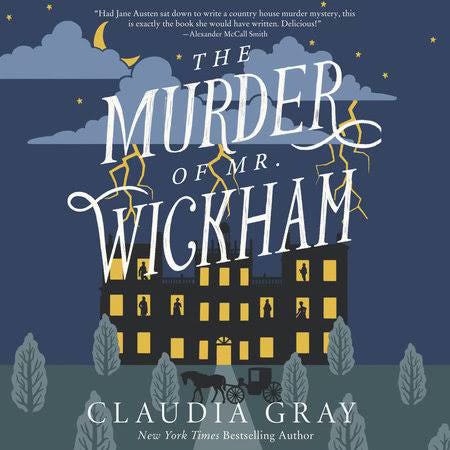
While I was reading this novel, I was completely baffled as to who the Villain might be. There seemed to be no options, since one hundred percent of the characters were either:
beloved Jane Austen characters, or
the children of those characters
And if you’re writing a book to appeal to the fans of Jane Austen—well, let’s just say you won’t get a lot of repeat readers by turning Lizzy Bennett’s baby boy into a killer.
The Villain had to be an established character. This was structurally necessary. The Villain could not be an Austen character. This seemed thematically necessary. But there was no one who could satisfy both requirements, so—who could it be?
We get the answer when Marianne Brandon (née Dashwood, Sense and Sensibility) confesses to the crime, in order to prevent her husband, Colonel Brandon, from being unjustly convicted. Marianne also tells us her motive: Mr. Wickham had cornered her in the library and attempted to rape her. She fought back, striking out with the marble bust and unintentionally causing Wickham’s death. Then, not understanding that her actions were legally justified, she tried to cover up her role in his death.
This ending solved the conundrum that had troubled me: it allowed one of the characters to be responsible for Wickham’s death, while leaving all of them morally intact and legally blameless. It also illustrates the Not So Murderous twist, in which we believe that a murder has occurred, but the death turns out to be due to:
justifiable self-defsense
suicide
accident
a natural medical event
In order to write a Not So Murderous Twist, you will need to create a death that fits one of these categories, and yet looks absolutely, unambiguously, like murder. Remember the Key Narrative, which we’ve discussed before. The reader can never be allowed to question the one lie upon which your plot is based. Which means, for this twist, that the reader can never doubt that a murder is exactly what happened.
This is easy in The Murder of Mr. Wickham, because the Victim’s death was due to self-defense—and so it’s possible for Wickham in a way that is violent, deliberate, and obviously caused by hands other than his own. It is more difficult in plots that revolve around a murder that turns out to be suicide, or a murder that turns out to be accident. But this is the circle you must square if you decide to tackle this twist.
The other difficulty in writing a Not So Murderous plot is that it tends to suffer from—well, from a lack of murder. And if you’re not careful, it can also suffer from a lack of clever scheming, shadowy secrets, and desperate danger—all the things that mysteries typically thrive on.
So it’s worth thinking about a way that you can work some of these things into your plot. Maybe the Victim arranged his suicide in such a way as to frame his heirs. Maybe the original death, which turns out to be Not So Murderous, nevertheless prompts additional crimes. Maybe an innocent perpetrator, like Marianne Brandon, engages in a deliberate coverup to conceal her supposed guilt.
Classic Plot Twist: Not so Murderous
Summary: We believe that a death is the result of murder, but it is not
Violated Belief: The Victim was murdered
Examples: The Murder of Mr. Wickham by Claudia Gray, Remington Steele, “In the Steele of the Night”
Want to keep reading? The next chapter is here:
Comments
Nothing yet. Say the first thing.
Sign in to join the conversation.