
In the preceding articles in this series on Art & Fear, I talk about work. Art is work. The process of creating is work. Let’s compare the drudgery of work to the concept of play.
I’ve always considered Montaigne the father of the blog—if there had been an internet in the 1500s. Michel de Montaigne lived in a vineyard in a wine-growing region of southwest France, where he took up an office in the attic of his castle, writing what he called essays. Translation: attempts.
These es-says, attempts, or discourses or whatever one wants to call them were Montaigne’s way of exploring the ideas swirling around inside his head, a way to better understand the world, and put down on paper the intricacies of living. He wrote about sorrow, the Divine, how to raise children, theories of idleness, happiness, the role of work, women, and, of course, death and dying. Montaigne examined the unexamined, or at least the unexpressed, breaking down experience (or in the case of writing about women—mansplaining). or memories and writing about them. Philosophical wanderings or thought experiments.
He tinkered with words.
Yes, he was a trust fund kid and didn’t have to worry about making a living, but my point is: He tried. He essay-ed. He attempted.
Another example is Julia Cameron with her trademarked morning pages. Put simply: free writing. Every morning, first thing, sit down with a blank book or blank page and simply blather. This kind of mind mapping or stream of consciousness doesn’t have to make sense, sequential, for follow a theme or arc. It is about letting your mind unravel, unwind its trouble and worries and prepare the writer for more focused work or to unleash gems that can be expanded upon or explored at length.
I’m also a fan of Sister Corita [Kent], an Immaculate Heart nun from the early 60s who experimented with serigraphy, the art of screen printing.
In this speedy world of ours when facts are multiplying rapidly and giant rearrangements are happening all around us, it seems dangerous to be made nervous by the new - to want what we can never have, to want things not to be rearranged. It would be better to be able to take the leap, which is to be able not only to live with change and newness, but even to help make it. Sister Corita
Corita Kent was born Frances Elizabeth Kent in 1918 to a religious Catholic family in Fort Dodge, Iowa and moved with her family to Southern California when she was a young girl. I imagine she and I might have had a lot in common as seekers, dwelling in the mysteries of faith and the universe. Upon graduating high school, she entered the Immaculate Heart of Mary order in Los Angeles and became Sister Mary Corita.
After a short stint teaching at an Inuit school in British Columbia, Sister Corita returned to the Hollywood Hills and Immaculate Heart College to continue her education and eventually went on to get a Master’s degree in art history at the University of Southern California. At Immaculate Heart College Sister Corita made a friend with Art Department director Sister Magdalen Mary who encouraged Corita to submit her thesis prints, “The Lord is with Thee” to the California State Fair, where it won first prize in 1951.
It was while attending art school that Sister Corita became interested in the democratic form of print arts; it was something relatively inexpensive to do, allowing most people to collect or own. She began with serigraphy or screen printing in the mid-1950s, with a DIY kit and carved out a studio and workshop space in the basement of the school.
Sister Corita’s niche or specialty was word art. At first this was seemingly didactic, straight-forward, where she shared her faith, God’s love, biblical messages, all with a twist, a certain tilt, causing the viewer to lean in closer, look harder, perhaps squint, to discover a deeper meaning. Read familiar words a new way.
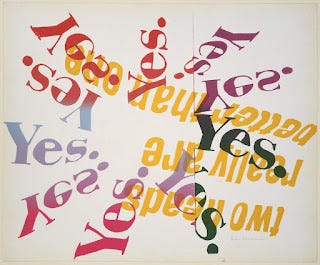
Then in 1962 Sister Corita attended the Andy Warhol “Soup” exhibit at the Ferus Gallery in Los Angeles. Warhol at the time was not a public figure and, though he became known for his screen prints, this first show were paintings. Paintings of Campbell’s tomato soup. Hardly a subject of any significance, but Sister Corita immediately got the message. It was about the meaning behind the meaning. Just as a still life wasn’t about the festive display or a bourgeoisie proclamation that one had made it—a bit like shopping at Whole Foods—but about mortality. All the luscious ripe fruits, the fresh game, flowers were but a moment, caught and held in paint. All this abundance is but a dream, which would eventually turn, corrupt, decay, stink. Therefore, transient. Like all of life.
If one thinks about it most of these still-life paintings were done during chaotic times: plague, wars, high infant mortality. There was no escaping the heavy hand of death.
Sister Corita sensed that the soup was more than soup, but rather a statement—certainly in a literal sense it catapulted Warhol onto the world stage—with much head-scratching.
Many struggling artists in New York City used sign painting as a way to augment their income, sometimes their only way to earn money. Commercial sign painting, word art, make it big, make it bold, make it red . . . led some into the Pop Art Movement, where not just the text, but the visual spoke louder than words. The word lemon without context is merely symbols on paper until the sign painter or artist takes those letters and with color choice, typography, and font transforms and imbues fresh meaning into the word. Pop Art played with the senses, a kind of transmutation, something Sister Corita connected with through the Eucharist. One has to be willing to let go of the literal and dwell in a spiritual realm; to believe.
Through a series of thought experiments and exercises, Sister Corita came up with the word Plork. A whimsical twist to work.
NEXT: Pop Art Nun Takes on the World
No posts
Comments
Nothing yet. Say the first thing.
Sign in to join the conversation.