

When is a weakness actually worth addressing?
In the previous two entries in this series, I argued against what might be called the default answer to this question, which is: every fucking time.
Now that I’ve made my case that a) our talent requires our weaknesses and b) embracing our weaknesses actually makes many things better, I think we can come at the question of addressing our weaknesses with a bit more nuance.
That is: once we know we don’t need to ameliorate our every weaknesses which ones actually are worth addressing? And how do we tell the difference?
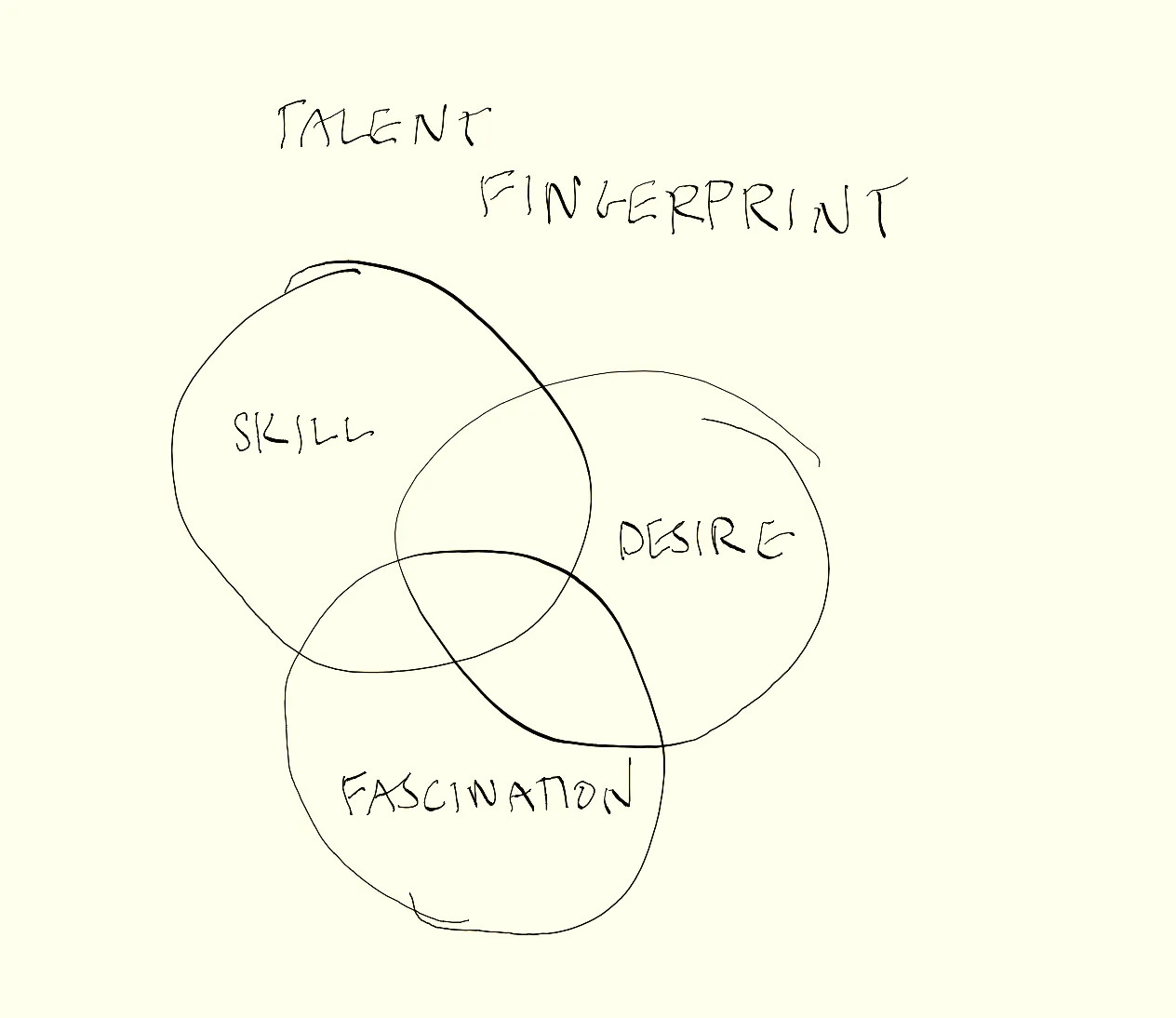
I want to come at the answer to this question via what I call your talent fingerprint. This is the place where your particular skills, passions, curiosity and drive combine with the unique way your brain works and your particular type of intuition. Your talent fingerprint marks out the things you find so engaging you’ll keep working to master them forever, as opposed to the things you lose interest in after the first few tries.
Where all of those things come together is as unique for each person as our actual fingerprints are. That means your talent fingerprint is also a kind of template or map: when you’re able to follow its contours, you have directions to a place where only you can go. Your talent fingerprint is like a blueprint for building your very own wheelhouse. In effect, it enables you to sort for which kind of work—including addressing weaknesses—is worth you taking on and which is not.

I created the concept of the talent fingerprint to highlight what I saw in my clients and myself: the peculiar and distinctive way that curiosity and passion direct and shape what we can do. What we call ‘talent’ is more the effect than the cause of that intersection. All the skill in the world can’t substitute for fascination, I once heard the radio producer Ira Glass talking about talent on some podcast, and he argued that what we call talent is really just a kind of obsessive problem-solving. You get good when you’re so obsessed with figuring out how to make something match your ideal that you don’t stop trying until you finally get there. Do that for enough years and you will probably have a pretty good radio show. Or novel. Or startup. Etc,
As that example suggests, addressing some kinds of weaknesses can be part of our talent fingerprint. Glass didn’t just say ‘I suck at X aspect of being a radio producer’ and give up. Instead, he followed his fascination, and it was strong enough that he spent his life iterating and problem solving until his results were really fucking good. He’s open about the parts of his work he’s less skilled at—he still has weaknesses—but clearly he resolved the ones that were essential.
When we focus on the ways that obsession, flow and passion do and (and don’t) come together for each of us, we have a way to identify what weaknesses are worth fixing and what we can just manoeuvre around. Now let’s look at some ways that these intersections can play out in practice.
First, take the sort of weaknesses we’ve discussed in the last two entries of this series. In these cases, the weakness didn’t touch on core skills, desires or fascinations, although as a lack of skill they did bring some downsides. When those key elements of the talent fingerprint are lacking, I’ve found it not worthwhile to treat the specific weakness as high on my agenda, unless it is actually causing me problems. Instead, I try to leverage the skills I have to make sure my deficits don’t penalise others. There no point trying to teach a fish how to walk when there are plenty of places it can swim to already.
On the other hand, let’s say that everything in your talent fingerprint is pointing in one direction, except for some weaknesses that are out of alignment. So you’ve got a wealth skill, intuition and obsessive interest, but you also lack ability or tend to screw up in some related or subsidiary areas. In this case, I’ve found it more useful treat the weakness like something that can be overcome.
For example, having a business has required me to do a lot of things that I am not good at or which feel pretty alien—so much so that even saying that I ‘have a business’ continues to sound odd to me—but no amount of mind-numbing spreadsheets will stop me from helping the people I want to help. So, even if I do often feel like a fish flopping around on a sidewalk, I’ve done what I need to do to figure it out, because that’s where my talent map is pointing me to go.
Then there’s a third category, which might be called perceived moral weakness. This one usually afflicts people who have strong commitments to service or transforming the world for the better. For this type, to know that they have the skills and focus to complete some big, beneficial project is to feel obligated to take on said project, whether they really want to or not. In fact, the knowledge that they don’t really want to do said Beneficial Thing often feels shameful in itself. Their lack of desire for the project registers as a moral weakness to be addressed.
If you’re in this boat, it is crucial to remember that wanting is part of the talent fingerprint for a reason. It is hard enough to do extraordinary things when we desire them in our bones. Desire and fascination are what make the energy we pour into our using talents renewable rather finite. If we keep trying to stretch ourselves without true desire, we burn ourselves down to ashes.
But the issue here isn’t just that we can wind up feeling used up and bereft. It’s also that our talent fingerprint is a kind of divining rod, and desire is a key part of how the rod functions. What we actually want to do is part of identifying the sweet spot where our wheelhouse can be built. Many people may have the ability to do some of the same things we can, but not everyone will want to use those skills in the exact same way. If we don’t solve for the point where our desire and our abilities overlap—if we dismiss the being obsessively absorbed part of the equation—we’re throwing a way a crucial segment of the blueprint for who we’re supposed to be.
I’ve found that most of the time, if we’re able to clear enough of the shame and self-judgment, people know what is in alignment with their talent fingerprint. When they touch it, they speak with a kind of certainty and authority that is unmistakeable. One of my current clients showed up this way yesterday. I’ll call him Anvar.
Anvar came in to my programme determined to overcome his longstanding resistance to doing further training at his high-level technical job. Instead, as we’ve cleared the deep beliefs that kept him fixated on jumping through yet another hoop, he’s come to recognise that his resistance to these kinds of initiatives came from a lack of true desire. He does want to do more with his intelligence and talents, but what that looks like will be very different from what he had assumed. Instead of continuing to level up at work, he’s going to finish his PhD research so he can return to teaching—something he loves—and also revive a skill he mastered in high school: breakdancing.
To say that the rest of the group and I were surprised to hear the word breakdancing come out of Anvar’s mouth would be an understatement, but after a second I could see it. As he’s set down the relentless demands for perfection he’s imposed on himself, Anvar has shown more and more of a mischievous, trickster side. And when he was talking about this part of his past, he swivelled his neck in way that made me able to see him on the dance floor. Anvar had come in weighed down by the burden of years of fighting himself, trying to use his talents the way he was supposed to, and now he was full of excitement and alight with discovery. He reported talking walks after work for the first time. His wife has noticed he’s no longer so tense and knuckled down. His whole face looks alive.
That’s what being aligned with your talent fingerprint can look like. And that is why I wanted to write this series—why I am so at war with our fixation on weakness.
The riches we each carry inside us are mysterious and infinite and individual and ours. No one else will ever receive the exact talent map each of us carries, and each of us is the only one who can get to its particular destination. So if a weakness isn’t on your path to that destination, I want to make the strongest case I can for just leaving it by the side of the road. Don’t stop unless you really have to, because there’s somewhere else you’re meant to be.
Comments
Nothing yet. Say the first thing.
Sign in to join the conversation.