
I’ll admit it: when I first heard about ageing-simulation suits, I thought they sounded like a good idea. The pitch is intuitive. You want students, service designers, and aged care providers to better understand older people. For thirty minutes they struggle, adjust, reflect, and return to themselves. Empathy achieved. Box ticked.
Quite recently, I sat in a forum where the impact of ageism was being discussed, while a student stood in the room dressed in such a suit. There was a disconnect for me immediately.
And I think anyone working in aged care, disability, or social policy should think again about what these simulations are really teaching.
Universities, training providers, and now aged care operators are adopting ageing-simulation suits sometimes home-built for a few hundred dollars, sometimes purpose-designed at several thousand as tools for building empathy in staff and students. Put on the vaseline-smeared glasses and ankle weights, shuffle down the corridor, struggle to hear instructions through earmuffs. Feel what it’s like. The laughter, apparently, gives way to reflection.
But here is what the suit actually teaches. Growing older is a series of physical malfunctions. Blurry. Heavy. Slow. Muffled. The suit is, in the most literal sense, a catalogue of deficits.
It teaches almost nothing about what it means to be older to have decades of accumulated knowledge, relationships, and hard-won strategies for navigating a world that increasingly isn’t designed with you in mind. It teaches nothing about the experience of being spoken to slowly and loudly by someone young enough to be your grandchild. Or of having your preferences routinely overridden by well-meaning professionals. Or of watching your social circle diminish while your autonomy is quietly renegotiated without your input.
You can take off the suit. That’s the difference.
There is a distinction worth pressing here. Sympathy says: I briefly felt uncomfortable in conditions that resemble yours. Empathy requires something harder, sustained attention, genuine curiosity, and the willingness to be changed by what you learn. A thirty-minute costume exercise is well suited to the former, and poorly suited to the latter.
The available research on whether simulation suits actually shift empathy is, at best, modest. Studies tend to show short-term attitudinal changes that are small in magnitude and difficult to sustain. What the suits do more reliably is generate a feeling of having understood which is not the same thing, and may in fact be counterproductive if it substitutes for the real work.
There is also something worth noting about the structure of the exercise itself. Students and staff don the suit, feel temporarily impaired, and then take it off and return to their normal lives. The emotional arc, discomfort followed by relief, is the arc of the observer, not the observed. It reinforces, subtly, the idea that ageing is something that happens to other people, something you visit and leave.
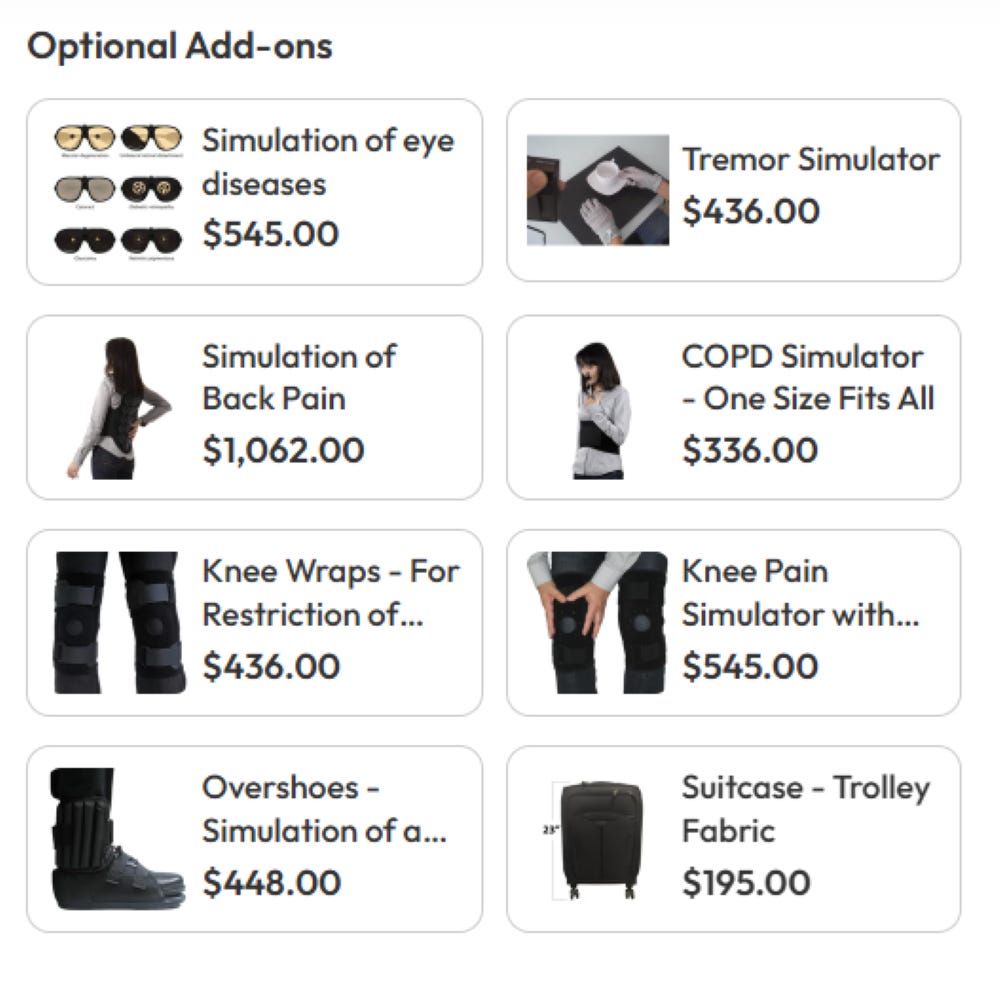
A simulation suit embedded in a broader educational curriculum is one thing. But the concept doesn’t stay in universities. It migrates into professional development programs, into tender documents, into advertising. One of Perth’s most prominent aged care providers, has been promoting simulation suit training on local radio as a tool for better understanding their clients. It is a well-produced advertisement. It sounds progressive. And it is exactly the kind of thing that made me pause and write this substack.
Because when a service provider uses simulation suits as evidence that their staff now “understand” the needs of older people, we have moved from education into something more troubling. The performance of empathy as a substitute for the harder work of actually listening.
Co-designing services with older people. Employing older workers. Creating genuine feedback mechanisms. Funding advocacy organisations led by older people themselves.
These are slow, effortful, and sometimes uncomfortable. A simulation suit is fast, photogenic, and makes everyone feel good. It’s easy to see which one tends to win in a pitch deck.
There is something worth naming directly. The simulation suit assumes a certain set of characteristics of older people. Age is modelled as subtraction of vision, of hearing, of mobility, of speed.
This framing is not neutral. It embeds a view of ageing as decline, and of older people as defined primarily by what they can no longer do. It is, in the precise sense of the word, ageist even when deployed with the best of intentions.
The gerontologist Bill Thomas argues that Western cultures reserve full personhood for the young and the productive. And quietly withdraw it as people age stripping older people of identity, agency, and complexity, and then wondering why aged care so often feels dehumanising. A suit that trains professionals to see an older person as a bundle of physical limitations is not a corrective to that problem.
None of this is an argument for less empathy training, or for ignoring the real physical challenges that many older people face. Those challenges are real and professionals should understand them.
But the primary way you come to understand another person’s life is not by mimicking their constraints. It is by spending time with them, asking questions you don’t already know the answers to, and crucially accepting that they are the authority on their own experience.
Royal commissions and advocacy organisations have documented for years the consequences of a system that treats older people as recipients of care rather than participants in it. A simulation suit doesn’t challenge that system. It makes everyone feel better about it.
The suit comes off. The work doesn’t.
Comments
Nothing yet. Say the first thing.
Sign in to join the conversation.