
I watched the Odyssey like everyone else in the world last week and I can’t stop thinking about it. It was very violent and I closed my eyes in several scenes (the pig scene especially) so I would caution that if you are sensitive to that amount of violence, it may not be a wise choice. With that said, war is violence and what humans have done to each other over the course of humanity is appalling. In English class in high school, we had to read the Odyssey and I can remember slaving over my assignment which was Odysseus’ journal. I dyed the pages with tea, burned the edges with fire and bound the journal with string. I was more concerned with presentation than the content lol.
I thought this was just a crazy piece of literature with all kinds of fantasies of an adventure. Weird gods, weird adventures. But what I didn’t pick up on until watching the movie were the similarities between God, the story of humanity, and homer’s ideas of how gods function in the lives of human beings. Homer wrote his work way before Jesus showed up on the scene yet many themes seem to match Jesus’ teachings. How can this be possible?
In our survey of the New Testament, our professor was geeking out over Hercules and the similarities between him and Jesus (shoutout Joey Dodson). It really sent one of our classmates into a tailspin and tiny faith crisis. What do you mean there are gods like our God? This can be disorienting until you think about how God enters into specific cultures able to morph into meaning over time, space, location. Jesus came into a culture that spoke Aramaic, he didn’t invent a new language. He was fully Jewish, he didn’t invent a new religion. He tells stories about the kingdom of heaven in terms of ideas they already understood: kings and kingdoms, servants and masters, sons and fathers and inheritance (patriarchy), and agriculture (farms/farmers, seeds, trees, etc), bride and grooms and wedding banquets. The list could go on and on but he is using concepts they are familiar with to explain something they are unfamiliar with. 1
In the same way, we shouldn’t be surprised that either Homer borrows concepts taught in the Old Testament about God or that God borrows concepts of “gods”, themes of generosity and hospitality, fidelity/faithfulness, obedience, and dependence on gods for direction/wisdom/provision to name just a few. This is what I hadn’t expected to see when I watched the Odyssey. Oh, this is a story about innate human needs for a creator and provider. This is, in fact, a story about God.
Namely, it was a story about hospitality. The law of Zeus is that you welcome the stranger, no questions asked, offering food and water, maybe a chance to clean up and find rest. The story is about hosts who are hostile and hosts who are exemplary and the heroes of the story are not who they should be. It’s ironic. This is good storytelling, and I am sure that Jesus would have been at least familiar with the Odyssey, greek gods and mythology (Paul was very knowledgeable with greek culture and mythology).
The Odyssey starts in idyllic conditions, then Odysseus leaves to fight in a war that wasn’t even his but he had sworn an oath. Aliances were very common at the time. Kings had vassals and the the kings would promise protection from others, in turn the vassals would promise loyalty in battles. These are covenants. If you are faithful to the covenant, you receive blessings, if you’re unfaithful, curses. Sound familiar? Yes, this is the language God uses with the Israelites all over the OT. People understood this framework. However, God is unusual in that when people are unfaithful and rebellious, God still uphold his part of the covenant. This God woos his unfaithful wife back to himself over and over again in the greatest epic ever lived and told.
I could stop there but I won’t because I was floored by how the O almost gets it, it’s right there but it just never completes it. Odysseus outwits his adversaries and death with intellect, whit, creative ideas but never for all of time. Penelope is the faithful wife who waits 26 years for her husband to come home even though she has suitors squatting and partying, tempting her in her own home. She eventually is willing to give in if anyone can complete the task she sets before them. Luckily it happens to be Odysseus disguised as a poor and dirty beggar (all kinds of bells should be ringing when you think of Jesus’ teachings).
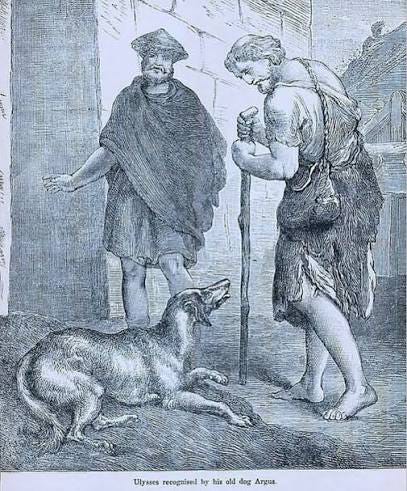
Hospitality is so key to the plot line, you can’t make a single turn without seeing it done poorly. The cyclops eats it’s guests, Calypso coerces her guest to stay for 7 years hoping Odysseus won’t remember who he is, Islands of giants killing O’s men like play things when they just wanted food, Circe initially welcoming men and feeds them but turns them into pigs because of their gluttony (they become outwardly what they are inwardly), and the suitors take advantage of Penelope’s hospitality and throw raucous parties in the palace with no permission. Her guests are routinely terrible to a blind man with an old, sick dog. On one adventure, O’s men eat cattle they’re expressly forbidden not to when they land on an island, showing no self control and lots of pride, lust of appetite(Eden and the apple?). In the end, O makes it home but he has to grapple with his greatest failure of proper hospitality which was breaking and entering into someone’s home via the trojan horse.
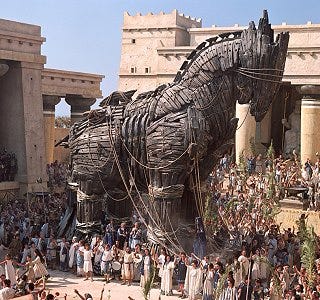
He laments that he left beauty and ildyllic Ithaca and saw so much suffering at his hands and the hands of others. He profaned Athena, his god, in the process. In discussing his exile with Penelope he observes: “One man's idea. One man's trick to break Zeus's law forever. We lived in a world of palaces and trade, language, blind to its beauty, until we broke it.” At the end, he returns to a restored Ithaca after his self produced exile: “And dawn will break over the darkened world. And our mistakes will once again be forgotten.” I gasped.
It just sounds a lot like the story of humanity, Adam and Eve and their exile from Eden, the Israelites and their exile and longing to be restored to a promised land, and then Jesus coming and promising to make the world right to restore all his people back to Idyllic Eden. Why did we leave in the first place, for what? And why do I keep playing into this same pattern myself, even now? Homer is telling that story and God is telling that story, but he completes it. It isn’t fictional, nor a fantasy. Homer’s characters don’t conquer all the monsters once and for all, all of them will eventually die. Peace can only last for some time before the pattern rears its gnarly monstrous head again.
What Homer suggests is the key theme to humanity is genius and true. We long for the hospitality of God in eternity (or we reject his hospitality as the pharisees did, as the older brother in the prodigal refused to go to the banquet). We host Holy Spirit in our bodies when we profess Christ. He makes a home in us and we in him. We are supposed to be the faithful bride, resisting temptation but we defile our marriage with lusts of the world. When a beggar shows up at the banquet, we don’t see Christ and we fill ourselves on more than we need. Even in our adventures pleasant and unpleasant, the wars we fight, the monsters that come out of no where and start eating us alive, our only guarantee is that this world isn’t it. He is with us until we live into that reality.
Homer doesn’t offer that kind of hope or peace in his story line. His gods are sometimes hard to please, absent, and can be swayed. But our God is unchanging, always faithful, and just. Compassion and Mercy are his very name.
To me, this makes me love God even more. He uses a framework we already understand and builds on it to complete it. And God keeps doing this for us. He uses modern ideas to continue to be relevant and relatable. AI? All powerful, all knowing, creator of many things… but still flawed. A shadow of a promise for a creator who is intentional, unbiased, containing all wisdom. We long for that. We create something like God. When people read the history of AI, they might say wow, God is similar in the same way we look at the Odyssey & see how similar but incomplete that concept is.
Anyway, what are your thoughts? Is that jarring or comforting? Does it push some buttons you don’t want pushed? AND HAVE YOU SEEN THE MOVIE? It was really out of my comfort zone for movies but in the end, I’m thankful to have seen it simply so it could bolster my faith.
Thanks for reading,
Jami
This is why we have such a hard time with context and try and superimpose modern concepts onto an ancient text. It is really important work to understand the context in which Jesus came. the Bible is not written TO us but it is written FOR us. We have to be very careful to see all of it as prescriptive rather than descriptive. This is why we get into so much trouble when we try and enforce ancient household codes of submission between master and slave, men and women and say this is how it should be for all of time. We no longer have slaves bc it is wrong. And we no longer should have hierarchy between sexes because that is also wrong. BUT ALAS! I created a whole course on this BTW. https://seminarylite.circle.so/checkout/seminary-lite

No posts
Comments
Nothing yet. Say the first thing.
Sign in to join the conversation.