
To understand what’s truly at stake in our current culture political moment, we might need to go back a few decades.
Or (since we’re slouching towards this nation’s b-day) maybe even a few centuries?
Share Altered States of America
“There are at least two kinds of games: finite and infinite” author and theologian James Carse explains. “A finite game is played for the purpose of winning, an infinite game for the purpose of continuing the play.
The infinite game - there is only one - includes any authentic interaction...that changes rules, plays with boundaries and exists solely for the purpose of continuing the game.”
We all experienced some version of this infinite game as children––where a bigger brother or neighbor who was dominating a game of kickball or hide and seek would, when facing mutiny by dispirited younger kids, agree to rejigger the rules.

He’d give some head starts, more time, or first picks for teammates to handicap the strongest and boost the smallest so it was closer to a fair fight. The big kids still loved winning, but were willing to concede just enough to the losers to entice them to keep playing rather than quit the game altogether.
That’s the infinite game in miniature.
Although Carse’s book didn’t come out until 1987, a deeper version of the Infinite Game had been in play for at least the past three hundred years.
It started with the French Enlightenment and a radical commitment to the inalienable rights of Man.
Liberté, égalité and fraternité (liberty, equality and brotherhood) for everyone.
A fledgling experiment to upend the Finite Game played where Might Makes Right—and usher in something different, new and compelling: the Infinite Game where Right Makes Might instead.
Across the Atlantic, Thomas Jefferson, James Madison and Ben Franklin followed these developments closely. They became convinced of the justness and urgency of this newly articulated Game.
While their main grievances with Britain centered on trade, taxation, and governance, they didn’t want to topple one king only to replace him with another. They wanted to create an entirely new way of governing centered on the deeper truths of natural law.
So they devoured and debated the ideas of the philosophes and tracked John Locke’s arguments. They looked back through history for precedents, obsessing over the republics of ancient Greece and Rome.
The Americans were all too aware of the gravitational pull of decadence and were determined to avoid Caesar’s decline into empire. Instead they emulated the reluctant general Cincinattus––who agreed to lead the Roman Republic through a time of crisis, but returned as soon as he could to his farm.
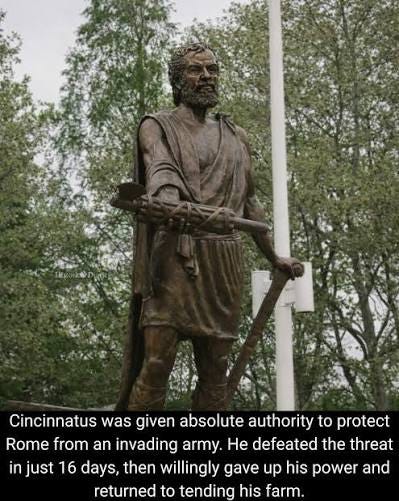
Personal ambition, they concluded, yoked a leader to the finite power games they were trying to leave behind.
In all of the elements they assembled––the three branches of government with checks and balances, the Senate (with equal representation for every state) and the House of Representatives (with proportional representation based on population) as an update to the familiar House of Lords and House of Commons, a Bill of Rights with the limited capability to add amendments over time, separation of church and state to avoid the heavy hand of the Vatican in Europe, veto power to the executive, even limiting presidential terms and declining fancy titles in favor of a simple “Mr. President”––they did their best to create a system that could hold dynamic tension where no single leader or party could prevail unconstrained.
It’s important to remember these “founding fathers” were the successful monied and landed gentry of the British Colonies––the planters of Virginia and the merchants of Boston and Philadelphia.
They had already “won” at the Finite Game, and with the American Revolution, they won not only a critical hand, but the right to deal and call the game from then on.
But they didn’t depose one king to crown another. They did their best to write the rules of a new game that could, over time, legitimately come to include all equally created men (and women) entitled to the same life, liberty and pursuit of happiness that they already enjoyed.
*****
And it’s this “you’ve got to win the last round of the Finite Game to call the next round of the Infinite Game” that is so crucial today.
The Founding fathers did it.
Abraham Lincoln did it.
MLK did it in ‘63.
George Bush did it on 9/11.
Obama did it after the Charlestown shootings.
So did Nelson Mandela with the Springboks rugby world cup in ‘95 (immortalized in the film Invictus)
And Mahatma Gandhi during his March to the Sea for Indian independence from British rule.
It’s an orientation to cash in your chips at the top of the Game, to play a better, longer Game altogether.
And it’s incredibly rare!
It’s the story of our fumbling efforts to move beyond the tribal imprinting of evolution and biology. Of win-lose Conan the Barbarian ““Crush your enemies, see them driven before you, and to hear the lamentations of their women.”
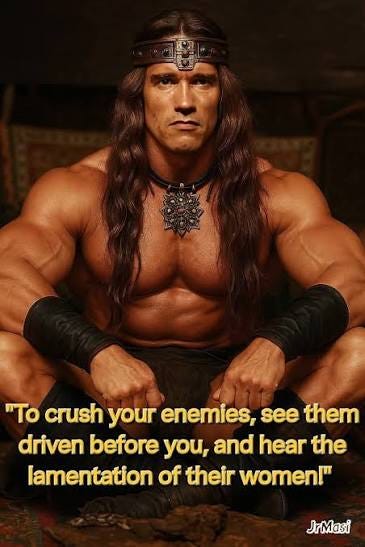
(Stephen Miller and Pete Hegseth both had Conan PJs when they were little)
Abraham Lincoln called that aspiration the move towards “the better angels of our nature.” .
It’s his address on the smoldering battlefield of Gettysburg that gives us the best clues as to the way forward.
Clocking in at a brief two hundred and seventy one words, he declined to deliver a long winded eulogy and instead directed the audience back to the founding of the nation “four score and seven years ago.”
He hammered home the need to recommit, in the midst of the bloodiest civil war, to the fundamental principles of the Infinite Game.
By the end of the war at Appomattox Court House, General Grant met General Lee with dignity, offered all Confederate officers the chance to keep their sidearms, and all rebel soldiers to keep their horses as it was planting season. He forbade the Union troops from jeering or catcalling, saying, “they are our brothers again now.”
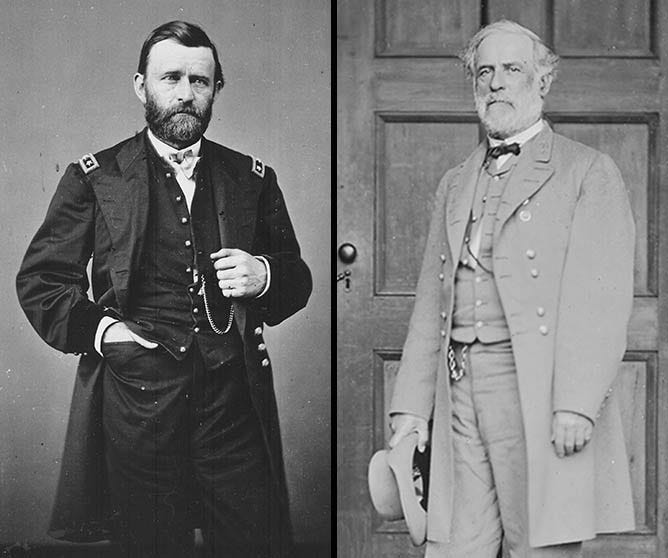
He’d won the bloodiest of finite games. And earned the right to call the next round.
A century later, Martin Luther King Jr., stood in front of Lincoln’s Memorial and repeated the same commitment. Rather than attacking white Americans for their complicity in the extremes of the Civil Rights violence or for the history of Jim Crow, Segregation and racism, King doubled down on the American promise.
In ringing tones he insisted that “all men created equal” meant something, and included African Americans too. “Instead of honoring this sacred obligation, America has given the Negro people a bad check, a check which has come back marked ‘insufficient funds.’ King declared. “But we refuse to believe that the bank of justice is bankrupt. We refuse to believe that there are insufficient funds in the great vaults of opportunity of this nation.”

(the reflecting pool is beautiful gorgeous, American Flag Blue. The black and white photo is a sinister plot from Amphiba to mask our greatness. And don’t be fooled, there are way less people here than at DJTs inauguration(s)
Time and again, in moments of national crisis, we have found our way through the confusion by returning to the thread of the Infinite Game. In the volatile aftermath of 9/11, President George W. Bush gave an address at the Islamic Center in Washington D.C. and affirmed the principles of shared identity beyond belief or ethnicity.
“America counts millions of Muslims amongst our citizens, and Muslims make an incredibly valuable contribution to our country. Muslims are doctors, lawyers, law professors, members of the military, entrepreneurs, shopkeepers, moms and dads. And they need to be treated with respect. In our anger and emotion, our fellow Americans must treat each other with respect. ...This is a great country. It’s a great country because we share the same values of respect and dignity and human worth.”
Rather than succumbing to an Us vs Them dynamic, or stoking fears and resentments based on tribalism or difference, Bush took that time of profound uncertainty and outrage and doubled down on the promise of inclusion. With the stain of Japanese internment camps in World War II in his mind, Bush opted to take the higher ground.

That move did not stop him from carrying out a questionable neoconservative prosecution of a global war on terror in the years that followed, but it did prevent a holy war from breaking out on American soil. In a time splitting the country along the fault lines of faith and ethnicity, Bush doubled down on the foundational premise of the American experience.
In 2015, after a tragic race-related shooting in an African American church in Charleston South Carolina killed nine parishioners, President Obama gave a compelling eulogy that many historians counted as among the most significant of his political career.
Like King before him, Obama both acknowledged the historic imbalances of America’s racial legacy, while calling for a renewed commitment to its ideals.
“The church is and always has been the center of African American life… a church built by blacks seeking liberty, burned to the ground because its founders sought to end slavery only to rise up again, a phoenix from these ashes...A sacred place, this church, not just for blacks, not just for Christians but for every American who cares about the steady expansion… of human rights and human dignity in this country, a foundation stone for liberty and justice for all.
That’s what the church meant.”
Crucially, Obama then took the time to highlight a key factor of the Infinite Game––the simple reality that agreeing to play by those better rules does not magically result in harmony and agreement.
“There’s no shortcut. We don’t need more talk...People of good will will continue to debate the merits of various policies as our democracy requires — the big, raucous place, America is. And there are good people on both sides of these debates.”

Make no mistake: those in power are almost always resistant to giving any of it away. Change comes hard fought, if at all. Abolitionists, suffragettes, unionizers, Black Panthers, Stonewall marchers, migrant laborers, anti-war pacifists, Farm protests and Sagebrush Rebels, Occupy Wall Street, the Tea Party and Black Lives Matter.
If rebranding Western Civilization as the “Infinite Game” was just a reboot of the same old triumphalist narrative, it wouldn’t be worth defending. But the Infinite Game represents all of it, and all of us––and that has got to be defended.
“The dream of the 18th century was that a single, coherent set of values, rooted in rationality, could make a heaven on Earth,” UC Berkeley philosopher Alison Gopnik writes, “But more-recent philosophers...sobered by the 20th century’s failed utopias, have argued for a more modest liberal pluralism that makes room for multiple, genuinely conflicting goods.
Family and work, solidarity and autonomy, tradition and innovation are really valuable, and really in tension, in both the lives of individuals and the life of a nation. One challenge for the enlightenment [project] now is to build social institutions that can bridge and balance these values.”
While that kind of split-the-difference compromise is often held in contempt by revolutionaries, there is a subtle genius to M.A.D.––mutually assured dissatisfaction. Opposing philosophies hold each other in dynamic tension and prevent the full capture of any “party or clique” to borrow Emerson, Wordsworth and Beecher-Stowe’s tagline for the Atlantic Monthly they founded in 1857.
At its worst, this kind of strategic stalemate leads to stagnation and frustration. At its best, it leads to the kinds of hard won compromises that delight virtually no one, frustrate nearly everyone, and perversely, expand the chance to keep playing the Infinite Game with more and more players, better than any other options we’ve found.
What’s better––supply side economics a la John Keynes, or libertarian free markets a la Milton Friedman?
Safety nets or bootstraps to build a just society?
Big sticks or carrots to preserve international order?
Federal or state’s rights to guide the governed?
Investing in education or employment to empower a citizenry?
Separation or integration of church and state?
Multicultural melting pot or national identity?
Revolution or evolution?
The only honest answer is “it depends.” And we’re not entirely sure. To put it in perspective, we’re still not settled on the simple facts of whether eggs, butter and coffee are the best things ever, or are going to murder us in our sleep.
Ideological diversity is as important as ecological diversity for a healthy world. And a finite tribalism that seeks to mow down any dissenting opinions in favor of a monoculture––gives us less vibrancy and resiliency than the raucous, competitive heterodox landscape that preceded it.
To be sure, the tidy system of checks and balances the founding fathers penciled out sounds great on paper. In reality, it’s never been that simple.
Shy of a few rosy hours after the ratification of the Constitution in 1789, much of the politics and governance of the United States has been a thinly veiled knife fight––the Finite Game trying to infiltrate the Infinite Game at every turn.
And no doubt about it, those with a Home Court advantage have always pulled every trick in the book to keep their upper hand.
“Because let’s be real: we always knew this shit wasn’t going to be easy.” Junot Diaz wrote in the New Yorker immediately after the 2016 election. “Colonial power, patriarchal power, capitalist power must always and everywhere be battled, because they never, ever quit. We have to keep fighting, because otherwise there will be no future—all will be consumed.
Those of us whose ancestors were owned and bred like animals know that future all too well, because it is, in part, our past. And we know that by fighting, against all odds, we who had nothing, not even our real names, transformed the universe. Our ancestors did this with very little, and we who have more must do the same.
This is the joyous destiny of our people—to bury the arc of the moral universe so deep in justice that it will never be undone.”
******
And that, more or less, brings us back to our current moment in the culture wars.
Cynicism is so deep on all sides, that it becomes incredibly tempting to conclude that it’s best to monkey wrench government, or to blow up the train in its tracks.
Joseph Stiglitz, the Nobel Prize winning economist, White House advisor, Columbia University professor and former chief economist at the World Bank offers a singular recommendation that aligns with Alison Gopnik’s.
“The only way forward, the only way to save our planet and our civilization, is a rebirth of history. We must revitalize the Enlightenment and recommit to honoring its values of freedom, respect for knowledge, and democracy.”
So that remains our present and most pressing challenge: can we take Stiglitz’s advice, and dust off the battered and bruised Enlightenment experiment––the one that stops the regression into tribalism that threatens both sides of the political spectrum these days––the one that aspires to get us past win-lose gamesmanship and into the win-win infinite game?
Because no matter how polarized we have become in the past few years, and how tempting it may be to conclude that those who oppose us do not deserve a seat at the table, we’d do well to look back at history.
The American Revolution, painstakingly built to prevent any singular faction from dominating, was soon followed by the French Revolution. Robespierre and the Jacobins followed a different playbook. Inspired by the same Enlightenment ideals, and faced with the same task of replacing a monarchy with something more representative, the French idealism consumed itself with a Reign of Terror that left tens of thousands guillotined.
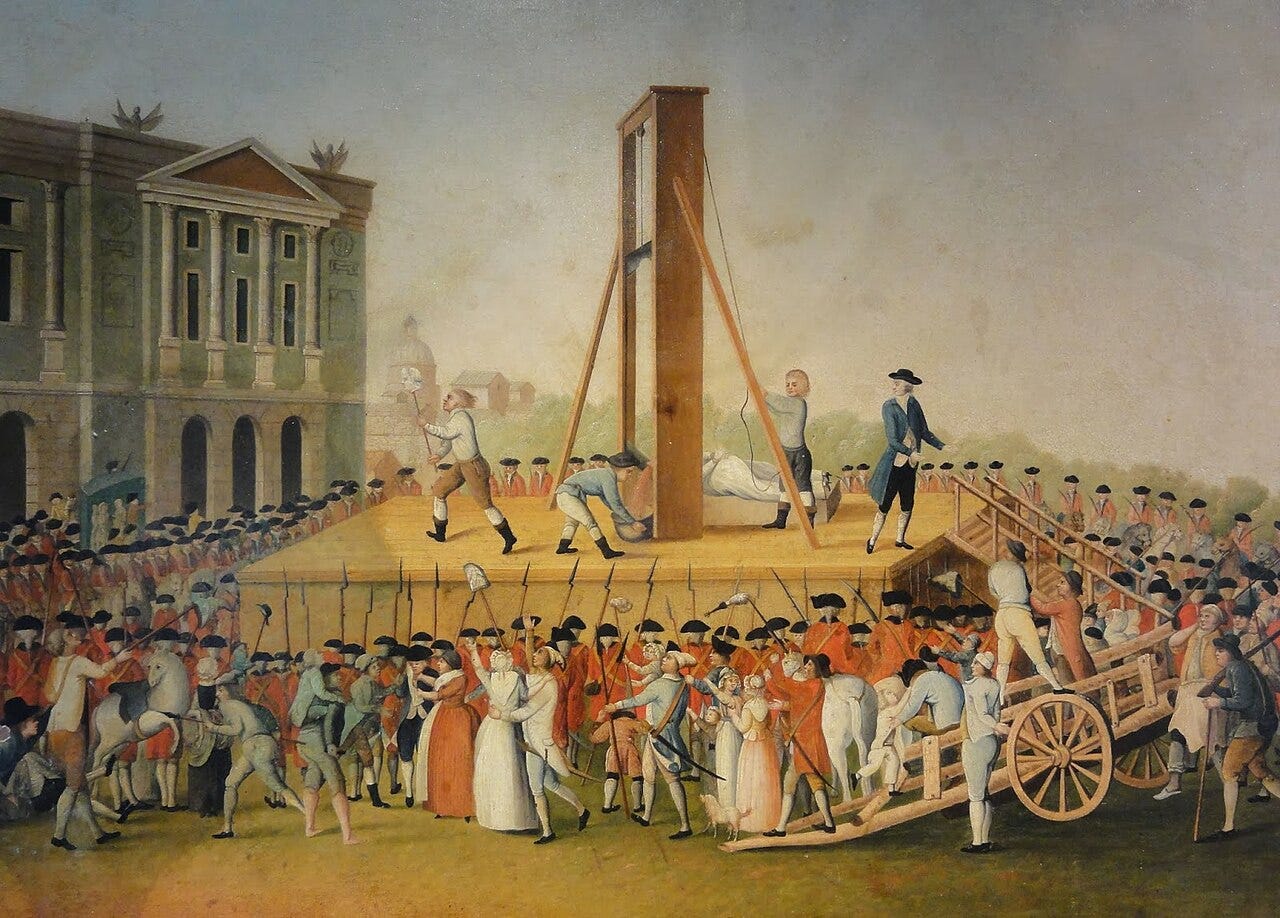
Absolutism fueled Stalin, Mao, Hitler, Pol Pot and countless others seeking to fulfill visions that sounded noble on paper, but became murderous in their unrelenting quest for purity. Many post-mortems of those disasters fault the leadership, but often uphold the ideals.
Christianity or Communism, these pundits would explain, are still perfect ideas, they were just poorly executed!
Every time we’ve repaid oppression with oppression, it’s ended in bloodshed and suffering. The few times our Better Angels have met oppression with compassion, we’ve remade the world.
At this point, anything less, will be our undoing.
As it’s always been and has to be, the choice is ours.
Happy Birthday ‘Merica.
Your stupidity!!!
I could almost love you again…
Comments
Nothing yet. Say the first thing.
Sign in to join the conversation.