
“In fricassée in days gone by, one dipped both bread and fingers in the sauce.” - Le Marquis Philippe de Coulanges, first cousin of Madame de Sévigné, 1680
In the September 15, 1777 issue of La Gazette (Paris), it was reported that 42 bricklayers, having dined on fricasseed meat and green beans, also fricasseed, at an innkeeper’s table in the Old Market of Aguesseau, Faubourg Saint-Honoré, suddenly and immediately fell ill, suffering from acute stomach pains, accompanied by general discomfort and violent cramps. Monsieur Coste, master surgeon of Paris, and Monsieur Ters, the King’s surgeon serving in the district, were consulted. “After inquiring about the nature of the food and inspecting the copper (cooking) vessels in the house, which they found to be in fairly good condition, they decided to provide some relief for the suffering of the unfortunate workers, without being able to determine the immediate cause.” Their remedies (which included white soap in milk and theriac diluted in wine) induced a complete (and somewhat violent) purging of their sorry bodies which did calm the pains and their suffering. “The next day, oily potions and rice water enemas were prescribed, and this method proved so successful that of the forty-two patients, none perished.”
Fricassée is truly a delightful dish, despite the misadventure that befell 42 bricklayers in the year 1777. Their misfortune could have been due to anything.
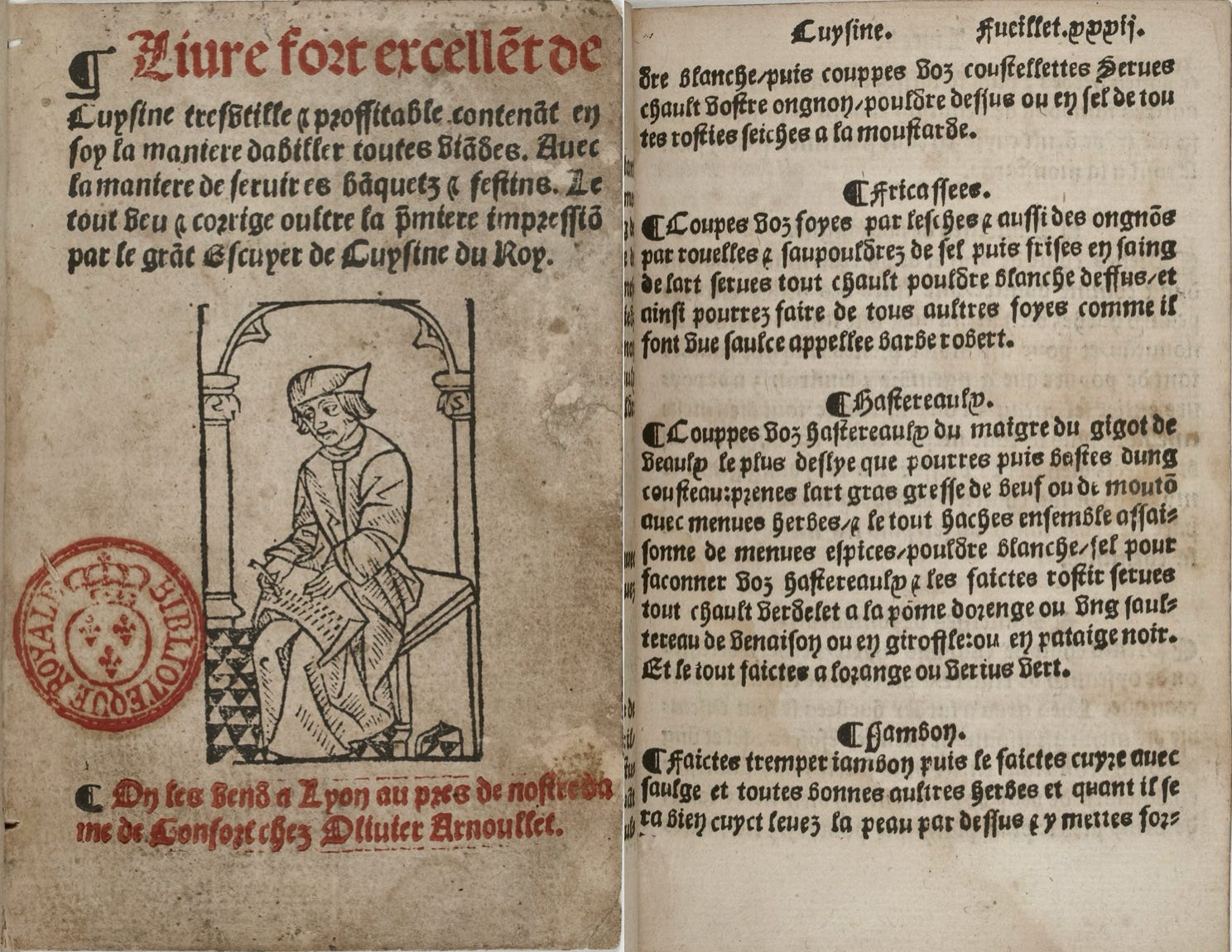
Fricassée is a fairly common word, both as a verb (to prepare as a fricassee) or as a noun (stewed meat, especially chicken or veal, and vegetables, served in a thick white sauce). It is, in fact, an extremely old word, already common in 16th century France. Livre Fort Excellent de Cuysine Tresutille & Proffitable, written in the most elegant gothic script in 1542, may be the first French cookbook to offer a fricassee recipe. The author slices both livers and onions, his focus ingredients, seasons with salt, and fries them in saindoux, or bacon grease, serving the dish dusted with “poudre blanche” or white powder, possibly a blend of cinnamon, ginger, cloves, and sugar - white foods and white ingredients were often associated with purity and high social standing, so used and prepared them often when one’s status could afford it.
The dish called fricassée appears to have emerged in France in the sixteenth century. The word itself may derive from frire (“to fry”) or from friture, a fried preparation, possibly influenced by Burgundian dialect. The dish itself, however, is thought to be older. Earlier medieval dishes such as cominée de gélines — a cumin-seasoned chicken stew — suggest that similar poultry preparations existed well before the term fricassée came into use.
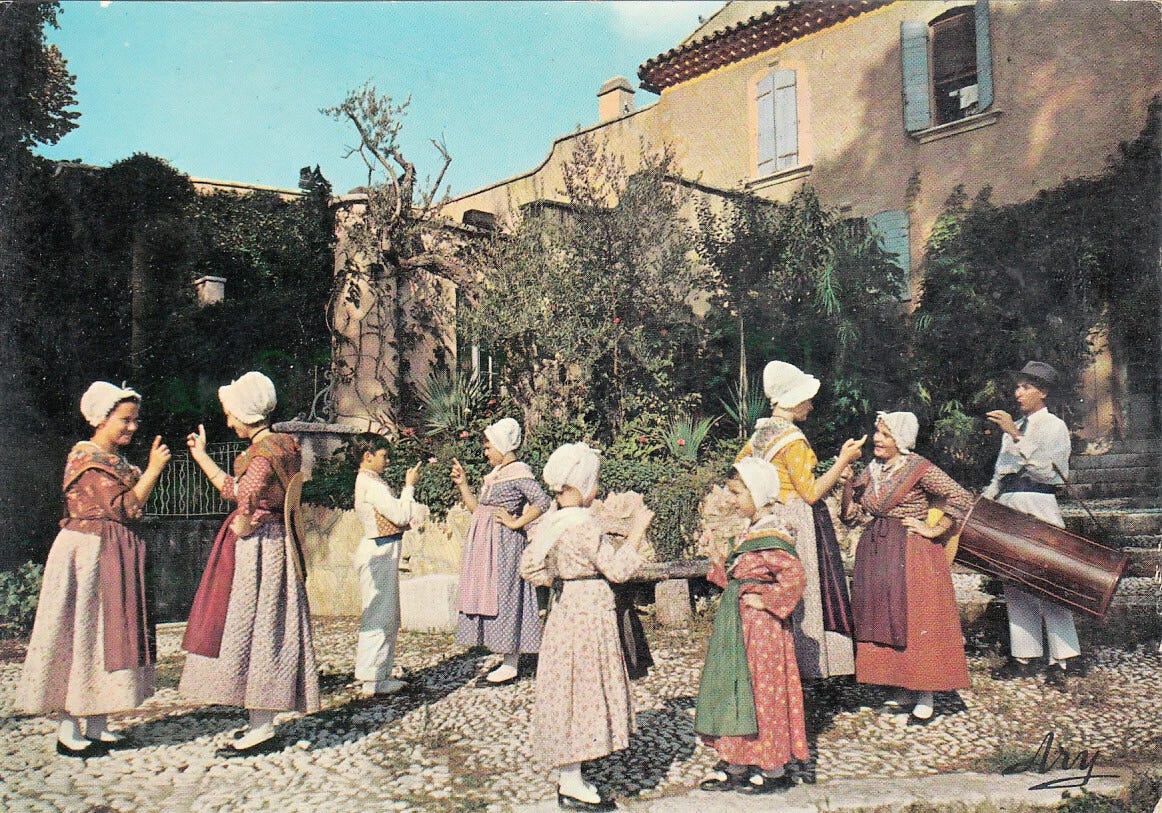
The word fricassée itself took on a dizzying array of meanings: proverbially, as Antoine Furetière explained in his 1690 dictionary, a fricassée was a chaotic mix of a whole bunch of different things, a fricassée of words or objets, such as “Fragonard’s fricassée of angels” from Denis Diderot’s biting criticism of the artist’s new-fangled style, as well as a military term to refer to the tumult, noise, and precipitation made by war drums to quickly gather the troops specifically upon the arrival of a person of special rank they wish to honor. Mme de Sévigné, in her famous letters of this same period, used the word fricassée to mean a light, informal meal eaten in the countryside or away from home, a hodgepodge of dishes probably from leftovers or prepared quickly with what was on hand. La fricassée was also a rustic folk dance dating from the 16th century, slowly evolving into something for the stage, a lively, chaotic medley of steps that sometimes bizarrely imitated real-life actions.
This makes me wonder: were these definitions taken from the dish, or was the dish taken from the meaning? A classic chicken and egg conundrum.
The earliest example I could find of the word fricassé appears in the 1530 text Summaire Trés Singulier de Toute Médecine et Cirurgie. This is a fascinating example because it shows the word fricasser used in a medical context, which helps confirm the word’s secondary meaning — to heat or fry vigorously — rather than the later culinary dish. The text instructs: “One should apply hot cloths to the head and make a preparation of honey and coarse salt, fricasseed together in a pan…” François Rabelais referred to a piece of clothing looking like a “paelle à fricasser chastaignes” - a pan for frying/fricasseeing chestnuts - in his 1553 tales of Pantagruel.
We see this strictly technical use continue into the next century; in 1604, Lancelot de Casteau uses the word fricassée in dozens of recipes for fish, birds, veal, poultry, or fruit in his Ouverture de Cuisine strictly as a verb, to mean “fry in butter or olive oil.”
In the late Middle Ages and the early French Renaissance, the period that it first appeared in the Livre Fort Excellent, the dish might very well have been defined by its movement. Meat cut into pieces — often chicken, veal, or even fish — though sometimes vegetables or fruit, was first sautéed in a pan with fat (the frire part, the verb and the action “to fry,” which also came to mean the frantic tossing and sizzling of the ingredients) before being simmered in a liquid. But the opposite could also be true : the many cultural meanings of the word — the military drums and the chaotic mix of objects or people, the crazy dance and the jumble of dishes offered at a casual meal — may very likely have come from this physical act in the kitchen. The way meat or vegetables were cut into pieces and tossed around willy-nilly in sizzling butter, oil, or fat created a scene of constant movement and fragmentation. It wasn’t just a recipe; it was a state of agitation.
François Pierre de La Varenne’s landmark Le Cuisinier François, a 1651 cookbook that marked the shift from medieval spiced cooking (pouldre/poudre blanche) to butter-or-cream based sauces and reductions, contains what I believe may be approaching the first modern version of the dish, cooking chicken pieces in broth, “fricasseeing” the drained pieces, seasoning them with fresh herbs, and thickening the sauce with yolks. In 1656, Pierre de Lune takes one step forward in Le Cuisinier by frying the piece in bacon grease, adding white wine with butter and seasonings, adding flour to thicken, and broth and lemon juice as a finishing, flavorful touch.
But it’s François Massialot, in his wonderful and important Cuisinier Roïal et Bourgeois published in 1691, that completed the recipe, the final steps in the evolution of the dish.
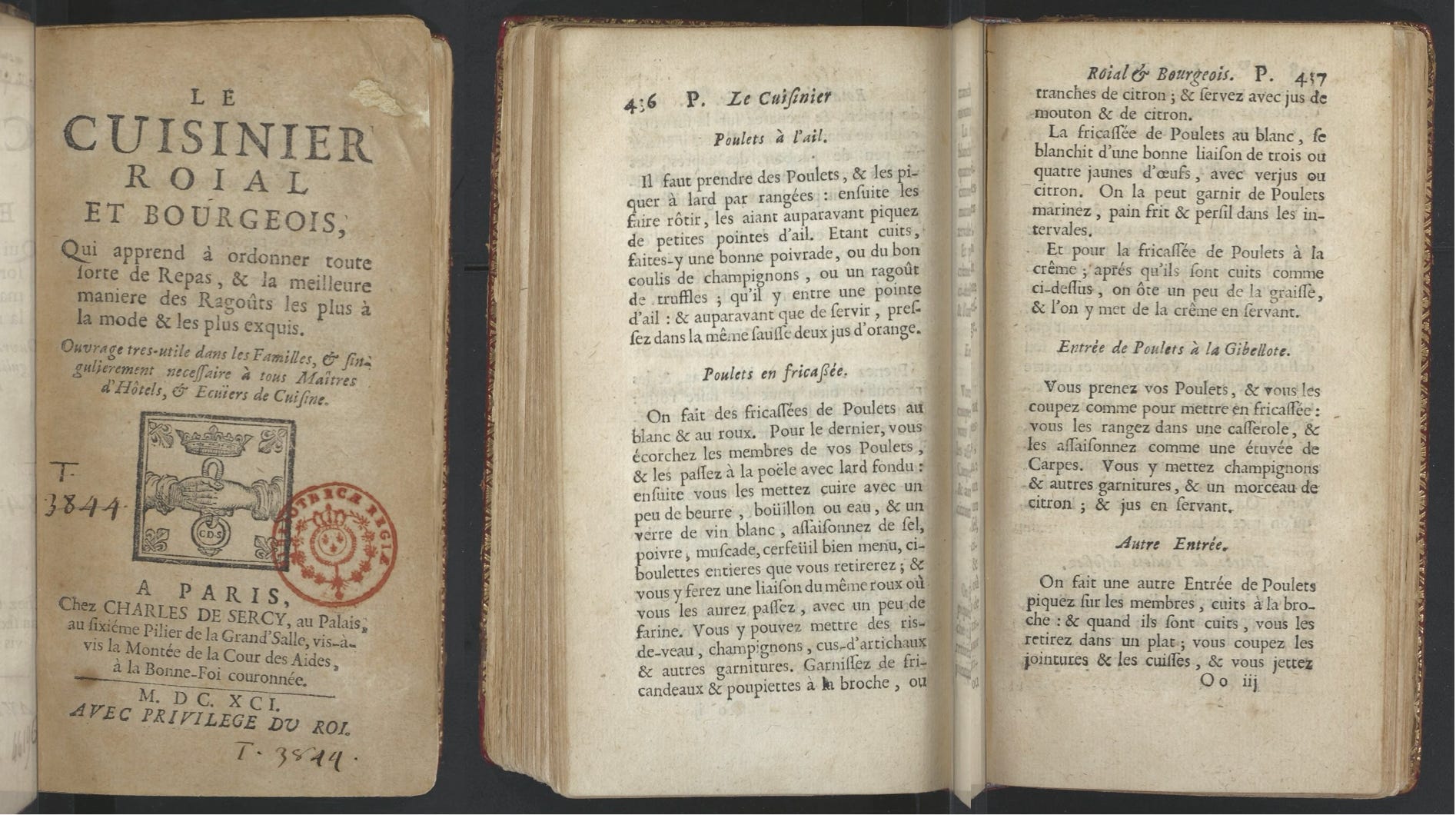
In his fricassée de poulets au blanc & au roux, the chicken pieces are first browned in bacon fat or lard, then simmered in butter with broth or water, white wine, and seasonings. The dish may be garnished with mushrooms, artichoke hearts, or kidneys, and the sauce is finished with egg yolks and brightened with lemon juice or verjus. A variation, fricassée de poulets à la crème, adds cream to the sauce before serving. We now have all of the elements of the dish cooked in French homes today : chicken pieces, butter, white wine, mushrooms, egg yolks, lemon juice, and cream; the sauce becomes what we would recognize as a velouté-based preparation that we’ll find in similar dishes, fricassée, blanquette, and coq au vin blanc.
The title of Massialot’s book Cuisinier Roïal et Bourgeois — “royal and bourgeois” — is significant, as well. It suggests a transition from purely courtly cuisine to something that could be reproduced in wealthy households, reflecting a deliberate shift in culinary culture. He even includes the phrase “very useful book for families” in the title itself, placing our fricassée de poulet not only on noble tables, but also in the homes and kitchens of the prosperous bourgeoisie.
Little by little, the dish descended the social ladder, spreading from upper-class kitchens into the homes of a broader and more modest public, where it would become an everyday, economical preparation. As early as 1757, the recipe appeared in Cuisine et Office de Santé Propre à Ceux Qui Vivent avec Oeconomie et Régime, “for those who manage their health and their pocketbook.” Louis Liger explains in his cookbook OEconomie Générale de la Campagne, ou Nouvelle Maison Rustique in the year 1700 that when “the chickens are a little too tough and gamey, we make a fricassee with them.” La Cuisinière du Bon Marché pour la Ville et la Campagne (The Economical/Thrifty Cook for Town and Country) by Mme Victorine de Blancmesnil, 1850, La Petite Ménagère (The Little Homemaker) by Madame Dufrénoy (1816), M. Burnet’s 1936 Dictionnaire de Cuisine et Économie, Le Cuisinier Parisien ou Manuel Complet d’Économie Domestique (B. Albert, 1812), La Véritable Cuisine de Famille by Tante Marie (1922), Henri-Paul Pellaprat’s Les Menus Détaillés de la Ménagère (The Housewife’s Detailed Menus, 1937), all contained recipes for chicken fricassée, which has now not only been standardized in both ingredients and cooking method, but it illustrates how this recipe went from high end to every day, an easy-to-prepare and economical family-style dish.
As Alexandre Dumas wrote in 1873 “In some provinces, a very appetizing and comforting fricassee is made.”
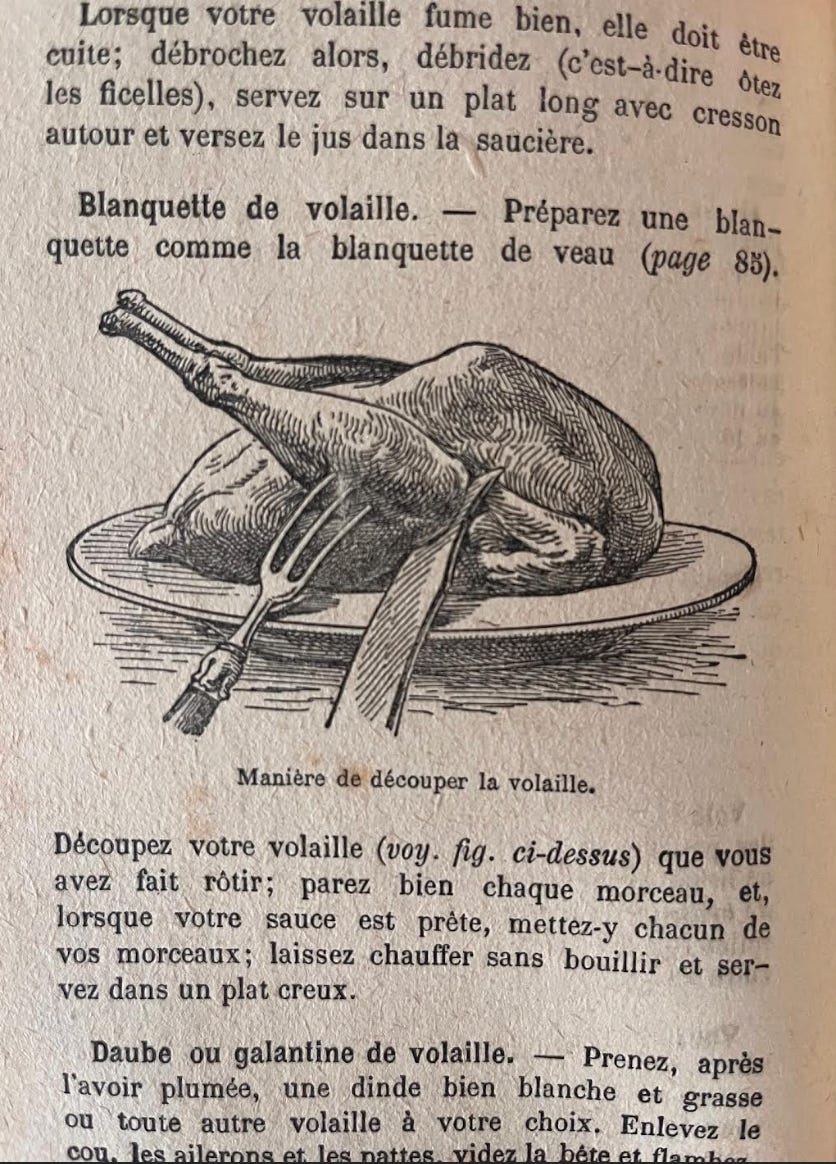
By this time, chicken had become the default fricassée; it was readily available throughout the year and accessible to people across all economic classes, as well as simple to separate into pieces. In his 1938 Larousse Gastronomique, Prosper Montagné confirms “In modern usage, the word fricassée is used almost exclusively to refer to a method of cooking poultry in white sauce”. You might see frogs’ legs or eels, rabbit, calve’s foot, or beef “fricasseed in the style of chicken”, as well as fricasée of pumpkin, mushrooms or onions, eggs or livers, with the cooking process, if not the ingredients, to be understood. By the end of the 19th century, you will also find variations of the classic now adapted by different regions of the country, fricassée de poulet à l’alsacienne or mode de Bresse or lyonnaise or à la dauphine or à l’angevine (from Anjou).
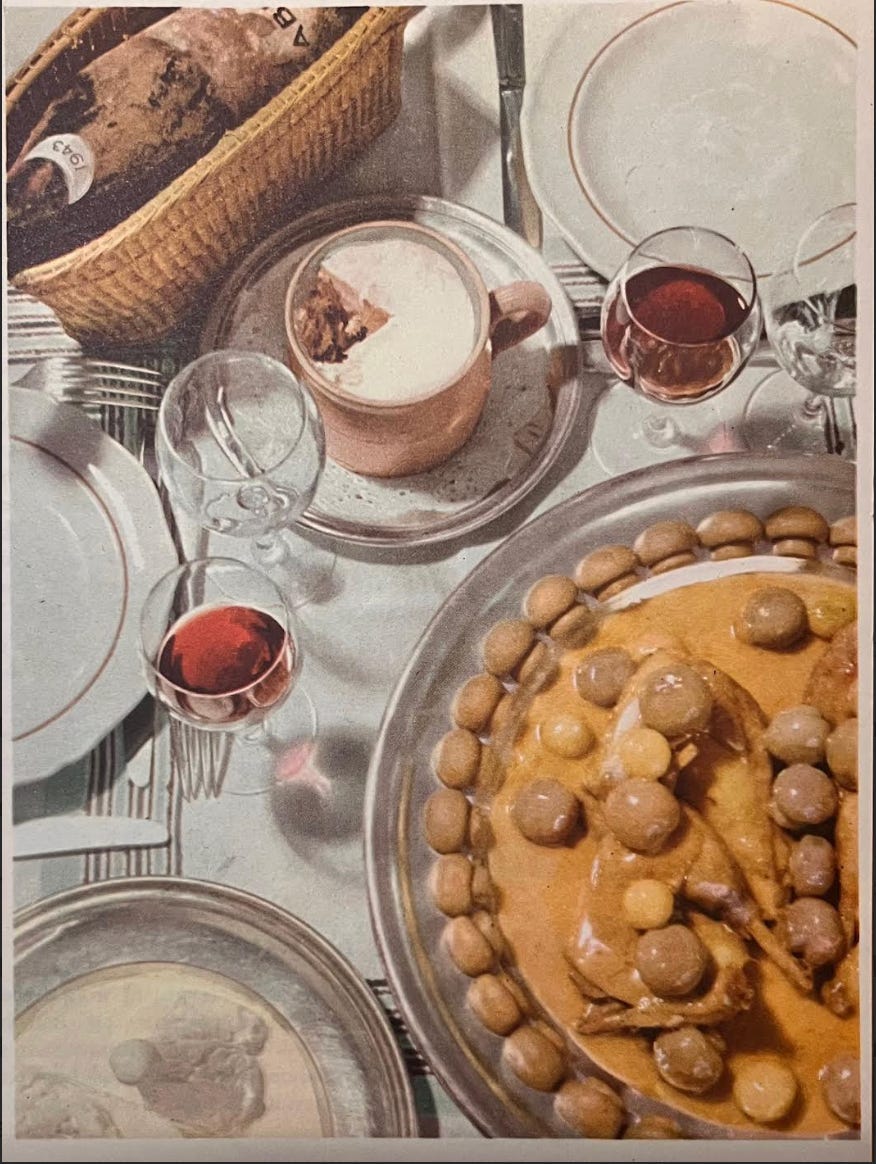
There was a story told in the August 1948 issue of Le Moniteur des Théâtres that illustrates perfectly how this dish moved from being a high end and, eventually, a high end restaurant dish to being a preferred family meal prepared in kitchens across France. This story is about a provincial lawyer, serious and educated, who traveled to Paris where he remained for several days. During his stay, he invited friends to dine with him at a celebrated restaurant where they ordered the fricassée de poulet - the chicken fricassee. The discussion turned to cooking. “ I must admit I know nothing about it,” declared the lawyer. “but if I were to speak purely from personal taste, I’d say that this Parisian chicken fricassee seems far inferior to the ones I’m served at home…..the recipe for which is simple and easy.” The group of gentlemen called over the garçon and demanded he have a fricassee prepared for them following his own cook’s instructions. When served the dish, the group unanimously declared this version delicious! They returned to following evening to have the dish prepared for them once more.
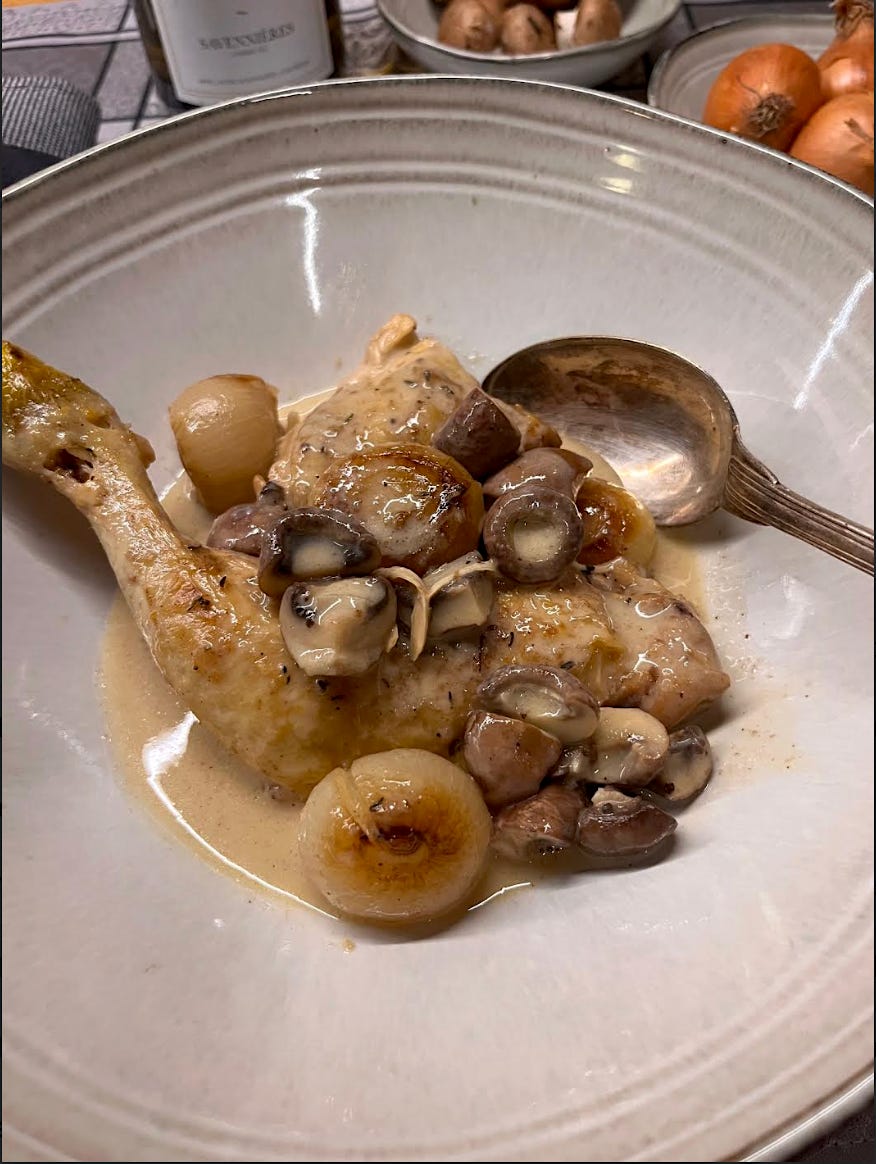
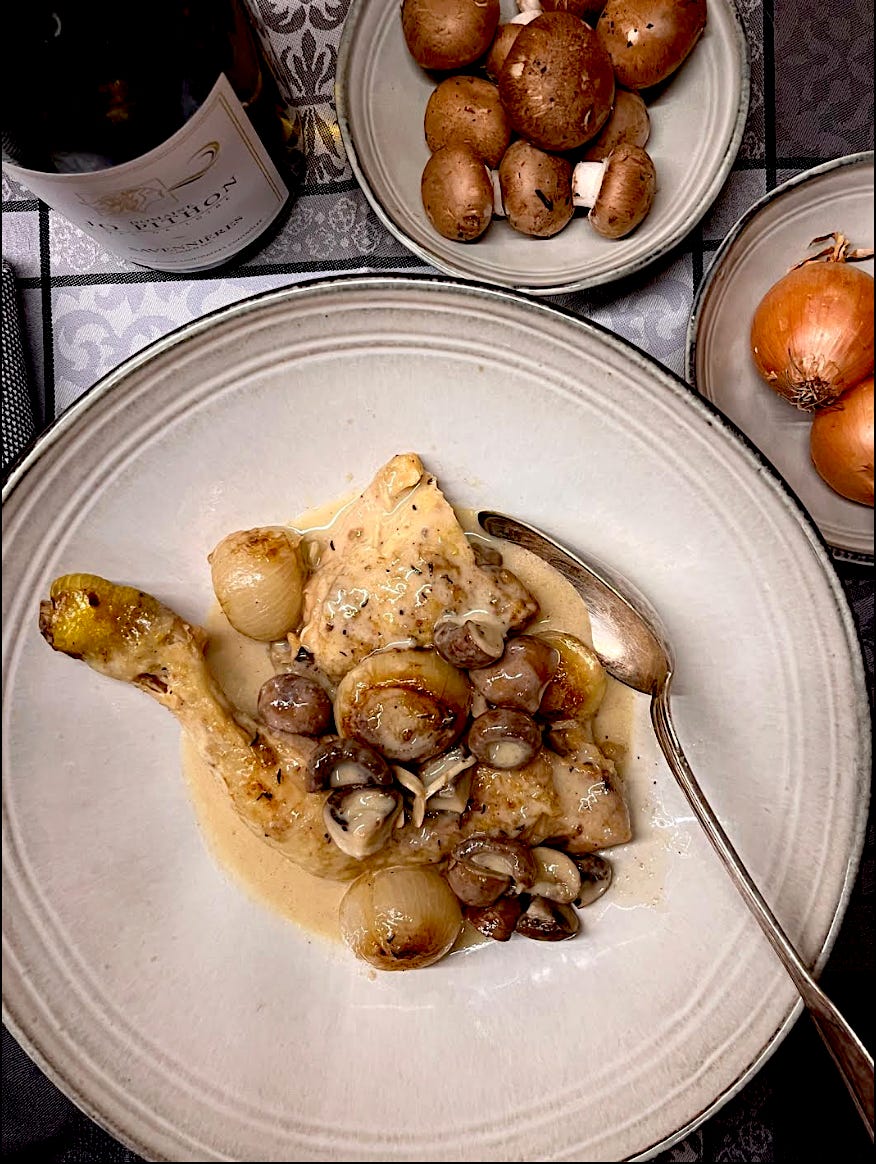
This is a classic fricassée de poulet and as delicious and comforting as it is to prepare, even if there are a few steps.
Fricassée de poulet
2.2 pounds (1 kilo) or slightly more skin-on chicken, either in pieces or cut into pieces
3 - 4 tablespoons flour seasoned well with salt and pepper
5 ounces (140 grams) champignons de Paris, white or brown
10 or 12 fresh small boiler onions or large pearl onions (oignons sauciers)
1 tablespoon vegetable oil, a little more if needed
1 tablespoon butter, a little more if needed
2 tablespoons (20 grams) flour
Salt and freshly ground black pepper
Large pinch ground nutmeg
½ bottle - 1 ½ cups (375 ml) dry white wine * (see note)
1 bay leaf and a few branches fresh thyme or 1 teaspoon dried thyme leaves
2 egg yolks
½ cup (125 ml) heavy whipped cream or crème fraîche
1 lemon
*note: the best white wine for this recipe is a dry French wine, a Chenin blanc from Anjou or Chinon, or a chardonnay, such as a Bordeaux blanc.
Prepare the chicken pieces by trimming off and discarding any large pockets of fat and flaps of skin; leave the skin on the chicken. Pat the chicken pieces on all sides with paper towels. Lightly flour the chicken pieces in the seasoned flour; or roll and lightly press each chicken piece in the seasoned flour, coating all sides, then shaking off the excess flour. Set aside.
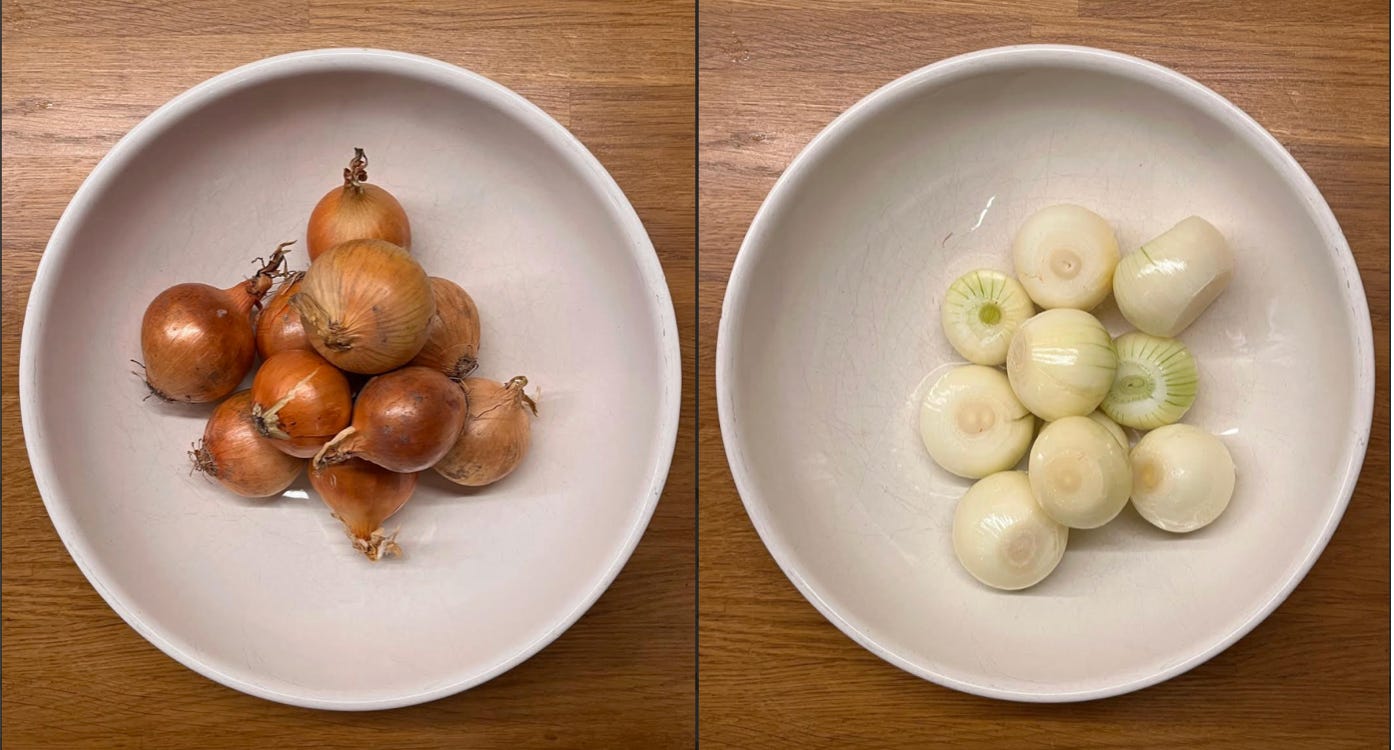
Clean the mushroom caps with paper towels and discard the stems (or save them for making vegetable broth). Slice smaller mushroom caps in half, larger ones in quarters. Trim and peel the onions. Set both aside.
Heat a tablespoon of oil and about a tablespoon of butter in a large heavy pot, Dutch oven or skillet, over medium heat. When the fat is very hot, lightly brown the floured and seasoned chicken pieces on both sides; this is best done in two batches to avoid crowding and takes only 6 or 7 minutes per batch. Remove the browned chicken to a plate and continue with the rest of the pieces.
Once all the chicken is lightly browned and set aside, add the onions to the sizzling fat in the pot and cook until browned on both or all sides; this should only take a couple of minutes.
Return the chicken pieces to the pot with the onions and dust with an additional tablespoon or two of flour, a generous dusting of salt and freshly ground black pepper, and a pinch of nutmeg. Add the wine, scraping the bottom of the pot as best you can, and then bring the liquid just up to a boil. If needed, add a little water (or broth, if you like) just to barely cover the chicken pieces with liquid. Add the thyme and bay leaf. Bring to a boil, lower the heat, place a lid on the pot slightly ajar, and allow the fricassée to simmer for 40 minutes.
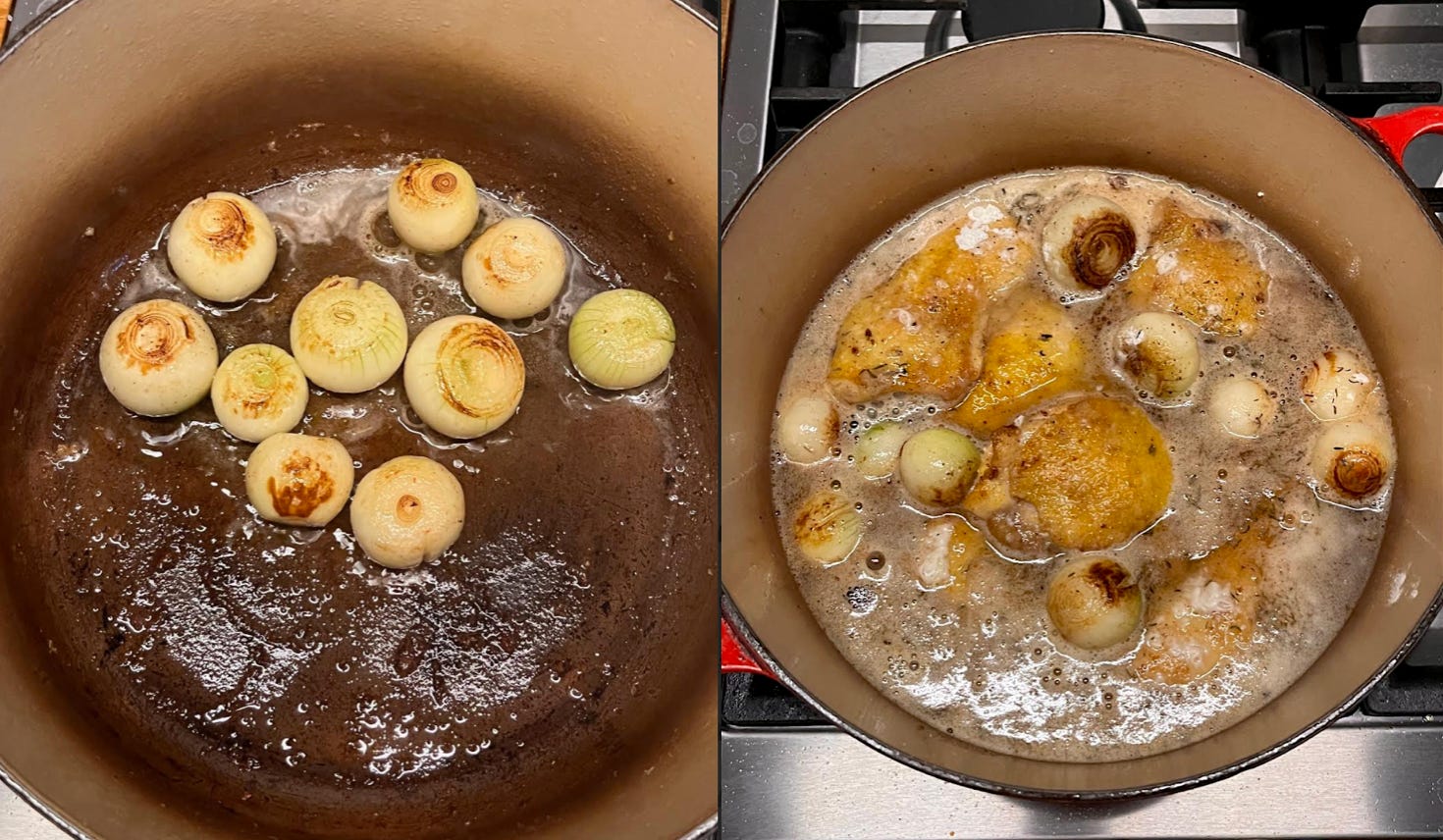
At the end of the 40 minutes, add the mushrooms, pushing them under the surface of the liquid. Continue to cook for an additional 15 to 20 minutes until the chicken is cooked through and the onions and mushrooms are tender.
Using a slotted spoon, carefully lift the chicken and onions out of the pot and onto a plate. If there is too much liquid for a nice, slightly thick sauce, leave it to simmer uncovered for several minutes then take the pot off the heat.
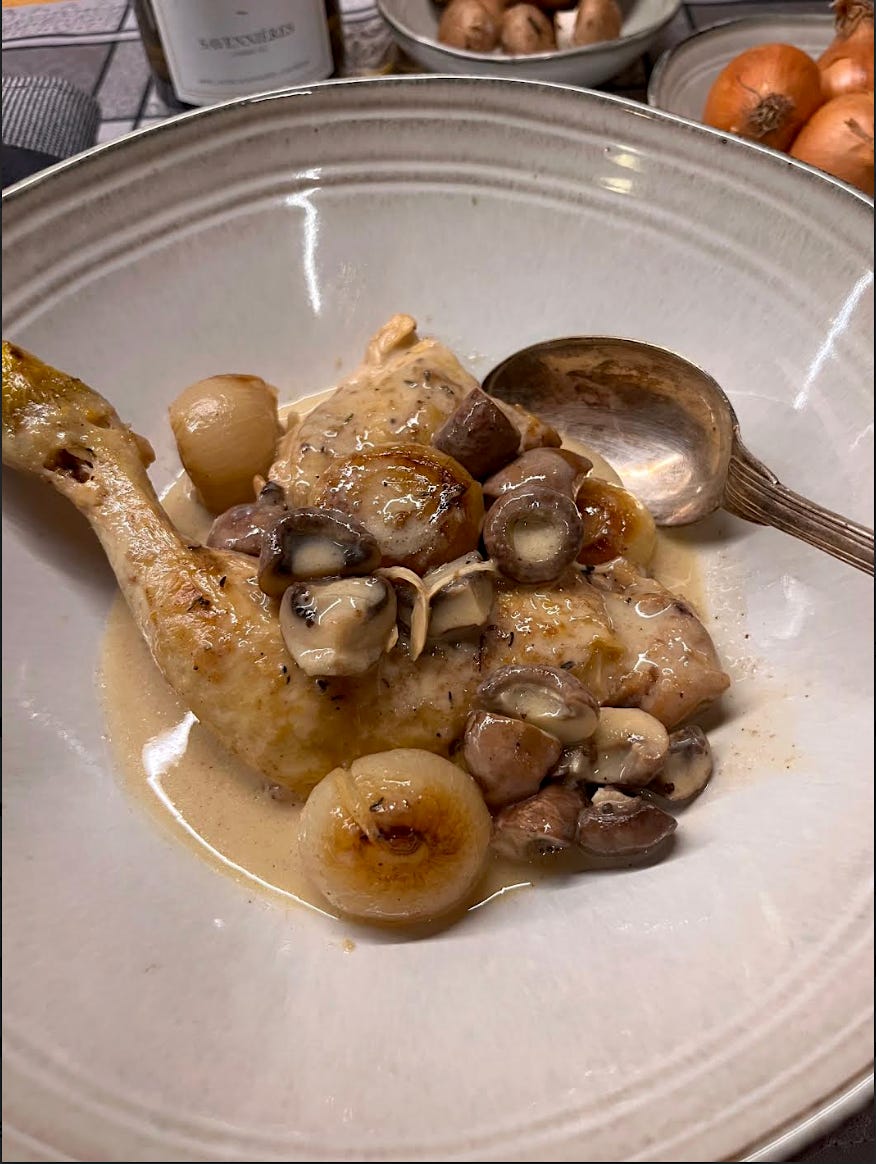
Just before serving, whisk the egg yolks into the cream then stir into the cooking liquid off the heat. Return the chicken to the pot and return to a low heat just to heat through. Squeeze the juice of about half a lemon into the sauce, taste, correct seasonings, and serve immediately.
Thank you for reading and subscribing to my Substack Life’s a Feast. Please leave a comment, like and share the post…these are all simple ways you can support my writing and help build this very cool community. If you would like to further support my work and recipes, please consider becoming a paid subscriber.
No posts
Comments
Nothing yet. Say the first thing.
Sign in to join the conversation.