
Pour la gloire comme pour la bonheur… - Jean-Jacques Régis de Cambacérès, 1804
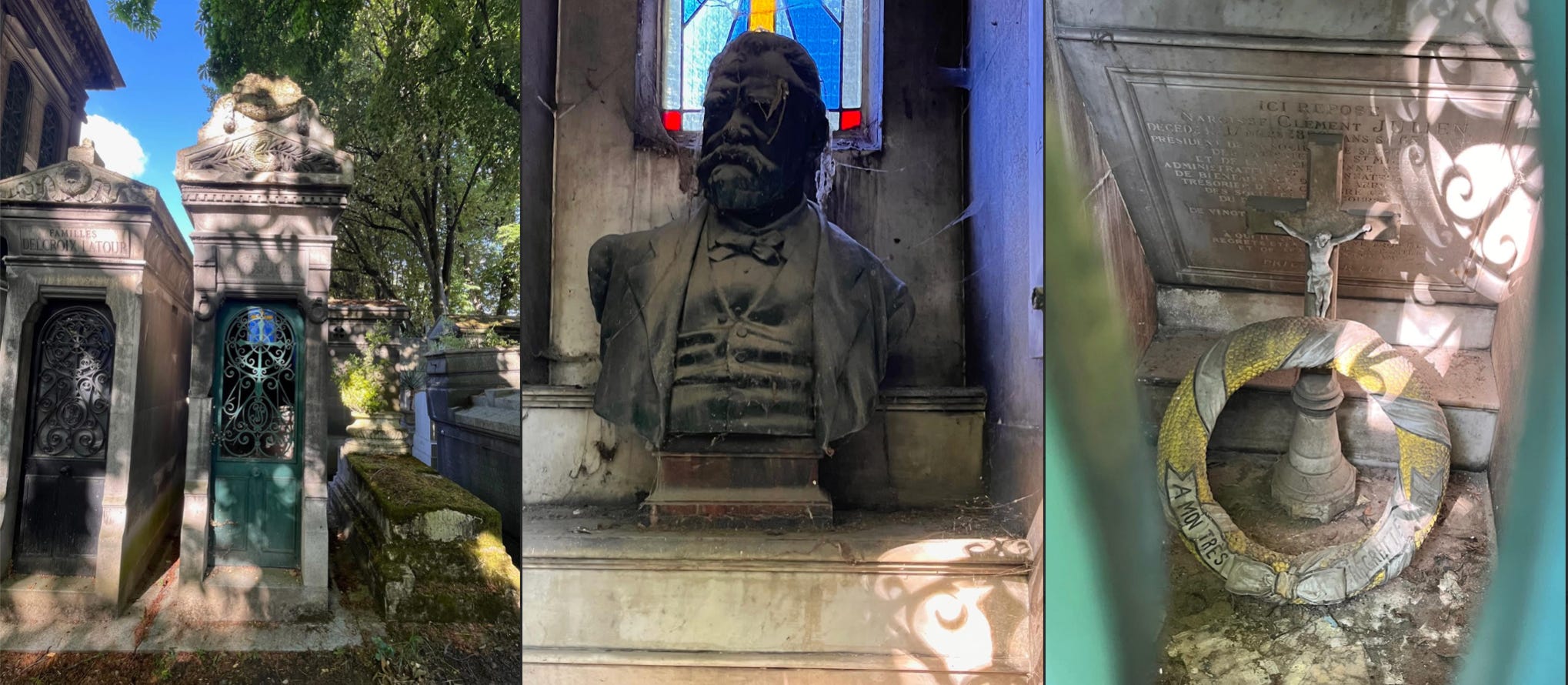
“Vous cherchez quelqu’un?” Are you looking for someone? A polite voice pulled me from my reverie as I slowly made my way around a block of mausoleums, aged but still elegant, a dense jumble of tiny stone houses, crumbling and twisted, each leaning at its own precarious angle without regard for its neighbors, some improbably still standing.
It was a beautiful morning, about half past nine: cool, but with a lovely summer sun, the early light filtering through the thick canopy of leaves on the towering rows of trees that bordered the cobbled lanes. Millions of footsteps had trod and worked these dirt paths and cobbled lanes, while the bulky, gnarled roots of ancient trees, thrusting upwards as though searching for air, had heaved my path into a dangerously broken, uneven surface. I had to keep my eyes fixed on the ground to avoid tripping - or, worse, twisting my ankle again - rather than looking for my destination.
“Yes, I’m looking for Narcisse Julien,” I answered.
“Ah, yes, I know Narcisse Julien, I passed by him this morning! I remember because I said good morning to the two Narcisses - Berchère and Julien! ‘Bonjour Narcisse et bonjour Narcisse!…now where did I see him? Come, follow me!”
I was glad of any help in making out the names, worn by time until they were barely legible in the stonework above the broken wrought-iron portals to each secret world encased inside each tomb. I know I never would have found my Narcisse, as I had already wandered around division 62 several times with no luck - unless you can count my not having tripped and twisted an ankle luck.
“I’m a guide here at Père Lachaise and since I live close by, I come often to keep my memory sharp and to say hello to those who are here. I knew you had to be looking for someone; anyone who is here as the gates open usually comes to find someone.”
And yes, he was right, I had.
And as I hadn’t set foot in the cemetery for decades, I remembered very little of it —certainly not its labyrinthine layout, and even less where any of its famous residents lay. I was feeling both lost and helpless. His assistance was welcome, indeed, because I was coming to find someone. Many “someones”.
The story of Père Lachaise is almost as fascinating as the lives of those whom I had come to see who now rest beneath its soil.
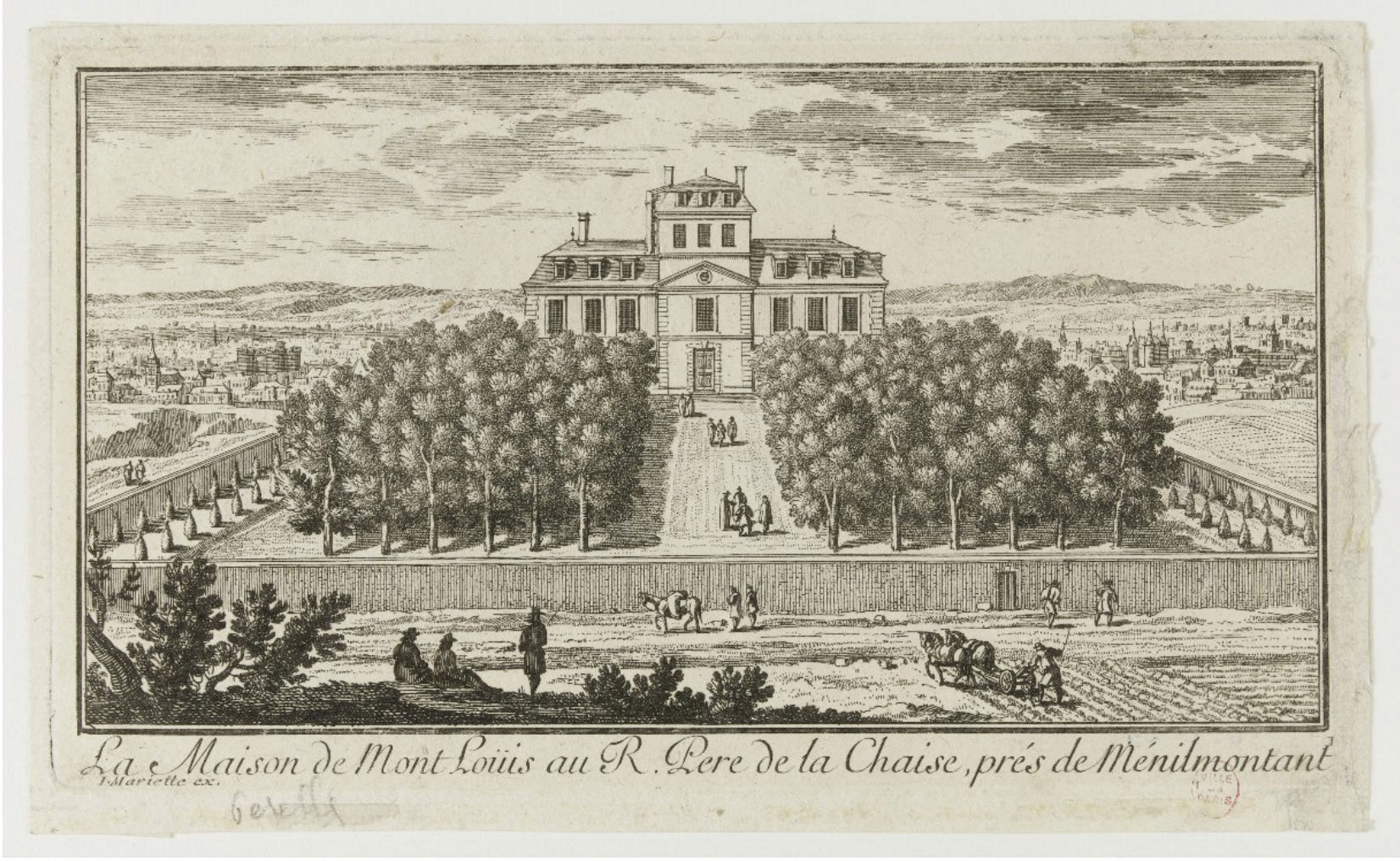
Opened by Napoleon in 1804 on 17 hectares (42 acres) of the former Mont-Louis estate just outside what were then the city’s limits, Père Lachaise - named after Père François de la Chaise, confessor to Louis XIV, who sometimes resided here - was designed by architect Alexandre-Théodore Brongniart as an English-style landscaped cemetery. The newly proclaimed Emperor had declared “Every citizen has the right to be buried regardless of race or religion.”
But, in fact, Paris simply lacked sanitary burial sites, particularly after the closure of The Holy Innocents’ Cemetery next to the city’s central market, Les Halles, a couple of decades earlier. It was intended to be a modern cemetery, designed to accommodate the deceased outside of the residential area.
Initially considered too remote from Paris, it attracted only 13 burials in its first year. In 1817, in a brilliant publicity move, the remains of Jean de La Fontaine, Molière, and later the legendary lovers, philosophers Pierre Abélard and Héloïse d’Argenteuil were transferred there (along with their extraordinary and sumptuous stone canopy), transforming the new cemetery’s fortunes: it quickly became the fashionable place to be buried. By 1830 it contained more than 33,000 graves. Expanded five times between 1824 and 1850, Père Lachaise is today the largest cemetery in Paris, with more than one million people buried within its walls.
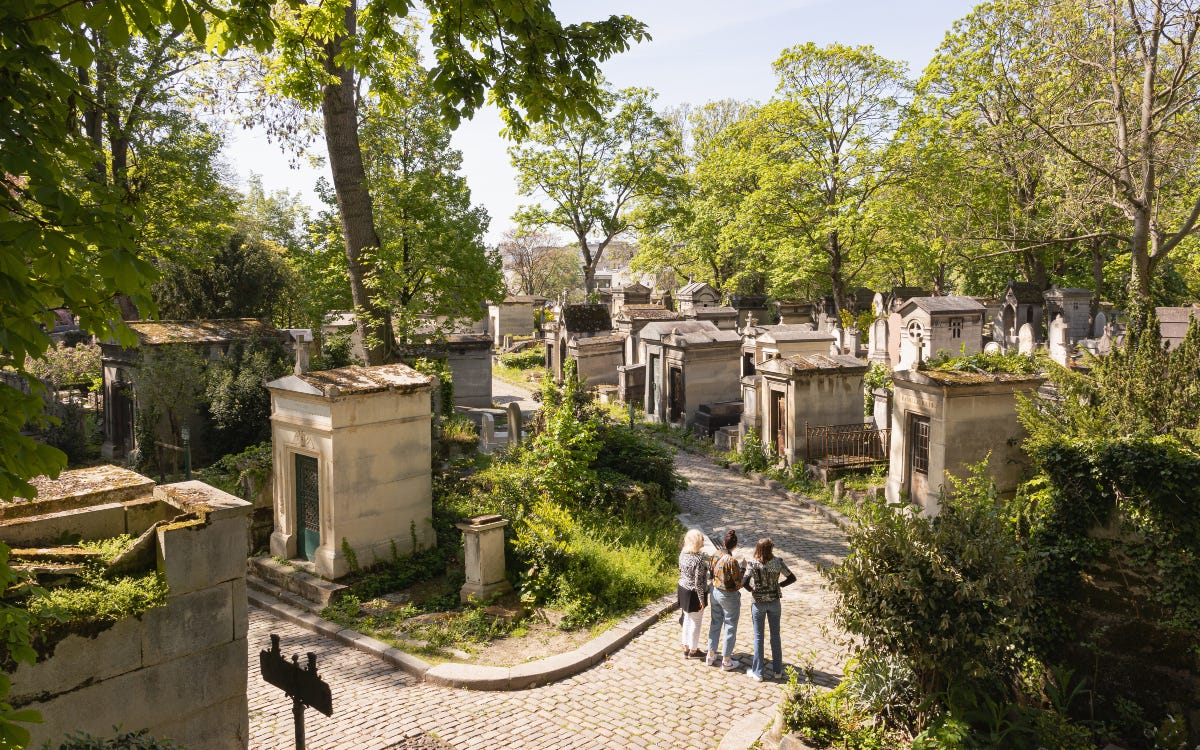
Of course, everyone knows of Père Lachaise now; it’s a famous tourist attraction, close to 3.5 million visitors each year coming to search out the famous dead, come to gawk and snap photos. But it is also a strangely enchanting and peaceful place. The many large, tree-lined avenues were created to allow the passage of funerary processions, but have become lovely shaded lanes for a bucolic stroll. The decorative mausoleums, sculpted tombs, and chapels, a hodgepodge of Gothic, Haussmann-style, and contemporary, are a veritable art museum. The serenity of Père Lachaise’s garden setting most definitely invites contemplation. Time spent either wandering the graves or sitting on a bench in the central park is deeply soothing.
Many of us also come to honor the dead, the illustrious figures who marked history.
I was there, like so many others, on a pilgrimage. Not to see Jim Morrison (although I did detour long enough to snap a quick photo for my friend Mike. A rather ravaged, drunken Frenchman, bottle clutched in one hand and gesturing theatrically with the other, had taken it upon himself to hold court in front of the barred enclosure, preventing the few curious tourists from getting too close), nor the magnificent Oscar Wilde (“The truth is rarely pure and never simple.” And, aptly “I don’t want to go to heaven. None of my friends are there.” Or my favorite “If I am occasionally a little overdressed, I make up for it by being always immensely overeducated.”). I wasn’t there for Edith Piaf, Apollinaire, Gertrude Stein, or Proust. I had come instead to pay my respects to my culinary heroes.
Starting with Narcisse Clément Julien, the youngest of the illustrious Julien brothers - Julien frères, as they officially named themselves, the 19th century Parisian pastry chefs I’ve been studying. So I allowed my search to be taken in hand by this mysterious man dressed like a cross between a schoolteacher and a safari tracker. It didn’t take him long, and I was standing in front of a dusty mausoleum, the wrought iron embraced by cobwebs, his majestic bronze bust likeness hidden in the darkness inside coated in a fine blanket of dust, his handsome face draped with more cobwebs.
I had really wanted to pay homage to my hero, whisper to him, maybe ask him questions… But my guide didn’t understand my holy reverence and kept rattling on and on about himself and his work. I stood there in awe of this great figure, trying to focus my thoughts, studying the inscriptions on the marble plaques inside as my companion’s words continued to intrude like someone yelling in a church while you are trying to pray.
I finally held up my hand to silence him, if ever so briefly, and I brought my hands together and bowed towards Narcisse - my Narcisse - and, speaking to him, declared my esteem and admiration for him. But I know that my guide, rather than thinking this strange American woman should be abandoned and left to her own crazy devices, must have understood, because he did the same in front of another tomb later in the morning. I do believe that simple gesture created a bond between me and…. You know, I never got his name.
I turned away from Narcisse and my guide asked me who else I was looking for. I unfolded a piece of paper I had been clutching and showed him my list - Brillat-Savarin, Antoine Parmentier, the potato man, Charles Monselet, writer, journalist, author, and culinary critic, Cambacérès (Jean-Jacques-Régis de…), grand gourmand known for his extravagant dinner parties, Auguste Escoffier, and Antoine Beauvilliers, the man who opened the first grand restaurant in Paris.
He perused the list quickly and said “okay, I know where he is and him and him… would you like me to take you to each one? Do you mind if I tag along?” If my search for Narcisse Julien was any indication, I knew this could save me a lot of time and footsteps.
And we were off. We spent a lovely morning roaming around Père Lachaise and I let him talk and I learned a great deal: about the history of the cemetery itself, about the men I had come to seek, and about figures I should have known but didn’t, including more contemporary influences on the French culinary and restaurant scene, like the fascinating Roxane Debuisson. I listened to his anecdotes, occasionally interjecting fragments of information of my own. He explained that the tomb of Brillat-Savarin had recently been restored, 200 years after his death, by the members of an association from his birthplace.
“Did you know,” he chattered on excitedly.… I wasn’t a paying client so I imagine his enthusiasm for each unique personnage buried in this place was authentic. He was quite knowledgable, and offered me tidbits that even I didn’t know about my food folks. “Did you know that Cambacérès was gay? As statesman, Napoleon’s Second Consul, and later Archchancellor of the Empire, his homosexuality was an open secret in Parisian society, protected by his rank, his immense political importance, and the Emperor’s favor. According to my guide, Cambacérès was anything but discreet, caring not a whit to hide his flamboyance. Napoleon teased him and and printed images and paintings may have exaggerated his elegance or portrayed him with feminine affectations. He did indeed cultivate elegance and luxury, was always immaculately dressed, quite taken by the display of his full Napoleanic regalia complete with gold trim, silk sash, sparkling medals, and a rakish display of feathers in his hat. His Paris residence was one of the most luxurious in the Empire, although considered more as refined and sophisticated than ostentatious. “Yet his dinners were legendary!” as my guide explained. He maintained one of the finest kitchens in France, employing several chefs and serving elaborate multi-course dinners that became the social highlight of Napoleonic Paris. It wasn’t simply abundance - Cambacérès insisted on perfect service, impeccable timing, and beautifully presented dishes. Revolutionary!
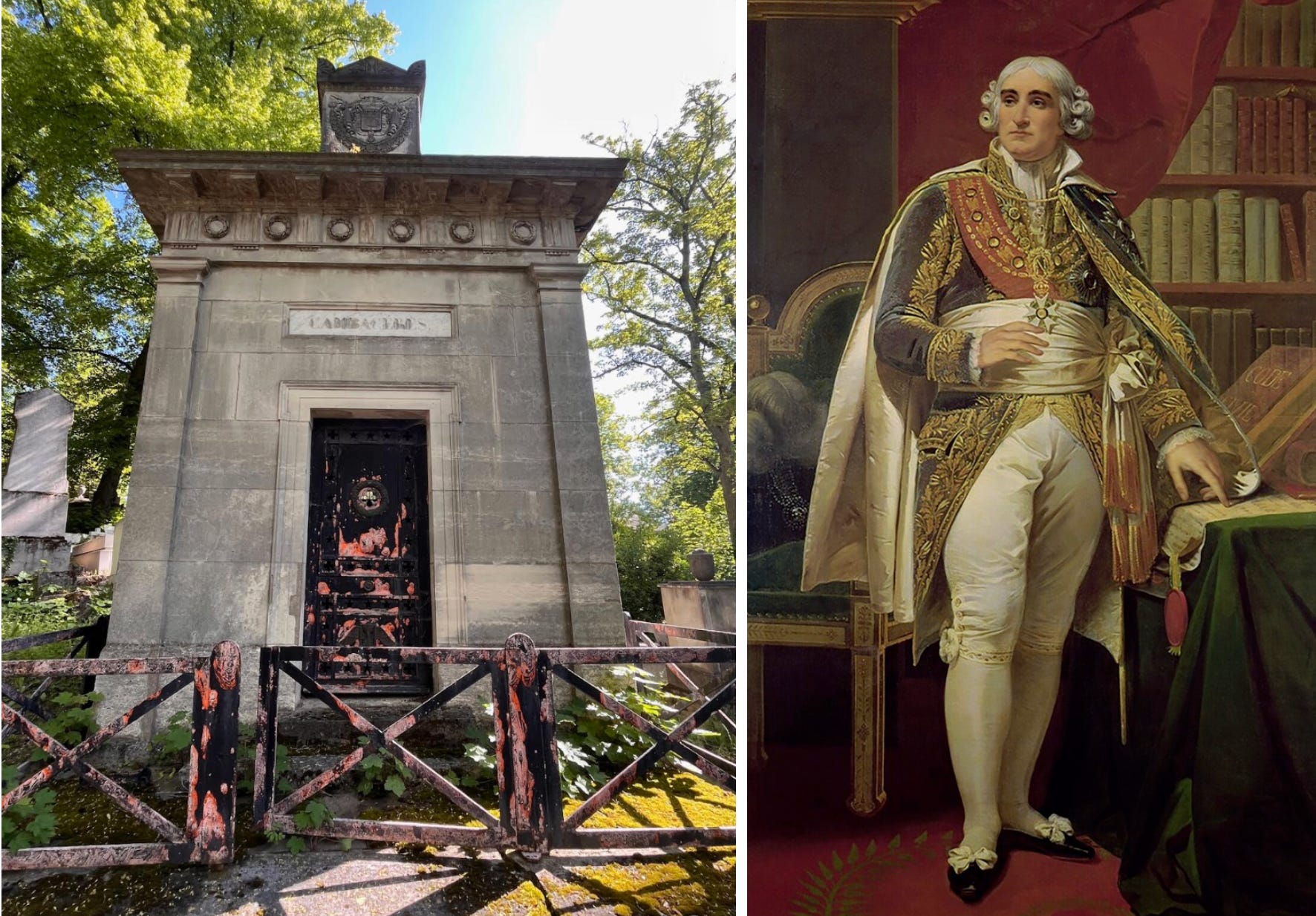
We stopped in front of Cambacérès to pay homage. While a large structure compared to many others, it is rather restrained and simple in design, a neoclassical funerary chapel with almost no decoration at all. The Cambacérès coat of arms - he was Duke of Parma - sits atop the mausoleum, while the sides are decorated with laurel wreaths, symbols of honour and achievement. Understated glory, his name only legible to those of us who stop purposely to see him and, eyes straining, pick it out in the stone.
The sun had risen as it neared noon, yet standing under the cover of leaves, the dance of the light fluttering across the gray stone and among the flowers, I felt unexpectedly light. This morning trip, this running conversation with my safari guide had brought these beings to life, figures that had seemed almost like illustrations, fictional characters that I had only encountered in books or huddled over a laptop in my apartment. And this cemetery felt less like a resting place than a discussion in progress, a conversation two people would have over a long meal, two passionate diners sharing stories and appetite for the curious.
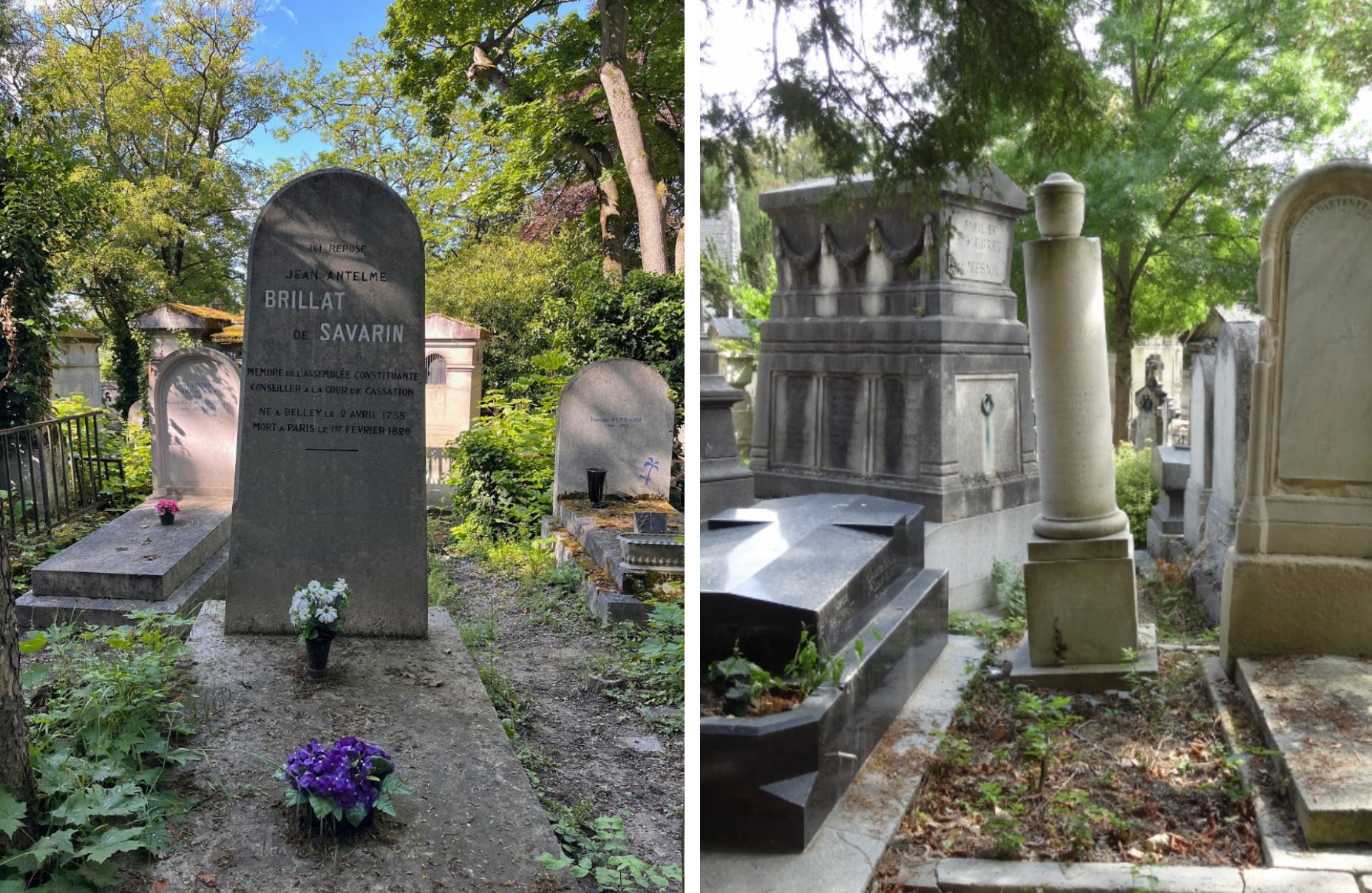
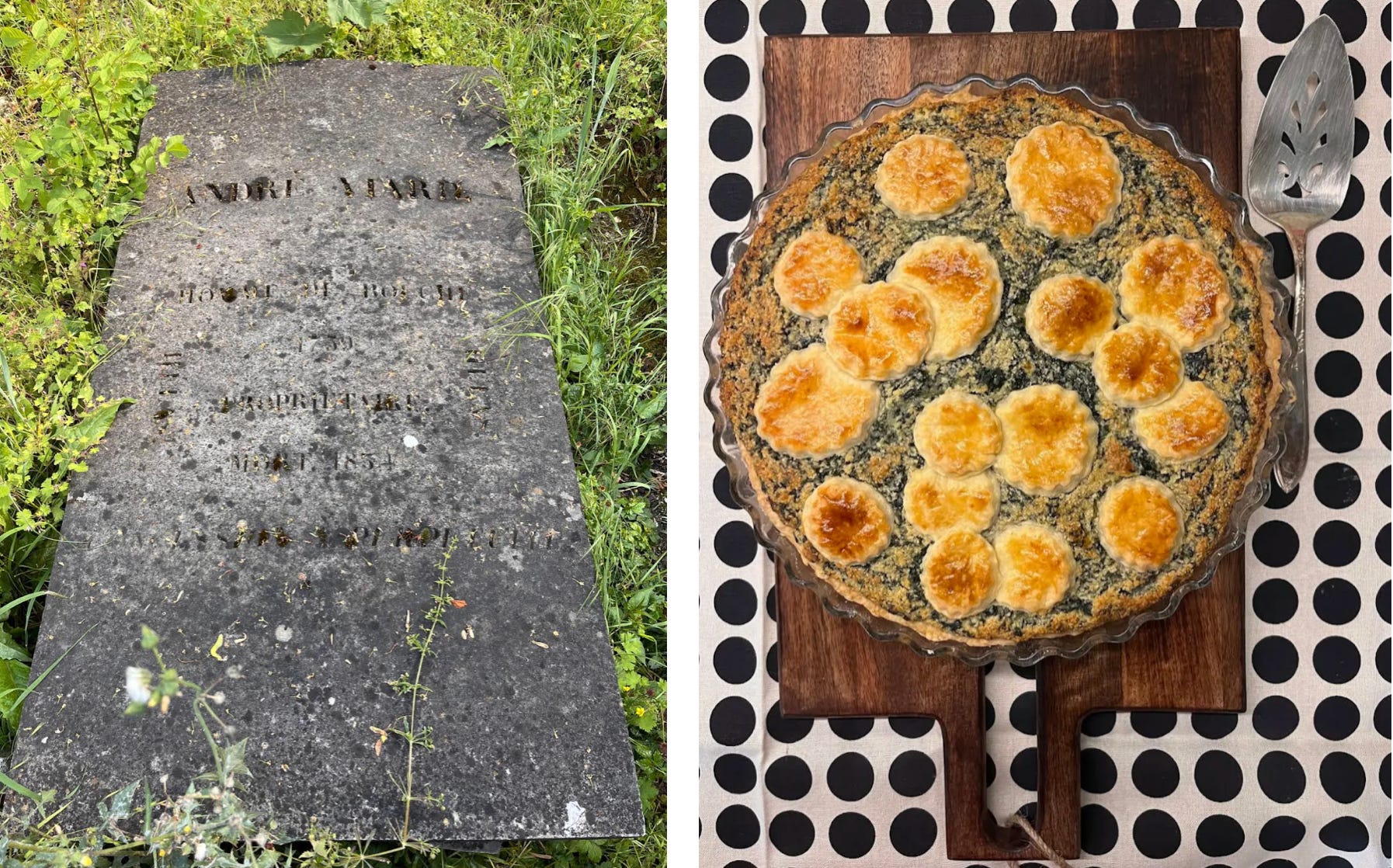
As we moved away from Brillat-Savarin’s lovingly restored headstone and Beauvilliers’ column, now weathered and listing in abandon, my guide suddenly became more animated and said “Oh, let me show you another…. It’s very old and the words are barely legible now, but I’m sure it says something about being a royal food taster!” He dragged me over to a section close at hand and pointed excitedly to the worn stone partially hidden in the unkempt, overgrown plants. We moved as close as we could, but neither of us could make out the words. As I was saying that maybe we could make a gravestone rubbing with paper and pencil, he said “and there’s another here, too, an “homme de bouche.” An “homme de bouche” was chef so this one must’ve been a fairly important figure in the culinary world of his time. I looked to where we was pointing: I studied the words carved into the stone for a bit before I worked it out. “André Viard,” I screamed, thrilled. “That’s André Viard, great chef and illustrious author of several cookbooks - one of which I own.” According to the Père Lachaise website : “(Viard’s) last wishes regarding his funeral reveal a certain penchant for eccentricity. Well before his death on May 5, 1819 (recorded as May 11), he purchased a burial plot at Père Lachaise. He had his tomb built there and visited it regularly thereafter. According to (journalist Édouard) Henrion, he insisted that his coffin be large enough to be filled with 1,000 pounds of salt and an equal amount of bran. This was indeed done upon his death! Furthermore, he also forbids his close friends—specifically named, 25 in number—from paying their respects at his grave on the day of his funeral. Instead, they must gather for a meal at a specific restaurant that he has already booked for the sum of one thousand francs.”
I had forgotten about Parmentier, the Apostle of the Potato, so was delighted when my guide pointed and said “here’s another one” as if he didn’t know who this great man was. I had seen photos online of his tomb, a miniature classical temple, this charmingly symbolic monument to the man who devoted much of his life to persuading the French that the humble tuber could help feed the nation. Visitors have long left potatoes on the grave, perched on the ledge in front of his profile sculpted in a bronze medallion set in the stone, potatoes often turned into little people with addition of eyes, mouths, and limbs, like a collection of little Potato Head people. I was sorely disappointed to find only one and that with no googly eyes.
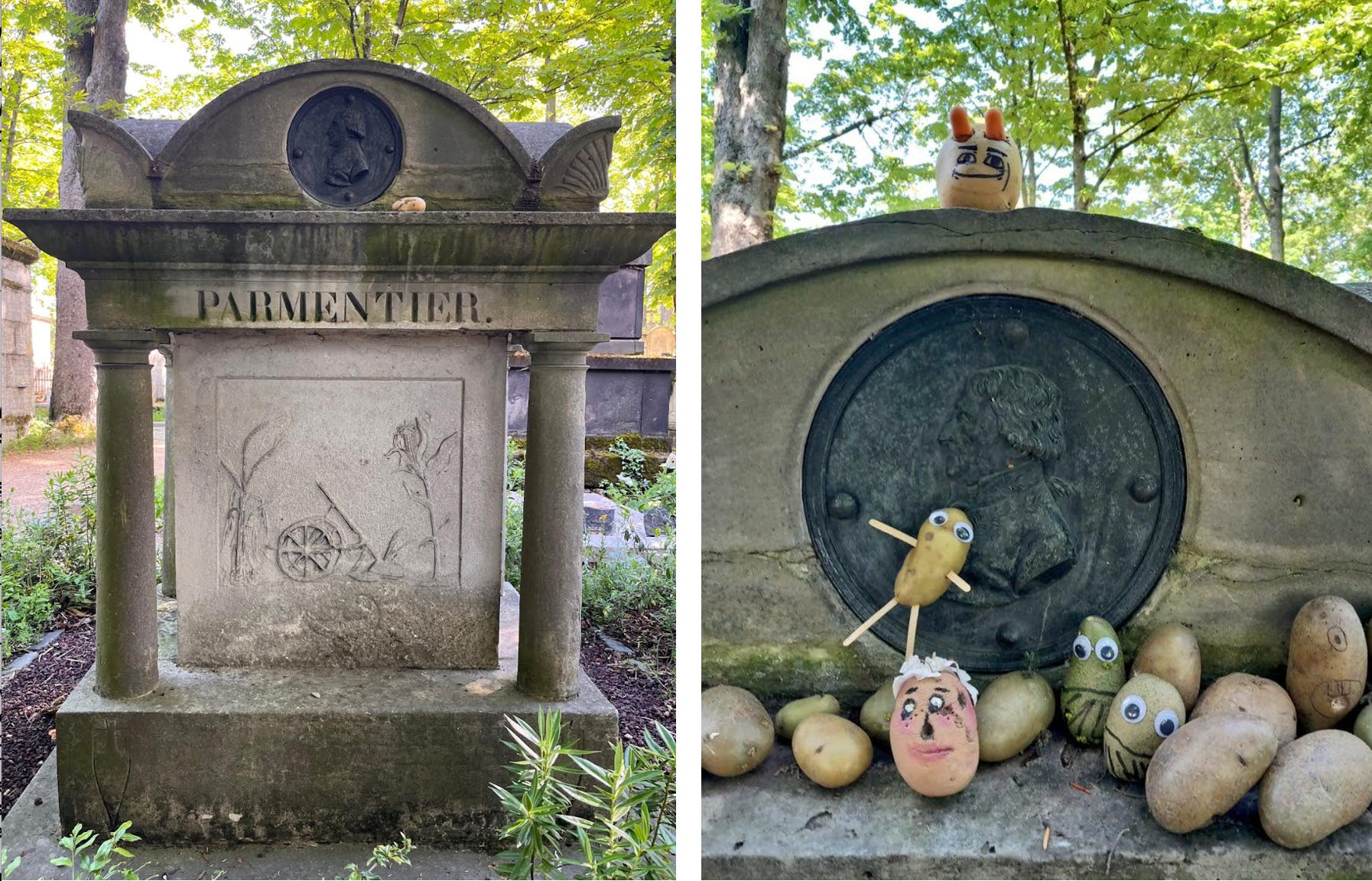
I wonder if Parmentier designed his own burial place as well. It’s a complete monument to his life’s work as a pharmacist and agronomist and his efforts to improve French farming. Each side is carved with representations of the tools and symbols of cultivation and agriculture, ears of wheat and corn, grapevines, an alembic with a furnace and a wheelbarrow, and, of course, a basket of potatoes. It’s planted (ha!) In the center of a mini square bordered with a narrow flower bed, and is regularly tended by certain pharmacists’ associations. Until the early 20th century, the grave was adorned with a vegetable garden where potato plants flourished, but it’s beautiful, nonetheless.
My last wish was to see the final resting place of Henri-Paul Pellaprat, another personal hero of mine. Pellaprat, who I have written about, was a well-known chef, culinary instructor, and co-creator of the Cordon Bleu cooking school. He advocated for teaching young women cooking and other household skills as early as grade school and was one of the first to write and popularize family cookbooks for modest homes. I checked for the location of his grave online and double- and tripled-checked on ChatGPT and got a different location every time. We looked and looked and, sadly, never found it. By this time I was too hot and too exhausted to head back across miles of cobblestones to the office to ask. All I wanted was to take the metro back to where I was staying and pull off my boots. I still had a coffee date with someone later that afternoon.
And in our search for Pellaprat, we lost each other. I wandered around a bit but couldn’t find my guide anywhere. So I headed towards the entrance gates and the metro.
It was a wonderful morning. I was thrilled to have been able to stand in front of Narcisse Julien (more on him later), as well as my other culinary folk heroes. And I loved rediscovering Père Lachaise after decades; I have always loved wandering around cemeteries, imagining the lives and stories of those buried there and honoring those who seem to have been forgotten to time. I love the beauty and sadness of funerary art. I love the peaceful atmosphere of a cemetery, a quiet peace that strangely comforts, a placid serenity that compels reflection and a feeling of weightlessness as if I am lost in time.
I spent the rest of my trip and the following meeting food historians, doing research at various libraries, and visiting museums. Somewhere in these last several years, I’ve found a purpose and chosen a role: to preserve a bit of culinary history, to commemorate those who have been forgotten by too many people. They lived extraordinary lives, rich with adventure, invention, and imagination, leaving an indelible and important imprint on French cuisine. They deserve to be both remembered and admired.
The least I can do is tell their stories.
There is no happiness where the chef’s art is ignored. - Jean-Jacques Régis de Cambacérès
Thank you for reading and subscribing to my Substack Life’s a Feast. Please leave a comment, like and share the post…these are all simple ways you can support my writing and help build this very cool community. If you would like to further support my work and the creation and development of the recipes, please consider becoming a paid subscriber.
No posts
Comments
Nothing yet. Say the first thing.
Sign in to join the conversation.