
“If Iboga Is to Save the World, Then the World Must Save Iboga.”
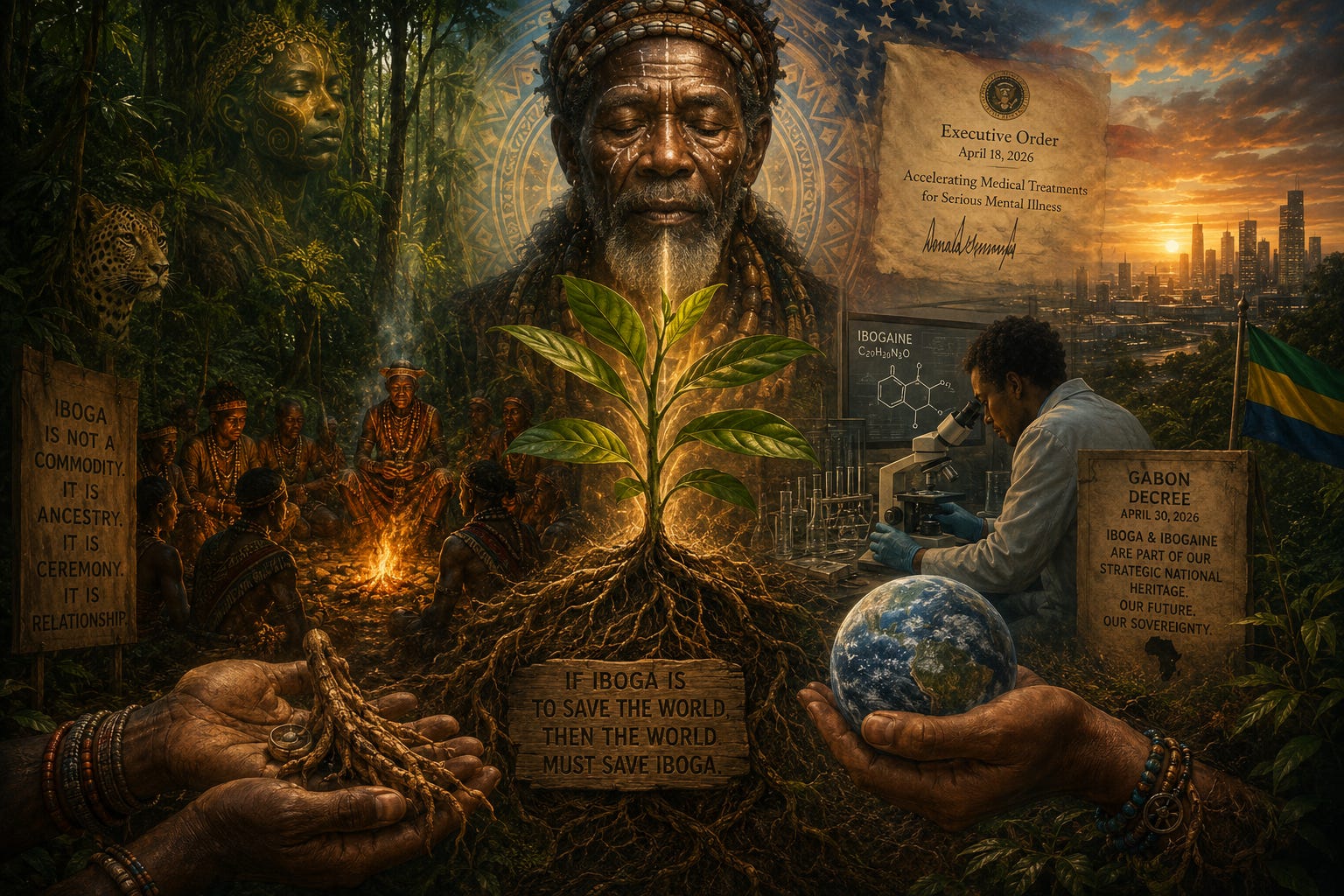
What happened in Gabon this spring did not make the front page of most American newspapers. There were no flashing banners across television screens or breaking-news countdowns. Not one loud debate between newscasters beneath bright studio lights.
Yet, quietly, deep in the equatorial forests of Central Africa, something profoundly important happened.
Just two weeks after President Donald Trump signed the April 18, 2026 executive order titled “Accelerating Medical Treatments for Serious Mental Illness,” the nation of Gabon responded with a message to the world that felt less like politics and more like a warning from an elder standing at the edge of a fire. It was a reminder, a plea, and a line drawn in the soil.
While the United States celebrated the future of psychedelic medicine, Gabon was trying to protect its soul.
The executive order itself marked a historical shift in American policy. It directed federal agencies to accelerate psychedelic research, expand access pathways, and prioritize treatments involving compounds like ibogaine (derivative from iboga), MDMA, and psilocybin for people suffering from severe mental illness who had not responded to conventional care. It also called for collaboration between the FDA, DEA, Veterans Affairs, and state governments while allocating at least $50 million toward psychedelic research initiatives.
For many Americans struggling with PTSD, addiction, depression, and suicidal ideation, the announcement felt like hope breaking through concrete. People who had spent decades whispering about psychedelic healing in dark corners suddenly watched the highest office in the country speak the words openly.
In the homeland of iboga, 7,000 miles away, a deeper conversation was taking place because to Gabon, iboga is not a trend. It is ancestry, ceremony, and relationship at risk of becoming a biotech opportunity and a molecule waiting to be patented.
On April 30, 2026, Gabon’s Council of Ministers formally adopted a decree classifying iboga and ibogaine as part of the nation’s “strategic national heritage.” Every export would now require direct government authorization. A sovereign fund would be created so profits from iboga would flow back to Gabonese communities instead of disappearing entirely into foreign pharmaceutical systems. Gabon watched what happened to peyote and ayahuasca and saw how sacred medicines become industries. They decided to act before history repeated itself.
To understand why this matters, we first have to be honest about ourselves. Western society was largely built through early colonialism that evolved into modern industrial capitalism. Extraction was normalized, profit was virtues, and expansion became synonymous with success. We learned how to take from the earth without ever asking what would happen if we never gave anything back. From this mindset somewhere along the way, many of us forgot who we are and where we come from. It is now foreign to sit in silence and listen to the wind moving through trees without reaching for our phones. We have forgotten that human beings once belonged to the earth instead of trying to dominate it. We’ve built lives around productivity and distraction while our souls quietly starve in the background. We are disconnected from ourselves, nature, one another, and the divine.
For some people, even reading the word “divine” creates an immediate reflex to pull away. Religion has wounded many people and institutions have distorted what is sacred. Yet long before organized systems claimed ownership over spirituality, human beings understood something deeper: that life carries a sacred intelligence far greater than our ability to fully explain. God, Spirit, Creator, consciousness are different names pointing toward the same river.
Perhaps part of the sickness we are now facing as a society is not simply chemical imbalance or trauma alone, but the collapse of the relationship to meaning, community, and the spiritual realm.
This is where iboga enters the conversation. For centuries, the Bwiti people of Gabon have worked with iboga in sacred ceremonial contexts designed to heal not only the body, but the spirit and the memory. At Psychedelic Science 2025 Master Moubeyi Bouale sat before a Western audience and spoke words that landed with the weight of generations.
“Iboga is not just a chemical formula,” he said. “It is a living entity, the spirit of a memory that has been preserved and honored.”
The room was quiet because somewhere beneath the clinical language, investment strategies, and FDA pathways, everyone could feel the truth inside what he was saying.
Modern society often wants the fruit while ignoring the roots. We want the compounds, patents, treatment centers, and breakthrough designations. Yet we shy away from the responsibility that comes with sacred relationships.
Master Moubeyi Bouale reminded the world that long before Western laboratories began studying ibogaine for PTSD and addiction, the people of Gabon had already spent centuries in relationship with the plant.
“It heals, confronts and reveals,” he said. “It heals the body, the soul and the memory.”
This is exactly what makes iboga so uncomfortable for modern culture because it does not simply numb pain, it asks people to face themselves and look directly at the fractures beneath the surface and remember.
Meanwhile, as Western interest intensifies, the roots of the plant itself are becoming endangered through overharvesting, illegal exporting, and exploitation. The very communities that protected this medicine for generations now risk being erased from the story entirely.
Master Moubeyi Bouale spoke with unwavering clarity.
“We are not against research,” he said. “We are not against worldwide access to this medicine.”
What they are against is the same pattern humanity has repeated for centuries:
Take the resource.
Erase the people.
Sell the product.
Call it innovation.
He called for genuine international cooperation rooted in reciprocity, ethical stewardship, cultural respect, and equitable sharing of benefits to avoid domination and extraction. This will require partnership, listening, and deep humility. There is something profoundly symbolic about this moment in history.
America, a nation drowning in addiction, depression, suicide, loneliness, and disconnection is now turning toward medicines that originated from cultures deeply rooted in community, ceremony, reverence, and relationship. What if the real lesson iboga carries is not simply how to survive trauma, but how to remember what it means to belong again? To ourselves, to one another, to the earth, and to something sacred.
This is why Gabon’s response matters so deeply. They are trying to protect not only a plant, but a way of relating to life itself. If we truly want healing, real healing, then we must resist the urge to turn sacred medicines into another extraction economy driven solely by profit, speed, and control. We cannot repeat the mistakes made with peyote. We cannot allow indigenous wisdom to become a footnote beneath billion-dollar industries. We cannot separate the medicine from the people who carried it through centuries of colonization, persecution, and sacrifice. Without reverence, healing becomes consumption. Without reciprocity, healing becomes theft. Without relationship, healing becomes another transaction.
There is still time to listen and choose differently around building ethical frameworks around iboga and psychedelic medicines before the machinery of greed fully consumes them. This is why Master Moubeyi Bouale’s final words continue echoing long after the applause faded from the room. Not because they sounded poetic, but because they rang true.
“If Iboga is to save the world,” he said, “then the world must save Iboga.”
No posts
Comments
Nothing yet. Say the first thing.
Sign in to join the conversation.