
Executive Summary:
The 2026 World AI Conference (WAIC), which featured remarks from Xi Jinping, highlighted the People’s Republic of China’s (PRC) pitch for global artificial intelligence (AI) governance and cooperation.
Since its launch in 2018, the WAIC has evolved with the PRC’s AI ambitions. Launched soon after the release of the country’s first AI development plan in 2017, it has reflected policies contained in Shanghai’s AI action plan for 2019–2021 and national-level global governance initiatives announced since 2022.
The 2026 WAIC marks a turning point for the PRC’s AI development, as models from Chinese companies like DeepSeek and Moonshot AI start to gain traction globally. Authorities also used the conference to launch a World AI Cooperation Organization, signifying the PRC’s growing comfort in pitching non-Western governance objectives to the world and especially the Global South.
The 2026 World Artificial Intelligence Conference (WAIC; 世界人工智能大会), held in Shanghai in July, was the first time that Chinese leader Xi Jinping attended and delivered remarks at the annual event. The conference has tracked the steadfast development of the country’s approach to artificial intelligence (AI) since its inaugural summit in 2018, which took place soon after the release of the New Generation Artificial Intelligence Development Plan (新一代人工智能发展规划), one of the PRC’s earliest AI strategies. The latest conference reflected the growing prominence that the Chinese leadership places on AI (PRC Government, July 20, 2017; China Brief, October 1, 2025).
Over the years, the WAIC has also grown alongside the country’s increasing international influence and is now an important vehicle for promoting its technological might. Previous conferences have featured high-level speakers like Jack Ma, Elon Musk, and Henry Kissinger. Having emerged as a result of the PRC’s domestic AI policy, it has slowly merged into a medium for Beijing’s bid for global AI leadership and governance abroad, evidenced by both government strategies and conference programming and attendance.
The WAIC emerged from Domestic AI Policy and Development
The formation of the WAIC can be seen as a direct result of the PRC’s early recognition of AI as a “strategic technology” (战略性技术) and its designation by PRC leaders as an “important strategic opportunity” (重大战略机遇). The government translated this top-level assessment into multiple AI policies and strategies starting from the mid-2010s, ultimately giving rise to the WAIC.
Beijing had already bet on the development of advanced technologies prior to the establishment of the WAIC. In 2015, the “Made in China 2025” (中国制造2025) sought to address the economic challenge presented by “significant gaps in independent innovation capabilities, resource utilization efficiency, level of industrial structure, degree of informatization, and quality and efficiency” (在自主创新能力、资源利用效率、产业结构水平、信息化程度、质量效益等方面差距明显) (State Council, May 8, 2015; CSET, March 8, 2022). The plan did not explicitly refer to AI at the time, but it did refer to intelligent, smart, and Internet technologies, laying the groundwork for future AI documents.
The PRC’s first dedicated AI strategy, the 2017 New Generation AI Development Plan, called for aligning domestic AI development with global developments, as well as providing a “new, important point of economic growth” (新的重要经济增长点), by 2020. Additional targets included significant technological breakthroughs in AI while making AI integral to the Chinese economy by 2025, and becoming the “world’s primary AI innovation center” (世界主要人工智能创新中心) by 2030 (PRC Government Net, July 20, 2017). Beyond technological advances, the plan also recognized the importance of standards and regulations for building a global AI power, an emerging area of focus for the PRC government.
Shanghai, the host of the WAIC, quickly fell in line with this broader central initiative. Several months after the national government launched its development plan, the city government published a set of implementation opinions on “Promoting the Development of the Next-Generation Artificial Intelligence in the City” (本市推动新一代人工智能发展) (Shanghai Municipal Government, October 26, 2017). In this initial document, the city envisioned leveraging Shanghai’s status as a domestic and international hub for finance, innovation, and business to build a new AI ecosystem and innovation hub, something that it further cemented in its subsequent action plan for 2019–2021. This plan also made use of the WAIC as a vehicle to implement national AI policy, calling for using it as one of a number of “hub-type innovation platforms” (枢纽型创新平台) and to help “organize and gather global innovation resources” (组织汇聚全球创新资源) (Shanghai Municipal Economy and Informatization Commission, September 13, 2019).
These strategies indicate the swift uptake and adoption of Beijing’s policy guidance through provincial and municipal implementation, with Shanghai at the forefront as a major hub. New strategies have proliferated in the years since in line with technological advances, with multiple AI governance documents released. Beyond focusing on domestic integration and development efforts, however, the PRC government has also turned outward to promote its approach to AI.
WAIC Broadcasts AI policy and Governance
Long before Xi Jinping’s speech at the WAIC, the conference had already established itself as a leading forum on AI conversation both within the PRC and globally. In 2018, Shanghai’s then deputy mayor, Wu Qing (吴清), held a press conference alongside other municipal officials to introduce the new platform. They signaled the city’s national and international ambitions for the conference, noting that it was co-hosted and approved by multiple government bodies, including the State Council and the Ministry of Industry and Information Technology, and that attendees for its first edition would include representatives of leading domestic and global companies, researchers, and technology leaders (Shanghai Municipal Science and Technology Commission, July 5, 2017). Its central-level imprimatur was indicated by Xi sending a congratulatory letter upon the opening of the conference, in which he wrote that AI was a “development opportunity” (发展机遇), but one that would bring “new issues” (新课题) in areas such as law, security, employment, ethics, and governance. This, he added, would require “deepened cooperation and joint exploration among all countries” (需要各国深化合作、共同探讨) (Xinhua, September 17, 2018).
Over the ensuing eight years, the WAIC’s grew into its role as an instrument for disseminating the PRC’s domestic and international vision for AI. For example, in 2024, the WAIC officially issued a Shanghai Declaration, in which signatories agreed to “promoting AI development,” “maintaining AI safety,” “developing the AI governance system,” “strengthening public participation and improving literacy,” and “improving quality of life and increasing social well-being,” in line with other Chinese government documents during that time (Ministry of Foreign Affairs, July 4, 2024). At the 2025 conference, a “Global AI Governance Action Plan” was released that featured 13 points spanning the development of AI and its infrastructure to establishing norms of using AI (Permanent Mission of the PRC to the United Nations, July 17, 2025). The PRC also used that conference to call for the establishment of an AI cooperation organization, laying the groundwork for the “World AI Cooperation Organization” (WAICO) unveiled at this year’s event. WAICO, which is headquartered in Shanghai, launched with 29 countries as founding members (Xinhua, July 17).
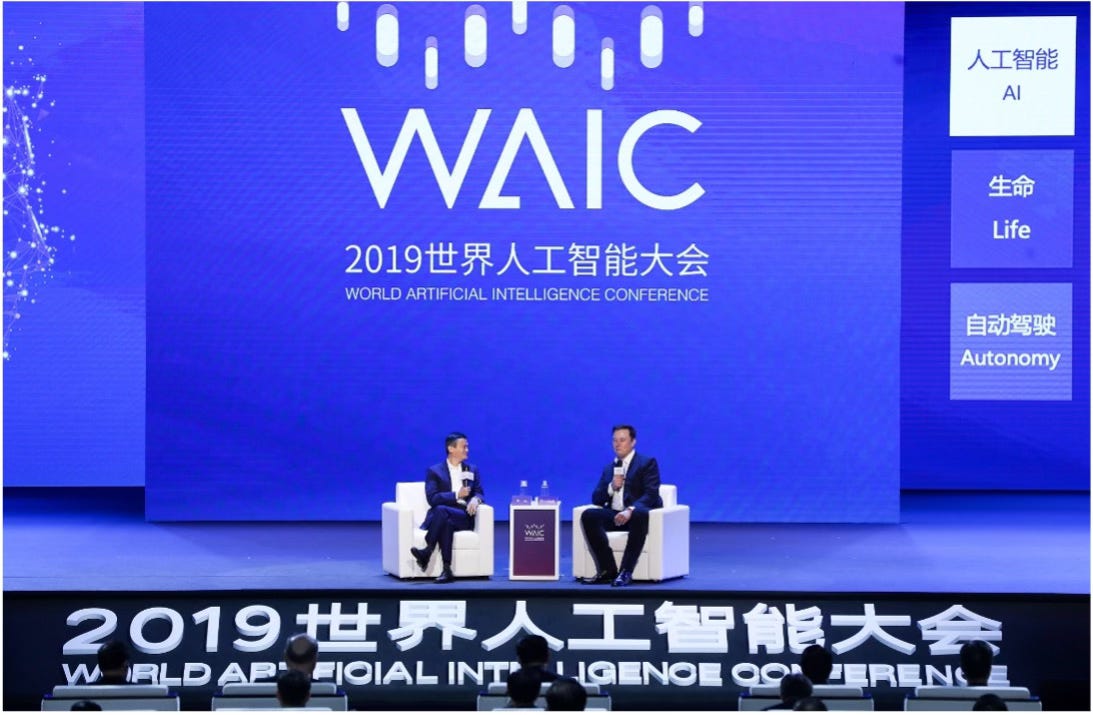
The WAIC’s growing international outlook has taken place alongside a decline in U.S. representation, mirroring the shift in global AI cooperation and dialogue. In 2019, Jack Ma—the founder of Alibaba and Ant Group—took the stage to debate the future of AI development and capabilities with Elon Musk. The two found common ground on areas like AI’s impact on population (YouTube/New China TV, August 29, 2019). Musk remained a high-level participant of the WAIC until 2025. Between 2019 and 2025, other notable speakers included Baidu’s Robin Li (李彦宏), Tencent’s Pony Ma (马化腾), former U.S. Secretary of State Henry Kissinger, Kai-Fu Lee, Geoffrey Hinton, Harry Shum (沈向洋). Former Google CEO Eric Schmidt, another high-profile attendee, was quoted by Xinhua at the 2025 WAIC as saying that when he visited the PRC in 2023, he felt that it “had not yet fully recognized the potential and power of AI” (还没完全认识到人工智能的潜力和力量), but that the recent “tremendous progress” (巨大进步) of Chinese AI models have achieved “remarkable results” (显著成绩) (Xinhua, August 11, 2025).
None of these Western technologists or former officials were present at the 2026 WAIC, although an opening address by United Nations Secretary-General António Guterres officially cemented the WAIC’s international reach (United Nations, July 17). The theme of the conference, “Intelligent Partners, Co-Creating the Future,” reflects Beijing’s growing confidence in pitching an alternative, non-Western global order to the rest of the world, and to the Global South in particular, in tandem with Beijing’s strategic documents on global AI governance and cooperation as well as its broader initiatives like the Global Governance Initiative (China Brief, June 26). This pitch appears to be paying off, as the conference’s online audience grew from around 253 million viewers in 2020 to over 2 billion by 2024, according to WAIC (Artificial Intelligence International Institute, accessed August 11).
Conclusion
In almost a decade, the WAIC has changed from an emerging forum for publicizing the PRC’s domestic policy to a global platform designed to promote its global vision. It has also become an emblem for the PRC’s broader AI ambitions.
The 2026 iteration, which led to the establishment of the WAICO, comes at a pivotal point in time. PRC companies have made significant strides in AI development, from DeepSeek’s January 2025 release of its breakthrough R-1 model to the release on the eve of the conference of Moonshot AI’s powerful new model, Kimi K3 (Kimi, July 16). These developments make the WAIC even more salient for analysts, leaders, and technology companies alike, as it serves not only as a convening ground but as a platform to exhibit the latest offerings from Chinese companies.
Beijing has realized that technological strength must go hand-in-hand with domestic and global AI diffusion. Xi made this clear in his speech at the WAIC, promising to “further support global AI development and advance global AI capacity building,” including through providing developing countries with 5,000 opportunities in AI training and seminar programs, offering concrete steps for how to turn the PRC’s bid for AI leadership from theory into practice (Xinhua, July 18). Little is currently known about the WAICO or how it will complement the PRC’s global AI governance vision, but its development and potential expansion to include more member states will provide useful indicators of the country’s influence and impact in shaping global approaches to AI in the months ahead.
This article originally appeared in China Brief. Check it out here!
Lea Thome is the Schwarzman Fellow at the Wilson Center, affiliated with the Kissinger Institute on China and the United States. She holds a master’s degree in Global Affairs as a Schwarzman Scholar from Tsinghua University in Beijing, China. She specializes in China’s maritime expansion through ports and bases.
Comments
Nothing yet. Say the first thing.
Sign in to join the conversation.