
Executive Summary
Al-Qaeda in the Arabian Peninsula’s (AQAP) May propaganda campaign reflects an effort to offset reduced battlefield prominence in Yemen by attaching itself to Jama’at Nusrat al-Islam wal-Muslimin’s (JNIM) momentum in the Sahel.
The campaign points to recalibration rather than decline, with AQAP sustaining relevance through reputational association, Inspire-branded incitement, and affiliate-to-affiliate reinforcement.
AQAP’s renewed Inspire output shows a shift from spectacular plots toward lower-cost lone-actor violence that remains difficult to prevent and can produce disproportionate political and psychological effects.
In May, al-Qaeda in the Arabian Peninsula (AQAP) put forth a narrative of connection to the Sahel—3,000 miles away from its base in Yemen. In a statement titled “Congratulations and Blessings to Our Brothers in the African Sahel,” AQAP praised Jama’at Nusrat al-Islam wal-Muslimin (JNIM) for its recent offensives. The group expressed hope that scenes similar to the Taliban’s takeover of Kabul in 2021 would one day be witnessed in Bamako and elsewhere.
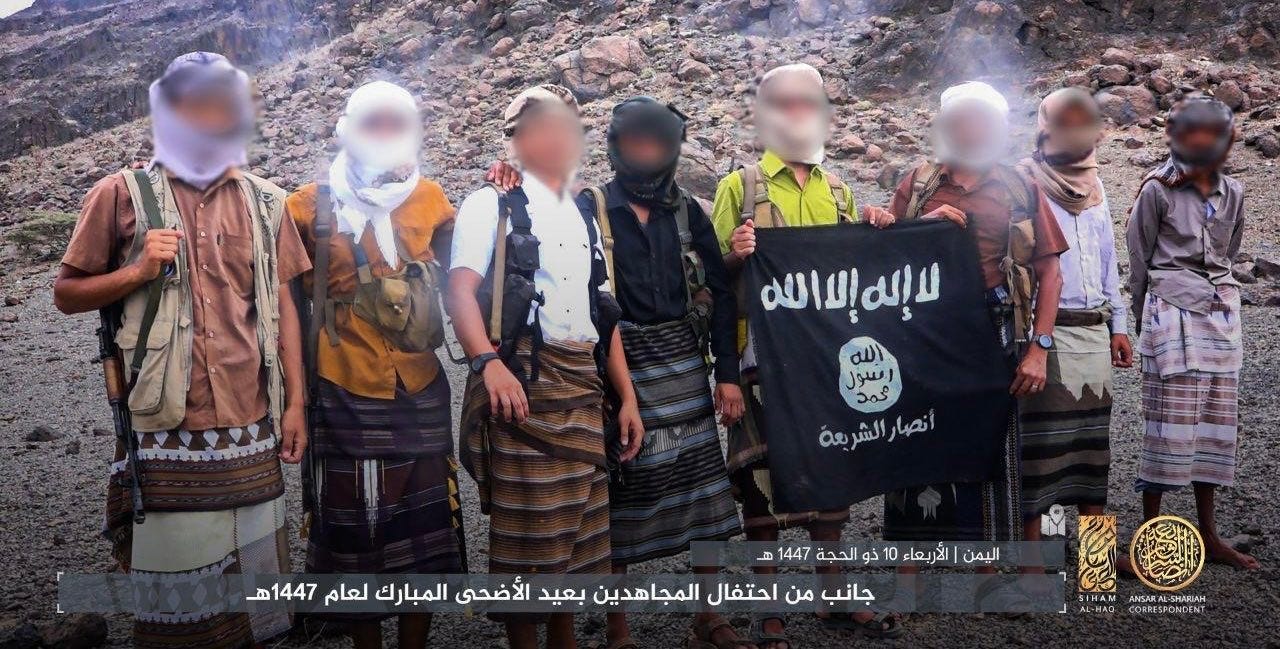
The same month, AQAP’s English-language publication Inspire encouraged lone actor attacks against Western and Israeli interests (X/@MaadAlzekri, May 8, [a], [b]). Another AQAP-linked media outlet circulated Eid al-Adha images from Yemen, demonstrating continued local presence despite reduced attack claims (Substack/DanieleGarofaloMonitoring, June 2). Collectively, the communiques suggest recalibration rather than decline: AQAP is offsetting its reduced battlefield prominence in Yemen through external operations rhetoric, inter-affiliate solidarity, and association with JNIM’s gains.
AQAP’s Rise and Retreat in Yemen
AQAP has become one of al-Qaeda’s most dangerous affiliates, combining local insurgency with ambitions to strike Western targets. The group was formed in 2009 through the merger of al-Qaeda’s Saudi and Yemeni branches. It has since been linked to the 2009 Underwear Bomber plot, the 2010 Printer Cartridge Bomb plot, the 2015 Charlie Hebdo attack, and the 2019 Pensacola shooting (sanaacenter.org, April 17, 2019). Inspire, launched in 2010, made AQAP al-Qaeda’s leading English-language media producer. Yemen’s civil war later allowed AQAP to seize Mukalla, generate revenue through looting, taxation, and port activity, and embed locally through Ansar al-Sharia (Saba News, June 21, 2016). Its 2016 expulsion marked the beginning of a long contraction driven by military pressure, U.S. strikes, leadership losses, and infiltration (ACLED, April 6, 2023; sanaacenter.org, October 13, 2023).
AQAP today bears little resemblance to the force that governed Mukalla. It administers no major population centers, receives less international attention, and has not demonstrated the sustained external plotting capability that made it notorious 15 years ago. Its attacks remain concentrated in Abyan, Shabwah, Ma’rib, and Hadramawt. The group, however, retains an estimated 3,000 fighters, significant financial resources, maritime ambitions, al-Shabaab links, and revived English-language propaganda (UN Monitoring Team, February 4). AQAP has maintained relevance through external messaging and propaganda despite declining operational activity.
Since late 2022, AQAP’s main battlefield enemy has been Southern Transitional Council (STC)-aligned forces, while direct AQAP-Houthi hostilities have largely stopped. The STC collapse following its failed December 2025 offensive and the subsequent Saudi-backed counteroffensive stripped it of nearly all territorial holdings in southern Yemen by January (Yemen Monitor, January 2; mecouncil.org, January 14). This opened space for AQAP and removed its local enemy, forcing a recalibration of priorities (South24, January 4; ACLED, February 12).
AQAP’s May Messaging Shows Recalibration
AQAP’s recent messaging highlights the growing centrality of the Sahel and JNIM within al-Qaeda’s global narrative. First, AQAP is preserving relevance during a period of reduced operational engagement in Yemen. In jihadist circles, restraint can look like weakness. By praising JNIM, AQAP shows that it remains attentive to developments and present in al-Qaeda’s transnational conversation even when its local tempo is low (Substack/DanieleGarofaloMonitoring, May 17).
Second, AQAP is borrowing momentum from the Sahel. JNIM offers al-Qaeda its strongest narrative of insurgent expansion, giving AQAP a battlefield success story it cannot presently produce from Yemen (Authors’ Interview, June 23). [1] Its reference to the Taliban’s capture of Kabul is deliberate. The narrative frames the Sahel as another long-war theater where patient insurgency, rural penetration, state exhaustion, and pressure on security forces could eventually produce political collapse (Authors’ Interview, June 25). [2]
Third, AQAP is trying to preserve its historic role as al-Qaeda’s transnational propaganda leader (Sawab Center, October 7, 2022). Its emphasis on lone-actor attacks compensates for reduced operational activity in Yemen by shifting attention from theatrical, planned plots to lower-cost violence by self-initiated attackers. Such attacks require less organizational capacity, are harder to detect, and can still generate disproportionate political, media, and psychological effects.
Fourth, the campaign reinforces cohesion across al-Qaeda’s dispersed network. Under AQAP leader Saad bin Atef al-Awlaki, AQAP’s praise for JNIM is best understood as symbolic alignment and lateral reinforcement. It is not, however, proof of direct operational coordination. Al-Shabaab’s later praise for both JNIM and AQAP further reflects this affiliate-to-affiliate validation (X/@Mucagcebe, May 27).
Conclusion
Al-Qaeda’s geographical focus has evolved. In the early 2010s, AQAP made Yemen central to the international jihadist threat through external plots, territorial ambition, and English-language propaganda. In 2026, that momentum lies increasingly in the Sahel. As Yemen grows quieter, the group is using JNIM’s battlefield gains to sustain its own claim to relevance, while Inspire keeps its external operations identity alive. The result is not an AQAP resurgence on the scale of its earlier years, but a strategy to prevent marginalization due to reduced battlefield activity.
Notes:
[1] Authors’ interview with Abdul Rahim, Senior Research Fellow, International Centre for Political Violence and Terrorism Research (ICPVTR), S. Rajaratnam School of International Studies (RSIS), Nanyang Technological University, Singapore, June 23, 2026.
[2] Authors’ interview with Dr. Aamer Raza, Professor of Political Science, University of Peshawar, Peshawar, Pakistan, June 25, 2026.
The article was originally published in Terrorism Monitor
Elsa Chandio is a Research Fellow at the Center for Research and Security Studies (CRSS) in Islamabad, where her work spans militant violence, migration, and the gendered dimensions of conflict, with a particular focus on Pakistan–Afghanistan security dynamics.
Mustafa Malik is Director of Monitoring, Evaluation, and Learning (MEL) and a countering violent extremism (CVE) expert at the Center for Research and Security Studies (CRSS) in Islamabad. His work centers on counter-radicalization, youth resilience, and social cohesion, with an emphasis on cross-border peacebuilding and multitrack diplomacy between Pakistan and Afghanistan.
Comments
Nothing yet. Say the first thing.
Sign in to join the conversation.