
This is the first in a periodic “Explainer Series” here at Who Decides Who Decides? The idea is simple. When a legal question moves to the center of the news, I want to lay out the actual law underneath it, in plain language. No assumed background. No jargon. Just the provision, the history, the machinery, and then the application to what is happening right now.
Article I gives Congress the power to declare war. The same section gives Congress the power to raise and support armies, to provide and maintain a navy, to make rules for the government and regulation of the armed forces, and to grant letters of marque and reprisal, which was the eighteenth-century way of authorizing limited hostilities short of full war.
Article II makes the President the Commander in Chief of the Army and Navy.
That is the whole textual foundation. Congress decides whether the country goes to war. The President directs the war once it has been authorized.
The Framers were deliberate about this, and we know it because we have the notes. At the Constitutional Convention in August 1787, the draft gave Congress the power to make war. Madison and Elbridge Gerry moved to change the word to declare. The reason they gave was narrow and specific: the President needed the ability “to repel sudden attacks” without waiting for Congress to assemble, which in 1787 could take weeks. The change was about emergency defense. It was never understood as a general license to begin wars.
The design was a deliberate friction. Starting a war would require the agreement of many people, in public, on the record.
That friction has not lasted.
Congress has formally declared war five times in American history: the War of 1812, the Mexican-American War, the Spanish-American War, the First World War, and the Second World War. The last formal declarations came in June 1942. Every American military conflict since then has been fought without one.
The drift began early. During the undeclared naval Quasi-War with France in 1798, the Supreme Court confronted the question and gave an answer that mattered. In cases like Bas v. Tingy and Talbot v. Seeman, the Court held that Congress could authorize a limited or “imperfect” war without a formal declaration. Congress still had to authorize it. The form could vary; the requirement of congressional approval could not. A few years later, in Little v. Barreme, Chief Justice Marshall held that the President could not exceed what Congress had actually authorized, even in wartime, even acting in good faith.
Korea broke the pattern. In 1950 President Truman committed American forces to a war that killed more than 36,000 Americans, and he never asked Congress for authorization. He called it a police action and pointed to a United Nations Security Council resolution. Congress objected, held hearings, and ultimately funded the war. That pattern repeats.
Vietnam followed. In 1964 Congress passed the Gulf of Tonkin Resolution, which authorized the President to take all necessary measures in Southeast Asia. It passed the House 416 to 0 and the Senate 88 to 2, on the strength of a naval incident whose facts were later contested. That single resolution became the legal foundation for a war that lasted another decade and killed more than 58,000 Americans. Congress repealed it in 1971. The war continued anyway.
An Authorization for Use of Military Force is the modern substitute for a declaration of war. It is an ordinary statute that says the President may use armed force against a particular enemy, for a particular purpose.
The 2001 AUMF was passed three days after the September 11 attacks. It authorized force against the nations, organizations, and persons the President determined planned, authorized, committed, or aided those attacks. It passed the House 420 to 1 and the Senate 98 to 0. It contained no geographic limit and no expiration date. Successive administrations of both parties have invoked it to justify operations in a long list of countries against groups that did not exist in 2001. It remains on the books.
The lesson of the 2001 AUMF is the lesson of Tonkin. A broad authorization, passed quickly in a moment of national emotion, can outlive the circumstances that produced it by decades. That is an argument for Congress voting. It is also an argument for how Congress drafts. The 2001 authorization named no country and set no expiration date, and those two omissions, rather than the vote itself, are what kept it alive for more than twenty years.
By 1973, after Vietnam and the secret bombing of Cambodia, Congress tried to reclaim the ground it had lost. It passed the War Powers Resolution over President Nixon’s veto, by margins of 284 to 135 in the House and 75 to 18 in the Senate.
The machinery has three moving parts.
First, the report. Within 48 hours of introducing armed forces into hostilities, or into situations where hostilities are imminent, the President must report to Congress in writing. That report starts the clock.
Second, the 60 days. The President must terminate the use of force within 60 days unless Congress declares war, enacts a specific authorization, or extends the deadline by law.
Third, the 30 additional days. The 60 can extend to 90 if the President certifies in writing that unavoidable military necessity involving the safety of the forces requires more time to withdraw them safely.
There is also a consultation requirement, and a provision, Section 5(c), that lets Congress direct the President to remove forces.
Notice what the statute does not contain. There is no provision for pausing the clock. There is no provision for restarting it. Congress wrote a deadline, not a stopwatch with buttons on it.
Every president since Nixon has treated the Resolution as an unconstitutional intrusion on the Commander in Chief power. Most have complied in form while denying it binds them, which is why presidential war powers letters are almost always styled as being submitted “consistent with” the Resolution rather than “pursuant to” it. That preposition is doing a great deal of work.
Four things keep the statute from operating as written.
1. The definition of hostilities. If the fighting is not “hostilities,” the clock never starts. In 2011, during the air campaign over Libya, the executive branch argued that sustained American airstrikes did not amount to hostilities within the meaning of the statute.
2. The intermittent hostilities theory. Executive branch lawyers have argued that a lull or a ceasefire ends the hostilities and stops the clock. No court has adopted that reading, no language in the statute provides for it, and Congress has never accepted it. It is an executive branch position, contested every time it has been asserted, and it sits at the center of the Iran dispute.
3. The Chadha problem. Section 5(c) lets Congress direct withdrawal by concurrent resolution, which clears both chambers but never goes to the President. INS v. Chadha struck down that device in 1983. A binding order now requires a joint resolution, which the President can veto and which then needs two-thirds of both chambers to override. Trump’s first-term war powers resolutions, on Yemen in 2019 and Iran in 2020, were both vetoed.
4. The courts stay out. Federal courts have generally declined to enforce the Resolution, holding that individual members of Congress lack standing or that the dispute presents a political question. The judiciary has largely concluded that this is a fight between the other two branches.
The War Powers Resolution has never been enforced by courts. It has been enforced, when it has been enforced at all, by Congress’s willingness to use the tools it actually controls. Above all, the power of the purse.
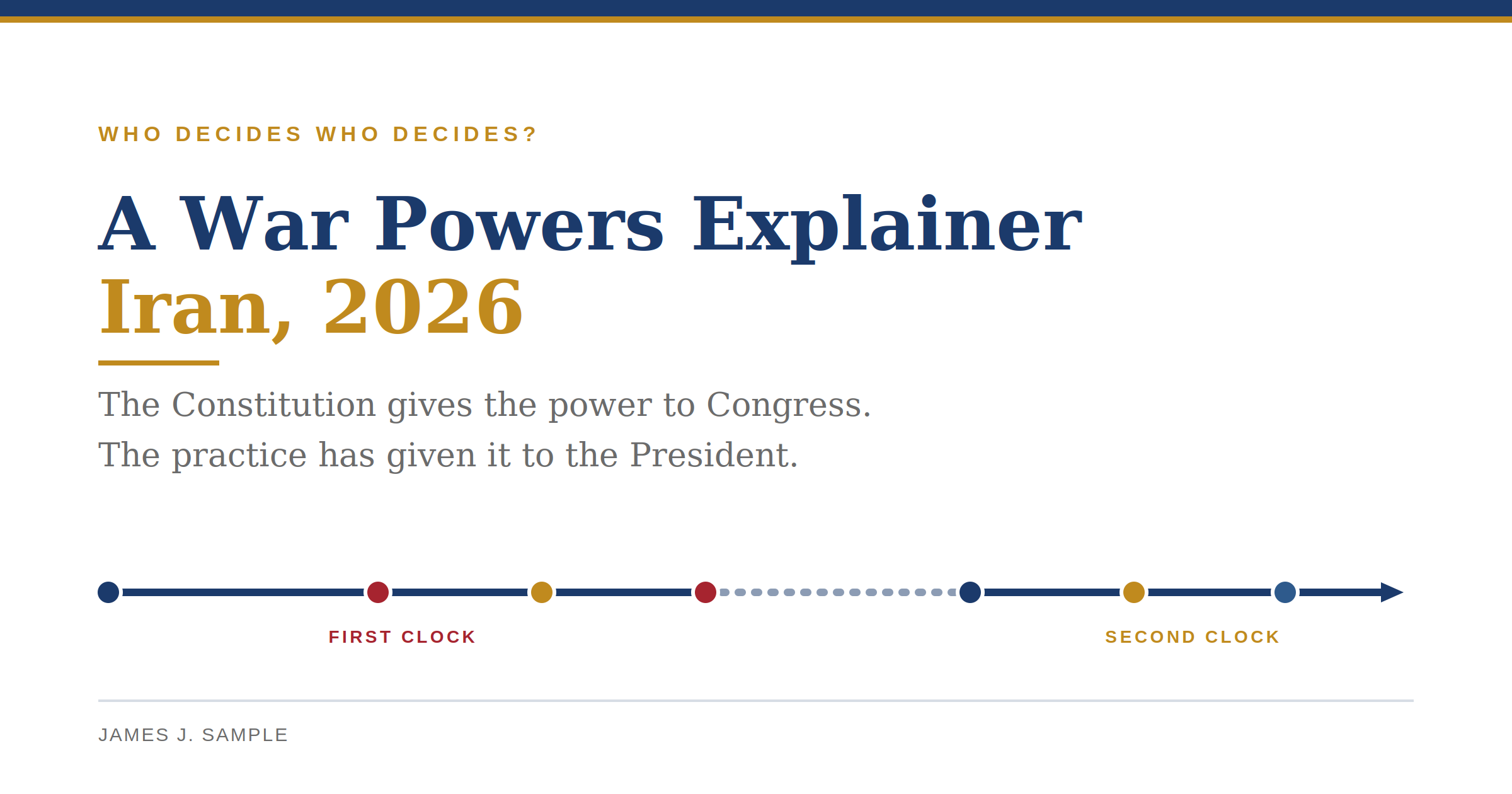
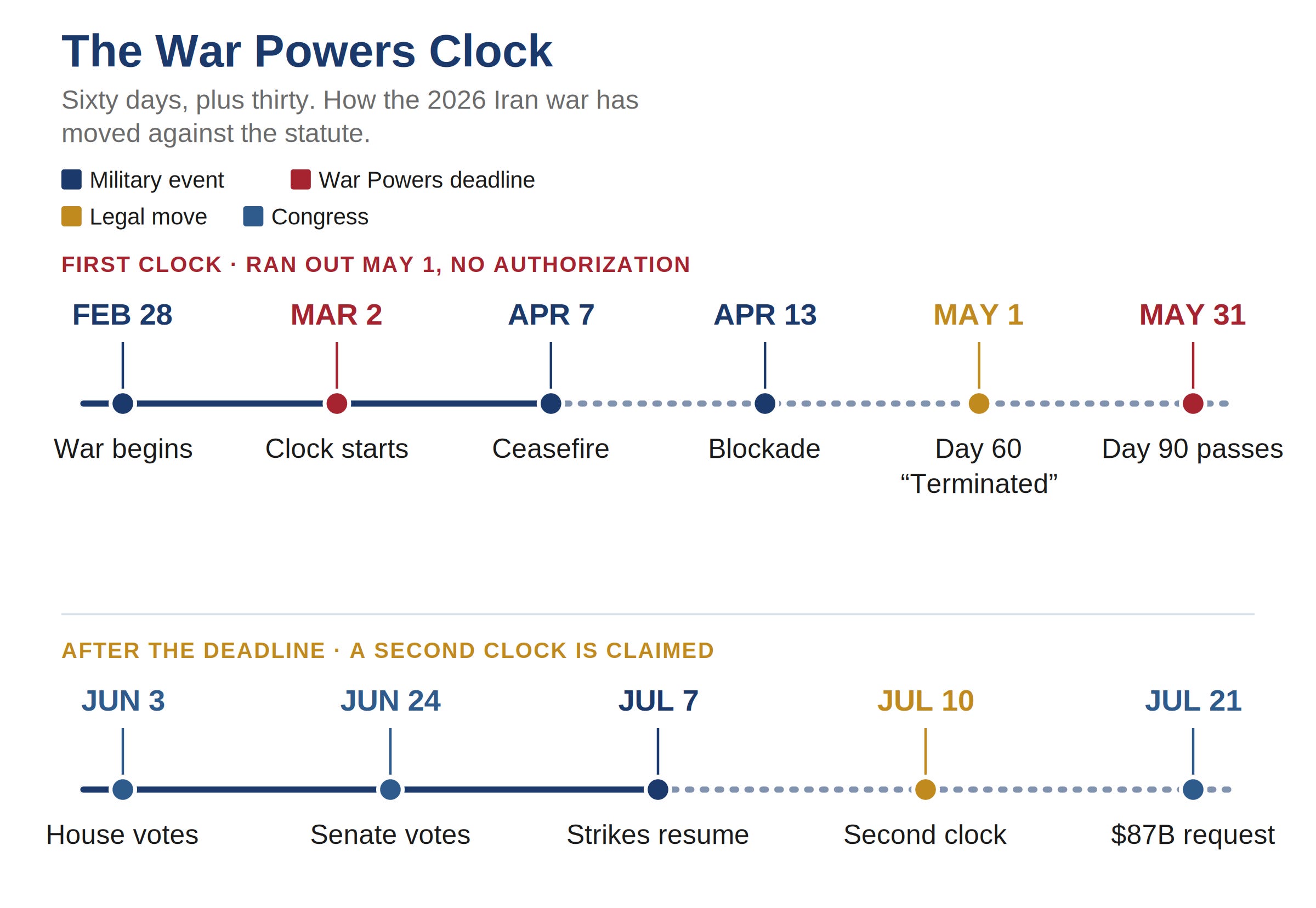
The United States and Israel opened the war against Iran on February 28, 2026. The President filed the required report, and the clock started running on March 2.
On April 7 the President ordered a two-week ceasefire, later extended. On April 13, while that ceasefire held, the United States imposed a naval blockade of Iranian ports.
On May 1, the day the clock ran out, the President wrote to the Speaker and the Senate president pro tempore. The operative sentence: “The hostilities that began on February 28, 2026, have terminated.” Because hostilities had ended, the argument went, the deadline no longer applied. The Defense Secretary had previewed the theory in Senate testimony, suggesting the clock could “pause or stop” during a ceasefire. No authorization was requested.
That absence matters. When presidents have wanted durable legal cover, they have asked for it, as in 2001 and 2002. Asking carries the risk of being told no. The reset theory carries no such risk.
By May 31 the outer ninety-day limit had passed. In June both chambers voted to direct withdrawal, the House 215 to 208 and the Senate 50 to 48. Neither vote bound anyone, for the Chadha reason above.
On July 6 and 7 the ceasefire collapsed and American strikes resumed. On July 10 the President notified Congress that military action had commenced on July 7, three days after the fact, which appears to exceed the statute’s own 48-hour window. The letter does not expressly claim a fresh sixty days. The administration has proceeded as though it has them, and most congressional Republicans have accepted that framing.
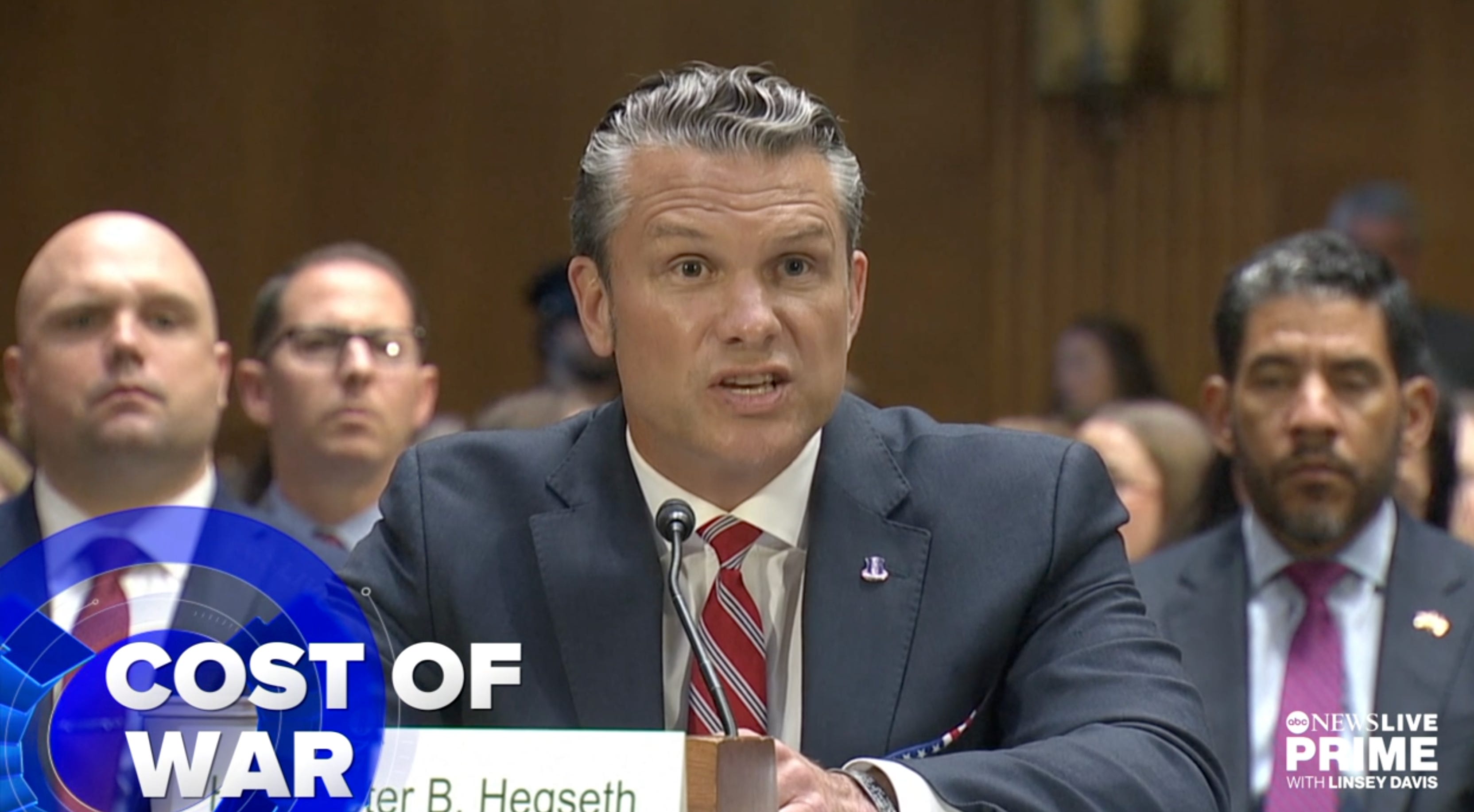
This week the Defense Secretary and the Chairman of the Joint Chiefs went before Senate appropriators to defend an $87 billion supplemental.
I have attempted, (with the aid of AI — graphic design not being my forté) to map the WPR clock and the Iran events on this two-row timeline, so as to provide a “visual” of the above-described timing:
The War Powers Resolution sets a deadline. It contains no mechanism to pause that deadline, and no mechanism to restart it. A theory under which a ceasefire resets the clock, and a second ceasefire could reset it again, would convert a 60-day limit into an indefinite authorization renewable at the President’s discretion. Congress did not write that statute. No prior administration of either party has claimed it.
Courts will almost certainly stay out. Non-binding resolutions have already failed twice. What remains is the appropriations process, which means the constitutional question of who authorizes this war is now being decided, functionally, as a vote on a spending bill.
Whoever wins the next election inherits whatever precedent is set here. A power claimed by one administration does not stay with that administration. If a ceasefire can reset the war powers clock in 2026, it can reset it in 2029, and in 2033, for a president whose judgment you may trust a great deal less.
The Framers put the war power in Congress because they wanted the decision to be hard, public, and shared. Every mechanism that has eroded since 1787 has eroded in the same direction, toward a single person deciding alone.
Whether this President has good judgment about Iran is a topic for a different — and important — discussion. For purposes of this Explainer, the question is who gets to decide, and whether the answer is still the one the Constitution provides.
I’m glad you’re here. I’m grateful you’re engaged. Here and everywhere. — James
Comments
Nothing yet. Say the first thing.
Sign in to join the conversation.