
Last year, my friend Tom Prol called to tell me my case was being used to protect the New Jersey State Bar Association’s diversity program. Tom, a past president of the Bar and its first openly gay leader, had become a friend through years of queer activism. So, when he called, I listened.
Then this week, he forwarded me an article from Law.com. The Supreme Court is now considering whether to take up a challenge to that same program. And the Bar, represented by lead attorney Larry Lustberg of Gibbons PC, is defending itself by citing Boy Scouts of America v. Dale.
My case. Again.
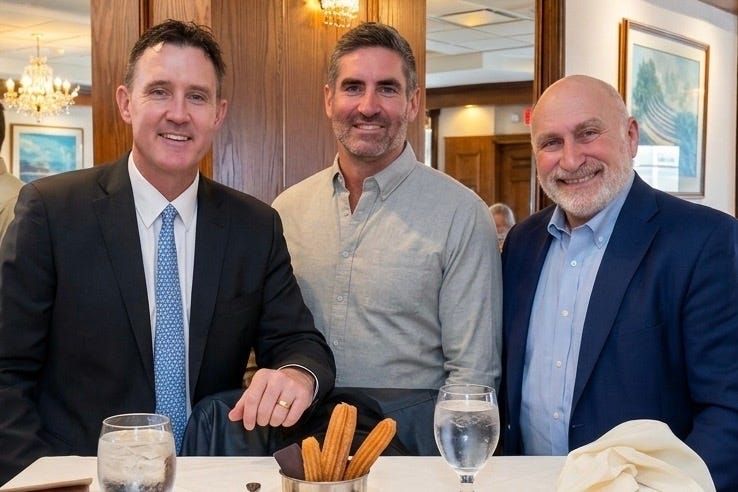
In April 2025, Tom arranged lunch at Fornos of Spain on Ferry Street in Newark’s Ironbound neighborhood, just the three of us: Tom, Larry, and me. Larry had won at the appellate level a few months earlier, in December 2024, arguing that the Bar’s diversity program was protected under the First Amendment under my case. We were there to celebrate. Larry signed the appellate brief first, then slid it across the table and asked me to sign it too. Tom took a picture.
I held the pen and didn’t quite know what to say.
He was returning what the Supreme Court had tried to take away. My pride.
So much of the world right now feels backward, upside down, like a dream where the rules keep changing and nobody tells you. But this felt different. This felt like someone had taken my name back.
I was 19 years old when I set all of this in motion. I had no idea what I was starting. I just knew I’d been expelled from the organization I loved, that I was gay, and that it was wrong. Lambda Legal took my case. We fought for ten years. We lost, five to four. Chief Justice Rehnquist wrote the majority opinion. And then my name became a citation. A precedent. A legal shorthand that other people’s lawyers would invoke in rooms I’d never enter, for arguments I’d never approve, for outcomes I couldn’t control.
I thought the Supreme Court had the last word. They don’t.
I knew it had to be that Wednesday. The Supreme Court always releases its final decisions on the last day of the term, and June 28, 2000, was that day. I called in to work and made my way to Lambda Legal’s headquarters near Wall Street.
I was optimistic. I had no right to be. This was a Republican court, a conservative court, and everyone around me had been managing my expectations for months. They were appealing a unanimous decision from the New Jersey Supreme Court. “James, this doesn’t look good.” “Be realistic.” I knew that. I wasn’t naive.
But I could not stop believing.
Growing up in the suburbs of New Jersey, I felt trapped. Trapped by expectations I couldn’t live up to and didn’t want. Trapped by a version of myself that didn’t fit anywhere I looked. Scouting was the one place that felt different. The one place where I could be more of myself than anywhere else. I was celebrated instead of mocked. I earned awards. I was put on a stage. It gave me a community I couldn’t find anywhere else. So when that letter arrived telling me I was no longer welcome, it felt so fundamentally wrong, so contrary to every value Scouting had instilled in me since I was eight years old, that I simply could not accept that the system would ultimately fail me. I believed in American institutions. I believed the truth would win.
The decision came down at 10:10 in the morning. We weren’t even looking in the right place. Someone else heard it on 1010 WINS radio first. Five to four. Rehnquist was writing for the majority.
Nobody looked at me. They were too upset, too afraid of making me feel even worse. The silence was its own kind of answer.
I felt crushed by democracy. By the American values I had believed in so completely that I had given ten years of my life to them. And then I thought about my name. James Dale. The name I had chosen. The name of my liberation, the openly gay version of me I had fought so hard to become. Now it was Boy Scouts of America v. Dale, above the fold, in every newspaper in the country. I didn’t know I was gay. I didn’t want to be gay. But I had chosen this name, this identity, and now I felt like a child again, trapped with something I couldn’t outrun. Afraid I would never get out of that moment.
It wasn’t the ending. It was only the beginning that I couldn’t yet see.
Almost immediately, the backlash began. Cities pulled Scouting’s access to public facilities. Corporate sponsors withdrew. United Way chapters across the country cut their funding. The organization that had fought so hard to keep me out watched America walk away, from PTAs to churches to corporations. The Scouts had destroyed themselves defending discrimination.
And I couldn’t feel any of it.
The depression was still there, heavy and close, and I couldn’t shake it. But I had learned something from years of watching ACT UP, from sitting in those meetings where people who had every reason to despair chose fury and hope instead. I knew how to perform optimism even when I couldn’t feel it. Every article, every letter, every phone call became a tiny brick. I was laying them one at a time, trying to rebuild something: my belief that the fight had meant something. I was doing it for the movement, for the people who still cared, trying to inspire them to keep going.
But I was also doing it for myself. I was trying to convince James Dale on the inside that it wasn’t over.
The backlash worked. Slowly, the organization changed.
Gay youth were allowed in 2013. The ban on gay adult leaders was lifted in 2015. Each step felt like a small brick landing, another piece of something being rebuilt. But the moment that stopped me was 2017, when an eight-year-old transgender boy in New Jersey was asked to leave his Cub Scout troop. The Boy Scouts of America reversed their policy almost immediately. No years of litigation. No decade of public pressure. They had learned their lesson, and this time they didn’t need to be dragged. They led.
They were embracing the most vulnerable kids at the exact moment much of the rest of society was still debating whether those kids were liars or criminals.
I thought about myself at eight years old. I didn’t know I was gay. I didn’t want to be gay. But Scouting was the one place I felt celebrated rather than mocked, seen rather than erased. It was a safe space for a kid who didn’t yet know what he needed to be safe from.
Whether they knew it or not, they were doing that again. For kids who knew exactly who they were.
Then came 303 Creative.
First, there was Masterpiece Cakeshop, a Colorado baker who refused to make a wedding cake for a gay couple. My name wasn’t in that one, but I was watching. I could see where this was going.
The right saw Masterpiece as unfinished business. So, they built 303 Creative. It was a case about a woman in Colorado who designed websites and wanted to ensure she could never be forced to make one for a gay couple. She hadn’t refused anyone yet. She might never have to. A request that appeared on her website turned out to have been submitted in the name of a man who said he never sent it, a straight man, married to a woman. The Supreme Court of the United States took up a hypothetical built on what appeared to be a fiction.
I really got those letters. I really joined Cub Scouts when I was eight years old. I really spent ten years of my life fighting. That was real. That was what Supreme Court cases were supposed to be about.
When the 303 Creative decision came down in June 2023, and I saw my case cited in the majority opinion, I wasn’t just heartbroken for myself. I thought about every gay couple who would now be turned away by someone hiding behind the First Amendment. Behind my name. The case law I had put in motion at 19, the thing I had set spinning without fully understanding where it would go, was now being used to hurt people I would never meet.
That saddens my soul. Even now, saying it out loud, I feel it. That’s not what I wanted. That’s not what I meant. That’s not right.
Legal scholars were tracking what I was feeling from the outside. In a 2024 law review article titled “The Return of Boy Scouts of America v. Dale,” University of Texas law professor Elizabeth Sepper mapped how courts had begun reading my case as broadly as anyone once feared, extending the right to discriminate to employers, for-profit businesses, and social service providers, well beyond the membership of nonprofit organizations it was meant to address.
Earlier this year, when Pete Hegseth announced that Scouting America was too woke, that trans kids would have to go, I was furious. But then something shifted.
I thought about that eight-year-old trans boy in New Jersey. I thought about everything Scouting had risked to include him. And then I thought about the decision I had spent twenty-five years trying to make peace with.
Wait.
The Scouts chose on their own to include trans kids. No court ordered them to. No law required it. They did it because they had learned, the hard way, what exclusion costs. And now the federal government was threatening to punish them for that choice, dangling military base access and Jamboree support like a weapon.
But the Supreme Court had already answered this question. In my case. The government cannot force a private organization to change its membership. That was the whole point of Boy Scouts of America v. Dale. The ruling I lost. The ruling I had hated for twenty-five years.
Use it, I thought. Use the same decision they fought so hard for to protect the inclusive organization they had chosen to become. The constitutional shield the Court handed them in 2000 to exclude me could now protect their right to include trans kids.
I wrote about it for Time Magazine in March 2026. I had waited twenty-five years to write that piece.
The depression that followed my loss in 2000 never fully disappeared.
The trauma of that fight, a decade of my life, my name becoming something I couldn’t control, doesn’t just go away. But sitting at that table in the Ironbound, holding that pen, something shifted. My name was being used for something I believed in. The 19-year-old version of me, the one who had set all of this in motion without understanding where it would go, felt seen and protected.
This week, Tom forwarded me a Law.com article. The Supreme Court is now considering whether to take up the challenge to the Bar’s diversity program. My case is back before the highest court in the land, this time on the right side of history.
I don’t know how the Court will rule. You never do. But I know something now that I couldn’t have known standing in that room on Wall Street on June 28, 2000, when nobody would look at me, and the silence said everything.
If I could go back to that 19-year-old, and to the 29-year-old who had just been crushed by the Supreme Court, I would tell him: You will win. It might take a very long time. It won’t be easy. But you will win. And justice will prevail.
I’m still waiting. But for the first time in a long time, I have hope.
If you enjoyed this piece, please consider Sharing it or Subscribing to receive future essays directly in your inbox.
No posts
Comments
Nothing yet. Say the first thing.
Sign in to join the conversation.