
Tech workers are feeling increasingly burnt out.
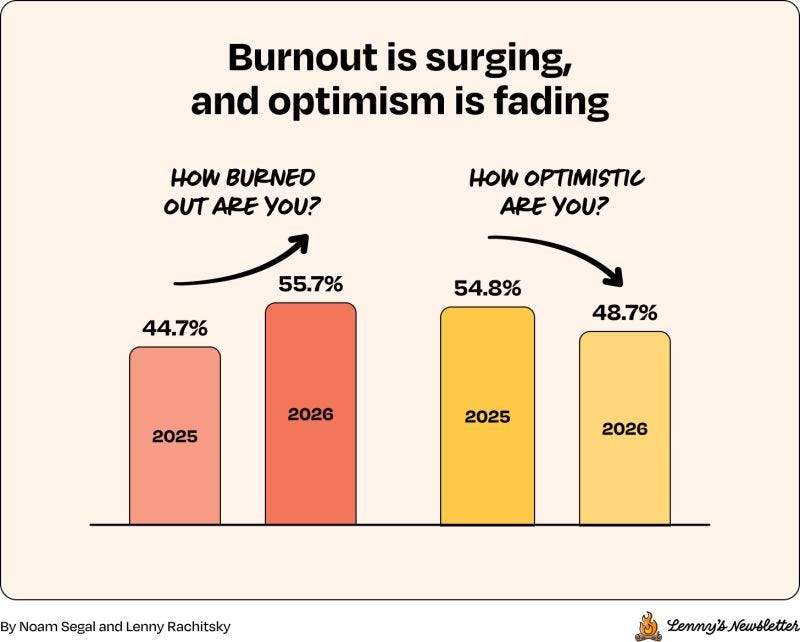
I find the results of this survey to be totally unsurprising. AI has, in a short few years, totally changed the vibe of what it feels like to work in the technology industry.
I think about how tech work is changing due to AI in three primary ways:
High performers suck up more of the available work and get more of the credit. Armed with AI, top performers move at absurd speeds, swallowing up more work, gathering more internal capital and status, all while capturing the upside.
Increased expectations are turning tech work into an endurance sport. Baseline expectations exploded overnight. You’re expected to produce 3x the output in the same time frame.
AI is the perfect excuse for layoffs, given how bullish most executives are. Whether a company actually runs better with fewer people or not matters not, AI gives leadership a clear mandate to cut headcount.
Basically, being a mid-to-low performer is probably really hard right now. It hasn’t always been this way, though. During peak-ZIRP one could be an average performer and coast, fairly comfortably. Silicon Valley, the brilliant HBO show about ZIRP-era tech madness, portrayed this perfectly via the character of Big Head, a happy-go-lucky-yet-entirely-mediocre software engineer who eventually finds himself on a roof in an “unassigned” role, which means he hangs out on the roof and does nothing. “Rest and vest” as famous line from the show goes.
Expectations around effort and work ethic within tech companies have now shifted, most likely forever. All of this is creating a highly chaotic and unstable environment inside these teams and organisations. Much digital ink has been spilled about the optimistic take on all of this for individuals, and the opportunities this presents for “high-agency” individuals. After all, “you can just do things” has become the defining meme of the AI era so far. For what it’s worth, I largely agree with this idea.
Something I’ve been pondering recently is just how (or why) working in tech became so cushy and comfortable, and whether or not we’ll see it as a temporary-weird-blip and historical anomaly.
Other “high status” fields like finance or consulting have maintained a culture of ruthlessness and cut-throat competition over decades. As far as I know, finance firms don’t have ping pong tables, free lunches and an on-site masseuse. For better or worse!?
It’s worth remembering that tech wasn’t always a cushy and comfortable job. Until very recently, it resembled more white-collar-factory-line than playground-with-desks. In the 1980’s Steve Jobs printed t-shirts at Apple with the slogan “90 hours a week and loving it” on them.
Bill Gates famously memorised the license plates of Microsoft employees, making mental notes of who was working “sufficient hours”.
“Microsoft was a high-stress environment because Bill drove others as hard as he drove himself. He was growing into a taskmaster... he’d prowl the parking lot on weekends to see who’d shown up.” - Microsoft co-founder Paul Allen in his memoir “Idea Man”.
One potential explanation for this curiosity is that technology, unlike finance, law or accounting, is ultimately about leverage, not effort. Lawyers must maximise the value per hour worked (you can only sell 24 hours in a day and you can’t sell the same hour twice), whereas engineers and product managers create systems that make money quite literally while you sleep. This technology-enabled leverage is why Instagram could sell for $1 billion dollars with only 13 employees.

Z Fellows@zfellows
Sam Altman: “AI will make it possible for one person to build a billion dollar company very soon.”
12:14 PM · Sep 4, 2024 · 604K Views
123 Replies · 307 Reposts · 2.4K Likes
The same leverage that allowed technologists to print cash overnight, also enabled them to demand unbelievably competitive pay, and in turn, directly influence the culture of their workplaces. Put simply, if great engineers (earning $300,000/year) asked for ping pong tables, you put in ping pong tables!
This dynamic didn’t happen in a vacuum of course. It was fueled by three macro-tailwinds hitting the industry all at once.
In the early-to-mid-2000’s, Google and Facebook (among others) started the perks arms race. Ping pong tables, on-campus concerts, massages, free lunches etc. This became so culturally significant that Vince Vaughn and Owen Wilson were making movies about it.
Cloud hosting and open source completely changed the economics of startups. You no longer needed millions of dollars to buy servers and infrastructure. As a result, companies started pouring more cash into pampering the most important asset, the talent.
Post-2008, we saw a decade of near-zero interest rates, flooding VC funds with cheap money. The venture industry exploded and every startup worth their salt was cashed up and most importantly, chasing the same talent.
A perfect storm of talent wars, collapsing infra costs and free money. The result? Companies would do everything to make their employees happy.
But the times they are a changin’.
Tech won’t look like a 1980’s white-collar assembly line ever again (famous last words?), but some of those old-school traits are firmly back in style: relentless work ethic, operational discipline, and sheer execution speed. We’ve wrapped this all up in new memes and cultural ideas. “Agency” and “you can just do things” to name a couple.
This is precisely because AI is actively dismantling the barrier that gave tech workers their ultimate leverage. As David Heinemeier Hansson, programmer, creator of Ruby on Rails and the guy who literally wrote a book on tech workplace culture, commented on a podcast recently, we’ve probably passed “peak programmer”. Not that we don’t need programmers, or that programmers aren’t important, and won’t be well paid, it’s just that the insane amount of leverage that their sought-after skills have bought them, may have peaked.
I’m reminded of Newton’s third law: for every action, there is an equal and opposite reaction. As traditional leverage recedes, the cultural pendulum is swinging hard the other way, back toward a “hustle culture”, captured perfectly by the resurgence of the 996-meme in tech/AI circles. “Time to lock in” and all that. When a tiny, hyper-focused team using AI tools can suddenly outpace a bloated engineering org, intensity becomes a true competitive advantage again.
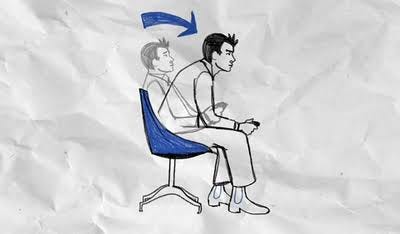
It’s easy to forget that tech wasn’t always the cool, high-status default choice, either.
“Before Tech became the dominant industry, jobs like investment banking were generally viewed as the best expected-value career trade to make out of school in terms of money, training, and accrued social capital. As tech began to rise in the 2000s-early 2010s, backed by cultural tenants of weirdness (what the smartest people do on weekends), meritocracy, and change for good, doing investment banking within many younger circles went from high status to a specific type of low status which is ‘this shows you’re smart but not that interesting.” - Michael Dempsey
Perhaps we’re in the middle of a new status shift. Coasting in a big tech company just doesn’t seem that cool anymore. Given all the layoffs, it’s certainly not as safe as it used to be, and if the surveys at the top of this post are anything to go by, it’s certainly not as fun as it used to be.
No posts
Comments
Nothing yet. Say the first thing.
Sign in to join the conversation.