
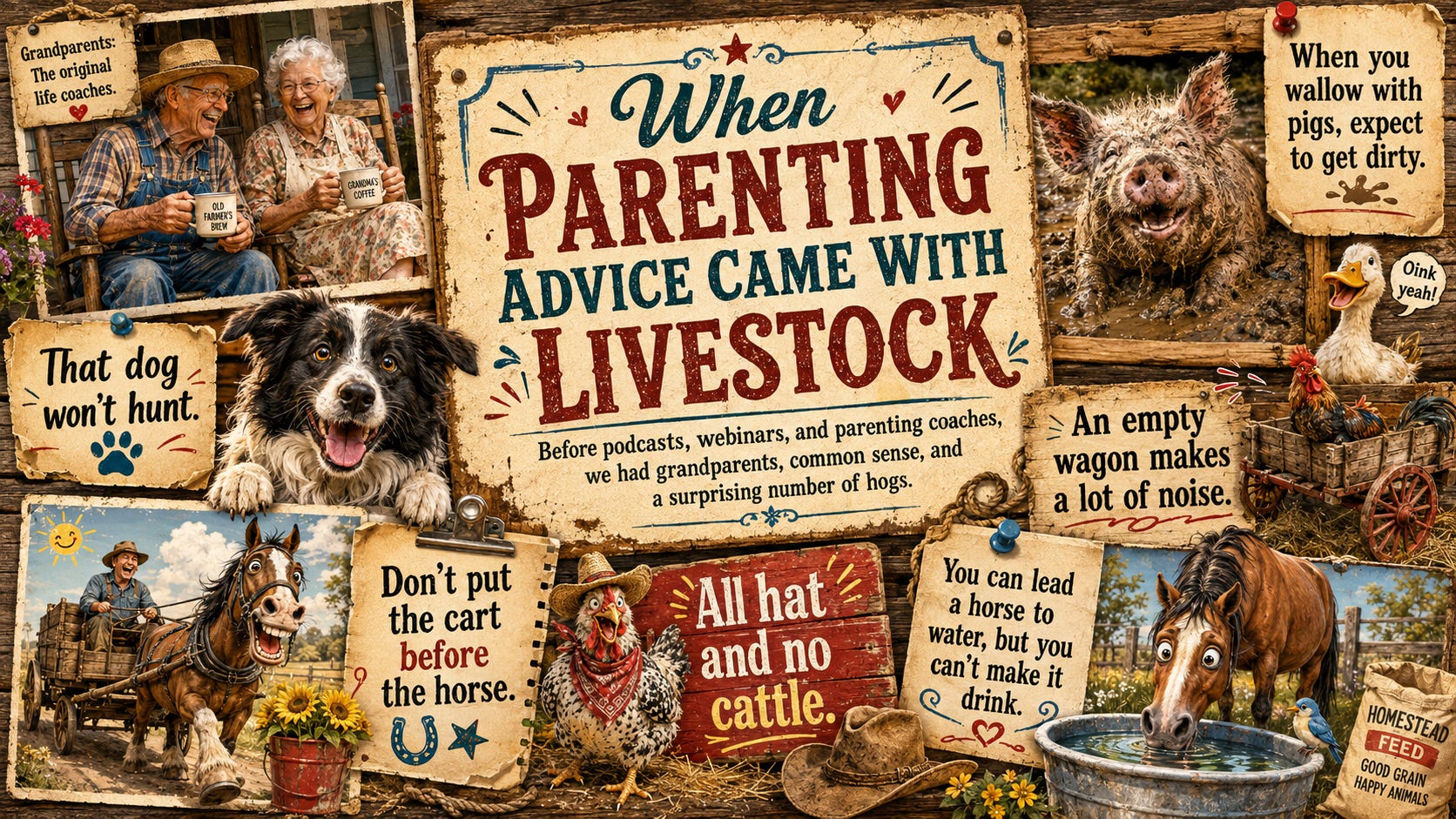
I grew up in the South (specifically rural North Carolina, but you probably know that if you are a regular reader), where adults did not explain life to children in numbered steps. When the sun went down, it got dark. When the adults sat down, they talked and shared their wisdom.
I can still see them on the porch after supper, shelling peas into a dented pot and settling the affairs of the community. Somebody would mention a man with a bad plan, and one of the old folks would say, “That dog won’t hunt,” then go right back to their work as though the matter had been settled by that statement.
Nobody explained or offered context. You were expected to figure it out on your own, preferably before adulthood.
That porch was my first parenting (really, life or leadership) seminar. No registration fee. No breakout sessions. Just experience, relatives, consequences, and sayings; most of which involved dogs, hogs, horses, wagons, chickens, snakes, axes, gravy, and one deeply unfortunate cat.
Parents today have other resources. Tons of other resources! We have books, audiobooks, podcasts, webinars, conferences, parenting and teen life coaches, summits, support groups, YouTube channels, and Facebook communities where complete strangers will diagnose your child before lunch without knowing anything about your family.
I have contributed to this myself. I have written books, recorded podcasts, taught classes, and trained coaches, which means I am now officially part of the problem.
I say that with affection.
We have reached the point where a parent can spend so much time learning how to raise a child that nobody has time left to raise one. A mother can listen to a podcast about being fully present with her teenager while driving the teenager to school and never notice the child has been trying to speak for eight minutes. A father can watch a webinar on family connection from the garage because the family is making too much noise inside.
We mean well; we really do. We are simply the first generation to believe every parenting problem should come with a workbook, three bonus videos, and a 5 easy steps.
The old folks on that porch built an entire curriculum without a single PowerPoint slide. As best I can reconstruct it, the course catalog had four subjects.
(Most of these I have heard used personally, though some may have originated from reruns of the Beverly Hillbillies.)
The first subject was character, and the sayings were mostly about livestock.
“A blacksnake knows the way to the hen’s nest.”
Once somebody finds an easy path to wrongdoing, he will travel it again.
As a boy, I thought this meant our chickens needed better security. I never quite got the meaning of these sayings the first time around. But older folks in my family understood snakes. A blacksnake finds the eggs by accident the first time, then every trip after that is on purpose.
Children work the same way. The first lie that succeeds is the dangerous one. If a teenager learns that saying “I forgot” ends a conversation, he will forget more and more often. Kinda like our politicians today.
Bad habits remember the road home.
“A cat can have kittens in an oven, but that don’t make ‘em biscuits.”
Being near something good does not make you good. Sitting in church does not make you faithful any more than standing in a garage makes you a Buick.
As a child, I had several concerns, beginning with why the cat was in the oven. I also wondered who first opened that oven door, saw kittens, and said, “Well, these biscuits have ears.”
Still, the message holds. Where you sit is not who you are. And somebody needs to get that cat out of the kitchen.
(We once had a cat give kittens in a closed drawer under a sink in our basement. But that is a story for a different time as it ended rather tragically.)
“All hat and no cattle.”
A man who looks the part but cannot back it up.
As a child, I pictured a sad cowboy standing alone in a field, dressed beautifully, with no herd in sight.
Today we would call him an influencer. He has the boots, the hat, the truck, and a podcast called Leading at the Next Level. What he does not have is a single follower or a single day of experience.
The old folks kept it simple: if you are going to wear the hat, you had better own some cows.
(I actually just heard this on the news recently as a US Senator tried to sound country even though they were from an urban area)
“An empty wagon makes a lot of noise.”
The people who know the least talk the most. You know this person; they are all over the online forums.
The saying works because the old folks knew their wagons. An empty one rattles over every bump in the road. A loaded one rolls by quiet.
Every family has one member who never raised a child, ran a business, coached a team, or read a book since 1978, yet holds strong opinions on all four. He does not enter a conversation. He backs into it with a warning beep.
The people worth listening to are usually the quiet ones at the end of the table. Full wagons do not rattle.
“You can hide the fire, but what’ll you do with the smoke?”
You can cover up the deed, but the evidence finds a way out.
Smoke does not knock. It slips under the door and announces the fire to the whole county whether you like it or not.
Children believe a lie gets stronger when you add detail. “I did not eat the cake. I was upstairs. Reading. About wildlife. Also, the dog looked hungry, and I recently saw a documentary proving some dogs can operate kitchen appliances.”
The fire is well hidden, but the smoke is everywhere: icing on his chin, and the dog under the table looking guilty.
“When you wallow with pigs, expect to get dirty.”
Choose your company carefully, because your company rubs off on you.
As a child, I thought this unfairly blamed the pigs. Nobody asked what kind of influence I was having on them. But the old folks knew something about mud. It does not stay on the pig. It gets on everything in the pen, and after a while you quit noticing the smell.
That may be the truest thing ever said about teenagers. Let a kid run long enough with people who complain, mock, and cut corners, and one day the mud is not on him. It is him.
We now call it ‘peer influence’. My grandfather called it ‘wallowing ‘, which is shorter and comes with a smell so you know where they have been.
The second subject was work. Class met early, attendance was mandatory, and tardiness was addressed from the porch at full volume.
“A sharp axe is better than big muscle.”
Work smart before you work hard.
The old folks knew the math on this one. A man with a dull axe can swing until sundown and have nothing to show for it but blisters. The man who stops to sharpen looks lazy for about ten minutes, then cuts twice the wood.
Children hate the sharpening; they want to dive in. Because to them, preparation looks suspiciously like work before the work.
I have assembled furniture this way. I ignored the directions, trusted my instincts, and finished with three spare bolts and a bookshelf that leaned toward Virginia.
A dull axe teaches humility. So does anything shipped in a flat cardboard box from Sweden; I hate IKEA.
“Make hay while it’s day.”
Use the opportunity while you have it.
Hay explains itself. Once it is cut, it lies in the field racing the weather. Get it in dry, and it feeds the cows all winter. Let the rain catch it, and it rots where it fell.
Children do not believe in closing windows. They assume there will always be another day, another chance, another adult willing to remind them. Adults know better. The sun can quit halfway through a good plan.
The old folks did not say, “Honor the season of opportunity.” They said, “Get the hay in before it rains,” because wet hay is a better teacher than a motivational poster.
“A lick and a promise.”
This meant doing a job fast and sorry, with a solemn promise to come back and finish it later. Nobody in recorded history has come back.
A child’s bedroom can be cleaned with a lick and a promise in under four minutes. Everything goes under the bed. The closet door closes by leaning against it. One book sits neatly on the desk as a decorative lie.
Teenagers are masters of the method. So are grown-ups cleaning a garage ten minutes before company arrives.
“Burning daylight.”
This one was less a proverb and more a command. Nobody ever said it sitting down.
Daylight was the budget. The work ran on sun, and when the sun quit, so did you, whether the work was finished or not. So when an adult hollered “You’re burning daylight,” it meant the most valuable thing on the planet was being wasted, and you were the one wasting it.
It’s also one of my favorite John Wayne movie lines. Extra credit if you know which movie.
We still burn daylight. We’ve simply moved the operation indoors. We check one message, watch one video, and wake up forty-seven minutes later more behind in our work than when we started
Our grandparents would have taken one look at social media and assigned the entire nation a fence to mend, calling a huge waste of time
“Can’t never could.”
Grammatically questionable, but spiritually sound.
Defeat begins the moment you decide not to try. “I can’t do math.” “I can’t speak in front of people.” “I can’t clean that room without immediate assistance.”
The old folks did not call this a fixed mindset. They simply refused to let “can’t” sit at the head of the table and make family decisions.
Sometimes wisdom shows up wearing poor grammar and work boots.
The third subject was common sense, which in those days came standard, like a tailgate. Nowadays it appears to be sold separately.
“That dog won’t hunt.”
Of all the sayings, this one carried the most authority. It was not an opinion. It was a verdict. When an adult said it, court was adjourned, the jury went home, and there was no appeals process in our county.
Notice what it did not require: an explanation. Nobody ever said which dog, or why he would not hunt, or what he planned to do instead. The dog was hypothetical. The ruling was final.
“I missed curfew because time is a social construct.” That dog won’t hunt.
“Everybody else’s parents are letting them go.” That dog has never hunted. That dog stays on the porch.
“I need a new bass boat because it will bring the family closer together.” That dog may get you put outside with him.
Today a parent will spend forty-five minutes explaining, negotiating, and citing peer-reviewed research to a twelve-year-old lobbying for a phone, as if every household decision requires Senate confirmation. The old folks understood something we have forgotten: some proposals do not deserve a committee meeting.
They also understood that a child benefits from learning early that “no” can be a complete sentence — even when it arrives disguised as a dog.
“Don’t put the cart before the horse.”
Do things in the right order.
Picture it. The cart sits out front while the horse stands behind it, staring at the back end of a wagon and wondering who drew up these plans. Nothing is moving, but everybody involved looks busy.
Children live in this arrangement full time. They want freedom before responsibility, results before effort, and dessert before vegetables. Teenagers want the car, then the job, then someday, possibly, the ability to pay for gasoline.
Adults do it too. We just call it vision casting, and we schedule a meeting about it.
The horse has attended that meeting. The horse remains unimpressed.
“Even a blind hog finds an acorn now and then.” (My wife refers to this one as even a blind squirrel finds a nut)
Meaning even the hopeless get lucky once in a while.
This was how Southern families kept children humble. You could make the winning basket or earn the highest grade in the class, and some older relative would compare you to visually impaired livestock stumbling into lunch.
Praise was available. It just came with agricultural limitations.
Oh, I have a story about being attacked by an angry squirrel in an attic too, so stay tuned for that one someday.
“You can lead a horse to water, but you can’t make it drink.”
Every parent arrives at this truth eventually.
You can teach, encourage, drive, pay, remind, pray, demonstrate, repeat, and provide a color-coded schedule. You cannot make another person care.
You can lead a teenager directly to the water, point at it, explain hydration, and hand him a cup. He will say, “I’m not thirsty.” Then he will complain there was nothing to drink.
“Don’t wash a pig.”
Do not argue with a fool. You both get dirty, and the pig enjoys it.
There comes a point in some arguments when no new information is being exchanged. The teenager repeats his point. The parent repeats the answer, only louder. Soon both are muddy, exhausted, and saying things nobody will remember correctly.
The pig, meanwhile, is having the best afternoon of his life.
“Too many cooks spoil the gravy.”
When everybody is in charge of one thing, nobody is.
Modern parents get advice from teachers, coaches, counselors, grandparents, bloggers, doctors, neighbors, and a woman at Target who overheard half a conversation near the paper towels. One expert says enforce stronger boundaries. Another says boundaries may inhibit self-expression. One says take the phone. Another says taking the phone could damage trust.
By supper, the gravy contains cinnamon, hot sauce, almond milk, and three opinions about attachment theory.
Sometimes a parent has to thank everybody, close the kitchen door, and cook.
The fourth subject was never printed in the catalog. These are the sayings that did more than instruct. They followed me home, and forty years later they are still here.
“Words that soak into your ears are whispered, not yelled.”
This may be the wisest one of all, and it is the one I have needed the longest.
There is a physics to it. A yell makes a child back up but a whisper makes him lean in. And you cannot pour truth into somebody who is backing away from you.
The old folks did not always practice this perfectly. Some of them could holler your full legal name across three fields, and when the middle name got involved, you knew the matter had escalated, and you better get home immediately.
But they understood the difference between getting a child’s attention and getting into his heart. Yelling accomplishes the first and forfeits the second. A child can remember the volume for forty years and never once remember the lesson.
The quiet words are the ones that stay. Ask any grown man what he still carries from childhood, and it will rarely be something that was shouted at him. It will be a sentence spoken low, at a truck tailgate, on a porch step, in the dark on the ride home, by an adult who looked him in the eye and meant it.
Our homes are loud places now. Televisions, notifications, three arguments about the thermostat running at once. Parents worry about being heard over the noise, so we raise the volume. The old folks knew the better trick: lower it. In a loud world, the quiet voice is the one that stands out.
Firmness does not require thunder. It never did.
“You cannot unsay a cruel word.”
Once words leave, they do not come back because we regret sending them.
Parents can apologize, children can forgive, relationships can heal, but some sentences hang around for years, sitting quietly in the corner like relatives who arrived before supper and never mentioned when they planned to leave.
The wisest adults taught us to swallow certain words before they escaped. They may cause indigestion, but that beats making them somebody else’s lifelong burden.
“Nervous as a long-tailed cat in a room full of rocking chairs.”
This one offers no moral instruction whatsoever, but it may be the finest description of anxiety ever composed.
You see the cat. You see the tail. You see twelve grandparents rocking after Sunday dinner with no concern for feline safety.
That’s how a parent feels the first time a teenager drives away alone. It is how a boy feels when his girlfriend’s father says, “Let’s sit on the porch.” It is how I feel when Melissa says, “I’m not mad. I just think it’s interesting…”
No webinar can prepare a man for that sentence.
The old folks did not know everything. Some of their advice was too harsh, and some sayings belong in permanent retirement. “A whistling woman and a crowing hen” can stay wherever we left it.
But they understood a few sturdy truths. Tell the truth. Work hard. Choose your friends carefully. Watch your mouth. Do things in order. Do not brag. Do not waste time. Know when to stop arguing. And never trust a teenager who says the icing reached his face through circumstances beyond his control.
Today we know far more about the adolescent brain, mental health, motivation, and communication than that porch ever did. That knowledge matters, and we are fortunate to have access to this. Because good parenting resources genuinely help families. I hope people keep reading the books and listening to the podcasts.
My mortgage hopes so too.
But maybe we have made parenting sound more mysterious than it is. Children need adults who are steady, honest, loving, present, and willing to admit when they are wrong. They need boundaries that hold, humor that softens, and wisdom that can survive outside a three-ring binder.
Some evenings I think about that porch and the dented pot, the dark road, the quiet voices settling the affairs of the community one saying at a time. Those folks raised children without a single downloadable PDF.
They had experience, each other, and more importantly, consequences. And when all of that failed, they had hogs, horses, snakes, wagons, biscuits, gravy, and one cat with a tail long enough to teach caution.
That may not be a complete parenting system.
But that dog will hunt.
P.S. My father had a saying of his own, and it did not contain a single farm animal, which in our county qualified as innovation.
“Be who you pretend to be.”
As a boy, I thought pretending was the opposite of being. It took me years to see what he was doing. He knew every child tries on a character, brave, honest, kind, long before it fits. Most adults tell a child to quit pretending. My father told me to grow into it. Act like the man you want to become until the acting is no longer required.
The porch gave me proverbs. My father handed me a set of clothes two sizes too big and expected me to fill them out.
That saying deserves more than a postscript. It will get its own essay soon.
Comments
Nothing yet. Say the first thing.
Sign in to join the conversation.