
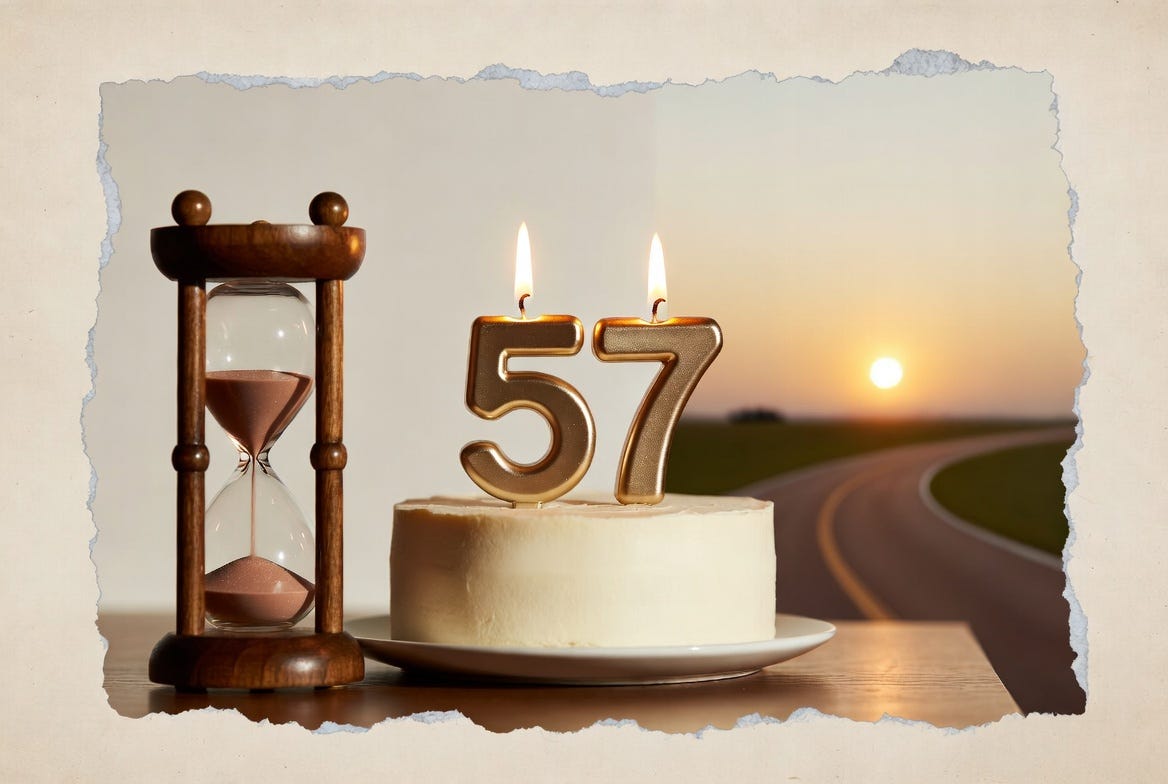
When I was a kid, 57 looked ancient.
Not “a little older and slowing down some” old. I mean genuinely old. The kind of old where a man automatically owned suspenders, carried a pocketknife everywhere, including church, had strong opinions about weather moving in from the west, and could fall asleep in a recliner during the six o’clock news with the volume loud enough to wake the dead.
Growing up around farms and nurseries in eastern North Carolina, I knew men like that. Their hands looked like they had been carved out of tree bark. They could fix almost anything with baling wire, duct tape, and words you were not supposed to repeat in church. Most of them drank coffee hot enough to remove paint and believed hard work could solve nearly every problem except maybe Yankees moving south.
As a boy, I looked at 57 and thought, “Well, they had a good run.”
Now I’m turning 57 myself, and honestly, the whole thing feels like a setup.
Because 57 does not feel ancient. It feels surprisingly young. Not physically young, mind you. My knees now sound like microwave popcorn when I stand up too fast, and I have reached the stage of life where stretching before doing yardwork feels less optional and more medically responsible.
But inside, this age feels different than I expected.
It does not feel like the beginning of the end. It feels more like finally reaching a place where the view gets clearer. You start understanding why some things mattered so much and why some things that once seemed enormous were never worth carrying in the first place.
At 57, you realize life is shorter than you thought, but also richer than you imagined. There are still people to encourage, lessons to share, young people to invest in, truths worth repeating, and moments worth slowing down long enough to notice.
The energy changes a little.
But the purpose deepens.

When I was younger, time felt generous. Summers stretched forever. School years took ages. Waiting for Christmas felt like an Old Testament wilderness journey.
Then I became a parent.
Parenting changes your relationship with time. One day you are teaching a child to tie shoes, and the next day you are watching them become adults with opinions, bills, dreams, and calendars that fill up faster than yours.
Nobody tells you how quickly the ordinary days become sacred in hindsight.
You think you will remember the big moments most, and you do. Birthdays. Graduations. Weddings. Big games. Major milestones. But what surprises me is how often the smaller moments come back with more tenderness.
The conversations in the car.
The meals around the table.
The laughter after something went wrong.
The long nights at camp.
The church pews.
The school events.
The everyday routines that felt normal at the time.
Those are the things that quietly become your life.
Parents of teens and young adults need to understand this deeply. Time is not something you manage as much as something you steward. You can spend it, waste it, invest it, or give it away, but you cannot store it in a barn for later like extra hay.
And this generation of young people is growing up in a world designed to steal their attention one tiny swipe at a time.
That is why parents must keep calling them back to real life. Not in a cranky “everything was better in my day” way, because some things were not better. Cars had bench seats hot enough in August to qualify as punishment, and we somehow thought Aqua Net was a household necessity.
But real life still matters.
Walks matter.
Meals matter.
Work matters.
Church matters.
Family stories matter.
Face-to-face conversations matter.
Serving others matters.
Looking someone in the eye matters.
A life built only through screens becomes thin. A life built through presence becomes rich.
After years of working with youth, I am more convinced than ever that self-image is one of the central battles of this generation.
Young people are constantly being asked to define themselves before they have had enough life to know who they are. They are measured, compared, ranked, photographed, filtered, liked, ignored, and judged in ways previous generations could not have imagined.
When I was a teenager, if you embarrassed yourself, the damage was usually contained to the people who were actually there. Today, a mistake can feel permanent before lunch.
That does something to a young person’s soul.
It teaches them to perform instead of become.
It teaches them to wonder, “How am I being seen?” more than “Who am I becoming?”
That is dangerous.
Parents must help teenagers build confidence from the inside out. Not fake confidence. Not swagger. Not the kind of confidence that needs constant applause to survive. Real confidence grows from character, competence, effort, integrity, humility, and the deep belief that their worth is not up for public vote.
This is where adults have to be careful. We cannot preach authenticity while performing perfection ourselves. Young people are smart. They notice when adults say one thing and live another.
They need to see us laugh at ourselves.
They need to see us admit mistakes.
They need to see us apologize.
They need to see us keep growing.
One of the best gifts we can give young people is the freedom to be human without believing every weakness is a crisis.
They do not need to be flawless. They need to be grounded.
If I could sit down with every teenager and young adult, I would tell them to choose their people carefully.
Very carefully.
The people closest to you will shape your future more than most young people understand. Friends, mentors, dating relationships, spouses, business partners, and spiritual influences all leave fingerprints on your life.
Culture often teaches young people to chase chemistry, popularity, excitement, or image. Life teaches you to value character.
Kindness matters.
Faith matters.
Self-control matters.
Humility matters.
Consistency matters.
The ability to listen matters.
A person can be impressive in public and exhausting in private. That is a lesson many people learn too late.
Marriage has taught me this over and over. A healthy marriage is not built on constant fireworks. Fireworks are beautiful, but if you live on fireworks, eventually somebody is going to lose an eyebrow.
Real love is steadier than that.
It is showing up.
It is listening.
It is forgiving.
It is laughing when life gets ridiculous.
It is staying tender when stress tries to make you sharp.
It is choosing faithfulness when feelings are tired.
Parents need to talk about relationships with more honesty. Not fear-based lectures. Not awkward speeches delivered while teenagers stare out the window praying for the rapture. Real conversations.
Talk about what respect looks like.
Talk about what manipulation looks like.
Talk about shared values.
Talk about emotional maturity.
Talk about faith.
Talk about friendship before romance.
Talk about how the right people help you become more fully who God created you to be.
Relationships are not a side issue. They are one of the main roads of life.
When you are young, success often looks like a moment.
A trophy. A stage. A paycheck. A title. A viral post. A big opportunity.
At 57, success looks much more like faithfulness over time.
I learned that growing up around agriculture. You do not plant something in the ground and then yell at it the next morning because it has not produced a harvest. Farming teaches patience, whether you signed up for the class or not.
You prepare the soil. You plant. You water. You wait. You work. You trust the process.
Life works much the same way. Marriage grows that way. Faith grows that way. Leadership grows that way. A business grows that way. A calling grows that way. A strong family grows that way.
This is hard for young people today because they live in a culture that rewards visibility more than consistency. But the deepest things in life often grow underground before anyone sees them.
Parents need to teach the power of small actions repeated over time. Read a little each day. Save a little each month. Move your body regularly. Pray consistently. Practice skills. Serve quietly. Keep promises. Do the next right thing.
That may not sound exciting, but it works.
The world keeps trying to sell shortcuts. Most of them are just long roads with worse scenery.
Growing up on a farm and nursery taught me lessons I did not appreciate at the time. Work has a way of doing that.
As a teenager, I did not wake up every summer morning thinking, “What a tremendous opportunity for character development.” I was more likely thinking, “It is already hot, and I may die before lunch.”
But those summers formed something in me. Work taught endurance. It taught responsibility. It taught me that money is connected to effort, and effort is connected to dignity. It taught me how to be tired and still finish the job.
That is not a small lesson.
I worry that too many young people are growing up without enough meaningful work. Not because they are lazy, but because we have sometimes overprotected them from the very things that build strength.
Work gives young people more than income. It gives them competence. It gives them structure. It gives them a place to contribute. It helps them meet people outside their normal circles. It teaches them how to handle difficult supervisors, long days, imperfect systems, and the strange spiritual discipline of doing what needs to be done even when you do not feel inspired.
Every teenager needs some version of that.
It may be a summer job, chores, service, camp staff work, volunteering, helping at church, or working in a family business. The form matters less than the formation.
Comfort rarely builds grit. Responsibility does.
Failure is one of the greatest teachers most young people spend too much energy trying to avoid.
Many teenagers today believe failure says something final about who they are. A bad grade, rejection, awkward moment, poor decision, or disappointing season quickly becomes, “I’m not good enough.” But failure is not identity. It is experience. It is instruction. Often, it is growth in work clothes.
After decades of working with youth, I have noticed something important. The strongest young people are usually not the ones who avoided struggle. They are the ones who learned they could survive it.
That is why parents, teachers, and coaches must stop rescuing kids from every hard moment. Young people absolutely need support, encouragement, and guidance, but they also need opportunities to struggle, adjust, recover, and try again.
Resilience is not taught through lectures. It is built through experience.
Growing up around farming taught me this early. Crops fail. Equipment breaks. Weather changes everything. You adapt, learn, work harder, and keep moving. Life works much the same way.
Some of the most confident adults I know are people who discovered failure did not destroy them. It taught them humility, perseverance, problem-solving, and grit.
Young people need to learn:
“I can mess up and recover.”
“I can struggle and still grow.”
“I can fail without believing I am a failure.”
That mindset changes everything.
Honestly, by 57, I have learned some of life’s greatest lessons did not come through success. They came through seasons where I had to humble myself, trust God more deeply, and keep going when things did not unfold the way I planned.
Success may impress people for a moment, but perseverance shapes people for a lifetime.
The older I get, the more I believe listening is one of the greatest gifts we can give another person.
Not pretending to listen.
Not waiting to talk.
Not nodding while mentally drafting our response.
Actually listening.
Young people today are surrounded by noise, but many of them feel unheard. They have information everywhere and wisdom in shorter supply. They can connect with hundreds of people in seconds and still feel deeply alone.
Parents, coaches, youth leaders, and teachers must become better listeners.
This does not mean we stop teaching truth. It means we earn the right to be heard by first caring enough to listen.
When I think about youth coaching, parenting, teaching, and ministry, this keeps coming back to me. Young people rarely open up because an adult gave a perfect speech. They open up because an adult paid attention long enough for them to feel safe telling the truth.
Listening builds trust.
Trust opens doors.
Open doors create influence.
And influence is what every parent wants, especially during the teen and young adult years.
The hard part is that listening takes humility. It requires us to slow down and resist the urge to fix everything immediately. Sometimes the most powerful thing we can say is, “Tell me more.”
That little sentence can do more than a lecture with three points and a closing poem.
One of the hardest but most important lessons young people need is this: no one else can live your life for you.
That may sound blunt, but it is actually hopeful.
Personal ownership is freedom. When a young person realizes their choices matter, they stop being only a victim of circumstances and start becoming a participant in their future.
Yes, life is unfair.
Yes, people face real obstacles.
Yes, some young people start with heavier burdens than others.
But even within difficulty, choices matter.
Attitude matters.
Effort matters.
Habits matter.
Relationships matter.
Faith matters.
Responsibility matters.
I have seen young people completely change direction when they stop asking, “Why is this happening to me?” and begin asking, “What can I do with what is in front of me?”
That shift is powerful.
Parents should teach ownership early. Let kids solve problems. Let them work through conflict. Let them experience consequences. Let them make decisions while the stakes are still small enough for recovery.
A teenager who never has to carry responsibility becomes a young adult shocked by the weight of real life.
And real life does not care whether you feel ready.
As a Christian, I believe the most important decision any young person will ever make is where they stand with Jesus Christ.
Not where they stand socially.
Not where they stand academically.
Not where they stand financially.
Not where they stand athletically.
Where they stand with Christ.
That is not a small religious category tucked neatly beside school, sports, career, and relationships. It is the foundation under all of it.
At 57, I believe this more deeply than ever.
I have watched people succeed outwardly and remain empty inwardly. I have watched families chase every achievement while spiritual formation quietly drifted to the margins. I have watched young people gain opportunities but lack an anchor.
Parents cannot outsource faith formation to the church and hope it sticks. Church matters deeply, but Deuteronomy 6 gives the responsibility to the home. Faith is formed in ordinary rhythms, in conversations, in prayer, in repentance, in forgiveness, in worship, in Scripture, and in watching parents actually live what they say they believe.
Kids do not need perfect Christian parents.
There are no such people.
They need honest Christian parents. Faithful parents. Repentant parents. Parents who point to Jesus not as a weekend accessory, but as Lord, Savior, hope, and truth.
The Gospel is not one lesson among many. It is the center.
When I was younger, I probably thought legacy meant big things.
Books.
Stages.
Organizations.
Achievements.
Influence.
Recognition.
Those things can matter, and I am grateful for opportunities God has given me. But at 57, legacy feels both smaller and bigger than that.
It is smaller because it shows up in ordinary faithfulness. A conversation. A prayer. A note. A hug after graduation. A child who knows you are listening. A spouse who knows you are still choosing them. A young person who believes they were created for more because you took time to say so.
It is bigger because those ordinary moments can echo for generations.
That is the part I understand more now.
The goal is not simply to build something impressive. The goal is to build something faithful.
I want my life to help parents feel stronger, youth feel seen, coaches feel equipped, and families move closer to Christ. I want young people to understand they are not accidents, not problems to be managed, and not products of a culture gone sideways. They are image-bearers with purpose, responsibility, and potential.
I want my children and the next generation to know that following Jesus is not a small life. It is the only life big enough to hold joy, suffering, calling, sacrifice, laughter, service, and eternity.
Fifty-seven once looked ancient to me.
Now it feels young.
Young enough to keep dreaming.
Old enough to know which dreams are worth chasing.
Young enough to keep building.
Old enough to know people matter more than platforms.
Young enough to keep laughing.
Old enough to know laughter is sometimes holy medicine.
I do not have everything figured out. That may be one of the gifts of getting older. You stop pretending you do.
But I do know a few things more clearly than I used to.
Time is precious.
Presence matters.
Character beats image.
Relationships shape life.
Work builds dignity.
Failure can form resilience.
Listening opens hearts.
Responsibility creates freedom.
Faith in Christ is the foundation.
Legacy is built in ordinary moments of faithfulness.
So if you are parenting teenagers or young adults, take heart. You do not need to be flawless. You do not need to have every answer. You do not need to outshout the culture.
You need to be present, faithful, honest, and anchored.
Keep showing up. Keep listening. Keep praying. Keep laughing when life gets ridiculous, because it will. Keep pointing them toward Christ. Keep building memories that will one day become their stories.
And when you reach an age that once seemed ancient, may you discover what I am discovering now.
There is still more road ahead.
And by God’s grace, it is worth walking.
Comments
Nothing yet. Say the first thing.
Sign in to join the conversation.