
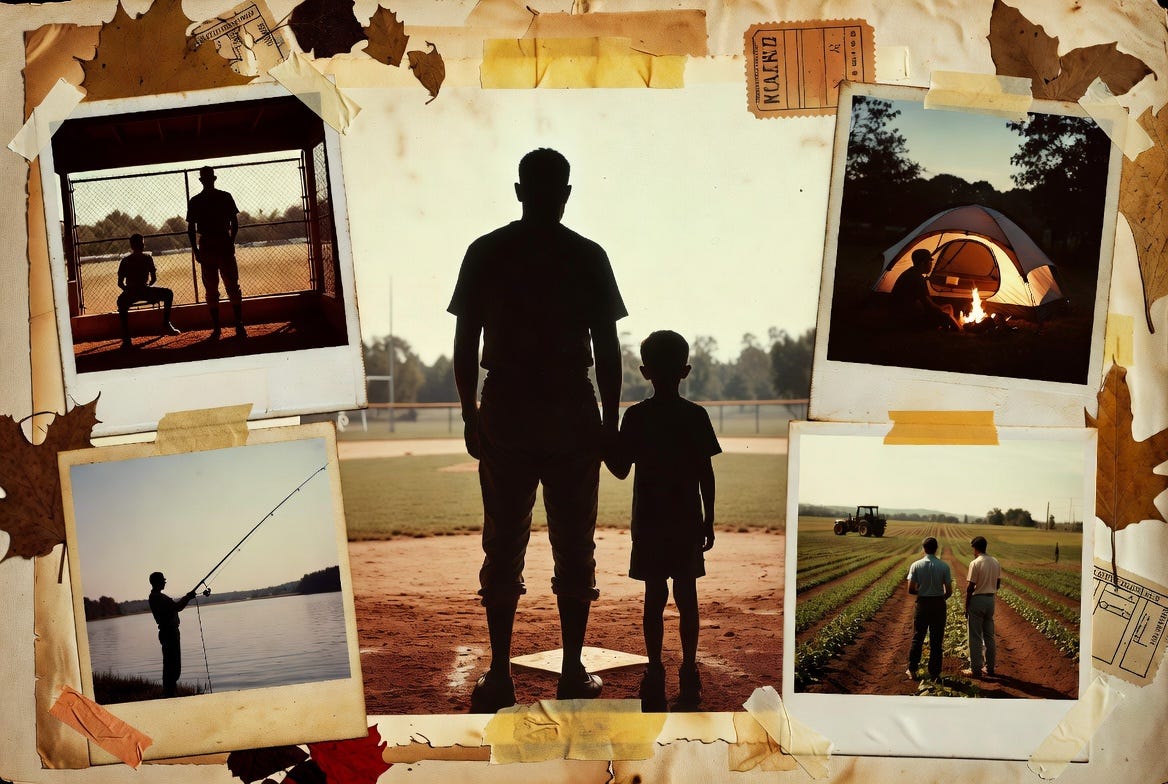
Four. Years. Old.
Standing at home plate in his brand-new t-ball uniform — cleats he’d probably grow out of before the season ended, hat slightly too big tilted to one side — when the coach asked each kid to introduce themselves to the other players.
The other children said things like “Tommy” or “Daniel” or just stared blankly into the distance because they were four, and most four-year-olds do not actually understand what “introduce yourself” means.
Not my son.
He squared his shoulders, looked that dugout dead in the eye, and announced with the confidence of a man running for Senate: “Jacob McLamb. Of the McLamb family.”
I nearly fell off the bleachers.
I’m not sure where he learned it. I’m not sure what possessed him to believe that his last name required a full family attribution, as if anyone in that park might confuse him with a different Jacob McLamb. But in that moment, standing there in his cleats that were already getting dirty, my son claimed his identity with a clarity that most adults spend decades trying to find.
And I thought: That’s my boy.
I have one son. His name is Jacob. He is my second child, adopted into our family and into our story — which, if you know anything about how God works, makes perfect sense. The best things in life rarely arrive the way you planned them.
I greet him to this day as my “Number One Son.” This is technically accurate, since he is also my only son, but I say it with the same energy every single time, like it might surprise him. It does not surprise him. He is too smart for that.
Smart. Funny. Tall. Handsome. Athletic. The kind of young man who walks into a room and people notice — not because he demands attention, but because there’s something in him that’s genuinely worth paying attention to.
He is also, like every young person I’ve ever worked with in thirty years of youth development, still working through three things: his self-image, his relationships, and his purpose.
And I — the man who has spent his career helping young people find exactly those three things — sit with a quiet, lingering question that no certification, no master’s degree, and no leadership training has fully answered for me:
Did I give him what he actually needed?
Let me tell you about my dad first, because you can’t fully understand any son without understanding the father who came before.
My dad is a remarkable man. He went from genuinely, deeply poor to building one of the most successful nursery businesses in our region — through sheer work ethic and force of will. He is a man of faith who doesn’t just attend church, he leads there. He models Christ-like love toward people in a way that isn’t performative or loud. He just... lives it. He is the kind of man who makes other men want to be better men, which is about the finest thing you can say about a father.
He took me fishing. He took me hunting. He worked harder than anyone I have ever known.
He also worked a lot.
Church responsibilities. The nursery. The endless demands of building something from nothing. And somewhere in the middle of all that faithfulness and industry, the business of being present — not just physically present, but tuned-in present — sometimes got crowded out.
He took me fishing and hunting, bless him. But those were the things he loved. I don’t ever remember him asking what I loved, what I wanted to chase, what kept me up at night in the best kind of way.
I don’t say that to wound him. He was doing what fathers of his generation understood fatherhood to be: provide, protect, lead, model. And he did all of those things. The research we now have on fatherhood confirms what he instinctively understood — that involved, present fathers shape sons who are more confident, more resilient, more capable of finding their footing in the world. My dad gave me all of that.
I just also needed him to see me — not just the next generation of McLambs, not just the boy who would carry on the name (with full family attribution, apparently), but me. What made me curious. What made me light up. What I was afraid of in the dark.
I don’t think he knew how to get there. And I learned a lot from him. I tried to pass it down.
I coached Jacob in baseball for twelve years.
Twelve years. That’s not a season or two of enthusiasm before real life calls you back. That’s twelve years of early Saturday mornings, of hot dogs from concession stands that may or may not have passed a health inspection, of red dirt permanently embedded in both our shoes. I was in the dugout. I was on the field. I was there.
We camped together. We watched his first movie together — Chicken Little, which holds up better than you might expect when you’re watching it next to a kid who is absolutely certain that the sky is, in fact, fine. He became an Eagle Scout, which means he navigated wilderness, leadership, service, and more bureaucratic merit badge paperwork than most adults could survive.
I was present. Deliberately, intentionally, consistently present in ways my dad wasn’t always able to be.
And yet.
Here’s what nobody tells you about fatherhood: showing up and seeing someone are related skills, but they are not the same skill.
I showed up to twelve years of baseball. I wonder now if I was seeing Jacob in those moments — his particular longings, his specific fears, the quiet questions he might have been carrying in that Number One Son heart of his — or if I was sometimes showing up for the version of fatherhood I had decided to give him, the corrected version of what I’d received, without fully stopping to ask what he needed from me.
The research on this is humbling. Fathers who are physically present but emotionally unavailable still leave gaps. Sons need more than a dad in the stands. They need a dad who notices what’s happening behind their eyes, who asks questions without an agenda, who makes space for the kind of conversations that don’t happen on command — the ones that unfold on long drives, at the back of campsites, after the last out of the last inning when everyone else has headed home.
I had those drives. I had those campsites. The question I keep turning over is: how often did I actually go there?
There’s a specific question that keeps me up more than the others.
Did I guide him toward his Heavenly Father?
I believe — with everything in me — that the deepest answer to every question Jacob is still working through about his self-image, his relationships, and his purpose is found in understanding whose he is. Not just the McLamb family. Though that identity has served him well, clearly. But the bigger one. The one that holds when everything else shifts.
Scripture doesn’t mince words on this. Ephesians 3 tells us that God is the Father from whom every family in heaven and earth is named. Deuteronomy 6 charges fathers to speak God’s truth when they sit, when they walk, when they lie down and rise up — which is another way of saying constantly, naturally, in the middle of ordinary life.
I believe I modeled faith. I believe I lived it imperfectly but genuinely. What I question is whether I made it personal for Jacob — whether I sat with him long enough to help him see that the God who made him, chose him, and has a purpose for him is a Father who sees him even more fully and more deeply than I ever could.
That’s the thing about being a father. You’re always pointing beyond yourself.
Or you should be.
I am proud of Jacob. I want to say that clearly and without qualification, because pride is a word I don’t throw around carelessly.
The kid who introduced himself as “Jacob McLamb of the McLamb family” at four years old is now a young man still figuring out who he is and what he’s here for — like every human being worth paying attention to is still figuring out. He is funny in the way that good comedians are funny, where the timing is instinctive and the delivery is dry and you laugh before you know you’re going to. He carries himself well. He is more capable than he currently believes himself to be.
And that last part — more capable than he currently believes — is the exact sentence I have said about hundreds of young people over thirty years of this work.
Young people often rise or fall to the level of belief surrounding them.
I believe in Jacob. I want him to know that. I want him to feel it not just in the abstract warmth of a parent’s general affection, but in the specific, named, you-in-particular way that actually lands.
Here is what I have learned, imperfectly and over a long time, about fathers and sons:
Presence is necessary but not sufficient. You have to be there. You also have to be awake when you’re there — curious, listening, noticing what the kid in front of you actually needs, not just what you’ve decided they need based on what you wish you’d had.
Fathers shape identity whether they mean to or not. The research on this is overwhelming and mostly sad, because so much of what gets passed between fathers and sons happens unconsciously — in patterns, habits, silences, and the things we never say out loud. The good news is that it also happens consciously, in intentional moments, in the spaces we choose to create.
The goal was never to be the perfect father. It was to be the present father, the seeing father, the father who points his son toward something bigger and truer than either of them.
And fathers who are imperfect — which is all of us, by the way, every last one — have access to the same grace they’re supposed to be showing their kids. That’s not a small thing. That’s actually the whole thing.
Jacob, if you’re reading this — and knowing you, you might read it just to have something to quote back at me later — I want you to know something.
I showed up. I was in that dugout for twelve years. I slept on the ground in a tent next to you more times than my back would currently like to remember. I watched you earn every one of those Eagle Scout merit badges, and I was proud at every single one.
I also didn’t always see what you needed. I am still learning what that was. And I am sorry for the gaps.
But I know this: you are not defined by the gaps in our story. You are not the sum of what any earthly father did or didn’t give you. You are Jacob McLamb — of the McLamb family, yes, but more importantly, of a much bigger family than that.
And you figured that out at four years old, at a dusty t-ball field, in cleats that were already getting dirty.
Me? I’m still catching up.
James McLamb is the founder of Generation Youth and the author of Tomorrow’s Youth. He works with parents, coaches, educators, and young people across the country to help the next generation discover identity, purpose, and belonging. Find more at generation-youth.com or wherever you get podcasts.
Comments
Nothing yet. Say the first thing.
Sign in to join the conversation.