
It was nine in the morning on the Fourth of July, and it was already hot enough to make you question the wisdom of everyone involved, including whoever decided this holiday belonged in July instead of, say, October.
Not the “nice summer morning” kind of hot.
The kind of hot where the pavement looks up at you and says, “You sure about this?” The kind where your shirt starts forming a permanent attachment to your back before you’ve finished your first cup of coffee. I found myself wondering if the Founding Fathers might have picked a different month if more of them had spent a July in North Carolina.
The forecast said we’d top a hundred degrees by afternoon. That’s not weather. That’s a crockpot with landscaping.
And yet, there they were.
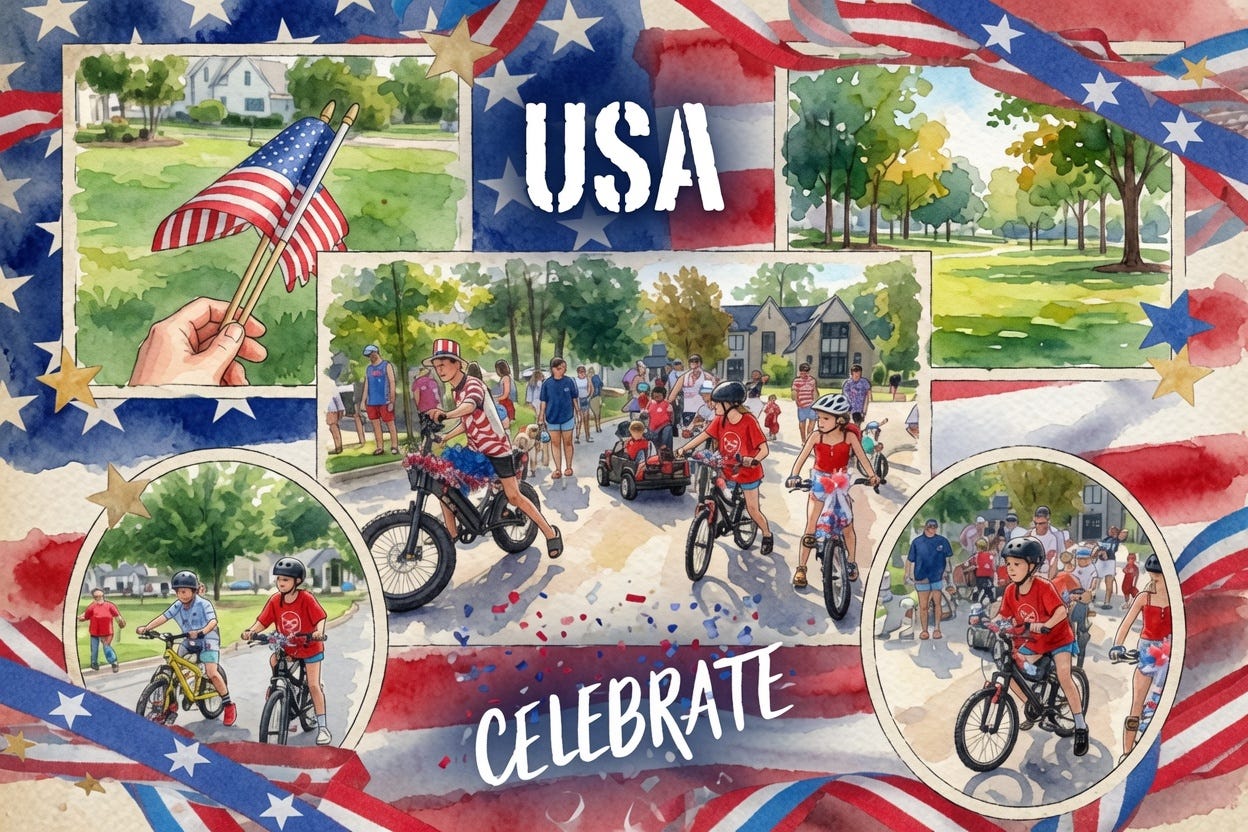
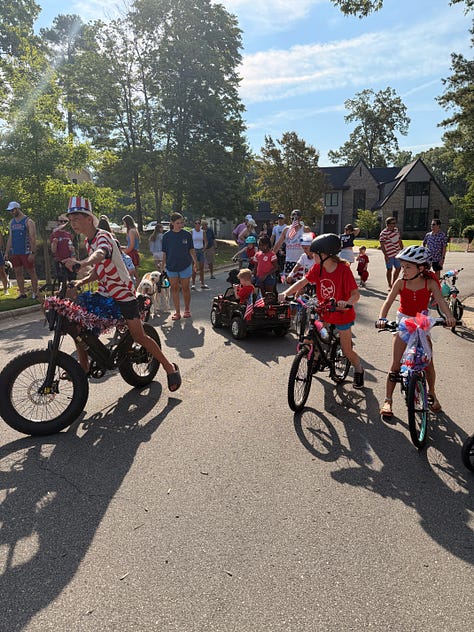
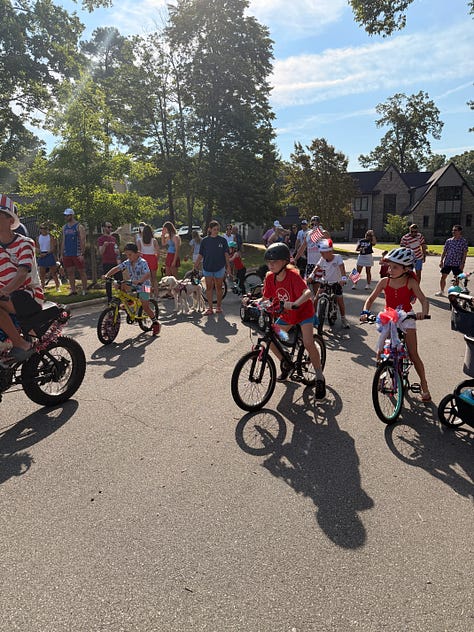
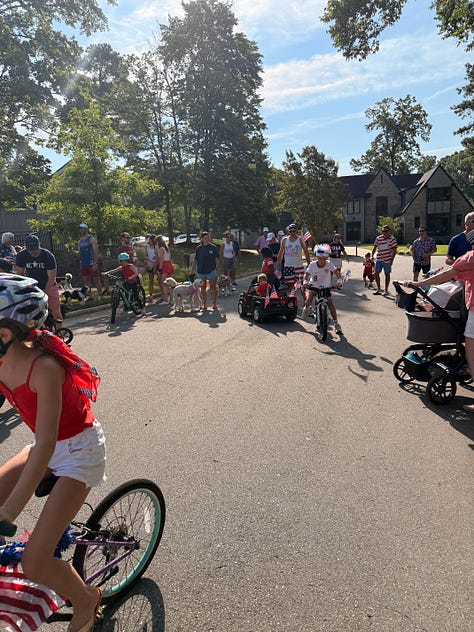
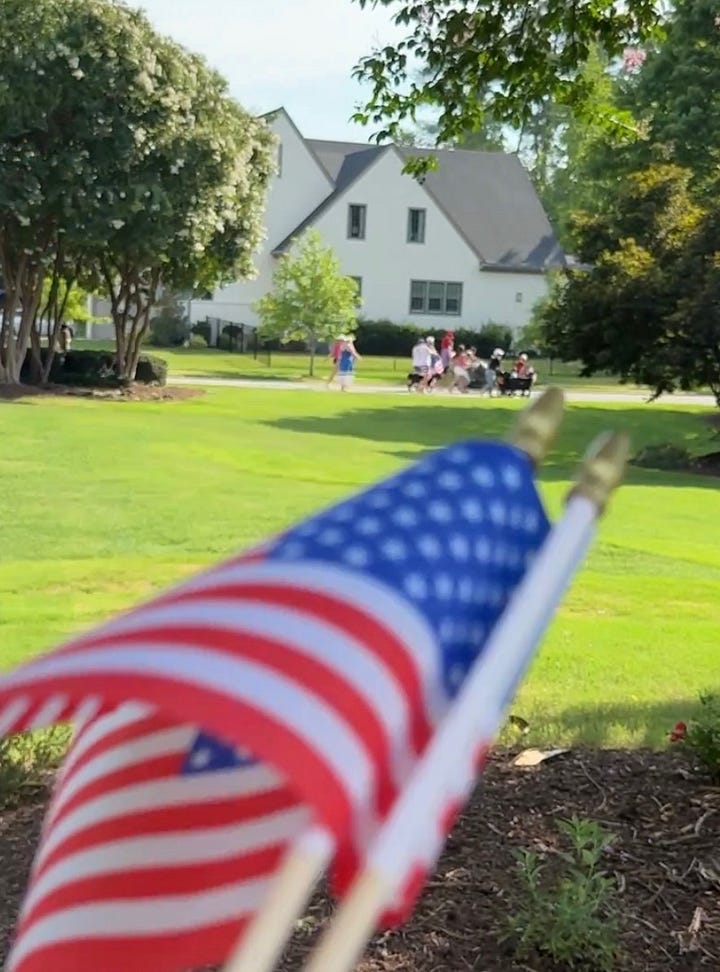
More than thirty people showed up in our neighborhood for a little parade. Nothing official. Nobody had a permit. Just moms and dads pushing strollers, kids on bikes wrapped in red, white, and blue streamers, a few wagons, and enough patriotic flair to make the seasonal aisle at Target proud.
Grandparents walked along smiling the way grandparents do when something simple and something sacred are happening at the exact same time.
Even the dogs got dressed up. Bandanas, little flag collars, the whole bit. Some of them looked proud to be part of it. Some looked confused. A few looked like they’d trade the entire concept of liberty for a kiddie pool and a bite of somebody’s hot dog.
I understand those dogs completely.
As the parade came past our house, my wife did what any patriotic American armed with a Bluetooth speaker and no fear of the volume knob would do.
She cranked up “Stars and Stripes Forever.”
Not politely. Not as background music you could talk over. She played it like John Philip Sousa himself was about to come marching over the hill by our mailbox with a full brass section.
For about four minutes, our ordinary street turned into something out of an old newsreel. Kids waved. Parents laughed. Flags bounced along in the heat. Nobody was performing for a camera or trying to impress a neighbor. Nobody needed a stage or a fireworks budget large enough to worry the insurance company.
It was just neighbors, walking together, on a hot morning, for no reason except that the day deserved it.
And here’s the thing I keep coming back to: it mattered. A whole lot more than it should have, for something that took twenty minutes and ended with donuts.
After the walk, everybody gathered for snacks. Mostly patriotic donuts, because nothing says “the pursuit of happiness” quite like red, white, and blue icing with enough sugar to make a bald eagle fly faster.
There have been years this parade included a short devotion. Kids running around while parents caught up. Grandparents visiting. People remembering, for a few minutes, that a neighborhood isn’t supposed to just be a row of garage doors that happen to face the same street.
It’s supposed to be a place where people know each other. Not deeply, not perfectly — just enough to wave. Enough to notice. Enough to care.
The heat thinned the crowd out some as the walk went on, which, again, I understand. There’s patriotic devotion, and then there’s heatstroke, and a wise republic knows the difference.
But even with people dropping off here and there, the spirit of the thing held. Nobody had to be there. They could’ve slept in. They could’ve said, honestly, “It’s too hot for this.” Nobody would’ve blamed them.
Instead, they came outside. Decorated bikes. Brought the kids. Gave up a piece of a hot morning for something bigger than their own comfort.
I don’t think that’s a small thing. I think that might be most of what holding a country together actually looks like.

Here’s a question worth sitting with: if our kids only know the Fourth of July as cookouts, lake days, and fireworks, have we handed them the celebration without the inheritance?
Now, don’t misunderstand me. I am fully in favor of the cookout. I believe hot dogs have a sacred, seasonal calling. I support watermelon, homemade ice cream, and fireworks displays that make every dad in the neighborhood quietly wonder if he could’ve done better with a little more planning and one questionable trip across the state line.
Enjoy the day. Please.
But a holiday can’t survive on food and noise alone. It has to carry something underneath it.
Kids are always watching for what makes the adults around them pause. What makes us go quiet. What we treat as worth remembering.
They notice when we stand for the anthem.
They notice when we slow down at a memorial.
They notice when we tell stories about the people who paid for the freedom we’re currently enjoying with a paper plate in one hand.
They notice when we get a little emotional and try to hide it, and — I’ll let you in on a secret — they notice that too, and it doesn’t make us look weak. It makes the moment real to them.
And they notice, just as clearly, when we treat the whole day like an excuse to scroll and grill and buy plates with flags printed on them.
Kids are better observers than they are listeners. They may forget the lecture. They remember the moment.
That’s the real gift of a silly little neighborhood parade. It turns an idea into something you can actually feel. Freedom stops being a vocabulary word from a textbook. It becomes a decorated bike, a song blasted too loud, a grandparent wiping sweat off his forehead and smiling anyway.
I don’t want to raise kids on blind patriotism. That version can’t handle a hard question. It gets nervous around real history. It thinks loyalty means pretending everything has always been fine.
I also don’t want to raise kids on bitter cynicism. That version only sees the failures. It rolls its eyes at tradition and mistakes tearing something down for being wise about it.
Neither one builds a person of character. Neither one builds a country worth handing to the next generation.
What I want for our kids — for my own kids, for the ones I’ve coached, taught, and mentored over twenty-five years — is honest gratitude.
Honest enough to know the country has never been perfect.
Grateful enough to know that freedom is still rare, and it still costs something.
Honest enough to learn the whole story, the hard parts included.
Grateful enough to want to protect what’s good about it anyway.
America turned 250 this year. That’s old enough to celebrate. Old enough to critique. And old enough to need some tending from people willing to do the unglamorous work.
Tending doesn’t look like fireworks. It looks like showing up. Teaching a kid something true. Serving a neighbor. Telling the story one more time even though you’ve told it before, because somebody in the yard hasn’t heard it yet.
Here’s something I’ve noticed both about faith and about a country’s memory: it rarely disappears all at once. It fades out quietly, one skipped conversation at a time.
It fades when the adults stop telling the story.
It fades when a holiday becomes only content for a feed.
It fades when a tradition survives as decoration but loses its explanation.
It fades when we quietly assume somebody else, a teacher, a coach, the History Channel, will pass it along, so we don’t have to.
Schools can teach history. Good teachers do beautiful work with it. Churches can speak on gratitude and sacrifice. Museums and documentaries have their place. But the first keepers of any story are almost always the ordinary people standing closest to the kids: parents, grandparents, neighbors, coaches, pastors.
Not with a forty-five-minute speech while a kid’s donut melts in one hand and his patience melts in the other. Nobody’s ever been inspired by that.
Just tell the story naturally, in pieces, as it comes up.
Tell them why the flag matters.
Tell them why people serve.
Tell them why we go quiet in certain places.
Tell them that loving your country, like loving anything worth loving, doesn’t mean pretending it has no flaws. It means caring enough to help it get better.
Big national celebrations are impressive — fireworks over monuments, flyovers, concerts, the whole production with somebody sweating through a headset backstage trying to keep the timing right.
But if you want to know where I think meaning actually sticks, it’s in the small places. A neighborhood bike parade. A church picnic. A veteran standing quietly while kids run circles around him with popsicles. Neighbors sharing donuts in the shade. A dog in a bandana he never consented to wearing.
A kid probably won’t remember the exact words anybody said on the Fourth of July. But they might remember that the neighborhood gathered. That Dad pushed the stroller in the heat. That Mom decorated the bike with him the night before. That Grandpa smiled even while he was sweating through his shirt.
That’s how memory actually works, at least in my experience. It sneaks in through the senses long before it settles into the soul.
Here’s what I’d offer parents, coaches, and youth leaders heading into the next holiday, birthday, or ordinary Tuesday:
Say something true before the fun starts. Not a speech. Just a sentence. “Freedom cost somebody something” is plenty.
Let them see you moved. Kids don’t need adults who have it all together. They need adults who are honest about what matters to them.
Tell the story in pieces, not lectures. A few sentences on a porch step will outlast a formal talk every time.
Show up to the small, unglamorous version. The neighborhood parade counts. The backyard cookout counts. You don’t need a monument to make a memory.
Then let them enjoy the day. Eat the hot dog. Watch the fireworks. Run through the yard. Meaning and fun were never in competition.
This morning, in the thick, sweaty heat of a North Carolina Fourth of July, I watched a small parade move down our street. It wasn’t fancy. It wasn’t polished. Nobody was filming it for anything.
It was strollers, bikes, grandparents, a few confused dogs, donuts, sweat, laughter, and “Stars and Stripes Forever” turned up loud enough to wake every sleeping patriot within a reasonable marching distance.
And somehow, that felt exactly right.
I don’t think America at 250 needs more nostalgia. I think it needs adults willing to pass along meaning, memory, and a sense of responsibility — one hot morning, one decorated bike, one story at a time.
Take the kids to the parade. Tell them the story. Let them serve somebody. Give them something better than cynicism and something deeper than fireworks.
Give them honest gratitude. Give them responsibility. Give them a country worth tending.
Then maybe, years from now, when they hear a patriotic song on a hot July morning, they won’t just remember the heat.
They’ll remember that somebody loved them enough to tell them why it mattered.
— James
P.S. If this reflection resonated with you, I wrote another article earlier today about the Fourth of July, America at 250, and what our youth need from the adults leading them. I hope you’ll take a few minutes to read it and share it with someone who cares about the next generation.
Comments
Nothing yet. Say the first thing.
Sign in to join the conversation.