
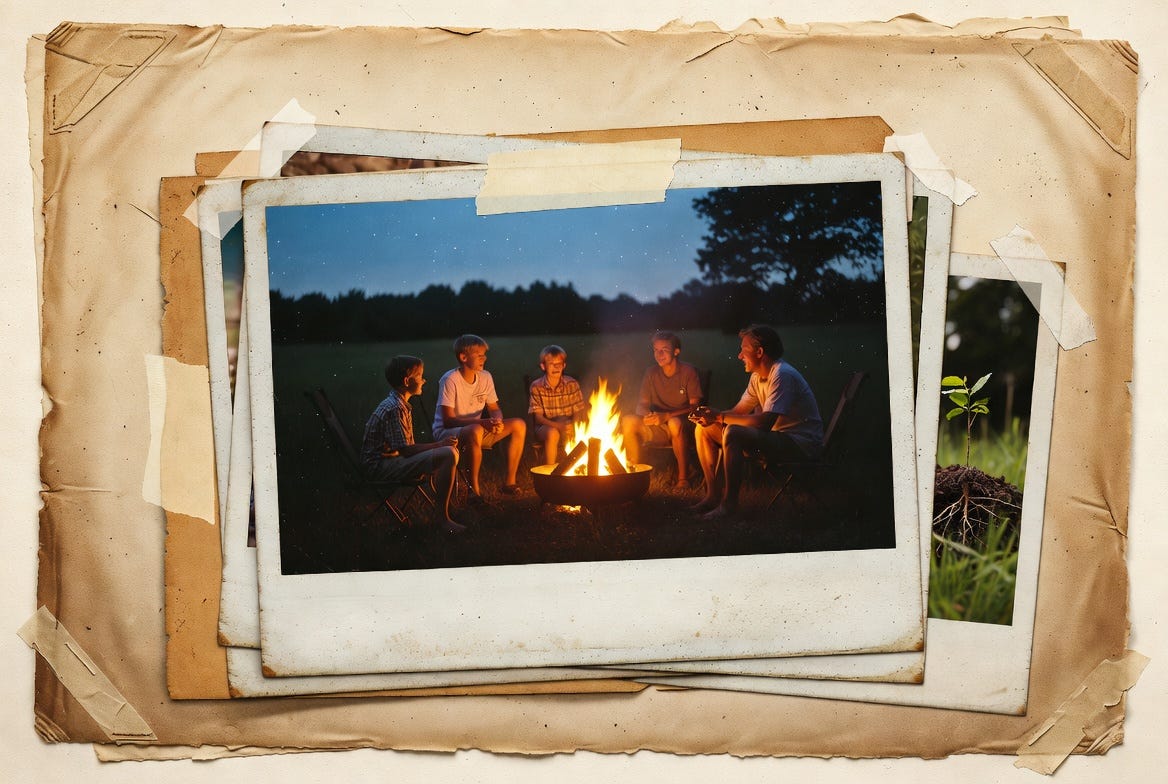
I grew up on a wholesale field and container nursery.
Five hundred acres of it.
Which means I grew up surrounded by things that were alive, things that needed tending, things that would die if you ignored them long enough, and approximately four thousand opportunities per day to get into something your mother would have preferred you hadn’t.
The road we lived on didn’t have a name worth knowing. It only had a number for most of my childhood. And for most of that time, it had almost nobody on it. Just our family, the land, and whatever was growing in the fields that week.
There were no streetlights.
Not because the town forgot us. Because there was no town. There was a nursery, a sky full of stars on clear nights, and the particular silence of a summer evening that you can only hear when there is nothing between you and the horizon but rows and rows of things quietly putting down roots.
My mother did not track me. She did not text me. She did not send seventeen increasingly anxious messages asking where I was.
She pointed toward the door after breakfast and trusted the land to give me back by supper.
It always did.
We called that childhood.
It turned out fine.
Growing up on a working nursery means growing up inside a living system.
You learn early that the world does not wait for you to feel ready. The irrigation doesn’t care what mood you’re in. The weather doesn’t reschedule. A container that tips in a storm needs righting whether you feel like it or not.
You learn what dead looks like and what alive looks like and how thin the line between them can be when something isn’t getting what it needs.
You learn patience the hard way — by watching something grow that cannot be hurried.
Psychologists now have clinical language for what the nursery taught me for free. They call it distress tolerance. They call it delayed gratification. They call it executive function. Dr. Peter Gray Peter Gray at Boston College has spent decades documenting what happens to children who lose unstructured outdoor time, and the findings are not encouraging. As free, child-directed play has declined since the 1980s, rates of anxiety, depression, and what researchers call inability to tolerate boredom have climbed steadily in children and adolescents.
The nursery was not teaching me botany. It was teaching me how to be a person.
I just didn’t know that at the time. I thought I was just staying out of trouble. Mostly successfully.
Today’s teenager carries something I could not have imagined walking between those field rows on a summer morning.
A device capable of delivering entertainment, connection, social comparison, distraction, bad advice, worse advice, and content designed by rooms full of very intelligent people specifically to keep young eyes locked on it as long as possible.
Twenty-four hours a day. Seven days a week. No days off for growing season.
The moment there is silence, they fill it.
The moment there is boredom — that boredom that the nursery used to turn into creativity and problem-solving — they scroll.
The moment there is discomfort of any kind, emotional or social or existential, they reach.
I understand the impulse completely. I am not throwing stones.
But the research is not gentle about what that reaching is costing them.
Jean Twenge, Jean M. Twenge a psychologist at San Diego State University who has tracked generational data for decades, found that after 2012 — when smartphone adoption hit critical mass among American teenagers — rates of teen depression, loneliness, anxiety, and suicide attempts began rising sharply. The timing was not a coincidence. A landmark study published in JAMA Pediatrics found that teenagers averaging more than three hours of daily recreational screen time were significantly more likely to experience anxiety and depression than those who didn’t.
But here is the detail that matters most, the one that gets lost in the headline numbers:
It isn’t just how long. It’s how.
The more teenagers use screens to escape discomfort, to cope with hard emotions, to numb something that hurts — the worse the outcomes. The nursery taught me to stand in the middle of something difficult and wait for it to change. The phone teaches them to never let the difficult thing arrive in the first place.
That is a significant difference in education.
Here is the part I didn’t expect.
Right in the middle of all this research about screens and anxiety and the slow erosion of something we can’t quite name, something else is quietly happening at the same time.
Young people are asking spiritual questions again.
Recent research from the Barna Group found that Gen Z is showing genuine, measurable openness to faith, to church, to conversations about Jesus that were not happening with the same frequency five years ago. The researchers describe a generation that is spiritually restless, disillusioned with what the digital world promised and failed to deliver, and looking — sometimes with great caution, sometimes with surprising urgency — for something with actual weight and permanence to it.
The hunger is real.
The phone just keeps handing them cotton candy when what they are actually starving for is a meal.
Summer is one of the best opportunities all year to serve them something substantial.
Summer is a gift that most parents don’t fully appreciate until the back-to-school sales start and they realize they spent it driving kids to activities and managing screen time negotiations and wondering where July went.
A few weeks when routines loosen. When the school calendar stops running the household. When families actually occupy the same space in daylight for longer than twenty minutes.
This is not a logistical problem to manage.
This is a door.
You have a choice about whether to walk through it or stand in the hallway scrolling.
I am not going to tell you to throw the phones into the nearest irrigation pond, though I have had conversations with parents who have considered it with a completely straight face and I respect the commitment. The answer is not simply less screen time. Less of nothing is still nothing.
The answer is more of everything worth having.
More purpose. More conversation. More faith. More service. More Tuesday evenings that turn into something nobody planned.
The first practical step is also the most important.
Talk to your kids.
Not a lecture. Not a policy announcement delivered from on high. A genuine conversation, at a time when nobody is hungry or rushed or already halfway out the door.
Say something like: I’ve been thinking about this summer. I don’t want us to waste it. Can we figure out together how we want to use it — including how we’re going to handle phones?
Then be quiet and let them talk.
A 2021 study in the Journal of Youth and Adolescence found that teenagers who participated in creating family screen time guidelines showed significantly better compliance and far less conflict than those who had rules handed to them from above. Ownership creates buy-in. This is true for teenagers. It is, if we’re being honest, true for adults in most workplaces too.
The goal of this conversation is not surrender. You are still the parent. But you are inviting them into the solution rather than installing them as the problem, and that changes everything about how the summer goes.
Conversation creates direction. Structure holds it in place.
Phone-free meals — every single one. No exceptions, no renegotiations, no special circumstances. The table is the table. Researchers at Columbia University found that regular family meals are among the strongest protective factors identified against teen depression, anxiety, substance use, and risky behavior. Not because of the food. Because of the conversation that happens when there is nothing else to do but talk to each other. Put the phones in a drawer. Hold the line. The drawer will not hurt them.
A charging station outside the bedroom — tonight. This is the one that parents resist and the research supports most forcefully. The National Sleep Foundation reports that 72% of teenagers sleep with their phones in or near their beds. Exposure to blue light suppresses melatonin. Late-night notifications interrupt sleep architecture. Teenagers need eight to ten hours. Most are getting six or seven. That gap is not a minor inconvenience — chronic sleep deprivation in adolescents is linked to impaired memory, emotional dysregulation, weakened immune function, and significantly increased risk of depression. Get a charging station. Put it in the hallway. It costs twelve dollars. It is one of the highest-return investments in your child’s health you will make this summer.
Screen-free mornings for the first thirty minutes. Before the phone, eat something. Go outside. Sit on the porch. Watch what’s happening in the yard. Watch nothing. The habit of beginning a day without immediately reaching for the device builds something that is hard to quantify and easy to recognize in a person who has it.
A weekly reset conversation. Sunday evenings, ten minutes, everyone in the same room. What’s coming this week? What does everybody need? What are we looking forward to? This is not a therapy session. This is a family functioning as a unit. Extraordinary things happen in ordinary ten-minute conversations that start with no particular agenda.
The structures create space. The space needs filling. Nature abhors a vacuum and so does a bored fourteen-year-old.
Get outside — specifically, together. Research from the University of Michigan found that twenty minutes in a natural outdoor environment significantly reduces cortisol, the body’s primary stress hormone. Twenty minutes. That is one walk. That is sitting on the porch steps while something moves in the tree line. On a nursery like the one I grew up on, you can’t walk ten feet without being in the middle of something alive. Most families have a yard. Use it. Go out there together and don’t bring anything that vibrates.
Serve somebody — and take your kids with you. A local food pantry. A Habitat build. A nursing home with residents who haven’t had a visitor in two weeks. Show up with your teenagers and don’t explain the lesson in advance. Let the experience do its own work. Research published in the Journal of Positive Psychology found that adolescents who regularly engage in community service report higher levels of purpose, stronger identity formation, and measurably lower rates of depression than those who don’t. A teenager who is discovering why they were made is considerably less interested in spending every available hour watching what somebody else made.
Read Scripture together. Not as performance. As practice. A verse at dinner. Something short before a road trip. The habit of returning together to something ancient and true creates an anchor that holds when everything else is moving. It does not need to be elaborate. It needs to be consistent.
Tell your stories. The nursery ones. The ones where something went wrong and had to be fixed. The ones your parents told you. The ones with complicated endings. Researcher Dan McAdams at Northwestern University has spent decades studying the relationship between family narrative and psychological health. Young people who know their family stories — including the failures, the hard seasons, the moments where somebody had to start over — show measurably greater resilience and stronger identity than those who don’t. Your stories are not nostalgia. They are formation.
Ask the questions worth asking. On a drive. Around the table. Walking somewhere in the evening. What breaks your heart? What do you think you’re genuinely good at? If you could do one thing this summer that actually helped somebody, what would it be? These are not trick questions. They are the questions underneath every question a teenager is already asking, usually silently, usually alone. Ask them out loud. Then be patient with the answer, because it might take a while to arrive.
Growing up on five hundred acres, there was always something to do in the evening that didn’t require electricity.
You sat outside. You watched the light change. Somebody built a fire because there was wood and there was a pit and that seemed reason enough.
Nobody planned what happened around that fire. Nobody had an agenda.
And yet somehow those evenings produced some of the most clarifying moments I can remember. Something about the dark around you and the light in front of you and the absence of anywhere else to be loosens things in people that the daytime keeps tight.
I have seen the same thing happen with my own kids.
Not at conferences. Not during planned family activities. Not during any moment I would have flagged in advance as significant.
In the car going somewhere ordinary. On the porch after supper. Around a fire that somebody built mostly because there was nothing else to do.
Faith grows in ordinary soil. It always has.
The campfire, the long drive, the Tuesday evening when everybody stayed at the table a little longer than usual — these are not interruptions to the important work of parenting.
They are the important work of parenting.
I will bet something meaningful that Sara Beth, Jacob, and Abby will not remember, twenty-five years from now, a single video they watched the summers of their youth.
But they might remember the night the whole family sat around a fire until it burned all the way down.
They might remember the morning you showed up somewhere to serve and they realized you actually meant it.
They might remember the car ride where the conversation went somewhere nobody expected, and nobody turned on the radio.
They might remember an evening that was completely unremarkable by any measurable standard — just ordinary summer and ordinary people who loved each other — where something quietly shifted and they began to understand, for the first time with any real clarity, that God had something specific in mind when He made them.
Those memories don’t fade.
Those memories make people.
Summer was never designed to fit in a pocket.
It was designed to be lived — in the heat and the dirt and the long evenings and the conversations that go somewhere unexpected and the service that costs you something and the faith that grows in ground you didn’t know you were planting.
You don’t need a program.
You need to open the back door and point your kids toward the sky.
There are no streetlights where I grew up.
There are no streetlights where the best summers happen.
You won’t need them.
You only get so many.
Use this one well.
James McLamb is a national youth empowerment strategist, speaker, and founder of Generation Youth. A former high school agriculture teacher, he is the author of Tomorrow's Youth, creator of the Ignite 30-Day Student Journal series, and the founder of the Generation Youth Coach Certification — a program training adults to mentor and coach young people ages 11–25 with emotional intelligence and purpose. His work has shaped schools, camps, churches, and youth organizations across the country. James hosts the Generation Youth podcast and is based in Raleigh, North Carolina. Learn more at generation-youth.com.
Comments
Nothing yet. Say the first thing.
Sign in to join the conversation.