
Share Truth Decay by James Macleod
The modern world is run by people who do not understand what they are doing, and this is usually considered leadership.
Bundaberg, Queensland is hot in a way that strips things back to their essentials. It is a place where success and failure show up with transparency, in full view, with little room for reinvention after the fact. Sugarcane does not care about ambition. Melons do not respond to confidence.
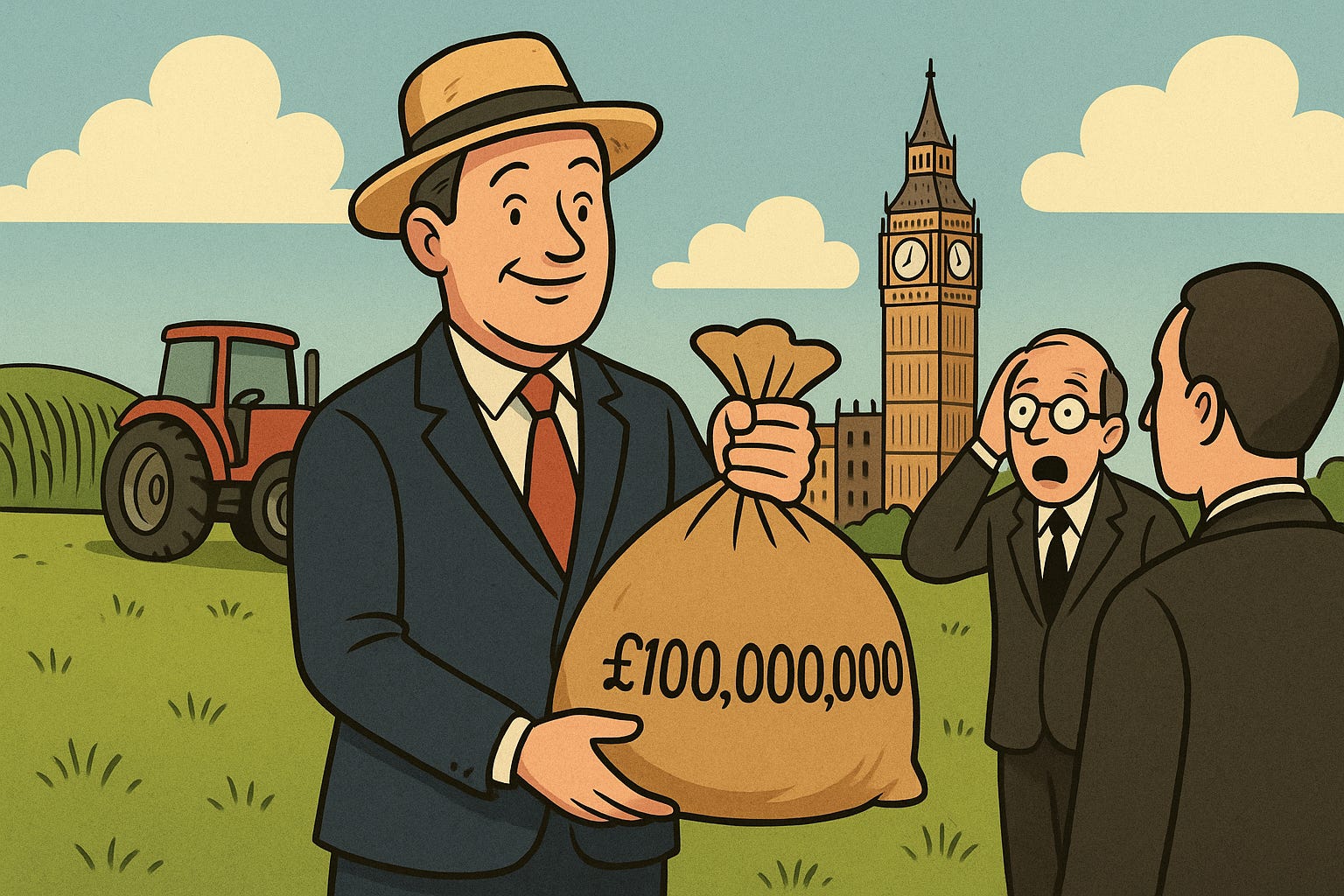
Lex Greensill was born here in 1976, into a family that ran a sugarcane and melon farm. That part is factual, uncontested, and essential, because without it none of what follows would have worked.
Greensill would later tell the same story again and again, across boardrooms, governments, banks and conferences: his parents worked hard, buyers paid late, cash flow nearly broke them. Young Lex watched this injustice and vowed to fix it.
It is a beautiful story. So beautiful that nobody seriously interrogated it and more importantly failed to notice how often it functioned less as biography and more as credential.
People who knew the family recall a bright, tidy kid, more accountant than agrarian. Lex himself was more likely to be near the books than the fields. One family acquaintance memorably noted that Lex was “the only bloke around who wanted to wear a suit.” Which is not a criticism, but maybe more of a directional sign.
Because Lex Greensill wasn’t shaped by the soil, he was shaped by impatience and “The farmer” wasn’t the backstory. “The farmer” was the Trojan horse.
A farmer is trustworthy. A banker is suspicious. Guess which one he kept calling himself.
Calling yourself a farmer in global finance is like wearing camouflage into a zoo. No one panics. No one looks too closely. Everyone assumes you’re harmless.
“Farmer” implies constraint, humility, connection to reality, it’s a counterweight to the suspicion that usually follows anyone talking enthusiastically about liquidity.
This mattered. Enormously.
Because Lex Greensill wasn’t selling machinery or crops. He was selling belief. And belief travels better when wrapped in earth tones and hardship narratives.
The farmer story would soften regulators, disarm journalists, relax investors. It suggested moral ballast. It implied a man anchored against nonsense.
Ironically, it just made nonsense a lot easier to sell.
Greensill studied law, worked while studying, then did what many ambitious Australians do: he left.
London is an excellent place to reinvent yourself because absolutely no one has the time or inclination to verify anything beyond your tone. If you can speak in sentences and maintain eye contact, you’re halfway to power.
At Morgan Stanley, Greensill entered supply-chain finance, a niche so dull it was invisible. This is significant, because boring sectors are where extraordinary bullshit grows unnoticed.
Supply-chain finance is normally plumbing. It keeps cash moving quietly through corporate infrastructure. No one dreams about it. No one builds empires on it.
Greensill looked at this and saw something else entirely: a religion waiting for scripture.
At Citi, Greensill refined this trick.
Supply-chain finance wasn’t discounting invoices, it was helping small suppliers thrive. It wasn’t leverage — it was fairness. It wasn’t risk — it was efficiency.
And by repeating this often enough, in the right rooms, something important happened:
Nobody wanted to be the person who ruined the vibe with arithmetic.
In 2011, Greensill founded Greensill Capital. The company didn’t behave like a bank so much as a narrative delivery system. Every explanation came packaged with reassurance. Every Powerpoint slide ended in moral uplift.
Invoices, Greensill told the world, were practically sacred objects.
Which is true, right until someone stops paying.
At some point, very quietly, Greensill Capital began financing future invoices. Money now, against sales later, for customers whose reliability was assumed rather than guaranteed.
This was framed as sophistication and praised as innovation. People used excited words like “dynamic” and “scalable.”
What it actually was: confidence sold wholesale.
And this worked because whilst the global financial system doesn’t reward caution, it does tolerate it when it isn’t contagious.
Here’s how power works: someone introduces you, and suddenly you’re ‘inside’.
Greensill’s friendship with Bill Crothers (one of Britain’s most senior civil servants) changed everything.
Crothers brought Greensill into government as an adviser. Not metaphorically. Physically.
He got a security pass. He had meetings. He had a desk. A private finance executive embedded inside the British state, explaining supply-chain finance to policymakers.
This should have caused skepticism and many questions.
Instead, it caused nodding.
Because in Britain, proximity is often mistaken for legitimacy. If someone seems comfortable in the room, the room assumes they belong. And Greensill, belonged, suddenly, everywhere.
Enter David Cameron — former Prime Minister, living LinkedIn endorsement.
Cameron joined Greensill Capital as an adviser after leaving office. He saw nothing strange about this, because the British elite generally regards government more as a phase rather than a responsibility.
When COVID struck, Cameron began lobbying ministers on Greensill’s behalf through texts and private messages, urging access to emergency loan schemes.
No laws were broken, but the act was so concentrated in entitlement it practically had it’s own oxygen. Not so much corruption, more class reflex.
Every collapse needs a second story — ideally one involving real people.
Sanjeev Gupta’s rise was real. A man from a migrant background. Son of a steelworker. An outsider in an industry that prefers people who were born already knowing what order the cutlery goes.
He didn’t turn up with inherited empires or a ready-made boardroom surname. He arrived with urgency, the sort of urgency that comes from having watched what happens when the biggest industry leaves town.
Gupta built what would become GFG Alliance by doing something unfashionable in modern finance: buying failed industrial assets. Steelworks, aluminium smelters, plants that glossy investors had already written off as nostalgia with huge maintenance and cost problems.
But for the towns that still depended on them, these weren’t sentimental relics. They were the life blood. In regional Australia, this mattered.
Gupta became the saviour of Whyalla. The steelworks there is the town. When it runs, the town survives. When it wobbles, shops close, families leave, futures vanish. Places like Whyalla don’t have diversified economies. They either have steel or they don’t. When Gupta’s Liberty Steel took over the mill, he wasn’t just buying machinery, he was buying time. Jobs were saved. Futures extended. Hope briefly returned.
And hope, as it turns out, makes excellent collateral.
Gupta’s expansion strategy required enormous, rolling amounts of capital. Plants needed upgrading. Debt needed refinancing. Acquisitions needed speed. Traditional banks were unsurprisingly hesitant. The sums were large. The risks were industrial, geopolitical and very messy.
Greensill Capital was not hesitant.
To Greensill, Gupta wasn’t a liability, he was a system.
A sprawling web of companies, transactions, shipments and contracts that could continuously generate receivables. Once invoices, or anticipated invoices existed, they could be financed. Once financed, they could be packaged, and once packaged, they could be sold as stable investment products. Sound familiar?
But to those involved, this wasn’t just a business relationship. It was symbiosis.
By some estimates, up to half of Greensill Capital’s exposure was ultimately tied to Gupta-controlled entities. Which in any sane system would trigger alarms, sirens, and a dude with a spreadsheet shouting “absolutely not.”
Instead, it triggered growth.
Because the invoices kept flowing. The insurance appeared intact. And nothing had gone wrong yet — the most reassuring phrase in modern capitalism.
For Gupta, Greensill was oxygen. For Greensill, Gupta was volume. Together, they created the impression of unstoppable momentum. Industry revived by finance, capitalism saving communities in real time.
The problem was that neither side could slow down without the other collapsing.
If Greensill pulled back, Gupta’s cash cycle seized.
If Gupta missed payments, Greensill’s entire model started blinking red.
This wasn’t diversification, more mutual dependency branded as strategy.
And while financiers admired the grace of it all, the real risk was borne elsewhere, those workers whose livelihoods were now chained to a financial structure they had never heard of, could not possibly understand, and were never asked to consent to.
When the system later faltered, the news, politicians and commentators would frame it as a failure of funding mechanisms, insurance arrangements, and investor confidence.
But for the people in steel towns, it felt much simpler and crueler than that.
Their future had been leveraged into someones spreadsheet.
Supply-chain finance is usually about what has already happened.
A supplier ships goods to a big customer. An invoice get’s issued. A financier pays the supplier early at a discount. Everyone sleeps well.
Greensill Capital slowly rewired that logic.
Instead of invoices for completed transactions, it began financing invoices that might exist. Invoices tied to contracts, forecasts, expectations, “vibes”. This was described as “future receivables.”
Which is the marketing departments way of saying: money now, paperwork later, trust us.
This wasn’t pitched as risk. It was pitched as inevitable.
Companies didn’t need to wait for sales. Sales were coming anyway. Why not unlock tomorrow’s cash today?
And here’s where the machine really starts to hum: once you believe future invoices are real, you can securitise them, package them, rate them, sell them — and repeat the process as long as the belief holds. This wasn’t fraud so much as optimism hooked up to life support.
The key innovation was discovering that the future is easiest to monetise before it arrives.
Greensill’s entire model depended on one thing appearing boring: credit insurance.
Insurers like Tokio Marine and others were meant to guarantee that if borrowers defaulted, investors would be protected. This is what allowed Credit Suisse and others to label Greensill funds “low risk.”
But the insurance was:
short-term
conditional
revocable
and heavily dependent on information provided by Greensill itself
Which is like trusting a smoke alarm installed by the arsonist.
When insurers started asking uncomfortable questions — about concentration risk, about Gupta exposure, about invoices that had not yet been born — they did the only rational thing:
They walked.
Once the insurance vanished, the illusion collapsed.
No insurance → no safety → no confidence → no funding.
A liquidity crisis followed, which in finance is what people call a panic.
Credit Suisse sold Greensill-linked funds as conservative investments. Suitable for corporates, treasuries, even cautious institutions.
They were not marketed as high-risk rocket fuel, more a financial chamomile tea.
Internally, warning signs flickered:
exposure to a single industrial group (GFG)
reliance on insurance that could be pulled instantly
opaque structures few outside Greensill fully understood
But the fees were healthy.
The clients were wealthy.
And nothing had exploded yet.
In large banks, “yet” is often mistaken for “never.”
When the collapse came, Credit Suisse froze roughly US$10 billion of investor funds, trapping pension funds, municipalities, and wealthy clients in a financial holding pen.
For many investors, this was their first lesson in the difference between low risk and low scrutiny.
There is no such thing as a safe product — only a product that hasn’t been questioned loudly enough.
By the time Greensill collapsed, Sanjeev Gupta’s GFG Alliance had become entangled in Greensill Capital like ivy around scaffolding.
The relationship wasn’t incidental, it was existential.
Greensill financed Gupta’s acquisitions, expansions, refinancing cycles. Debt rolled forward. Cash flowed in. Assets multiplied.
From outside, it looked like industrial revival.
Inside, the system relied on continuous refinancing. If funding slowed, everything slackened. If funding stopped, everything seized.
Which is exactly what happened.
As Greensill fell, GFG’s finances became the subject of investigations, restructurings, and emergency negotiations across multiple countries.
This is the moment the story stops being clever and becomes tragic.
Because while financiers rearranged exposure spreadsheets, workers wondered whether the plants that fed their towns would still open next month.
When finance says ‘restructuring’, communities hear ‘goodbye’.
When Greensill Capital collapsed in March 2021, the language immediately went soft.
“Liquidity pressures.”
“Market conditions.”
“Complex unwind.”
This is how powerful institutions talk when they want their tragedy without blood.
In reality, the firm ran out of trust all at once. Insurance was withdrawn. Funding evaporated. Confidence, their only real asset turned into smoke.
Overnight, Greensill Capital went from financial innovator to cautionary tale faster than a tech bro removing “AI” from his bio.
Employees were locked out of systems. Phones stopped ringing. Credit Suisse froze US$10 billion in investor funds like a spooked possum.
And somewhere behind the scenes, accountants began the slow, joyless work of discovering which invoices were real, which were “anticipated,” and which existed only because someone had been very persuasive in a meeting.
When confidence collapses, even geniuses suddenly discover the importance of receipts.
Investigations began — serious ones. Parliamentary committees in the UK. Regulators. Auditors. Lawyers who suddenly used words like exposure and material misstatement as if they were a new concept.
The findings were grim but familiar:
astonishing concentration risk
dependency on a single borrower (Gupta)
over-reliance on short-term insurance
breathtaking faith in long chains of assumption
No single illegal act, just systematic negligence, turbocharged by status.
This is where the scandal loses buoyancy — because the absence of handcuffs comforts the powerful reader.
Nothing illegal happened, therefore nothing really happened.
This is nonsense, of course. Entire towns don’t destabilise themselves by accident.
Whyalla doesn’t trade derivatives. They pourd steel.
When Liberty Steel, under Gupta’s GFG Alliance, began to strain, it wasn’t shareholders who felt it first, it was welders, drivers, engineers and contractors.
Local governments stalled. Infrastructure plans paused and the families waited.
This part is the part that never makes it into financial news because it doesn’t fit the narrative: No charts, no tickers, no elegant graphs.
The Greensill collapse wasn’t a far away city scandal. It was anxiety measured in groceries and mortgage payments.
And yet, by the time parliamentary hearings rolled around, this human cost had already been converted into language so passive it could nap standing up.
Finance loves innovation. It hates explaining who cleans up afterward.
Credit Suisse’s handling of Greensill-linked funds became one of the defining institutional embarrassments of its long, decorated collapse.
Executives resigned. Share prices fell. Reports admitted “shortcomings.”
The bank itself survived, barely… Before being swallowed whole by UBS, like a wounded aristocrat being quietly carried away into the fog.
Investors recovered some money. Some didn’t. Litigation continues.
But systemic accountability?
That concept was quietly exited from the building, box of belongings in hand.
Because the financial system does not treat failure as a flaw. It treats it as tuition.
Cameron’s messages were released and dissected.
He insisted he’d done nothing wrong. And he was correct in the narrow, bloodless sense the elite reserve for themselves.
The real issue wasn’t what he did, it was how normal it all felt. A former Prime Minister lobbying serving officials for a company paying him millions.
Not corruption, just continuity.
No consequences followed. History absorbed it. Britain shrugged and moved on, as it always does when class friction is involved.
Lex Greensill did not flee. He didn’t even hide.
He maintained he’d built something valuable, and that others failed to support it when it mattered.
He appeared at hearings. Spoke calmly. Expressed regret without surrender.
No cartoon villain. No moustache-twirling exit.
Just a man whose greatest gift was believing his own story long enough for others to finance it.
And here is the uncomfortable truth most coverage avoided:
Lex Greensill did not outsmart the world, he reflected it.
People want scams to look like cons.
We want our villains to look untrustworthy — loud, vulgar, desperate.
Greensill was none of these things, he was tidy, courteous, softly-spoken and to most people, plausible.
That’s what scares institutions: not criminality, but normality.
This wasn’t a failure of intelligence.
It was a failure of imagination — the inability to imagine that someone so acceptable might still be wrong.
Nothing truly changed after Greensill.
Supply-chain finance continues, political lobbying still flourishes. “Innovation” remains a spell used to ward off scrutiny.
The system learned nothing because learning would imply responsibility.
And the farmer from Bundaberg?
He didn’t just milk the elites, they lined up for him.
This story is only funny in the same way satire is funny when it’s accurate. When you laugh and then immediately realise you shouldn’t have.
It’s not even that Lex Greensill was clever, it’s more that power is often lazy, vanity is expensive, and no one ever wants to be the person who asks the boring question in a room full of important people.

Comments
Nothing yet. Say the first thing.
Sign in to join the conversation.