
Share Truth Decay by James Macleod
I hightailed it out of the UK in 2010, back when David Cameron was still running the joint. I saw the whole ship starting to sink from miles away, but honestly, I never imagined the removal vans would become such a permanent fixture on Downing Street that they’d eventually get their very own parking spots.
Looking back at what’s happened since, from overseas, has been genuinely horrifying to watch. I knew things were going to head south, just not so far south it would fall off the cliffs of Dover and drown in the sewage of the English Channel. By next week, the United Kingdom will probably be on its seventh Prime Minister since I left, and somehow it doesn’t even feel like it’s been that long. Sixteen years. Seven leaders. That’s not a normal democracy, it’s a car crash filmed in slow motion and a stuntman who keeps insisting the next take will be the good one.
So let’s do the tour. Six funerals and, presumably, a wedding, if Andy Burnham can find a party that still has the will to live.
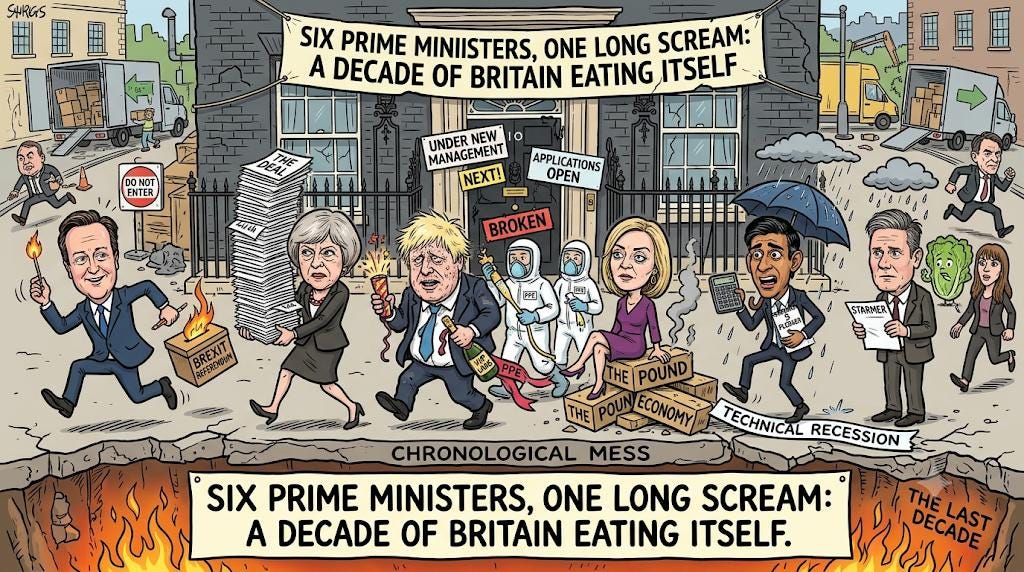
David Cameron arrived in Downing Street in 2010 promising to fix Britain’s finances, and he did technically do something to the finances, in the sense that arson is technically doing something to a house. Roughly £110 billion in spending cuts, sold to the public as tough medicine for a country recovering from the 2008 crash. What actually happened is that demand collapsed, investment stalled, and the social safety net got taken out back and quietly shot, sending poverty rates climbing in a country that could, in fact, afford not to do that.
But austerity isn’t even Cameron’s headline act. His real legacy, the one that will outlive him, his memoirs, and possibly the country itself, is that he gambled the UK’s entire relationship with Europe to shut up the more excitable wing of his own party, lost, and then resigned the very next day like a man who’d bet the house on a coin flip and immediately remembered he had somewhere else to be. The bill for that particular flutter has been estimated at somewhere between £180 billion and £240 billion in lost economic output over the following decade. Cameron, for his part, went on to have a nice little chat about Greensill Capital lobbying years later, because of course he did.
Theresa May inherited a country that had just voted for a divorce nobody had actually planned, and spent the best part of three years trying to negotiate the terms while her own MPs treated every proposal like it was radioactive. Parliament rejected her deal three times. Three times. That’s not a rejection, that’s a pattern of behaviour. She stood outside Number 10 in the rain announcing her resignation with the exact energy of someone who has just realised the emergency exit was welded shut the entire time. May’s real crime wasn’t incompetence, it was being handed an impossible brief by the man who created it and then walked away whistling.
Boris Johnson took over in 2019 and, credit where it’s due, immediately had to deal with an actual global pandemic, which is more than can be said for some of his successors’ self-inflicted crises. Did he do a good job? Fuck no. Approximately 232,120 people died, whilst his wing man took a drive across the country with his family, defying lockdown restrictions to “test his eyesight”. But the UK did still manage to spend close to £400 billion “fighting COVID”, a figure so large it would cover the 2008 bank bailouts sixteen times over. Some of that was genuinely necessary. A rather large chunk of it went on shonky PPE contracts handed to people whose primary qualification appeared to be knowing someone in government, a phenomenon now permanently filed under “VIP lane” in the national memory. Johnson left office in 2022 the way he did most things, surrounded by scandal, trailing resignations, and insisting the party everyone attended never actually happened.
And then, Liz Truss. Has there ever been a premiership that so perfectly resembled a controlled demolition? Inflation was already north of 11% when she walked in. Her answer was £45 billion in unfunded tax cuts, mostly benefiting people who did not, by any reasonable definition, need the help. The market’s response was swift and brutal: the pound cratered to roughly $1.03, an all-time low against the dollar, lower than at any point in British history, including several points in British history that involved actual wars. Forty-nine days. She lasted less time than a supermarket lettuce under stage lighting, and livestreamed by the Daily Star specifically to make the point.
The conservatives pride themselves at being the most fiscally responsible political party, Truss on average cost the economy £918,367,346.94 a day. Nice work Liz.
Rishi Sunak arrived promising competence, stability, and five pledges he’d apparently written on the back of a napkin under duress. To his credit, he did bring inflation down, from double digits to around 4.2% by the end of 2023. To his rather larger discredit, the economy contracted by 0.3% in the same period, tipping the UK into a technical recession on his watch. He then called an early general election in the summer rain without an umbrella, which turned out to be the most honest metaphor British politics has produced in years, and lost to Labour in a landslide that ended fourteen years of Conservative government.
Keir Starmer, a man with less charisma than Lizzy’s limp lettuce, arrived in July 2024 with the biggest parliamentary majority Labour had seen in decades and somehow managed to burn through the goodwill faster than any of his predecessors managed to burn through the actual economy. Inflation, which was close to the government’s 2% target when he took office, had crept back up to 3.8% by July 2025, unwinding one of the few genuine improvements the previous government had managed to leave behind. Unemployment rose steadily under his leadership. His net approval rating slid to an average of around minus 46% by November 2025, reportedly the worst of any Prime Minister since polling on the question began in 1977, which is an achievement of a kind, if not the kind anyone campaigns on.
Then came the scandal that finished it: his chief of staff resigned over the appointment of Peter Mandelson as ambassador to Washington, an appointment made despite Mandelson’s documented links to Jeffrey Epstein, because apparently nobody in Downing Street runs a basic background check anymore. His deputy, Angela Rayner, resigned separately over an unpaid property tax investigation. His Home Secretary defected to Reform UK. Labour lost over 1,400 councillors in the May 2026 local elections, then lost the Makerfield by-election to a returning Andy Burnham, and on 22 June 2026, Starmer announced he was resigning too, joining the club. Nearly two years in office, one of the largest majorities in modern British history, and he still couldn’t outlast Boris Johnson’s dog.
Which brings us to today. Nominations for Starmer’s successor open on 9 July, the contest is expected to wrap before Parliament’s summer recess, and Andy Burnham is, at the time of writing, the only declared candidate with any real momentum, meaning Britain may simply crown him without the tedious formality of an actual contest. He could be standing outside Number 10 as early as next Friday (17 July). Seven Prime Ministers. Ten years. An average tenure shorter than most Netflix subscriptions people forget to cancel.
Here’s the bit that should probably worry you, wherever you’re reading this from. Every single one of these people arrived promising stability and competence, and every single one of them left having demonstrably reduced the supply of both. Cameron gambled the country’s future on a referendum to manage his own backbenchers and lost. May inherited that mess and got chewed up trying to deliver something that was never deliverable. Johnson spent a fortune, some of it well, plenty of it badly, and left in disgrace. Truss set fire to the pound in under two months. Sunak stabilised the numbers and still lost the country. And Starmer, who arrived with more political capital than anyone on this list, managed to burn through it faster than all of them, scandal by scandal, resignation by resignation.
This isn’t a run of bad luck. Six different people, two different parties in spirit if not in name, and the same outcome every time: promise, blame the last guy, fail, leave. If a machine kept producing the same defective product regardless of who was operating it, at some point you’d stop blaming the operators and start asking questions about the machine. Britain hasn’t asked that question yet. It’s too busy watching the door.
The real cost of all this isn’t just the headline figures, the £110 billion here, the £400 billion there, though those numbers are staggering enough on their own. It’s the fourteen years of institutional memory walking out the door every time a new occupant moves into Number 10, the civil servants relearning what their political masters actually want every eighteen months, the international partners who’ve stopped bothering to remember the name of whoever’s currently in charge because they’ll likely be gone before the ink dries on any agreement. Stability isn’t a nice-to-have in government. It’s the entire point of the job. Britain has spent a decade proving what happens when nobody’s actually doing it.
So here’s the question worth sitting with as Burnham, or whoever else, gets fitted for the door of Number 10: what, precisely, would have to change for the eighth Prime Minister in this saga to last longer than the seventh? Because on current form, the honest answer is nothing. The system isn’t broken by accident. It’s working exactly as designed, and the design is the problem.
If Truth Decay is useful to you, the best way to support it is to share it with someone who needs to read it, or to become a paid subscriber. Subscriptions start at $5/month and directly fund the time it takes to fact-check pieces like this one properly, rather than just shouting into the void for free (though I’ll probably keep doing that too).
Al Jazeera. “Political turmoil: UK will see its seventh prime minister in 10 years.” 22 June 2026. https://www.aljazeera.com/news/2026/6/22/political-turmoil-uk-will-see-its-seventh-prime-minister-in-10-years
CBS News. “British pound slides to an all-time low against the dollar. Here’s the impact.” 26 September 2022. https://www.cbsnews.com/news/british-pound-at-all-time-low-against-the-dollar-heres-the-impact/
CNBC. “British pound falls to its lowest level against the dollar since 1985.” 7 September 2022. https://www.cnbc.com/2022/09/07/british-pound-falls-to-its-lowest-level-against-the-dollar-since-1985.html
GOV.UK. “The Rt Hon Sir Keir Starmer KCB KC MP.” Accessed 10 July 2026. https://www.gov.uk/government/people/keir-starmer
NPR. “The British pound hit a record low over fears about income tax cuts and debt.” 26 September 2022. https://www.npr.org/2022/09/26/1125080014/british-pound-record-low-dollar
TIME. “How Will the New Prime Minister Be Chosen—and How Soon Could They Be in Downing Street?” 22 June 2026. https://time.com/article/2026/06/22/how-will-new-uk-prime-minister-be-chosen-timeline-leadership-contest-burnham/
Wikipedia. “Keir Starmer.” Accessed 10 July 2026. https://en.wikipedia.org/wiki/Keir_Starmer
Wikipedia. “Prime Minister of the United Kingdom.” Accessed 10 July 2026. https://en.wikipedia.org/wiki/Prime_Minister_of_the_United_Kingdom
**Unique Reference Identifier:** TD-2026-07-SixFuneralsAndAWedding-001
Comments
Nothing yet. Say the first thing.
Sign in to join the conversation.