
Share Truth Decay by James Macleod
A little explanation before we get into it. This piece started life a little over two years ago as my second Substack article, written back when I genuinely didn’t know what the hell I was doing here, wasn’t sure I was going to keep doing this at all, and really didn’t think anyone would be reading this. I came here as a Twitter refugee, Substack it just launched notes and initially I thought it was kind of the same thing. I had no aspiration to write. But four months in, I began to appreciate the ambition of what this platform was really trying to be, and dipped my toe in the water. I’d written two pieces about the two things I cared about most, they landed reasonably well, and that’s more or less how Truth Decay became a regular habit rather than a one / two off vent. I’ll be honest: the writing wasn’t great and the argument tried to do too many things at once. But the core idea underneath it, that political parties are the single biggest structural flaw in modern democracy, hasn’t aged a day. If anything, the last two years have made the case for me.
You may have also noticed a gap since my last piece. I’ve been away for a couple of weeks. Turns out that’s useful for something: it gave me time to sit with this argument properly instead of dictating it into my phone on a walk and hoping for the best. So here’s the 2026 version. Tighter, meaner, and backed by things that have actually happened since I first wrote it, including a couple of very expensive lessons in what happens when you tear a government down without a plan for what replaces it.
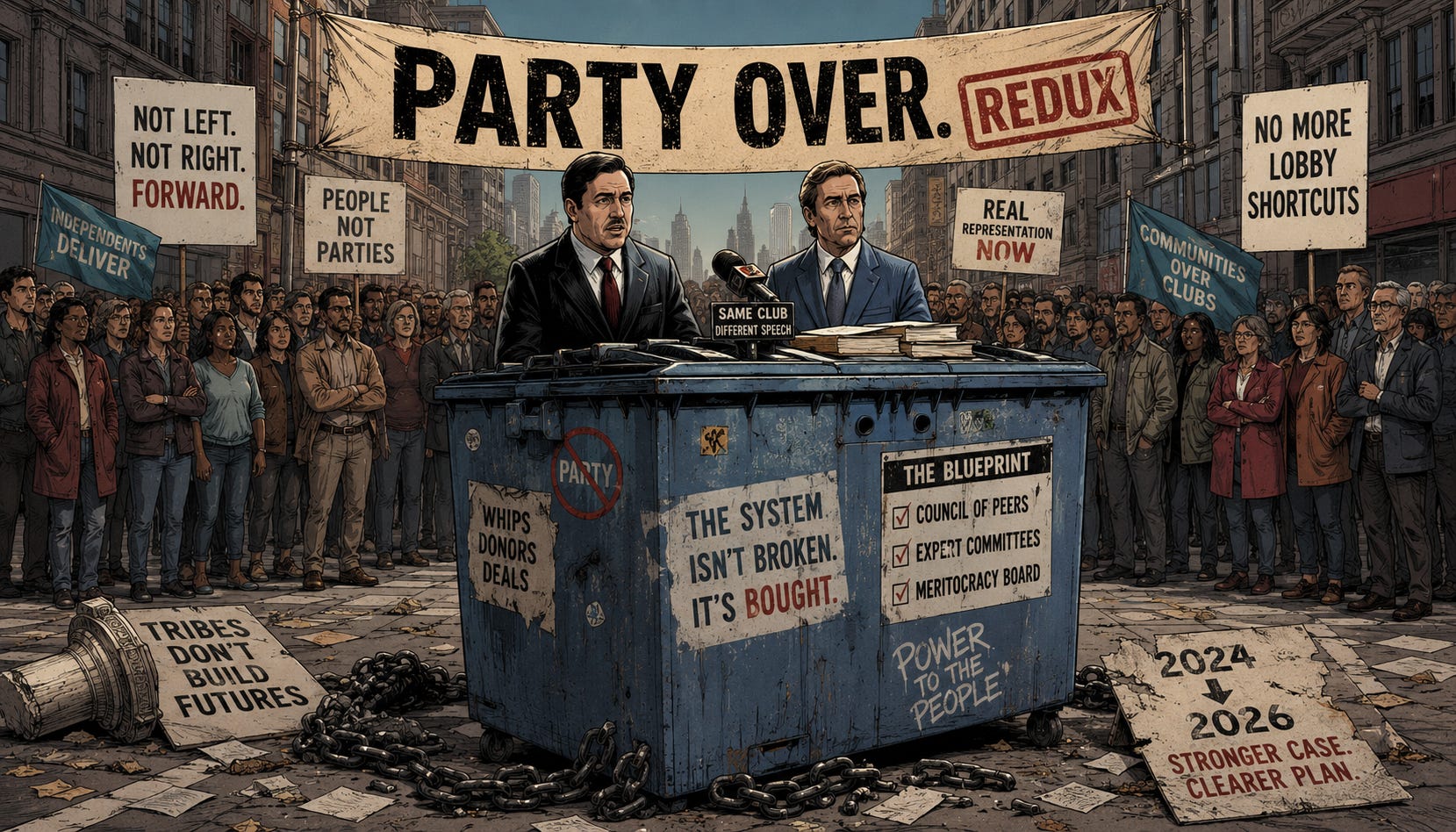
Here’s one sentence to distil the whole argument: political parties are a lobbying shortcut, and shortcuts are exactly what you don’t want in a system meant to represent millions of people with wildly different interests.
That’s it. That’s the piece. Everything else is just evidence.
Political parties sell themselves as vehicles for representation. What they really are, functionally, is an aggregation layer. They take millions of individual voters and hundreds of individual policy positions and compress them down into two or three purchasable blocs. That compression is the entire business model of modern lobbying. It is vastly cheaper and more efficient to capture three party leaderships than to individually persuade, pressure or purchase six hundred independent representatives. Parties don’t just fail to prevent corporate and ideological capture, they are the mechanism that makes capture, cost effective.
Think about what you’re actually offered at the ballot box like a buffet. Two fixed plates, each with twenty different policies stacked on it, and you have to swallow the whole plate to get the two or three items you actually wanted. Rational people would build their own plate. Instead the system trains you to defend the plate you were handed, bitter aftertaste and all, because admitting the plate is bad feels like admitting your tribe is bad. That’s not a bug. That’s the design. Tribalism is cheaper to manage than a genuinely plural electorate, and a two party system manufactures tribalism as a byproduct of simply existing.
When I first wrote this, the strongest real world evidence I had was a handful of Teal independents in Australia and some vague gestures at Switzerland. The picture in 2026 is considerably better, and considerably more complicated, which is more useful than a clean success story would have been.
As most of you are reading this from outside of Australia, a quick translation. The Teals aren’t a party, that’s the whole point of them, but they’re not just a loose scattering of independents either. They’re a wave of centrist candidates, mostly women, who ran in 2022 on climate action, political integrity and gender equity, funded largely through a crowdfunding vehicle called Climate 200, and named for the colour that sits between Liberal blue and Greens green. What makes them structurally different from the independents Australia has produced before is who they beat. Previous Australian independents tended to win rural, single-issue seats where a major party had simply stopped turning up. The Teals did the opposite. They took some of the safest, wealthiest, most reliably conservative urban seats in the country, seats the Liberal Party (Conservative / Right everywhere else in the non upside down world) had held for generations, and did it by running a genuinely local, community-funded campaign against a national party machine. That’s the part worth noting. It wasn’t a protest vote in a forgotten electorate. It was a direct hit on the heartland.
The Teal independents didn’t fade after their breakthrough. Allegra Spender, Zali Steggall, Sophie Scamps, Monique Ryan, Zoe Daniel and Kate Chaney all retained their seats at the 2025 federal election, most of them with bigger margins than previously. That’s not a protest vote anymore. These are electorates that tried independents once, liked the result, and came back for more.
Now the complication, and it’s an interesting one. An Australian National University (ANU) study examining the Teals’ full voting record from 2022 to 2025 found they voted together with a degree of cohesion that sometimes exceeded the major parties. Which raises an uncomfortable question for my whole argument: if independents keep voting as a bloc anyway, have you actually solved the lobbying problem, or just rebranded the party you were trying to get rid of? My answer is that shared values producing occasional alignment is not the same structural risk as a whip system, a preselection process and a party machine with donor obligations. But it’s a fair challenge, and I’d rather flag it than pretend the model is completely flawless.
Then there’s the proof of concept that doesn’t get nearly enough attention: countries that already run entirely without political parties, today, not hypothetically. Nauru has no political parties at all, and every candidate for its 19 seat parliament runs independently. Its most recent election, in October 2025, returned a parliament that is entirely non-partisan. Next door, Tuvalu’s sixteen seat parliament is officially non-partisan too, with all candidates standing as independents and a system built on personal alliances rather than party loyalty. Neither country is a utopia and both have their own problems, mostly around clan politics filling the vacuum party politics leaves behind. But the basic claim that a functioning national parliament cannot exist without parties is simply false. It exists. It’s existed for decades. Nobody in Canberra, Westminster or Washington ever wants to talk about it, because it’s inconvenient.
This is the part of this article that didn’t exist two years ago, because the evidence for it hadn’t happened yet.
If there’s one thing that’s defined global politics since 2024, it’s that citizens have gotten very good at tearing governments down and remained catastrophically bad at building the replacement. In August 2024, Sheikh Hasina, Bangladesh’s longest serving prime minister, was forced to resign and flee after weeks of student protests, and just over a year later Nepal’s prime minister was driven from office by a strikingly similar wave of demonstrations. Two uprisings, same playbook, same rage, same generation doing the organising. What happened next is the part we should learn from.
Nepal’s Gen Z converted their September 2025 protests into actual electoral gains by March 2026, reshaping the country’s politics in six months flat. Protest leaders rallied quickly around a credible interim figure, and the country moved from street uprising to snap election with genuine speed. Bangladesh took the opposite path. Despite toppling its government in 2024, the movement failed to achieve anything like the same dominance in the 2026 polls that followed, with old guard parties reasserting themselves instead. Elections in 2026 ultimately brought the Bangladesh Nationalist Party back to power, and the country’s political trajectory remains genuinely uncertain.
Same anger. Same courage. Wildly different outcomes. The difference wasn’t the size of the crowd or even the depth of the grievance. It was whether anyone had actually built something to hand power to once the old system fell over. That’s the mistake that keeps repeating itself, from Sri Lanka in 2022 through Bangladesh and now into Nepal’s still uncertain rebuild: every one of these movements has been united by its rejection of the old order and its total absence of a blueprint for what comes next. Burn the palace down by all means. Just have the floor plan for the next building ready before you strike the match, or someone with a much worse floor plan will fill the gap while you’re still celebrating.
And to be clear, you don’t need a revolution to get there. This doesn’t require tanks in the street or a government falling over. It just requires one government, in one country, willing to genuinely dismantle the party structure it currently benefits from. Ambitious, sure. A fantasy, no. Every electoral reform that now looks permanent, compulsory voting, ranked choice ballots, fixed terms, started as one administration deciding the old rules no longer served the public and legislating them out of existence anyway.
Two years ago I threw six different models at the wall. So in the interest of the concision I promised at the top, here are three I feel are worth building on, updated with what we now know works in the real world rather than just in theory.
The Council of Peers. No permanent leader, a rotating chair, decisions built through genuine roundtable negotiation rather than whipped votes. Tuvalu already runs a version of this: a parliament that maintains a functioning government and opposition without a single party structure holding either together. The risk is speed, consensus government can be slow, but slow and legitimate beats fast and captured.
Regional Assemblies with Delegated Committees. Representatives elected locally, then assigned to national committees based on demonstrated expertise rather than party seniority. This solves the single biggest complaint about modern legislatures, that finance committees are staffed by career politicians rather than anyone who understands finance. Nauru’s small size makes this easier to picture, but there’s no structural reason it can’t scale.
The Meritocracy Board. An independent citizen body that reviews MPs on delivery rather than their rhetoric, with genuine consequences for chronic underperformance. Pair it with the kind of sustained, high engagement voting culture Nauru shows off, an election in 2025 that saw incumbents genuinely held to account by their own communities rather than protected by a party machine, and you get accountability that doesn’t depend on a four year electoral cycle to bite.
None of these require a blank slate or a revolution. They require political will, which is the one resource every government claims to have and almost none actually spend.
Where This Leaves Us.
If politics has been short of one thing consistently, across every country I’ve covered in this publication, it’s vision. Not policy detail, there’s no shortage of white papers gathering dust in ministerial drawers. Vision. Somebody willing to say the current architecture is the problem, not just the people currently occupying it.
Nauru and Tuvalu prove a party free parliament isn’t just a thought experiment. The Aussie Teals prove voters will back genuine independents and keep backing them once they deliver. Nepal proves an organised alternative can convert street anger into real institutional change inside six months. Bangladesh proves, very expensively, what happens when nobody does the organising. The evidence isn’t hypothetical anymore. It’s sitting right there, in four different countries, waiting for someone with the nerve to actually build from it rather than just admire it from a distance.
Ditching the parties was never really the radical idea. Assuming the current system is permanent, that’s the radical idea. It’s just the one nobody adequately questions.
Truth Decay runs on no ads and no institutional backing, just me, a lot of coffee and readers who’d rather know than be comfortable. If this piece was useful, sharing it does more for reach than any algorithm favour ever will. Please share it here and beyond Substack. Also, let me know your thoughts in the comment section below.

Paid subscriptions start at $5 a month and keep this independent. Free subscriptions get everything too, because information shouldn’t sit behind a paywall while the people who need it most can least afford one.
Britannica. “2025 Nepalese Gen Z Protests.” Accessed August 18, 2026. https://www.britannica.com/event/2025-Nepalese-Gen-Z-Protests.
Council on Foreign Relations. “After Gen Z Protests, Bangladesh and Nepal Head to the Polls.” February 17, 2026. https://www.cfr.org/articles/after-gen-z-protests-bangladesh-and-nepal-head-to-the-polls.
Crisis Group. “Nepal Picks Up the Pieces after Protests Topple the Government.” September 19, 2025. https://www.crisisgroup.org/qna/asia-pacific/nepal/nepal-picks-pieces-after-protests-topple-government.
Giannini, Dominic. “Federal Election 2025: Teal Independents Prove They’re No One-Hit Wonders.” The Nightly, May 4, 2025. https://thenightly.com.au/politics/federal-election-2025/federal-election-2025-teal-independents-prove-theyre-no-one-hit-wonders-c-18574273.
Himal Southasian. “The Overlapping Factors Behind Nepal, Bangladesh and Sri Lanka’s Uprisings.” Accessed August 18, 2026. https://www.himalmag.com/nepal-bangladesh-srilanka-genz-protest-economics/.
IFES Election Guide. “Elections: Nauruan Parliament 2025 General.” Accessed August 18, 2026. https://www.electionguide.org/elections/id/4603/.
Pakistan Today. “Nepal’s Youth Succeeded Where Bangladesh’s Failed.” April 14, 2026. https://www.pakistantoday.com.pk/2026/04/14/nepals-youth-succeeded-where-bangladeshs-failed.
Policy Brief, ANU. “Do the Teal Independents Vote Like a Political Party?” Accessed August 18, 2026. https://policybrief.anu.edu.au/do-the-teal-independents-vote-like-a-political-party/.
Wikipedia. “25th Parliament of Nauru.” Accessed August 18, 2026. https://en.wikipedia.org/wiki/25th_Parliament_of_Nauru.
Wikipedia. “Parliament of Nauru.” Accessed August 18, 2026. https://en.wikipedia.org/wiki/Parliament_of_Nauru.
Wikipedia. “Parliament of Tuvalu.” Accessed August 18, 2026. https://en.wikipedia.org/wiki/Parliament_of_Tuvalu.
Wikipedia. “List of Tuvalu MPs.” Accessed August 18, 2026. https://en.wikipedia.org/wiki/List_of_Tuvalu_MPs.
Friendly Fire: What Merging With the IDF Will Actually Cost Western Soldiers.
·
Jul 31

Here’s a prediction… It doesn’t require a crystal ball, inside information, or a particularly wild imagination. Just some simple maths and a bit of logical foresight. If America, the United Kingdom and Australia keep moving toward deeper military integration with Israel, personnel from all three of these countries will start dying in friendly fire incid…
Comments
Nothing yet. Say the first thing.
Sign in to join the conversation.