
The current data brief shows the number and rates of maternal mortality deaths in the United States (U.S.) between 1950 and 2024. Please see the Bonus Commentary for why these data should be interpreted cautiously.
Maternal mortality is defined by the U.S. Centers for Disease Control and Prevention (CDC) as: “the death of a woman while pregnant or within 42 days of termination of pregnancy, but excludes those [deaths] from accidental/incidental causes.”
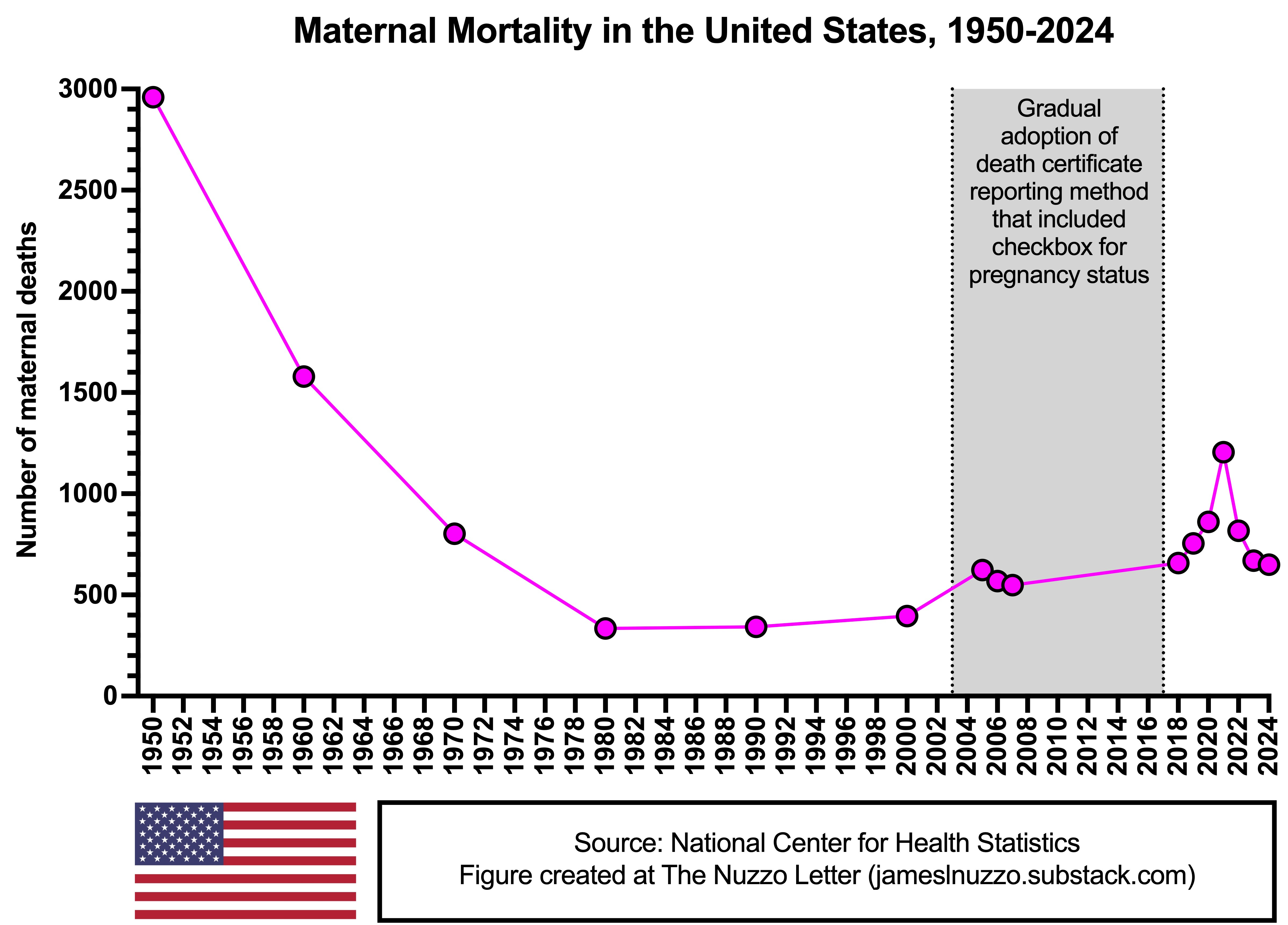
The total number of maternal deaths in the U.S. declined from approximately 3,000 in 1950 to 334 in 1980 to about 500-800 per year since 2005 (top graph).
In 2024, 649 maternal deaths occurred.
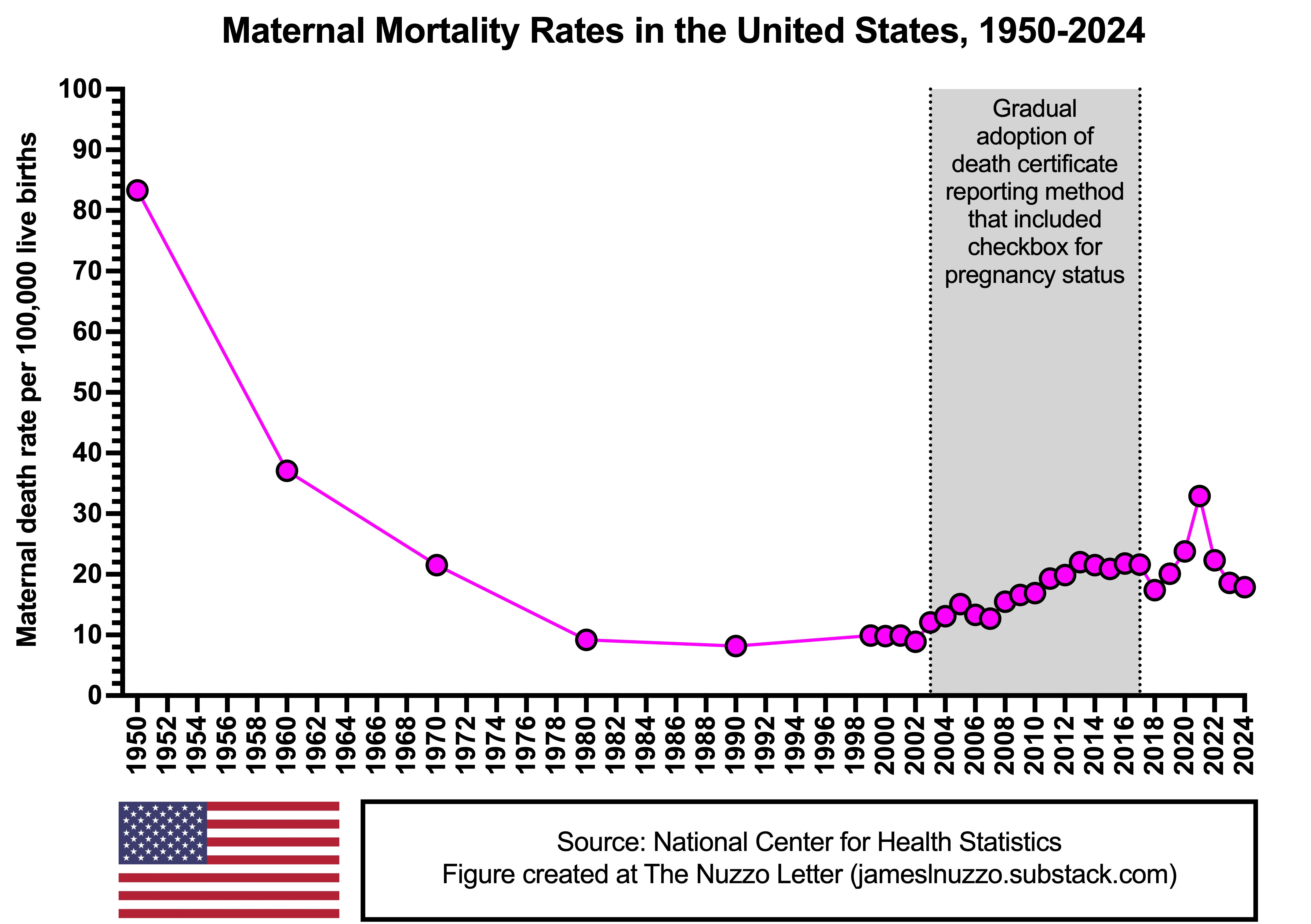
Rates of maternal mortality expressed relative to every 100,000 live births (i.e., accounting for population growth) exhibited a similar trend over this time (bottom graph). However, parts of these trend lines can be explained by changes in data reporting methods (see Bonus Commentary below).
Hoyert DL, National Center for Health Statistics. (2026). Maternal Mortality Rates in the United States, 2024.
National Center for Health Statistics. Table 36. Maternal mortality for complications of pregnancy, childbirth, and the puerperium, by race, Hispanic origin, and age: United States, selected years 1950-2007.
Rossen LM, Womack LS, Hoyert DL, Anderson RN, Uddin SFG, National Center for Health Statistics. (2020). The Impact of the Pregnancy Checkbox and Misclassification on Maternal Mortality Trends in the United States, 1999-2017. Vital Health Statistics (44):1-61.
Technological advancements and enhanced knowledge of human physiology have presumably helped reduce maternal deaths over time. Nevertheless, monitoring these deaths has been hindered by incomplete and inconsistent reporting. At first glance, the data in the graphs seem to suggest that maternal deaths have increased in recent years – a concerning trend if true. However, these data are confounded by the fact that reporting practices for maternal deaths have been inconsistent.
In 2003, a pregnancy question (a series of checkboxes) was added to the U.S. Standard Certificate of Death to try to improve the identification of maternal deaths. This new reporting method was not adopted consistently across the U.S. In 2020, the National Center for Health Statistics (NCHS) published a report detailing how the adoption of the pregnancy checkboxes on the U.S. Standard Certificate of Death impacted numbers of maternal deaths between 1999 to 2017. The NCHS reported an increase in maternal deaths between 1999 and 2017 and concluded that “the observed increases in [maternal mortality rates] during this time were largely due to the staggered implementation of the checkbox, which increases identification of maternal deaths.” Thus, the NCHS does not recommend using these national vital statistics data to “examine trends in maternal deaths during this transition period” (see the NCHS website for details). Nevertheless, assuming the new reporting method continues to be used, the above graphs present the new baseline that future trends can be compared against.
Maternal mortality is a health issues that carries significant emotional salience, and it is often cited in calls for more funding for women’s health. Maternal mortality is indeed an important health issue, and ideally, the number of such deaths would be zero. Nevertheless, the number of maternal deaths per year (~700) should be remembered within the broader context of causes of death. For example, each year, roughly 400 women die from fatal occupational injuries, 1,000 die from accidental drownings, 30,000 die from drug overdoses, 10,000 die from suicide, and 40,000 die from breast cancer. Moreover, it may surprise some readers to know that approximately the number of men who die each year from breast cancer (~500 men) and testicular cancer (~600 men) is similar to the number of women who die each year while pregnant or within 42 days of termination of pregnancy.
If you appreciated this content, please consider supporting The Nuzzo Letter with a one-time or recurring donation. Your support is greatly appreciated. It helps me to continue to work on independent research projects and fight for my evidence-based discourse. To donate, click the DonorBox logo. In two simple steps, you can donate using ApplePay, PayPal, or another service. Thank you!

No posts
Comments
Nothing yet. Say the first thing.
Sign in to join the conversation.