
First, a few book updates:
My new book, Make Your Home in This Luminous Dark: Mysticism, Art, and the Path of Unknowing will be released one week from today! You can pre-order now or look for it next week at your favorite bookseller.
Or…come see me on Book Tour! There are three events next week in New York City, then events in Boston, Grand Rapids, Austin, Chicago, and Denver (so far). Details here.
I spoke with Sarah Pulliam Bailey at Publishers Weekly about the book: “A Philosopher Embraces Mystery.”
If you’re a podcast listener and would like to like to get a taste of the book, you can listen to an early conversation with Rick Lee James on “Voices in My Head.” More to come.
OK, back to irregularly scheduled programming…
I often tell people that becoming a grandparent is like finding out, in the second half of your life, why you exist. Every single one of the clichés is true and I’m here for all of it.
I have come to the place where I think my calling to be a grandfather is the defining vocation for the rest of my life. My wife and I just came through a pretty intense season of professional discernment, reckoning with both challenges and opportunities, trying to listen for the whispers of the spirit about how to spend the next decade taking us to retirement. In the end, while there were all sorts of variables that factored into our decision, I would say the overwhelming determiner was this: What professional role/location makes us most available to our grandchildren—and able to support our children as they parent?1 I found myself immediately at peace with what some might judge as a less ambitious professional decision. But I’m not defined by the people who call me “Doctor” or “Professor.” I live for the people who call me Papa. (Or will, as soon as they’re old enough to talk!).
But I also can’t help being a philosopher-grandpa. This, too, is one of the gifts of my vocation and profession. To read, study, teach, and write about philosophy is to have constant opportunity to reflect afresh on the shape of one’s life. And insofar as that life keeps unfolding, and one keeps learning, there are always new facets and angles on one’s life—new opportunities to become more intentional about how one lives.
And so now, in surprising ways, I find myself reading arcane philosophical texts and thinking about grandpahood. Let me share just a couple of examples that have come to mind over the past couple of days.
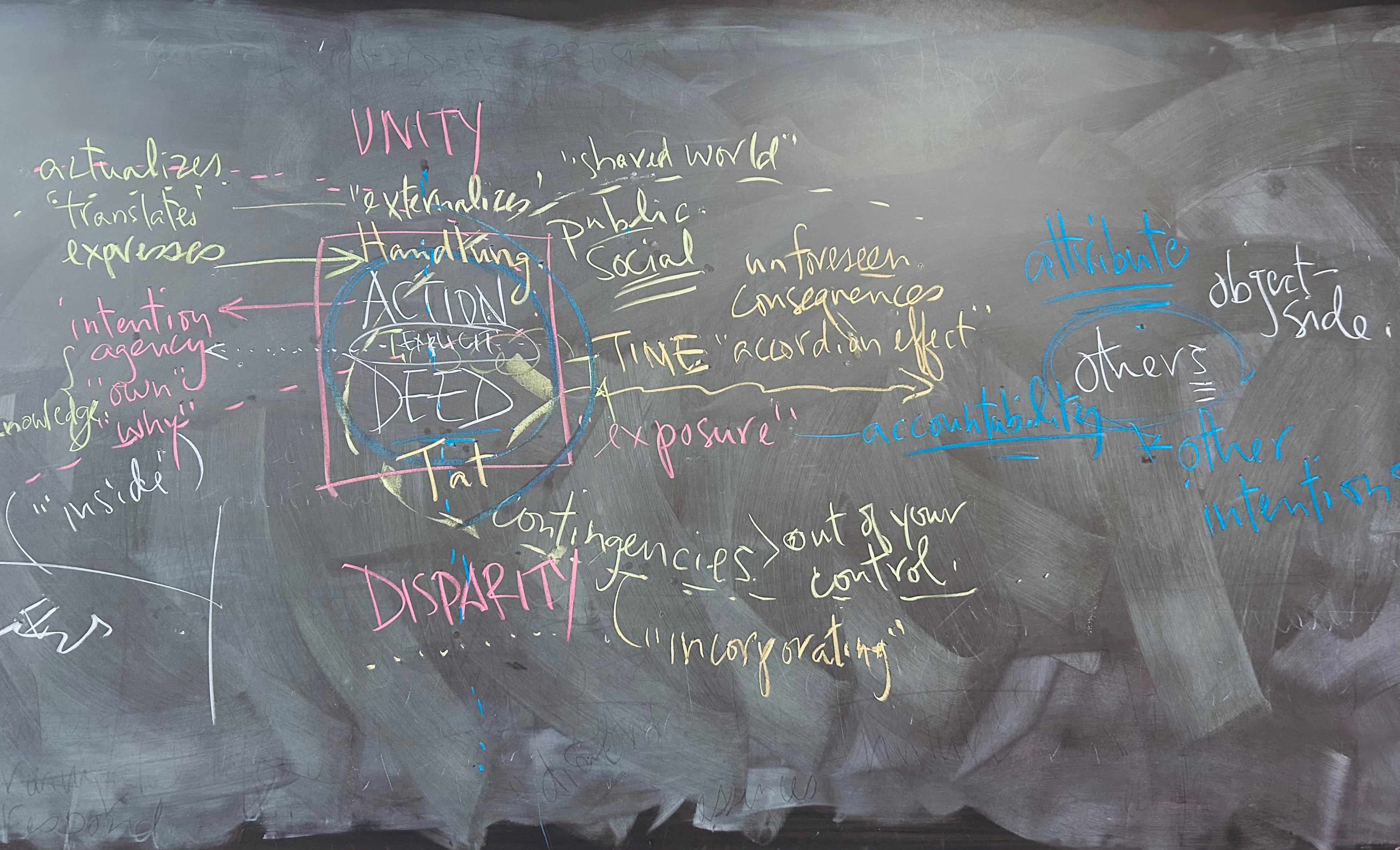
This semester I am teaching an upper-level seminar on Hegel—more specifically on Robert Brandom’s reading of Hegel. It is challenging, technical stuff. Today we were talking about Hegel’s concept of action. I will not bore you with the details. But two facets of this analysis resonated with me as a grandpa in interesting ways.
First, Hegel’s concept of action invokes a distinction between what he calls “the deed” (Tat) and “action” (Handlung). Roughly, it means something like this: what makes some “happening” X an action is that it is a happening for which some agent takes responsibility. It is something that happened because an agent intended it. However, once action X takes place, it is undertaken “in public,” so to speak. The action becomes a deed in the world—in the shared, social space of time and history. And here’s what’s interesting: the consequences of a deed can outstrip the agent’s intentions. This is because the consequences of an action can take on a life of their own, in the contingencies of an environment and the unfolding of history. Brandom draws on Donald Davidson’s notion of a deed’s “accordion effect”: action can be redescribed over time and continue to have reverberations beyond the agent’s intentions.
One thing that dawns afresh with grandpahood is a renewed sense of mortality—at least that has been my experience. I am more conscious of the dwindling years I have left, doing the math on a few rounds of my fingers. I also now want to live forever! I can’t tell you how many times I imagine my granddaughters walking down the aisle; how many times I imagine taking my grandson to visit colleges; how much I long to see my children’s children’s children. I want to be a danged paterfamilias (to quote Ulysses Everett McGill)!
I am, of course, well acquainted with finitude. This is where I find a strange grandfatherly encouragement in Hegel’s concept of action. What are the actions I can undertake, what deeds of mine can make a dent on the world that might make grooves for my grandchildren to run in? What have I done/can I do/need to do that could have an accordion effect that will outlast my own mortal coil?2 In a way, not even my own death is the end of the deed. Its consequences rumble on, tumble on. One of my favorite lines from this discussion in Hegel: “An individual cannot know what he is until he has made himself a reality through action” (PhG §401). I am still making myself in my grandpa-ing. And my deeds could still be doing their work after I’m gone.
Here’s where a second theme from Hegel struck a grandpa chord for me. Hegel has what Brandom calls a “recollective” account of rationality. One way to describe this is to say we don’t know what something means except in retrospect. Meaning emerges as we make sense of what we’ve come through. As Hegel puts it, “the truth is the whole.” But that means you can’t know the truth until you have the full picture.
This plays out in his concept of action because he has an appreciation for how actions are often not discrete and punctiliar. They play out in time, over time (they are “diachronic,” through-chronos). So what I intend in my action might involve mistakes, false starts, wrong turns, dead-ends and backtracking. I am trying to accomplish X, so I act; but as time unfurls, I might realize that this action is not the way to accomplish X. So I revise, retool, reconnoiter and try again. For Hegel, one cannot judge or evaluate my action/deed with a mere “snap shot” of one of these false starts. The true is the whole and my ongoing acting in time can still be a way of chasing X, achieving X.
Here’s the passage that struck me, from Brandom:
“Because there is no end in principle to the progression to larger or later purposes, it is never too late for a new context to arise within which a previously failed project can count as successfully contributing to the realization of a plan.”
One of the clichés about grandparenthood is that it’s a second crack at parenthood. I think there’s a mistaken way to understand that (PSA: Don’t parent your grandchildren!). But there’s another way in which I have found it to be true. It’s not just that you might finally be emotionally healthy enough to be gentle and patient with your grandchildren in ways you weren’t with your own children (Kids, again: I’m sorry). It’s that you’re still a parent to your children who are now parents and your story is far from finished. Grandparenthood is a “new context” for parenthood and even if you might have “previously failed” in that project, or not “realized” it in all the ways you might have hoped, your story with your children is still unfolding. It’s never too late to still be the parent you wanted to be. Indeed, it’s never too late to be the parent you needed. To be that for your children is to be exactly the grandpa your grandchildren need.
For what it’s worth, I think this is key facet of being a grandparent: to still be a parent of your own children, and now parent them as they are parenting. This, of course, is yet another way your relationship to adult children changes. But it is also a way to spend your empty-nester energy being the scaffolding and safety net for your children as you watch them grow as parents. Even here I’m mindful of a Heideggerian distinction about what authentic “being-with” looks like–two different forms of “solicitude.” What he calls “leaping in” is a way of relating where I alleviate the burden of the other in such a way that I take over. I try to live their life for them. “Leaping ahead,” by contrast, is a form of authentic care in which my presence to the other is meant to catalyze their own authentic realization of themselves. I hope you can imagine the parallels to grandparenting: the grandparent who “leaps in” become a substitute or rival parent, undermining their child’s calling (“burden,” Heidegger would call it) to realize their own identity as a parent. In contrast, the parent who “leaps ahead” is present, alongside, in such a way that you are helping your child become free to be the parent they are called to be.
I’ll give you one example of something I dream about. It’s a dorky dream of a bookish man. I sometimes dream of how my grandchildren might discover different parts of my library at different times in their life, even after I’m gone. Maybe a grandson (or granddaughter!) stumbles upon Scott’s Waverly novels on a boring summer afternoon when he’s 10. Maybe one of my granddaughters picks up an art book from the Harlem Renaissance when she’s 13. Maybe one of them falls in love with P.G. Wodehouse or Flaubert. Maybe when they’re home from college one summer, they find themselves melancholy and browse the poetry shelf and are absorbed by Marilyn Nelson or Carolyn Forché. I dream of how every book in this library could be a way to love my grandchildren.
Comments
Nothing yet. Say the first thing.
Sign in to join the conversation.