
Yesterday, the IPO for SpaceX made one of the world’s most heinous public actors grotesquely wealthy. (Oxfam notes that this makes one person, Elon Musk, wealthier than 46% of the global population. Try to let that sink in.)
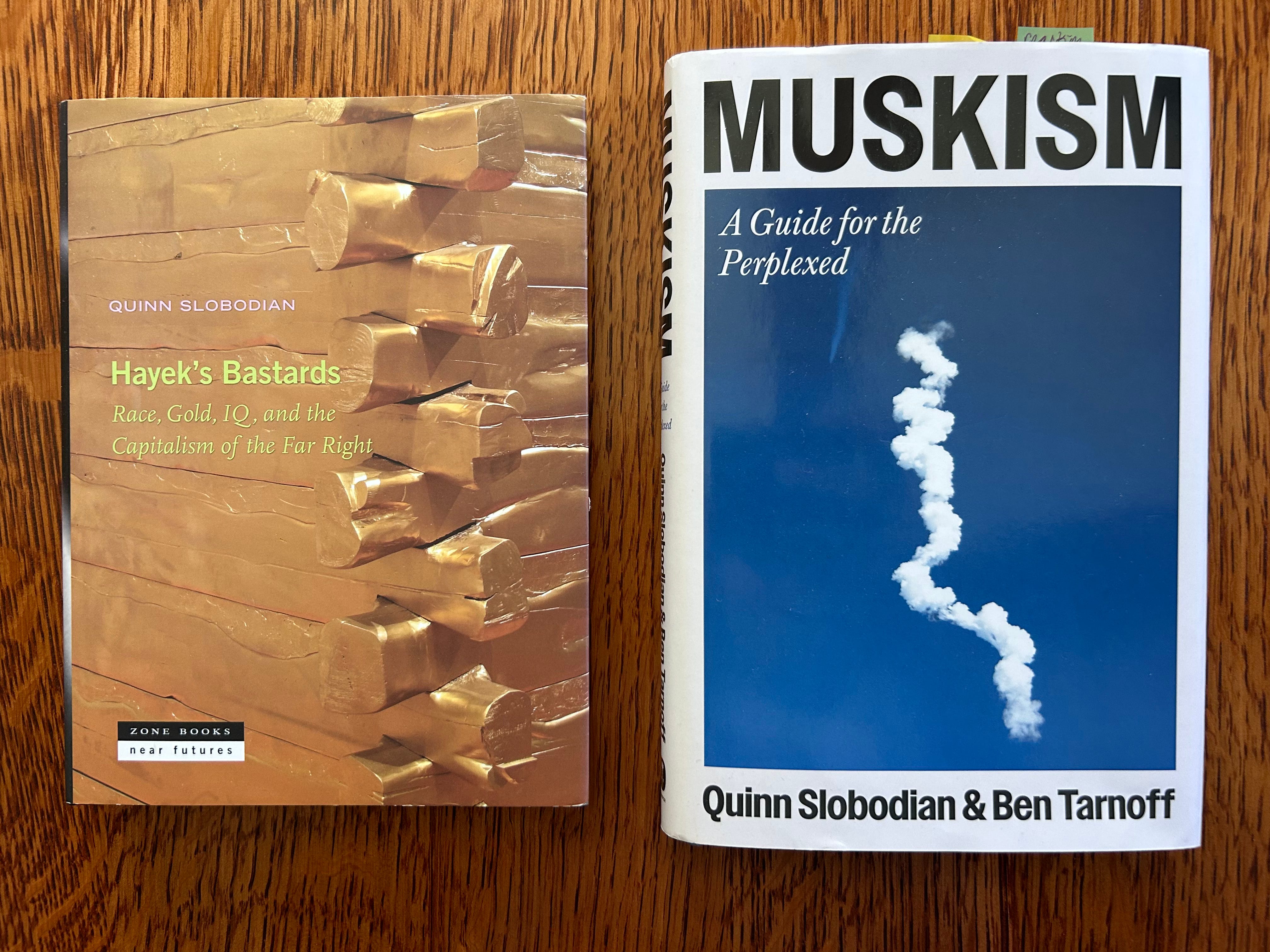
To better understand this phenomenon and, increasingly, the world Elon has made and that we have to live in, I commend an excellent new book by Quinn Slobodian and Ben Tarnoff: Muskism: A Guide for the Perplexed. I want to highlight some of their account with the hope of enticing you to read the book for yourself.
Co-authored by a historian and a journalist, Muskism is the sort of “first draft of history” that is also shored up by serious historical scholarship. (I highly recommend reading this new one as a companion to Slobodian’s remarkable, award-winning history of neoliberalism and the rise of the far right, Hayek’s Bastards.1) Tarnoff’s journalism, coupled with Slobodian’s incisive theoretical frame, weds reportage to critical analysis and insight. And as a first draft of history, it also tells us something about the future, such that it almost feels like this book, published on April 21, saw June 12 coming.
“Muskism” is coined as a correlate to “Fordism.” If Fordism was shorthand for 20th century capitalism, Muskism is shorthand for 21st century capitalism. The authors track Musk’s formation and entrepreneurial history to glimpse what has shaped him and, subsequently, how his business practices and “philosophy” have shaped the world we inhabit today. You can see most of these features of “Muskism” in yesterday’s IPO offering, which also signaled the willing complicity of banks and governments in the monstrosity of such financial mythology.
Fabulism
A key ingredient of Muskism has always been “fabulism.” Musk “sells fantasy.” In this regard, Slobodian and Tarnoff note that “Musk’s wealth is also almost entirely held in the stock of his own company. As he put it in an interview, ‘if Tesla and SpaceX went bankrupt, I would go bankrupt immediately.” In other words, Musk’s own wealth depends on a hype-machine (which is why he bought Twitter, which he turned into a personal hype-megaphone, algorithmically centering his own voice and views.)
“Valuation,” as Marx anticipated, has a “mystical character;” in a financialized world, “worth” is numinous and mysterious. Musk understands this, and as a devoted reader of fantasy and sci-fi (common in the Silicon Valley set), he leverages this to inflate value. “Fabulism,” as Slobodian and Tarnoff put it, “is a literary genre that mixes fantasy and realism.” You have to keep inflating the bubble because “value” isn’t objective; rather, to paraphrase Richard Rorty, “value” is what JP Morgan will let you get away with.
This is why Muskism depends on the perpetual expectation of pending technological breakthroughs, planetary salvation, or financial windfalls. To sustain his wealth, Musk must sustain belief in the exponential future growth of his companies.
Yesterday’s IPO was a barometer of the extent to which the world—and especially the financial world—is buying the fantasies that Musk is selling.
Grift, or “State Symbiosis”
Such fabulism always functions as a mask or stalking horse. If you keep telling tall tales about SpaceX’s goal of colonizing [sic!] Mars, it will distract from the fact that SpaceX makes money by launching satellites—and that these satellites expand capacities for surveillance and military destruction. That way you can “talk libertarian” while creating businesses that are completely dependent on the state—both for infrastructure and as a client.
Slobodian and Tarnoff highlight this as one of the lessons Musk learned from Silicon Valley in the 1990s:
Silicon Valley would teach him that the real opportunity didn’t lie in escaping the state but grafting into it—using its guarantees as scaffolding for private gain. […] Uncle Sam would finance the future, but capital would own it.
Pressing for deregulation and decentralization was not about withering the state but rather making it pliable and dependent on private actors/corporations while, at the same time, these corporations leveraged state-funded investments. “Silicon Valley as a whole owed its existence to the federal government, which bankrolled the region’s tech industry after World War Two because the military needed electronics.” After the National Science Foundation relinquished control of the internet’s core infrastructure to the private sector in April 1995 (Al Gore was a key player in this), then the private sector dot-com boom began. Musk watched and learned: look for strategic opportunities to surf public-sector investment for private gain.
“Space [= satellites] represented the next big publicly funded business opportunity” (35)—not to mention an unprecedented expansion of the U.S. security apparatus alongside increasing privatization (38). The outworking of neoliberalism since Reagan, the pattern was “a form of privatization in which not only money but power flowed from public into private hands.” In other words, it’s not just that private coprorations would be contracted to do the government’s or military’s bidding. The government and military ceded agency about means and, frighteningly, even ends.
SpaceX, like Blackwater, would also benefit from the privatization of power. The company helped pioneer a new style of aerospace contracting in which design and production decisions were no longer dictated by the state, as in the traditional Cold War model. Instead, entrepreneur’s would be the ones in charge.
Slobodian and Tarnoff calls this “state symbiosis” (39), an arrangement by which private companies become “state-like”: “The goal was not to eliminate government but to vassalize it” (39). SpaceX is now “the de facto gatekeeper for government access to low Earth orbit,” which means strategic access to space is governed by Elon Musk—and not only for the U.S.. The un-democratic implications of this should be obvious.
This “sovereignty-by-service” is behind Musk’s arrogance and hubris on the world stage. “When a single individual owns the infrastructure, he doesn’t need to run a government to shape geo-politics” (55). This is especially true not only because his company is “state-like” but also because so many states—via his Starlink network—are dependent on his company.
Platform Capitalism
This gets a key aspect of Musk’s power—and “Muskism” as a philosophy to which others aspire, especially in Silicon Valley. It has been described as “platform capitalism” (and is a feature of “technofeudalism”). The authors summarize the formula: “Make a market not a product. Don't worry about revenue until you’ve reached hyper scale, then use your monopoly position to extract super-profits. Idolize your founder as a princely visionary” (29). In other words, create a platform; play the long game to first get everyone on that platform; then make them dependent on that platform; secure your monopoly; then extract, extract, and extract, without competition and, in some cases, with the force of government requirement. This cycle, of course, is not unlike the role of the drug dealer: give the first hits for free, create a market of people dependent on your supply, secure your market dominance and, ideally, monopoly.
This plays out in Muskism’s version of techno-sovereignty:
The wager of Muskism is that sovereignty, going forward, will be infrastructural before it is territorial—defined by access to bandwidth, compute, launch cadence, and orbital real estate.
The goal of SpaceX is to monopolize state access to low Earth orbit, which has a range of geopolitical and military implications.
Fortress Futurism, or Apartheid Modernism
One of the lessons Musk absorbed from his South Africa childhood was not only white supremacy2 but also a particular worldview that leverages civil unrest and violence as a market opportunity for securing privileged whites (for the most part) in their compounds and fortresses. This is why Tesla is not about cars; it is about batteries and selling self-reliance for when the infrastructure collapses. The Tesla cyber truck is exhibit A with its Mad Max-ish “survival aesthetic”: “This was not a vehicle for a better world. It was a vehicle for whatever came after.” Muskism looks at our polarization and civil unrest and concludes: there’s a lot of money to be made in a (cold?) civil war. Which is why fomenting the civil war is a business strategy.
Late Musk: Cyborgs and Viruses
Tarnoff and Slobodian track Musk’s development up through his DOGE experiment with the U.S. government. DOGE looks like a failure if you think it was about efficiency and saving money. But what if it really wasn’t? What if it was about access and surveillance?
In the second half of the book, Tarnoff and Slobodian trace Musk’s formation by video game culture, Anime films & TV, and the way his “very online” persona feeds, and feeds off of, memes (this relates back to fabulism and hype3). This part of the story was kind of shocking to me, mostly because I am so ignorant about these digital worlds. What Musk grasped was that “the internet was becoming the primary layer of reality” (102).
For Musk, the internet is a human-machine interface. As Musk once told Joe Rogan, humanity is just becoming “the biological bootloader for AI” (105). If memes move human behavior (as Musk learned and leveraged), that also means this interface was susceptible to being leveraged ‘for ill,’ so to speak—for Musk that means the human mind could, by means of the internet, become infected with a “woke virus” that would contaminate us with ideas like (gasp!) all humans are equal. This explains a lot of Musk’s supposedly “erratic” behavior of late: It is all calculated to secure his empire. Thus Muskism turns out to be a form of “cyborg conservatism” (11).
§
This brief encapsulation is intended as a kind of PSA, written with the hope that you’ll read the book, which is well-researched, with copious notes. It is also written with a verve that matches the urgency of this inflection point. As the authors put it, “Muskism can be found in the feedback loop between man and moment. To understand the world that Musk aims to build, we have to understand the worlds that Musk built.” Muskism is the place to start.
This is where Muskism intersects importantly with Slobodian’s Hayek’s Bastards—in the libertarian and neoliberal turn that argues that only certain “natural” peoples and civilizations are really cut out for free markets and liberalism. This is coupled with a fetishization of IQ as a “natural” (i.e., biological) marker of those peoples capable of building and living in liberal societies. (This all pretends to be “scientific.”) It also entails the view that inequality is the natural state of things and hence libertarians and the far right rail against “the egalitarian fiction.” As Slobodian comments, “This was a naturalization of a racial, ethnic, and gendered hierarchy of ability consciously designed to roll back the egalitarianism of the 1960s” (Hayek’s Bastards, 122). Read Hayek’s Bastards as the backstory to the Trump administration’s immigration policies.
As the authors playfully suggest, “The first meme stock wasn’t GameStop but Tesla” (102).
Comments
Nothing yet. Say the first thing.
Sign in to join the conversation.