
Today is my birthday, which means I’m participating in my annual tradition of briefly becoming way too aware of the passage of time.
Birthdays have a cute little terrifying way of making your life feel measurable. You think about where you were a year ago, what you thought would have happened by now, what actually happened instead. You notice the things that became important without you deciding they would be, and the things you were convinced mattered that you can hardly remember anymore.
This year, I’ve been thinking a lot about identity. Creative identity, specifically, although turning another year older probably has something to do with it.
I’ve spent most of my career trying to find increasingly accurate ways of explaining what I do.
Every version has felt correct when I wrote it. There was never a moment where I knowingly overly flexed in an Instagram bio.
And then I kept making things, and eventually the description stopped fitting quite as well. But there is one description I’ve been strangely unwilling to update: my Instagram bio has said “the only graphic designer in LA” since 2023.
Obviously, I am not the only graphic designer in Los Angeles. I’m also not only a graphic designer.
These days my work spills into art direction, illustration, writing, teaching, strategy, video, whatever else I’ve managed to convince someone to let me do. If I were writing the most technically accurate bio possible, “graphic designer” probably wouldn’t cover it anymore.
Still, I’ve never changed it.
For the first few years I was actually working as a graphic designer, I had a hard time calling myself one. I could do the work, and people were paying me to do the work. The title just continued to feel like something I needed to earn a little longer before I was allowed to claim it.
Eventually I did, and “the only graphic designer in LA” came later, once being a graphic designer felt comfortable enough that I could make a joke out of it.
So I’ve become sentimental about that bio. It belongs to a version of myself who had finally figured out how to claim something he had wanted for a long time.
I imagine a lot of creative people have some version of this problem. Our websites and bios make our identities look much more intentional than they actually were. You click through someone’s portfolio and see this beautifully coherent body of work, divided neatly into categories, introduced by a sentence that explains exactly who they are and what they care about.
But when and how?
You don’t see the year they wanted to become an illustrator. The three months they were obsessed with type design. The terrible motion experiment. The client project that completely changed how they thought about their practice. The side project nobody cared about that quietly became the basis for the thing everyone now knows them for.
You see the identity once it has already become legible. Meanwhile, you’re still trying to figure out what yours is.
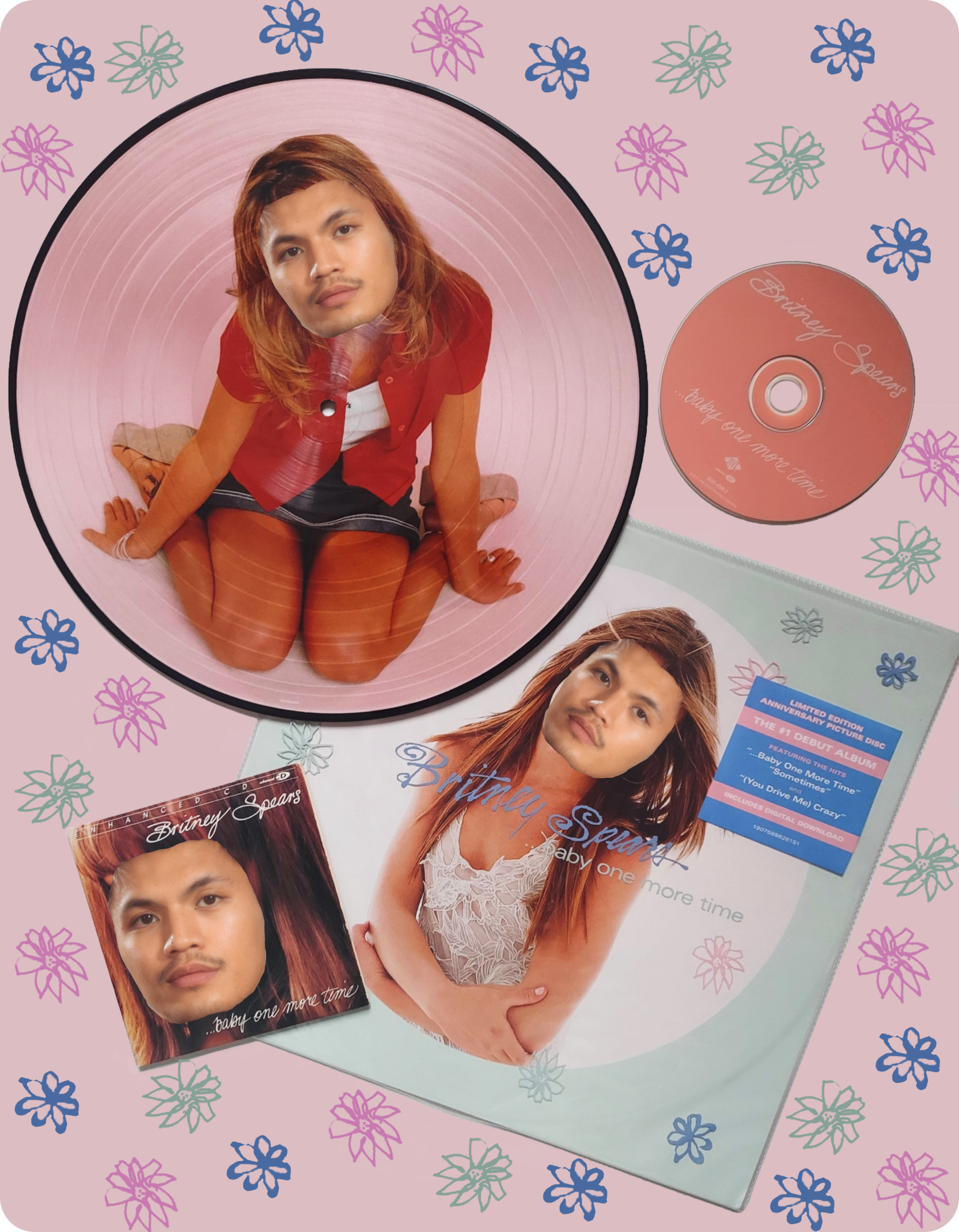
One of the stranger things about becoming a creative person online is how early you’re expected to know what kind of creative person you’re going to be.
Find your niche.
Develop a recognizable style.
Figure out your positioning.
Decide what you want to be known for.
Make the portfolio cohesive.
Be consistent.
I understand why this advice exists - recognition is useful! A clear point of view makes it easier for people to remember you, hire you, follow you, recommend you. There is real value in being able to explain what you do without making the person who asked regret asking; I’ve benefited from all that myself.
I also think we sometimes confuse the ability to articulate an identity with actually having developed one.
A creative identity requires evidence.
You need to make enough things to discover what you keep returning to. You need to follow an idea longer than expected and abandon another one you were sure would define you. You need projects you love, projects you hate, projects you misunderstood while you were making them. You need enough distance to notice that the things you thought were unrelated have apparently been having a conversation with each other the whole time.
A lot of the qualities I now think of as central to my own work were never decisions I made. I didn’t sit down at the beginning of my career and construct a list of recurring interests. I made things, then made more things, and slowly started noticing myself in them. Even now, I sometimes only understand what I’ve been interested in once I’ve already been interested in it for a while.
Writing has been one of those things.
For most of my career, I would have described writing as something adjacent to my creative practice. I was a designer who happened to write sometimes. Then I kept writing. I started publishing essays. I found myself thinking about sentences while designing and thinking about design while writing. Ideas that might once have become an Instagram post became something I wanted to sit with for a few thousand words.
Most shifts in creative identity seem to work like that. There’s no ceremony, nobody sends you a new job title. One day you realize the version of yourself you’ve been describing is just a little behind the version of yourself doing the work.
That would probably be easier to navigate if we developed in private. But alas! Many of us do not.
There is an audience there now: they saw the old work, and they followed you because of it. Maybe they hired you for it. Maybe they praised it. Maybe an algorithm noticed people liked it and very helpfully suggested you make the same thing again.
The process of becoming a creative person has started happening in front of other people, and I’m convinced that this changes the way we become one.
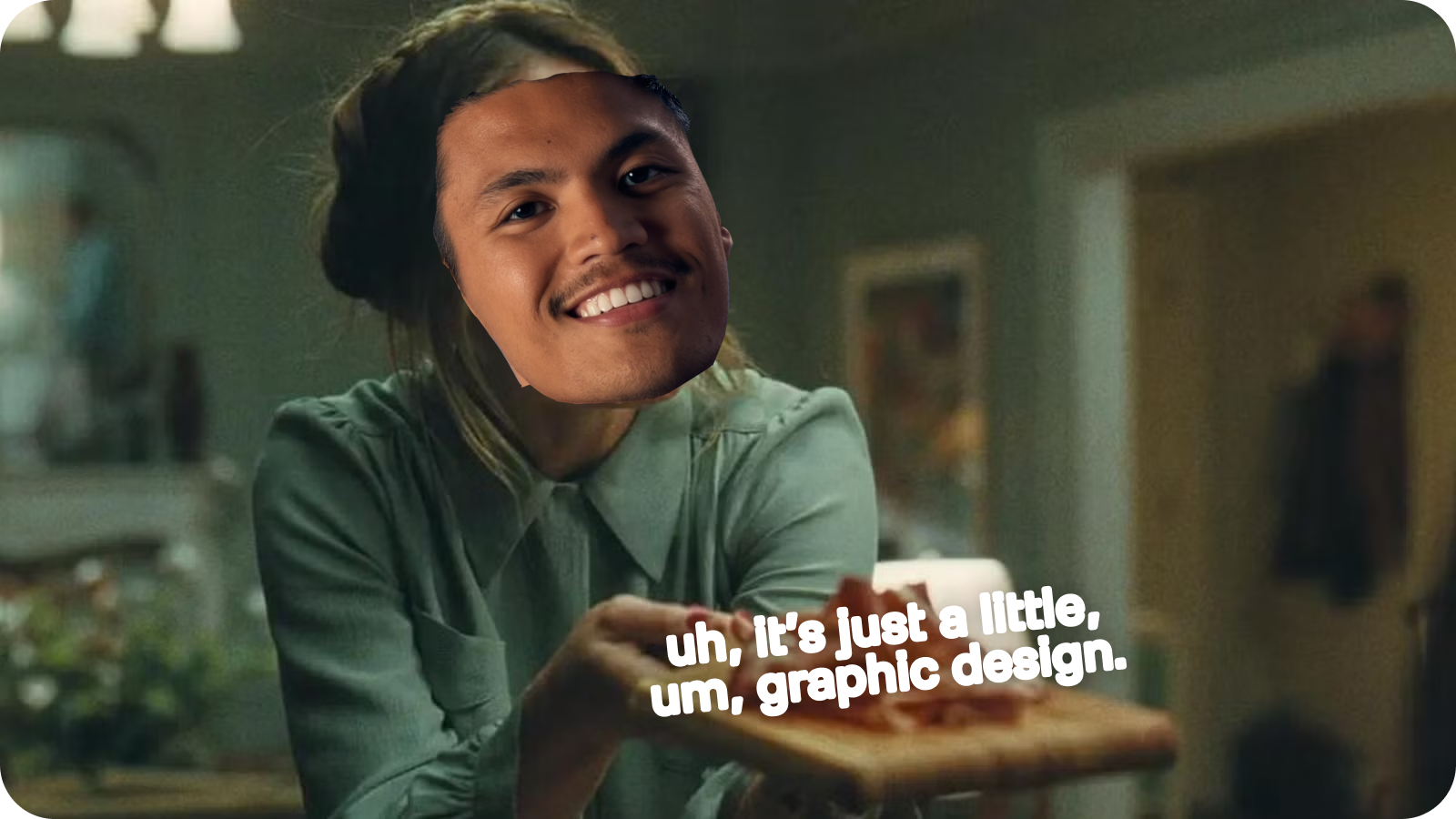
For all the anxiety I have about having a creative identity online, I owe a huge part of mine to the internet.
I learned how to become a designer in public.
I posted work before I was completely sure it was good. I made things because I wanted an excuse to try a technique and put them online when I was done. I watched what other designers were making, found references through their references, and slowly developed some sense of what I liked. Sometimes people responded to something and gave me a reason to keep pulling on that thread. Sometimes nobody responded and I kept pulling anyway.
A lot of my career happened because somebody saw something: a post became a freelance inquiry. A personal experiment became something people started associating with me. People I admired found my work before I had any reason to believe they would. Eventually, the internet started reflecting a version of me back to myself that I hadn’t quite learned how to see yet.
Other people are occasionally useful witnesses because they notice repetitions you haven’t noticed. They connect something you made six months ago to something you made yesterday. They ask you to try something you wouldn’t have thought to. They give you language for a quality in your work that you had only understood as instinct.
There have been plenty of moments when someone else seemed to understand what I was doing a few steps before I did, which I found lovely and only mildly terrifying.
Once someone can describe you, you become describable, which is incredibly useful. It helps people remember you. It helps them explain you to somebody else. It helps a creative director say, “I know exactly who we should call for this.” It gives your work edges. For a long time, I wanted those edges desperately.
When you’re early in your career, being recognized for anything feels like progress. You’re trying to establish proof that you exist in the field at all. If people start associating you with a particular kind of work, that association can feel like an enormous gift - someone remembers you! Yay!
Then enough people remember you that way, and something subtly changes. The thing you worked very hard to become known for can start feeling a little smaller than you do.
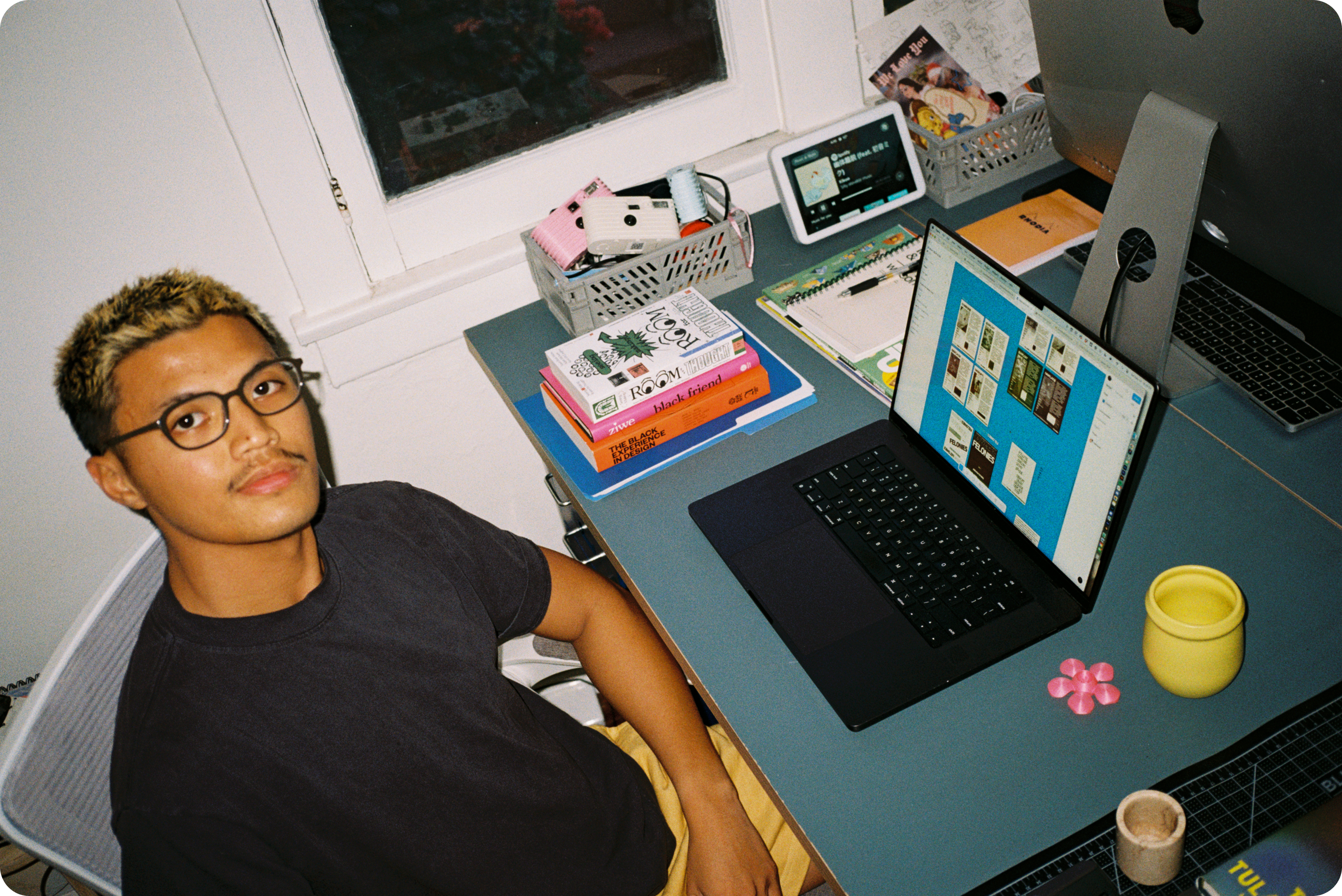
For years, almost every decision I made was in service of becoming more recognizably a designer. I wanted better design projects. I wanted my work to become more sophisticated. I wanted other designers to see me as one of them. I wanted to get to the point where calling myself a graphic designer didn’t require an internal debate first.
Then I got there.
And in the process, I became interested in all these other things.
I wanted to write. I wanted to teach. I wanted to talk about the systems around creative work, not only make the work itself. I wanted to think about social media as its own design discipline. I wanted to make videos. I wanted to art direct. I wanted to build things where the idea mattered as much as the image at the end.
None of those interests felt like a dramatic departure while I was following them. They accumulated gradually enough that each one seemed perfectly reasonable.
Then I would have to introduce myself to someone.
“I’m a graphic designer.”
True.
“And I make videos.”
Also true.
“And I write.”
Apparently true.
“And I do art direction and strategy and teach and—”
This is usually the point where I begin to understand why everyone keeps inventing increasingly vague titles for themselves, and “creative” starts sounding pretty convenient.
I’m resistant to that too. There’s something about specificity that I still love. I like being a graphic designer. I worked hard to become one. I don’t want an expanding practice to flatten into a word so broad that it stops telling anyone anything.
So I’ve ended up in this funny situation where my creative identity has become larger while the sentence I use to describe it has stayed almost exactly the same.
Is that why I’m less interested now in finding the perfect title? Because a title has to sit still long enough to be useful, while a person doesn’t? Hmm.
The internet, unfortunately, is very good at rewarding the parts of you that sit still.
Once people respond to a certain version of you, you have data! You know which post got shared, which project got the most attention, you know exactly what someone means when they DM you and say, “This is so you.”
Those signals matter when creativity is also how you make a living. They become clients, commissions, followers, invitations, opportunities. Also, they can make repetition feel unusually rational.
Without realizing it, you can begin making decisions for the person people already think you are.
I’ve done this.
There have been things I continued longer than I probably would have because people responded to them. Things I assumed were central to my identity because they were legible to an audience. Things I hesitated to post because I couldn’t immediately connect them to everything else. This part never really feels restrictive while it’s happening, it just feels like momentum. And who could argue with momentum? Consistency can stop describing your practice and start directing it. You make the work that looks like your work, then you make more work that looks like that work. The whole thing becomes incredibly coherent. Maybe suspiciously so.
I’ve started to think that one of the healthier things a creative person can do is occasionally confuse the people paying attention.
Post something they didn’t expect, develop an interest you can’t yet explain, make something that doesn’t fit neatly into the portfolio, spend six months getting weirdly serious about something you have no professional credentials in (remember when I designed a whole identity for LA Pride!?), or become a beginner again while everyone can see you being one! That last part is probably the hardest.
Once you’re known for being good at something, being visibly mediocre at something new requires a specific kind of humility. You’ve already built the version of yourself that knows what they’re doing. Now you have to let people watch you become uncertain again.
Writing has given me a lot of practice with this.
Design is a language I’ve been speaking long enough that many decisions happen instinctively. Writing still makes me aware of every sentence. I can feel myself learning while I’m doing it. I reread things I wrote a year ago and already see where I would approach them differently.
Which, inconveniently, is exactly how I once felt about design.
I know what happens next.
You keep doing it. You make enough of it that the awkwardness becomes a body of work. Your instincts sharpen and your taste changes. What once felt like a detour starts appearing in the sentence you use to explain yourself.
And then, if you’re lucky, something else makes you a beginner all over again.
I’m starting to suspect that this cycle might be more useful than coming to a perfectly resolved creative identity. Could it be that the moments where our work becomes harder to categorize are evidence that something is moving?
I’ve spent years making myself pretty damn legible to other people. Now, I’m becoming interested in how much illegibility I can tolerate.
How long can I follow something before I know what it’s for? How much can my work change before I feel the need to explain the change? Can I let a new interest exist without immediately turning it into an offering, a content pillar, a new line in my bio? Can I become something before I announce that I’ve become it?
And, maybe more importantly: Can I let other people be a little behind?
I think I can.
Actually, I think I have to.
There will always be people who know an earlier version of me. Someone who found me through a poster I made five years ago might still think of me as the person who makes posters. Someone who followed me for design might have no idea I write. Someone reading this might know me primarily from these essays and barely know what my design work looks like. A client might have a completely different understanding of what I do than someone who follows me on Instagram.
All of them know me, just at different points.
For a long time, I felt a responsibility to keep those versions synchronized. If my practice changed, the way I presented myself had to change with it. Update the site. Rewrite the bio. Reorder the portfolio. Explain the pivot. Make sure everyone knows what that new thing is.
It’s exhausting treating yourself like software.
Sometimes, I don’t want to issue release notes!
Sometimes I just want to make something and let it sit there without explaining what it means for the larger trajectory of my career. Sometimes I want to change faster than the language and industry around me can keep up.
Somewhere in the past few years, I started wondering what we’re actually doing when we constantly revise the public record of ourselves.
Every time our taste changes, we wanna clean up the feed. Every few years, we rebuild the portfolio so thoroughly that the person who made the previous one practically disappears.
This desire for accuracy is understandable, but strange when applied to a person, because is the most current version of me the most complete one? Not necessarily.
There are things I no longer make that still belong to me. Things I no longer believe that mattered deeply when I believed them. Ways I described myself that don’t cover the full picture anymore and still describe something real.
I don’t want becoming someone new to require continually correcting the fact that I was someone else first.
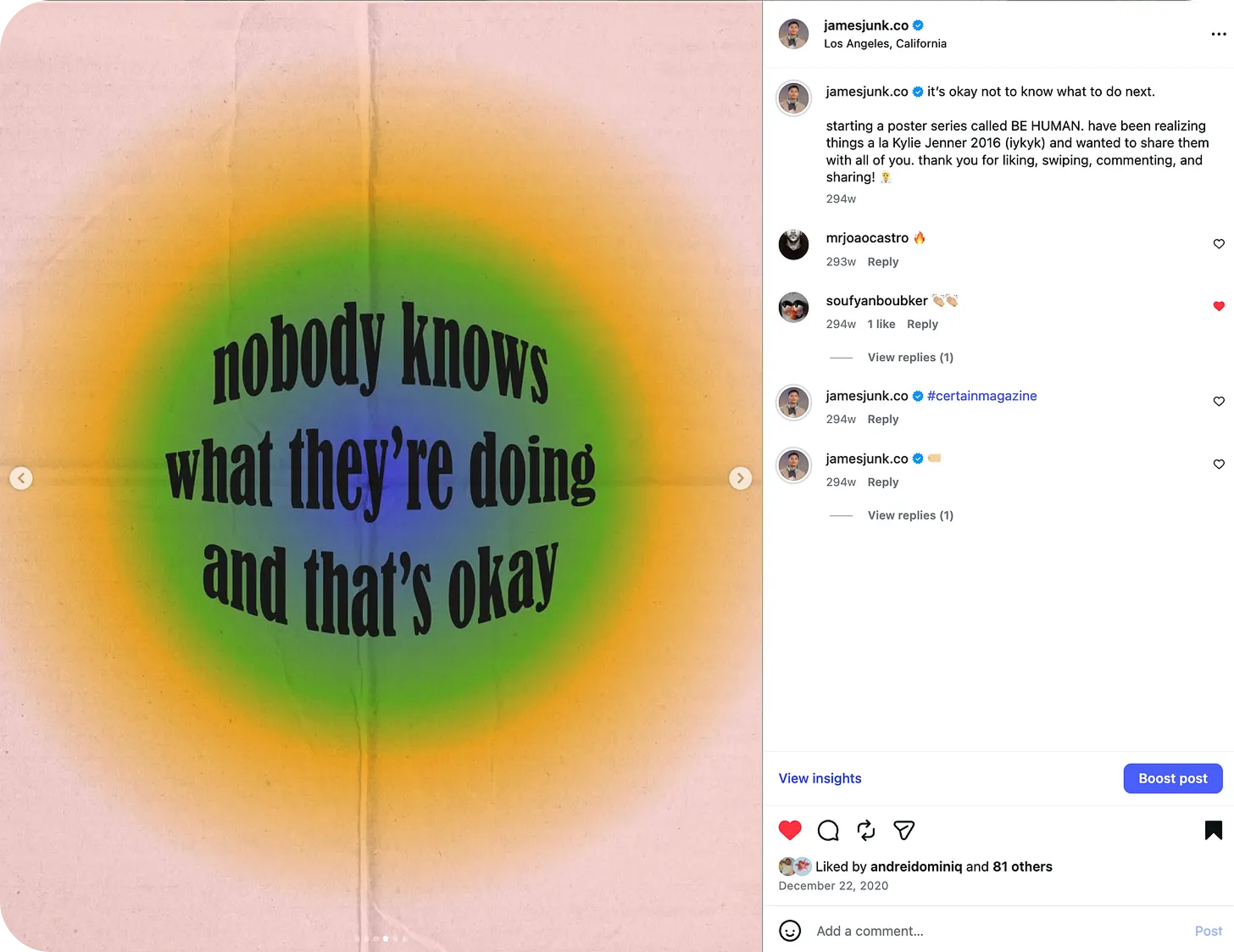
Maybe that’s why I have never deleted or archived a single post from my Instagram. (Not one!)
If you scroll far enough, you’ll find work I would never make now. Different references, techniques. Different ideas of what looked good. Things I was incredibly proud of and things I barely remember making. Things that performed well and things that flopped. They all stay.
For a long time, I thought I kept them because I liked having an archive of my work, which is still partly true. The older I get, though, the less interested I am in looking at that archive as a timeline of creative growth.
I don’t really want to scroll back and evaluate whether I was a worse designer. I don’t want to measure the distance between two posts by follower count or clients or polish or taste. I don’t need every old piece of work to become the embarrassing “before” image that makes whatever I’m doing now look like the triumphant “after.”
I don’t even think growth is the word I’m looking for. Those posts are just evidence that I was there, I made something, and I cared enough about it to put it somewhere.
There is a person attached to every one of those little squares who woke up that morning and had a whole life I can only partially remember now.
He had things he was excited about. He had things he was worried about. He had people he talked to every day who he might not speak to anymore. He lived in a particular apartment. He listened to particular music. He had some idea of what the next few years were going to look like, and he was probably wrong about most of it.
And some time that day, he hopped on Photoshop and made something.
And maybe it’s because it’s my birthday and birthdays make you sentimental about the extremely ordinary fact that you have existed for another year, but to me, that’s what’s worth keeping.
You spend so much of a creative career thinking about what comes next that it’s easy to turn the past into a collection of stepping stones. Every project led to another project. Every experiment taught you something. Every failure was a learning curve. Every old version of yourself existed in service of producing the current one.
I’m not sure I believe life is that efficient.
Some things happened because they happened. Some things mattered because I cared about them at the time. Some things were fun. Some things were weird. Some things I made because I had nothing better to do on a Tuesday.
They don’t all need to justify their place in the archive by contributing to my professional development. They were just part of my life, and that’s enough.

I used to think developing a creative identity meant getting increasingly precise about who I was: make enough work and eventually the pattern would become obvious. Find the right words, build the right portfolio, develop the right point of view. Come to a version of yourself coherent enough that everything finally clicks into place.
Today, I’m less convinced there is a place to arrive at.
There are things about my work that have remained remarkably consistent. There are things I was sure would define me forever that I barely think about anymore. There are interests I can trace back years and others that showed up recently and completely rearranged the furniture. It all belongs.
Maybe creative identity is less like a statement and more like an accumulation: the work you still love. The work you’d rather never look at again. The thing everyone knows you for. The thing hardly anybody noticed. The title you spent years learning to claim. The title you haven’t figured out yet. The interests that lasted and those that didn’t. The contradictory evidence.
I used to worry that too much contradiction would make me difficult to understand, but now I find it comforting. Of course I contradict myself - I’ve been alive this whole time!
I’m another year older today (presumably another year wiser, although I don’t know who handles that certification), and I still call myself a graphic designer. I’m writing this, too, and also being creative in a while bunch of other ways at the same time. All this is true.
There will probably be another thing eventually, and another version of me who looks back at this essay and sees all the things I couldn’t see just yet.
He can leave this up.

Comments
Nothing yet. Say the first thing.
Sign in to join the conversation.