
BEFORE YOU READ please consider donating to the The Immigrant Law Center of Minnesota, who provides free immigration legal representation to low-income immigrants and refugees in the area.
Finished work rarely shows up alone anymore.
It comes with screenshots, progress shots, captioned explanations, and some version of here’s how I got here. The work is accompanied by proof: evidence that it was labored over, iterated on, earned. Even when the final output is strong, there’s an expectation that the path toward it be visible.
This new creative instinct to document everything wasn’t always an expectation. Process used to be something you shared if you wanted to, often after the fact. Now it’s closer to a prerequisite. Work that appears without context can read as suspicious. Work that doesn’t show its steps can feel incomplete.
The first place I felt this pressure wasn’t a client meeting or a critique - it was here, on social media. Process became a way to stay visible between launches, a way to perform momentum. Showing the work alone didn’t feel sufficient. The work needed drip marketing. Screenshots. Teaser on the story. A narrative arc on the broadcast channel. Suddenly, there was labor devoted not to making the thing, but to making the making look palatable.
I reject that shift because it interrupts creative flow. The attention is moved away from the work itself and toward how the work will read, how it will perform, how it can be packaged while it’s still forming.
I don’t think this comes from oversharing or ego. It feels more structural than that. In online creative spaces where credentials seldom matter and audiences blur together, documentation fills the gap. It explains, justifies, and reassures. The expectation isn’t simply that our work be good - it’s that its goodness be demonstrated as though evidence in court.
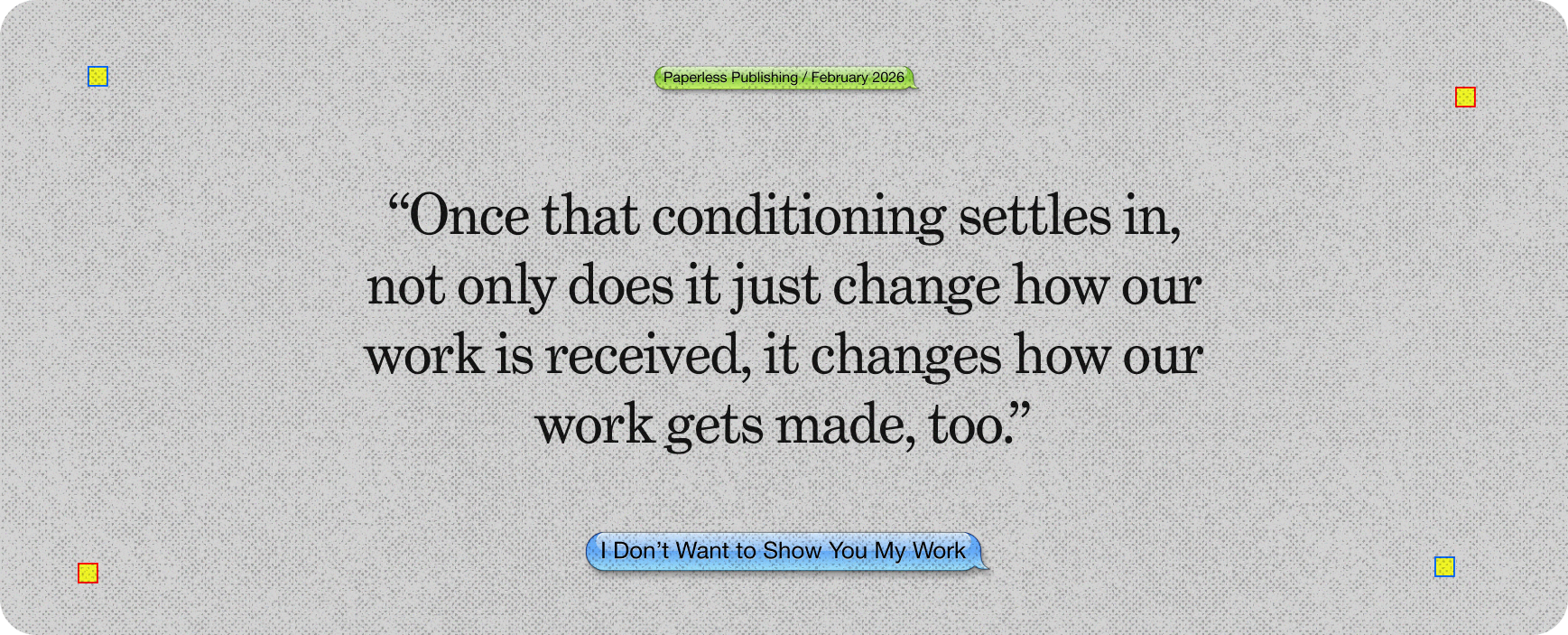
Once that conditioning settles in, not only does it just change how our work is received, it changes how our work gets made, too.
I notice how early documentation enters the process now. Before I know whether an idea is worth pursuing, there’s already a sense of how it might look as a post. What would screenshot well. What would read as progress. Even when nothing gets shared, the work bends around the possibility of being shown.
Platforms encourage this. Algorithms reward continuity more than completion. Tools make it easy to capture, annotate, and distribute every step. Process content fills the space between finished outputs and keeps creators visible in the meantime.
Behind-the-scenes culture didn’t always work this way. Earlier forms of process sharing (blogs, sketchbooks, messy forums) offered access without obligation. The tone was exploratory. Sharing didn’t need to justify the final outcome.
Today, process content is delivered already polished. The mess is edited. The struggle, curated. What looks raw is well-composed. Documentation becomes anticipatory. Creators think about how the process will read while they’re still inside it. I know I do.
This overlaps with a broader conversation in the creative industry. A recent It’s Nice That piece reflects on how creative work gets pushed toward legibility and efficiency, where uncertainty starts to feel like a liability and resolved output becomes the default. The pressure has become systemic. When work is rewarded for appearing coherent and controlled, real creative exploration and the wont to get weird becomes second string.
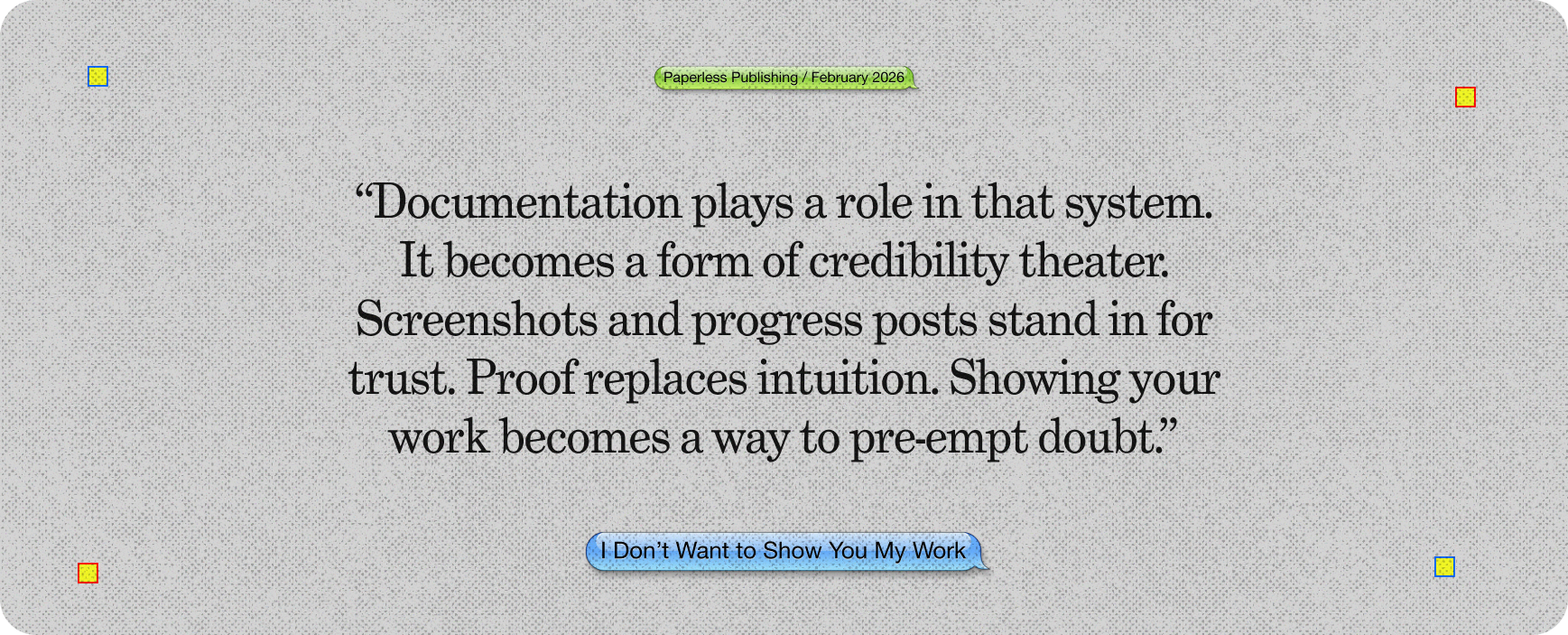
Documentation plays a role in that system. It becomes a form of credibility theater. Screenshots and progress posts stand in for trust. Proof replaces intuition. Showing your work becomes a way to pre-empt doubt.
For designers especially, this reshapes how we take creative risks. Ideas that don’t document well start to feel inconvenient. Process becomes more linear, not because linearity produces better work, but because it reads better from the outside. And since when has the creative process been so perfectly linear?
The rise of AI-generated visuals has intensified this. As synthetic imagery becomes more common, skepticism rises alongside it. The burden of proof shifts again. Work is now expected to look considered and verifiable alike. I’ve had someone question whether a poster was AI-generated even after I wrote about how much it meant to me. That moment made something clear: meaning doesn’t protect you. Proof does. Documentation moves from something you choose to share to being a keg for self-defense.
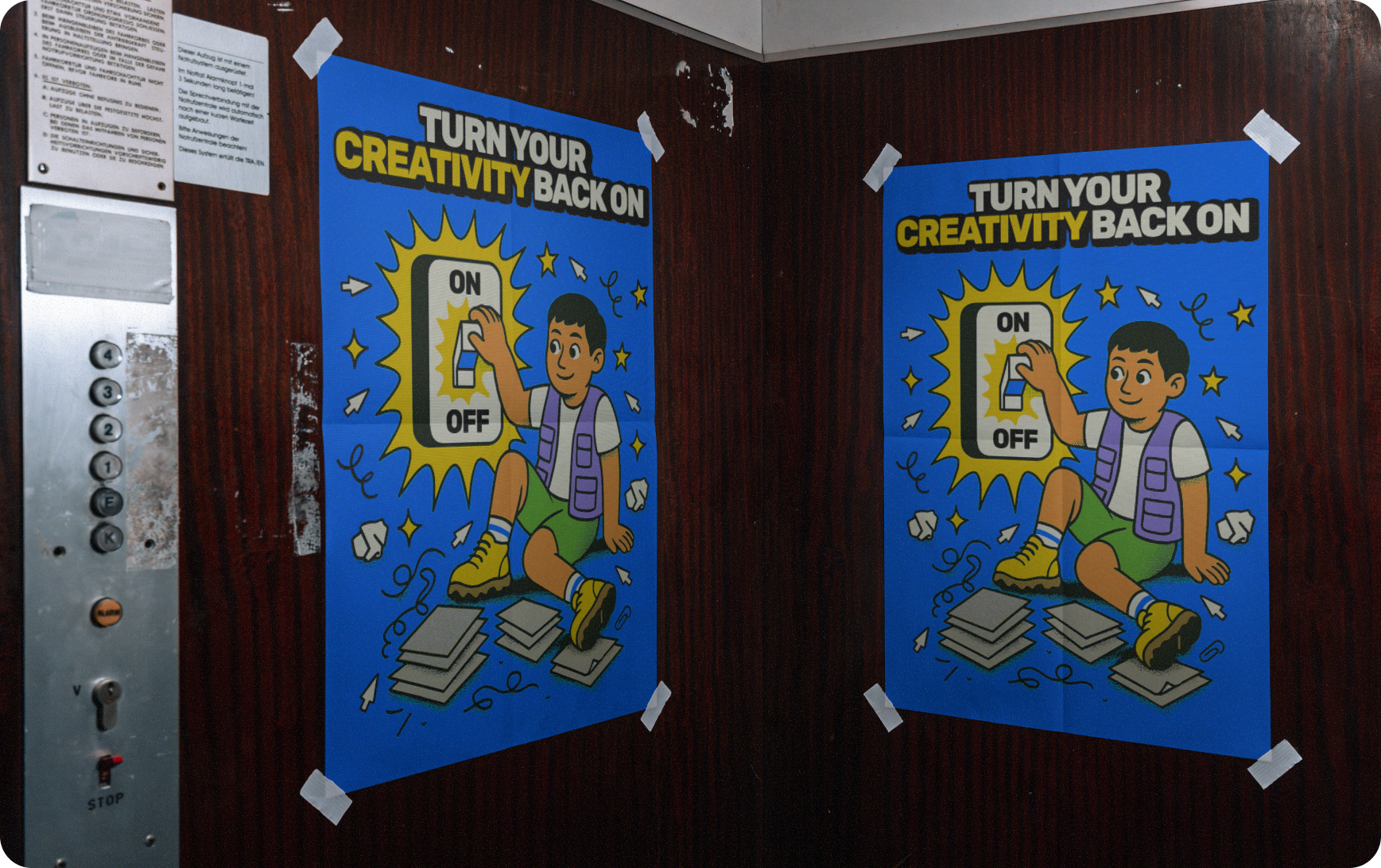
Personally, this is why I hesitate to share process at all. Not because I’m precious about it, but because process, for me, is where work is most fragile. It’s not meant to be narrated in real time. I’d rather show results than expose half-formed thinking while it’s still finding its footing.
Constant documentation changes the texture of creating. Behind-the-scenes content stops being backstage. It becomes part of the front stage. The paradox is that visibility increases while intimacy decreases. Viewers see effort and labor, but rarely doubt, boredom, or the decay of ideas that don’t make it - the parts of the creative process that actually matter.
Research on creative labor in platform environments consistently shows that when visibility is continuous, creative cycles compress. Creative reflection happens under pressure. Output begins earlier in the life of an idea, sometimes before the idea even knows what it is.
I still believe in learning from how other people work. What feels different now is the obligation. Documentation no longer feels optional.
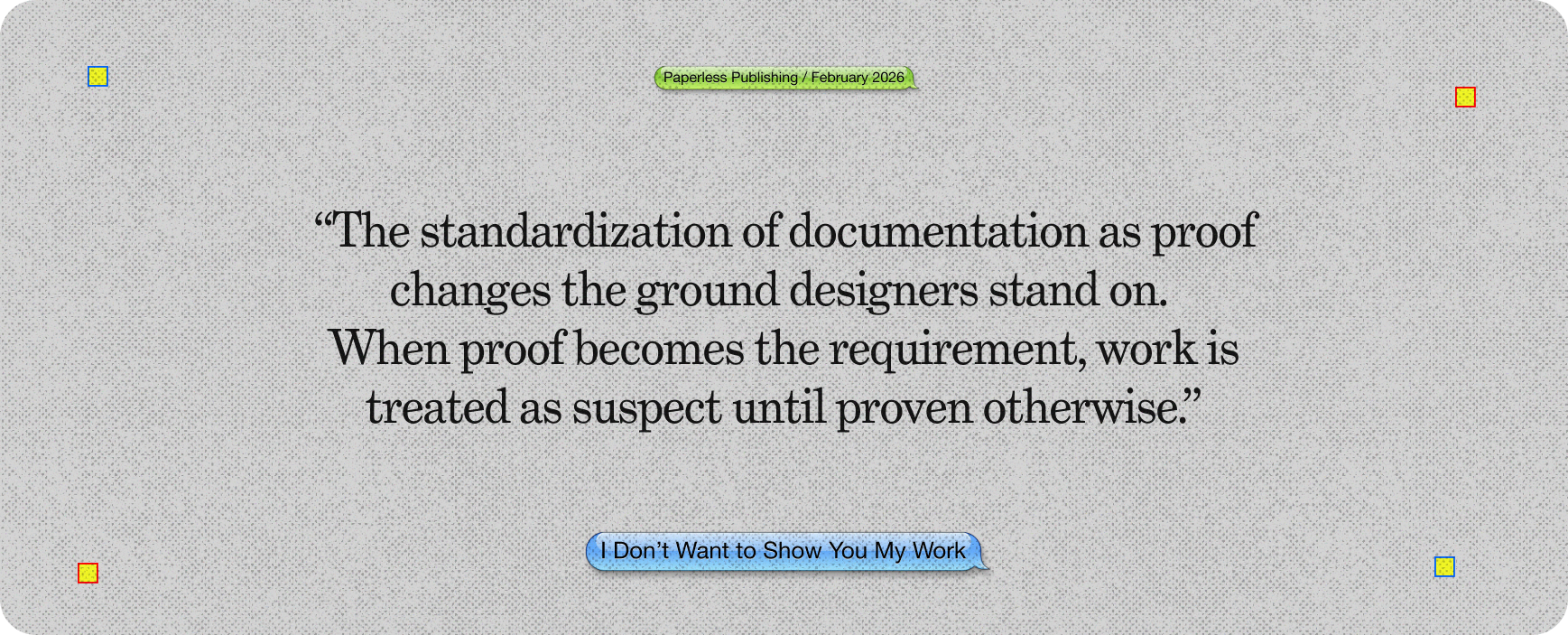
The standardization of documentation as proof changes the ground designers stand on. When proof becomes the requirement, work is treated as suspect until proven otherwise. Meaning has to justify itself before it’s allowed to exist.
That condition is incompatible with creative practice. Design depends on trust: trust that work can speak before it’s explained, that ideas can exist before they’re defended, that meaning doesn’t need to arrive with receipts attached.
Documentation has its place. Learning from one another has value. But when explanation becomes compulsory and verification replaces trust, the parts that make the creative process special, break.
A creative culture that requires proof at every step leaves little room for uncertainty, risk, or quiet conviction. And that cannot be the standard we accept as designers.

Comments
Nothing yet. Say the first thing.
Sign in to join the conversation.