
(This will likely be my last sermon for a while. As you can learn below my ability to leave home for more time than it takes to run a necessary errands is going to be superseded by more pressing concerns. Delivered at the Unitarian Universalist Community Church of Santa Monica on Sunday, the 9th of August, 2026. Followers of this page may recognize some of a previous reflection shamelessly reused to a different purpose…)
Leo Toystoy writes in his The Death of Ivan IIyich
Just then his schoolboy son had crept softly in and gone up to the bedside. The dying man was still screaming desperately and waving his arms. His hand fell on the boy’s head, and the boy caught it, pressed it to his lips, and began to cry.
At that very moment Ivan Ilyich fell through and caught sight of the light, and it was revealed to him that though his life had not been what it should have been, this could still be rectified. He asked himself, “What is the right thing?” and grew still, listening.
(Then, with that, the shape of his terror shifts)
He sought his former accustomed fear of death and did not find it. “Where is it? What death?” There was no fear because there was no death.
In place of death there was light.
As I believe some of you know, two years ago my spouse Jan and I sold our condo in Long Beach and moved in as Jan’s mom’s caregivers. Two things to know. She just turned 99 at the end of July. And she is now seven months into hospice.
She suffers from a lot of things, much of it just being very, very old. But the presenting issues for her are a combination of congestive heart failure and COPD. The COPD being galling as she never smoked and she never lived with smokers.
But life. Well, and death.
After six months stabilized, now over the past month things have begun shifting again, and we might be on the long expected downward spiral. Not sure, of course. We’re a bit too far out for the hospice nurses to make any kind of predictions. Well, there was one, maybe six months. Big emphasis on that maybe.
Me, I learned years ago to pay attention to the rhythms of such liminal times. I find the dark and the deep are good terms for our most important experiences. Those places where we finally let go of our various clingings and allow the spirit to rest as it will.
Here we find a kind of not knowing. Which itself becomes a hinge between worlds.
I find it very much like in that passage from the Death of Ivan Ilyich, where for Ivan dark turns to light. Or, really, as I’ve noticed, maybe dark and light are no longer clearly distinguishable. The three of us, mom, Jan, and me we’re living in a house where that certainly seems true. There’s still clinging. It’s something we humans do. But also, a body is passing through the great dark. A dark where breath itself is a fragile thing, mostly slipping away.
For us our days and nights turn on breathing and not being able to breathe. Breath. Dark. Light. Life. Death. And breath, again. Etymologically spirit means breath. It’s a connection found across the globe in many different and totally unrelated languages.
Breath. Spirit.
I think about that trope I just used a minute ago. It goes “the spirit rests (or lists if you like the King James version) where it will.” The spirit lands where it will. As someone walking the Zen way, I’ve always felt that line particularly captures something of the (if you will) spirit of Zen’s awakening.
Awakening. Another word rich in image. For me that word is rising from the slumber of distraction. Awakening is letting go and being present to. It’s a place where denial vanishes like morning dew. It’s also a kind of rebirth. It’s a gift of new eyes and new ears. As individuals we have something to do with it. But it turns out, not as much as we might wish.
Awakening has no hard causal associations. Sure, there are practices that incline us in that direction. Mainly they turn on paying attention. But the moment, the turning, the noticing; well, just like the spirit coming when it wants rather than when I want. Like the bottom falling out of a bucket. One of the great Zen images with a wonderful story attached. Or, to use an image from the Christian tradition, like tongues of fire resting on a crowd.
Every culture appears to have some image, or several, for this turning of the heart.
Most commonly in Christian iconography the spirit is pictured as a dove.
Sometimes tongues of fire. Often, as gentle as a dove. Like for Ivan, a touch can be the trigger.
I’m very much taken with the vagueness of what the holy spirit is in the Christian scriptures. In fact, the existence of the spirit is the weak link in the theory of the divine as a trinity. What the spirit is precisely is elusive, certainly not clear from the texts themselves. Its only centuries later as creeds were being developed, that the spirit becomes a face of God.
Something I’ve found helpful is how in English spirit was for the longest time also called ghost. I recall a friend’s child, the family all Episcopalians, and kind of high church, learning to cross herself saying “In the name of the father. And of the son. And of the holy monster.” That family quickly shifted its use from ghost to spirit.
Although, me, I rather like that childish use. Monster.
I think of my mother-in-law’s struggles for breath and monster fits in there. The denial of breath is a kind of monster.
And. While our contemporary use for monster is an imaginary beast, its etymology suggests something else. “To point out, to indicate, to demonstrate.” I like taking all those things together, including imaginary beast. Including in the mess struggling for air. All of it. Monster. Ghost. Spirit. Elusive. And yet unbidden, present. Like the wind. Like tongues of fire. Sometimes like a hovering dove, looking to rest.
As to the phrase itself about the spirit listing or landing or resting. While I know the line is biblical, I have to admit over time I’d forgotten the actual citation. So, preparing for our time together here, I dug around a bit.
It first appears in the Hebrew Scriptures, in the Book of Numbers, Chapter 11, verses 25 and 26. In the King James version it goes
“And the Lord came down in a cloud, and spake unto him, and took of the spirit that was upon him, and gave it unto the seventy elders: and it came to pass, that, when the spirit rested upon them, they prophesied, and did not cease.”
I then searched a Jewish website for a translation not read through a Christian lens, and in fact the text isn’t in fact much different.
“And HaShem came down in the cloud, and spoke unto him, and took of the spirit that was upon him, and put it upon the seventy elders; and it came to pass, that, when the spirit rested upon them, they prophesied…”
This scene is echoed in the Gospel According to John, the third chapter, the eighth verse. The actual text in the always lovely King James version goes
“The wind bloweth where it listeth, and thou hearest the sound thereof, but canst not tell whence it cometh, and whither it goeth: so is every one that is born of the Spirit.“
What I find important here is that in the end we cannot grasp, there is no control; instead we can only experience. But if we do, we find our true home within the wind. I watch, I witness someone dying; and see all around me the wind, the spirit, breath coming and going. But only on its own terms, never on mine.
We find it in what I consider a complicated and not entirely attractive text, the Gospel According to John. John contains some of the most sublime mystical writings in the whole of the scriptures. And it is riddled with anti-semitism. Some of my Christian friends try to mitigate by claiming it’s really pre-anti-semitic, and the more correct term would be anti-Jewish polemics. For me this is a distinction without a difference.
Internal contradictions are important, I find. It’s certainly like me and my life. As Walt Whitman said, “I contain multitudes.” The good and the ill, cheek by jowel.
As someone dies, as Jan and I sit with mom, and witness her struggles, with all the sorrow and regret, I find something that I can only call holy. A terrible holy, but holy. Another strange word with an interesting etymology. Here whole and uninjured and safe are invoked. At the very same time as struggle and death.
A point for all of us, I believe. It’s there for anyone willing to be open wide and let it all rest. And at some point, as folk within the twelve steps will tell us, we each of us need to let go and let God.
I think of Ivan Illyich. I think of the story of Saul and his fateful encounter on that road to Damascus. I think of Jan’s mom. I think of Jan and me and our hours with her. Of various moments, especially those where we touch each other.
This is what has become my universalism. Not the old Christian idea that all dead people go to heaven. Rather that the spirit cannot be contained, and genuine wisdom is available to all of us. And, how that wisdom, that awakening, that ability to be reborn something new that gift comes like a thief in the night. Often, it comes in the worst of times.
Spirit. Breath. Gift. The gift of life contains the reality of death. Awakening is our meeting it, less with our heads, as important as that can be; but most of all with our hearts. Another kind of knowing. Something never fully under anyone’s control.
Now. On balance I think we’re better off preparing ourselves. You know become fit hosts for the gift. That’s why I practice a form of meditation and recommend such practices. Me, I think Zen meditation is a good way to do that. They’re all forms of noticing, of paying attention. Maybe you have your own route. There are a lot of them. But they do call for some diligence, some preparing. They prepare us for the moment when it all falls apart.
And with that there’s a bottom line.
Like breathing. Like dying. Like that touch between the dying man and his son. Like Jan stroking her mother’s head. Like the bottom falling out of a bucket.
Monster. Ghost. Spirit. And yet present. Like the wind. Like tongues of fire. Like a dove.
Awakening. Wisdom. Death. Light. Love. All different, and all connected.
An invitation to attention. Someone asked a Zen master what is Zen? She said, “Attention.” The person asked, “Is that all? Surely there must be more?” He replied “Attention, attention.”
Turns out there are many true paths. And there’s a bottom line to it.
Prepared or not, the spirit rests where it will. And with that, in place of death there is light. It’s that significant. It’s that important.
So... Attention. Attention.
It’s the final gift.
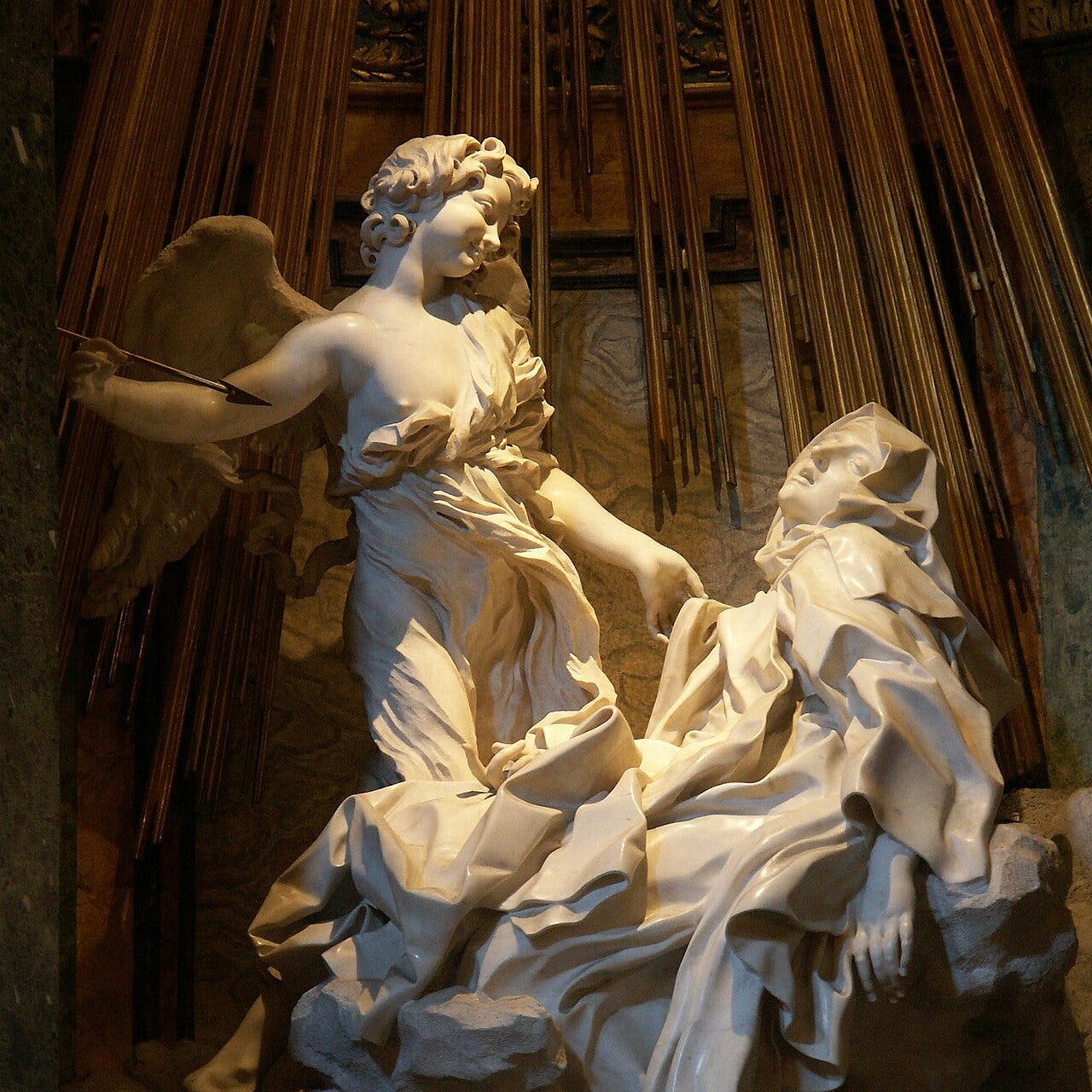
The image is Bernini’s Ecstasy of Saint Teresa
Comments
Nothing yet. Say the first thing.
Sign in to join the conversation.