
(A draft of a chapter for my forthcoming Zen Master Jesus)
Alan Watts was the first person to write popular books about Zen in the west, most importantly in 1957 with his bestselling Way of Zen. He drew mainly on the scholarly volumes just being written by D. T. Suzuki, the first person to write authentically and extensively about Zen in European languages. Through Watts engaging style made Suzuki’s scholarly presentation enormously readable and genuinely compelling.
His take built upon Suzuki’s thesis of Zen as a way of being but then took a turn against formal practice. This earned him a lot of criticism in Zen circles as well as making his version very attractive. Very much a mixed bag.
I recall once attending a talk by an American Zen priest. At the end, during a question-and-answer period, someone asked about Watts. The priest sighed, and then said, “I know there’s a lot of controversy about Alan Watts and what he really understood about Zen.” He paused. And then, added, “But, you know, without Alan Watts, I wouldn’t be standing here on this platform.”
I have to say, in large part, that’s true for me as well.
In the 1960s and 70s, Alan Watts opened some important doors for many of us looking for a new way. I’m not really sure another version, a more accurate version of Zen would have caught the popular imagination. All of this is so, messy. Kind of like life, I find.
Over these passing years I’ve come to feel the title of his biography In My Own Way and the title of the English edition of Monica Furlong’s biography of him, Genuine Fake, taken together points to the complexities of this intriguing Anglo-American Zen trickster/ancestor of our contemporary spiritual scene.
There are also numerous critiques, pretty much all of them deserved.
In one such, a relentless critique of Alan Watts, Lou Nordstrom and Richard Pilgrim, two religious studies scholars, one, Nordstrom, also a Zen priest, pointed out how an authentic spirituality must encompass “practice, discipline, and effort,” features completely lacking in Alan Watts’ ‘Zen.’” Big emphases on the scare quotes around the word Zen.
In significant part I agree, but not completely. On the spiritual path there is absolutely a time and place of a falling away of practice, discipline, and effort. As we open our hearts, we find the way is in fact broad and forgiving. And it seems Watts tasted that freedom and joy. I really believe he did. But. The authentic spiritual is also in that delightful conundrum of a real life, totally bound up with practice, discipline, and effort. The intimate way is also, without a doubt, harsh and demands everything. And here Watts frequently seems clueless.
Now, in my opinion, Alan Watts was at his very best during a brief period when he tried at practice, discipline, and effort. Or, at least stood in their general neighborhood.
Raised in England, his natal tradition was Anglicanism. Although he formally abandoned it by sixteen for the eclectic and Theosophically tinged Buddhism of the London Buddhist Society. In his later twenties and now in America, Watts would eventually say that he decided to become an Episcopal priest because he was desperate for an occupation that paid. From what would come out of this period, I think his relationship with Christianity was more than a job vaguely connected to his interests.
Despite not having an undergraduate degree he was admitted to the divinity program at Seabury-Western Theological Seminary in Evanston, Illinois. Three years later, Watts graduated with a master’s degree in divinity and was ordained an Episcopal priest. He was immediately engaged as the Episcopal chaplain at Northwestern University. It was 1945, and he was thirty years old.
It appears to have been an amazing moment. He was wildly popular on campus, and his books were received in progressive religious circles as challenging and compelling.
What is most important for me, is how he touches the perennial spiritual thirst of our human condition. His divinity degree thesis was reworked and published as the book Behold the Spirit, as I mentioned first released in 1947. I can’t tell if it has ever been out of print. What I do know is you can buy a new copy today. There’s even a Kindle version.
The book is an attempt at synthesizing eastern and western spirituality grounded in a broad and sympathetic expression of Anglicanism. Here Watts offered an outline of a nondual Christianity.
While one can argue there have always been nondual currents in Christianity, this perspective has definitely never been a significant part of normative Christianity. In mainstream Christianity the world and God are seen as relentlessly separate, creator and created. A world of problems followed this setting up of a hierarchy with the spirit above and good and the world below.
If the proposition that the world is completely separate from the divine were true, well, we would just have to live with it. But and let me make a categorical statement rather than my usual inclination toward hedging: That’s not true.
Rather, as I open my heart to the world, this world, this great mess that is you and me and all things, I find each thing is created and creating all that is at the same time. We, you and me, our living and our dying, exists within a dance or web of intimacy. Here each of us is a moment in a shimmering play of reality. And that play of reality is exactly where I find the divine, the holy, the sacred.
I don’t need to go to some other place to find it. And neither do you. A small word of good news. And it sits close to the heart of this book.
Today a host of emergent and even traditional Christians don’t see the separation, either.
And. Alan Watts’ book Behold the Spirit kind of spells it all out in a way perhaps even best done by someone not actually immersed in it all. And he did it before a lot of other people in our moment in history.
It is true he stood more in the neighborhood of that “practice, discipline, and effort” than within it. And yes, that distance also means he missed some things. I admit I find Watts a tad too comfortable with his own insight, insufficiently checked by others who’ve walked the way before. Which is a danger for the spiritually unaffiliated. And I find sometimes he feels a bit too instrumental in his reframing of Christianity. Still.
He did touch something.
The book was a revelation when he hit the scene in 1945. It was I gather, and perhaps obviously, criticized for its “creeping pantheism.” I’m not sure how creeping, it was. I would say the Alan Watts of that book was in fact a thorough going panentheistic screed. Panentheism is probably the most compatible Christian variation on pantheism, another word for nondual or monistic spirituality. In panentheism the world is seen is divine, but that the divine, God, cannot be limited to the universe.
The book was published in 1947. In 1971, about quarter of a century later, it was reissued with a new preface. In it Watts said how he “felt that Catholic Christianity might be taught and practiced as a form of that perennial philosophy which is he gold with the sectarian dross of every great religion.”
I think Watts in fact spells out in that book a fair amount of what an affirmation of a nondual Christianity can look like in his thesis and book. The sad thing, as I see it, was that he couldn’t follow through for himself. His personality, what he liked to characterize as his “bohemian personality” just didn’t have a fit in the organized church. I’d have to add his lack of personal boundaries would have meant he would never had made it as a Unitarian Universalist minister, either. He was born to be an outsider. And after that five years, eight or nine counting his seminary experience, of stirring up the Anglican church, he made sure he would forever be an outsider.
But he also pointed a way.
First, he spells out a reality. In that 1971 preface to Behold the Spirit he warns “A Christianity which is not basically mystical must become either a political ideology or a mindless fundamentalism.” He certainly put his finger on that point. Fundamentalisms, bare literalisms, are a curse on humanity. Politics informed by religion cuts in several directions. If it is informed by insight into who we are and how we are related, if engaged modestly, and truly informed by love, it can be powerful.
But even that is not the primary purpose. Which is to know who we are.
His metaphors are straight out of the traditional church, which might be difficult for some of us, and to my ears even more difficult when he uses the relentless masculine by preference language of that time. He was writing before that necessary linguist shift within our culture. But, if we allow ourselves to listen, we find the underlying understanding he presents shakes the very foundations of the moral universe the conventional church preaches. He declares:
“God is the most obvious thing in the world. He is absolutely self-evident - the simplest, clearest and closest reality of life and consciousness. We are only unaware of him because we are too complicated, for our vision is darkened by the complexity of pride. We seek him beyond the horizon with our noses lifted high in the air, and fail to see that he lies at our vary feet. We flatter ourselves in premeditating the long, long journey we are going to take in order to find him, the giddy heights of spiritual progress we are going to scale, and all the time are unaware of the truth that ‘God is nearer to us than we are to ourselves.’ We are like birds flying in quest of the air, or men with lighted candles searching through the darkness for fire.”
His is the nondual God.
Watts lays out the traditions of the Christian church as a manifestation of this truth of our radical interdependence, of our bottomless unity. The man who can only stand in the neighborhood of practice, discipline, and effort, shows where it can be found. I think in part because he really did taste the deeper truths, really did to some degree, and none of us are judge of how deep any other, or for that matter, even we ourselves have traveled, really did touch the great insight.
In some ways Alan Watts treatment of Christianity feels to me instrumental. He worked primarily in the realms of philosophy and symbol. And to my taste, was always a bit abstract. That noticed, there is something in what he shared over the years, although I think best when he tried to cleave more closely to a tradition, that is something organic and true.
In the wonderful (forthcoming) book The Lost Christian Writings of Alan Watts compiled and edited by Daniel Collier contains a review of Behold the Spirit. It was written by Alan G. Whittemore, who was a the time the Superior of the Episcopal Order of the Holy Cross. The monk was a friend and mentor to Watts and served as his spiritual director through seminary and into his priesthood.
Watts deeply admired him, calling Fr Whittemore “a full-blooded mystic, who could not only sense the presence of God in every flicker of light and sound, but had also reached the deep state of contemplative prayer where one feels God in the very feeling of not feeling him, the state of the divine darkness or the ‘cloud of unknowing.’”
Fr Whittemore was equally admiring of his student.
In his review, Fr Whittemore lists how failing and flailing churches try everything under the sun to find life in their dying institutions. Bless them, the good father says. And then writes, “When they acknowledge their failure, when at last they desist if only through sheer fatigue, the Spirit of God will touch Christendom, and it will revive. It will revive because, at long last, hordes of men and women will realize what the mystics have known all along—that we do not need to attain God, because He is in us already. To strain to find God is, in the words of a Chinese sage quoted by Father Watts, “very much like looking for an ox when you are riding on one.”
In using the Zen image from the Ox Herding Pictures, one of the traditions most important guideposts we capture a hint. A deep current. Something perennial, something returning, and returning again.
The hope of our humanity.
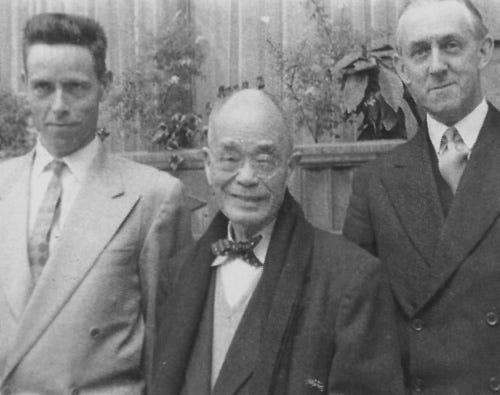
The photograph is of, from left to right, Alan Watts, D.T. Suzuki, and Christmas Humphreys
Comments
Nothing yet. Say the first thing.
Sign in to join the conversation.